Tech
Best Free VPN Services in 2026: 5 Safe Options Compared

Proton VPN Free is the best overall free VPN in this evidence-based comparison because it combines unlimited data, no advertising, open-source applications, and recurring independent no-logs audits. Windscribe Free is better for multiple personal devices, while hide.me is a strong alternative when unlimited data and no-email signup matter.
The important word is not just “free.” Every no-cost VPN imposes a trade-off somewhere, whether that means restricted server choice, a monthly data allowance, fewer features, one simultaneous connection, or an account requirement. This guide compares those limits using current provider documentation verified on September 8, 2026. No first-hand speed, latency, or streaming tests were supplied, so none are presented as our own results.
Quick Take: Best Free VPNs at a Glance
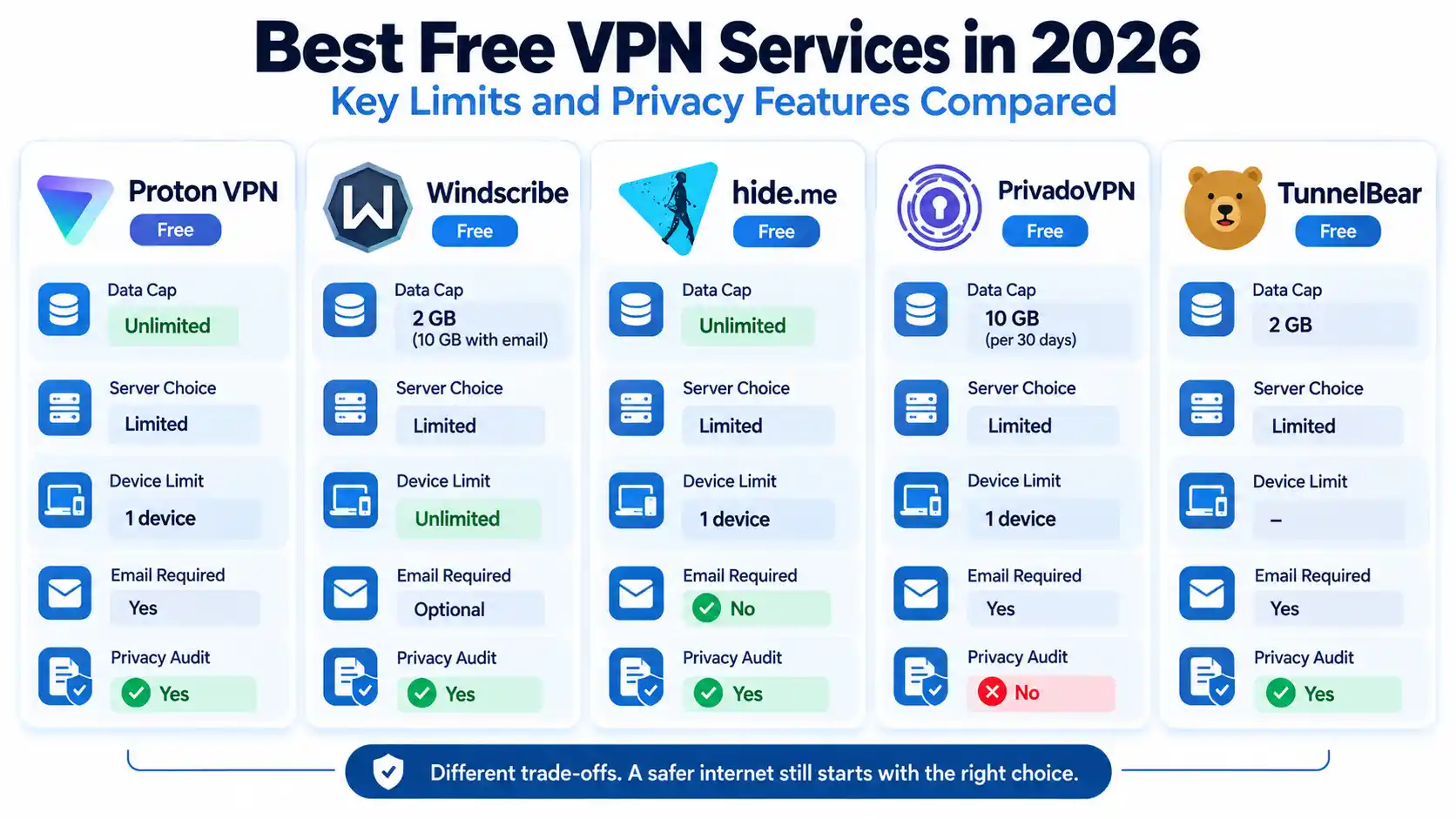
The table below focuses on what actually changes when you pay $0. Compare the data allowance first, then look at simultaneous connections, server choice, registration requirements, and the strength of the provider’s privacy evidence.
| Rank | VPN | Free data | Connections | Registration | Best for | What you give up |
|---|---|---|---|---|---|---|
| 1 | Proton VPN Free | Unlimited | 1 device | Account required | Always-on free use | Automatic connection to a limited free-server pool and fewer advanced features |
| 2 | Windscribe Free | 2 GB/month without email; 10 GB/month with confirmed email | Unlimited personal devices | Email optional | Multiple devices and advanced controls | Monthly data cap and smaller server pool |
| 3 | hide.me Free | Unlimited | 1 connection | No email or card required | Unlimited use without signup | Restricted speeds, limited locations, and no streaming-optimized servers |
| 4 | PrivadoVPN Free | 10 GB full-speed allowance every 30 days, then restricted emergency/Lite access | 1 connection at a time | Verified email required | Defined higher-speed workloads | Limited locations, one active device, and reduced post-cap performance |
| 5 | TunnelBear Free | 2 GB/month | Current free-plan documentation does not clearly state a separate simultaneous-device allowance | Account required | Light occasional use | No country selection or split tunneling on the standard free tier |
Proton VPN is the easiest recommendation when one device needs continuous protection because there is no monthly data ceiling. Windscribe becomes more attractive when several personal devices need VPN access. hide.me also removes the data cap, but its free tier restricts speed and location choice.

How We Evaluated Free VPN Services
Privacy Comes Before Price
A virtual private network, or VPN, creates an encrypted connection between your device and a VPN server. That can prevent the local network or internet service provider from directly inspecting traffic inside the VPN tunnel, but it also means the VPN operator occupies an important position in your network path.
That trust should not be granted simply because an application appears in an app store. The Federal Trade Commission’s VPN privacy guidance warns that VPN apps can receive extensive access to internet traffic and that some free services may fund themselves through advertising or information sharing. The FTC also notes that a VPN does not make a person completely anonymous.
For this reason, a free VPN gets more credit here when its privacy claims have evidence beyond marketing language. Useful signals include published source code, independent security assessments, no-logs audits, transparent descriptions of retained account data, and clear explanations of how the free service is funded.
An audit still has limits. It examines a defined system at a particular time. It does not guarantee that a provider can never make a configuration error, suffer a vulnerability, or change its practices later.
Data Caps and Speed Limits Are Not the Same Thing
A data cap is the total quantity of data you are allowed to transfer over a period. A speed limit restricts how quickly that data can move. The distinction matters because providers use both approaches.
For example, a 10 GB free VPN could run at normal available speed until that 10 GB is consumed. An unlimited-data service can remain connected indefinitely but may restrict free-user speeds or give paid customers more capacity.
Server congestion is another variable. Even when a provider says it does not impose a formal speed cap, a heavily used free server can still be slower because many customers share finite network resources. That is why this article does not translate “no speed limit” into a guarantee of a particular throughput.
Free VPN Business Models Matter
The most understandable free-VPN model is freemium. A freemium provider offers a restricted service at no cost and funds it partly from customers who upgrade to paid subscriptions.
That model explains why a free account might receive 10 GB instead of unlimited data, fewer server locations, or one connection rather than ten. It does not prove that the provider is secure, but it provides a clear economic reason for maintaining the free tier without needing to monetize browsing activity.
The evaluation therefore considers both technical restrictions and the transparency of the privacy model. A large free allowance does not compensate for unclear data handling.
The Best Free VPN Services in 2026
1. Proton VPN Free: Best Overall
Proton VPN Free takes the top position because its most important limitation is not data volume. The provider currently offers unlimited free data with no stated time limit, no advertising, and one simultaneous device.
The free application automatically connects to a server from Proton’s limited free-server pool rather than giving users the full location control of a paid account. Current official documentation identifies automatic free connections across the United States, Netherlands, Japan, Poland, Romania, Canada, Norway, Mexico, Singapore, and Switzerland. Proton also notes that free servers can become busy.
That makes the free plan especially practical for one laptop or phone that stays connected for long periods. You do not have to calculate whether normal browsing, software updates, cloud synchronization, or occasional video use will exhaust a monthly quota.
The privacy evidence is also stronger than a simple no-logs statement. Proton’s apps are open source, and its free-plan documentation states that the free service has no data limit and uses the same core privacy protections. Proton also publishes a recurring no-logs audit record, updated in June 2026 to include its fifth consecutive annual assessment.
The main compromise is control. Free users receive automatic server selection and do not receive the complete paid server network or features such as Secure Core, BitTorrent support, and Proton’s full premium server choices.
- Best fit: one user who wants to leave a VPN connected without watching a data meter.
- Look elsewhere if: you need several simultaneous devices or precise control over your exit country.
2. Windscribe Free: Best for Multiple Devices and Controls
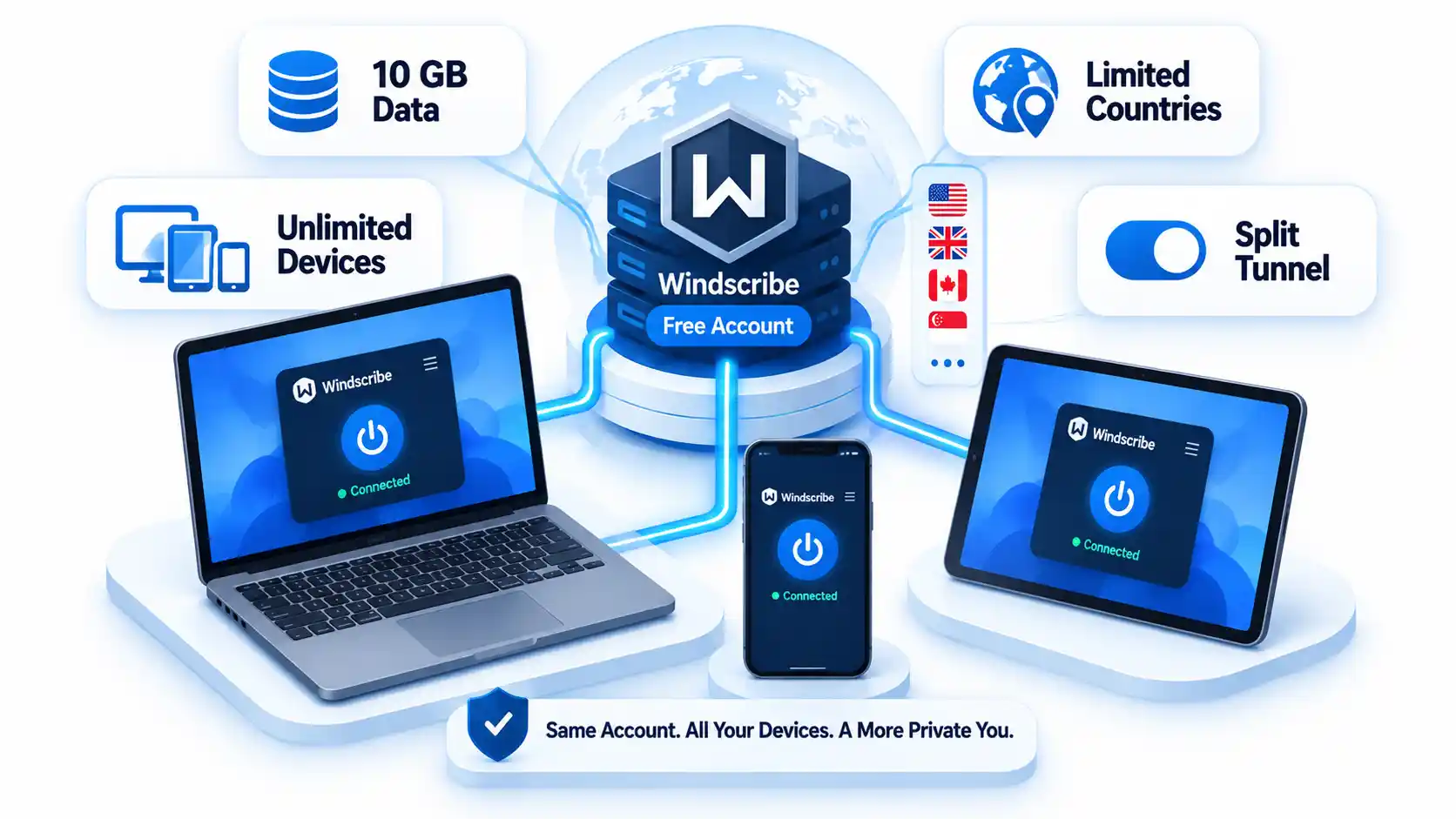
Windscribe Free is a better fit when device count matters more than unlimited data. The free account can be used across unlimited personal devices, while the baseline monthly allowance depends on whether you provide an email address.
You receive 2 GB per month without an email. Confirming an email increases that allowance to 10 GB per month. Windscribe also runs optional promotions that can increase the cap, but those conditional bonuses are not treated as the standard allowance in this comparison.
The free tier includes more technical controls than many no-cost competitors. Current free-plan documentation lists its firewall leak protection, multiple VPN protocols, split tunneling, and limited R.O.B.E.R.T. domain filtering alongside a smaller server pool.
Windscribe is also unusually explicit about operational records. For free accounts, it says it retains the total bandwidth used during the current period so it can enforce the cap, plus a last-activity timestamp used to remove abandoned accounts. It states that it does not retain browsing destinations, DNS queries, or traffic-linked session histories.
This is a useful example of why “no logs” should not be interpreted as “no operational information of any kind.” A provider with a 10 GB cap needs some mechanism to determine when the account reaches 10 GB.
The biggest weakness is obvious: 10 GB can be generous for web browsing but restrictive for heavy video, large downloads, operating-system updates, or continuous cloud synchronization.
- Best fit: users who want to protect several personal devices and value configuration controls.
- Look elsewhere if: you expect to keep the VPN active during large data transfers every day.
3. hide.me Free: Best Unlimited-Data Alternative
hide.me is the strongest direct alternative to Proton for users who dislike monthly data caps. Its current free plan provides unlimited data, allows one simultaneous connection, and does not require an email address or payment card.
That last point creates a meaningful difference. A user can install the client and begin using the free service without tying the VPN account to an email address. The trade-off is that the free tier has restricted speed and a much smaller location pool than the paid service.
Current hide.me pages are not completely consistent about whether the free tier exposes seven or eight locations. Its pricing and free-VPN pages say eight, while one support comparison updated in 2026 lists seven named server locations. Because the provider’s own documentation conflicts, this article treats the exact count as changeable rather than presenting one number as definitive.
The provider has stronger privacy evidence than most free products. Its no-logs documentation describes independent assessments of its logging implementation and provides access to audit material. A 2024 Securitum assessment examined areas including server configuration, deployment processes, and the standardized VPN environment used by the service.
That audit is valuable evidence, but it remains a point-in-time assessment. It should not be interpreted as a permanent security certificate.
Best fit: one-device users who want unlimited data and prefer not to provide an email address.
Look elsewhere if: you need predictable high throughput, several simultaneous devices, or specialized streaming servers.
4. PrivadoVPN Free: Best for Defined Higher-Speed Workloads
PrivadoVPN Free uses a different model. Instead of offering unrestricted full-speed usage, it provides 10 GB of data every 30 days on its normal free service and then offers restricted emergency or Lite-mode connectivity after that allowance is consumed.
Current pricing documentation states that free users receive 10 GB every 30 days, access to a limited group of server locations, and one connection at a time. Its support documentation says older post-cap behavior limits the connection to 1 Mbps, while a January 2026 product guide describes the transition more generally as Lite Mode with adjusted performance parameters.
Because those descriptions are not perfectly aligned, the defensible conclusion is that full-speed usage is restricted after the 10 GB allowance. The exact post-cap behavior should be verified in the current application rather than treated as a permanent fixed number.
PrivadoVPN requires a verified email but not a credit card for its free account. Its applications can be installed on multiple supported devices, although only one free connection can be active at a time. That distinction prevents a common misunderstanding between “works on unlimited devices” and “unlimited simultaneous connections.”
The company states that the same no-log policy applies to free and paid users. However, a sufficiently strong current public independent no-logs assessment did not surface during this research pass, so this article treats that as a vendor claim rather than independently verified assurance.
- Best fit: someone who needs a modest amount of normal-speed VPN traffic and can monitor the 10 GB allowance.
- Look elsewhere if: public audit evidence or unlimited normal-speed data is a higher priority.
5. TunnelBear Free: Best for Light Occasional Use
TunnelBear’s free plan is increasingly best understood as a limited entry point rather than a full-time free VPN. It currently includes 2 GB of encrypted data per month.
The allowance is enough to learn the interface, protect occasional browsing, or cover a short period on an unfamiliar network. It can disappear quickly when large downloads, cloud backups, application updates, or video are involved.
TunnelBear also changed the free tier materially heading into 2026. Its December 2025 free-account announcement moved country selection and SplitBear split tunneling into the paid experience for ordinary free users. Free accounts retain VPN connectivity along with features such as VigilantBear and GhostBear.
The service has a substantial security-audit history. Cure53 has repeatedly examined TunnelBear applications, infrastructure, backend systems, server configurations, public-facing interfaces, and data-handling components. That transparency is meaningful, although the company’s own publications contain an inconsistency in how they number the most recent audit years. For that reason, it is more accurate to describe a long-running annual audit program than claim a precise total.
- Best fit: occasional users who want a small free allowance from a provider with an established public security-assessment history.
- Look elsewhere if: you want continuous protection, control over the exit country, or more than 2 GB every month.
What Does a Free VPN Actually Cost?
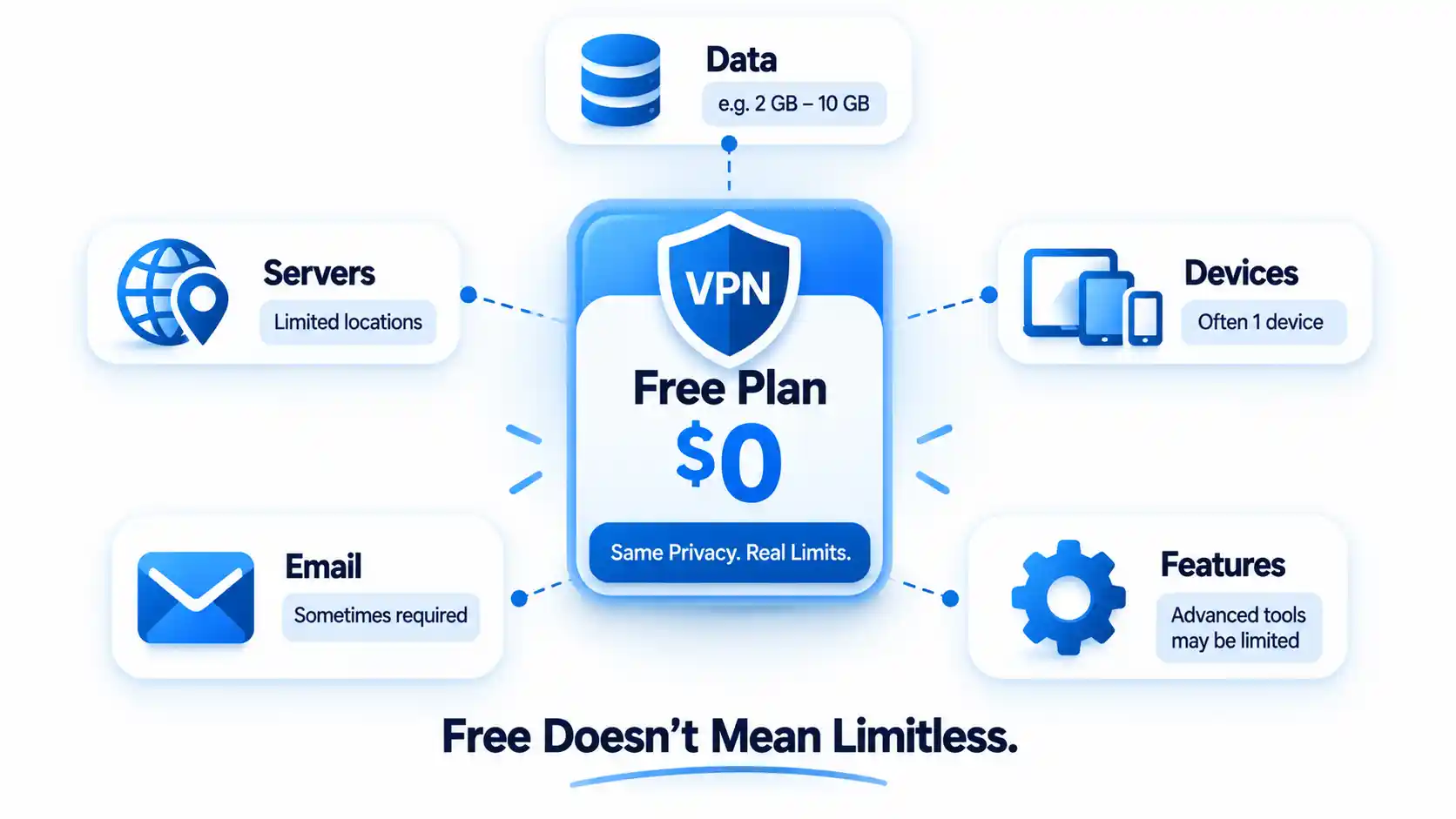
A $0 subscription still has an economic cost. The difference is that the provider collects it through restrictions rather than a payment at checkout.
The five services above show the main ways that happens.
| Trade-off | What it means | Current example |
|---|---|---|
| Data allowance | You can transfer only a fixed amount each month before the service stops or changes behavior | Windscribe and PrivadoVPN use monthly allowances; TunnelBear provides 2 GB |
| Server choice | You receive fewer countries or less control over the exact exit location | Proton automatically assigns free servers; all five restrict locations compared with paid service |
| Device limit | Only one active device may use the account at a time | Proton, hide.me, and PrivadoVPN limit the free tier to one active connection |
| Account information | More allowance may require registration details | Windscribe increases 2 GB to 10 GB when a user confirms an email |
| Feature restrictions | Advanced routing or location controls stay behind the paid tier | TunnelBear moved country selection and split tunneling to paid plans |
| Performance priority | Free infrastructure may be restricted or more congested | hide.me documents restricted free-tier speeds; Proton warns that free servers can become busy |
These are not necessarily deceptive restrictions. Running VPN infrastructure costs money. The relevant question is whether the provider explains its boundary clearly enough for you to decide whether the free tier fits your workload.
Are Free VPNs Safe?
Some are defensible choices. The category as a whole is not automatically safe.
A VPN occupies a privileged position because traffic is intentionally routed through infrastructure operated by the provider. The encryption protects the connection between your device and the VPN server, but it does not remove the need to trust whoever operates that server.
This is why a credible free service should be evaluated using more than a lock icon and a statement such as “military-grade encryption.” Encryption can protect the tunnel while a poor privacy policy still permits problematic collection elsewhere.
Before installing a free VPN, check the following:
- Identify the actual company.
Know who operates the app and where its privacy policy applies. - Read what it collects.
Separate browsing or connection logs from account information, crash diagnostics, bandwidth counters, and support records. - Understand how the free tier is funded.
A paid upgrade model is easier to evaluate than an unexplained product with no obvious source of revenue. - Look for independent evidence.
Public audits do not guarantee perfection, but they are stronger than an unsupported assertion that the service keeps no logs. - Check permissions.
A VPN needs networking privileges, but unrelated access requests deserve scrutiny. - Verify the official download source.
Install from the provider’s real website or its verified app-store listing rather than an advertisement or unofficial download mirror. - Check the free-tier security boundary.
Determine whether free accounts use the same encryption and protocols or a technically different network implementation.
A free VPN also does not make an unsafe device safe. Malware can still run locally. A phishing site can still steal credentials you enter voluntarily. Cookies can still recognize your browser, and logging into an account can identify you regardless of the VPN exit address.
The practical goal is therefore narrower: protect a network path, reduce exposure to the local network and internet provider, and change the public IP address destinations normally see. Do not treat a VPN as an anonymity system or complete cybersecurity package.
Free VPN Limits That Matter in Practice
Some restrictions sound minor on a pricing page but become important during everyday use. The following table translates them into operational consequences.
| Limit | What happens in practice | Who should care most |
|---|---|---|
| 2 GB data cap | Large downloads or prolonged video can consume the monthly allowance quickly | Video viewers, cloud-storage users, software developers |
| 10 GB data cap | Comfortable for moderate browsing but still requires monitoring during heavier workloads | Travelers, students, remote workers |
| One connection | A phone and laptop cannot both stay protected through the same free account simultaneously | Multi-device users |
| Automatic server assignment | You cannot reliably choose a specific country whenever you connect | Travelers and users with jurisdiction-sensitive requirements |
| Restricted speed | Large transfers, video calls, and high-resolution media may feel less responsive | Heavy data users |
| No streaming servers | Provider-specific optimized infrastructure is unavailable on the free tier | Media users |
| No split tunneling | You may be unable to choose which applications bypass the VPN | Users of local-network devices or apps that reject VPN connections |
A restriction also interacts with your device behavior. An operating-system update or cloud-photo upload can consume data without looking like deliberate VPN usage. If you select a capped plan, check whether background applications are transferring large amounts of data.
When You Should Not Use a Free VPN
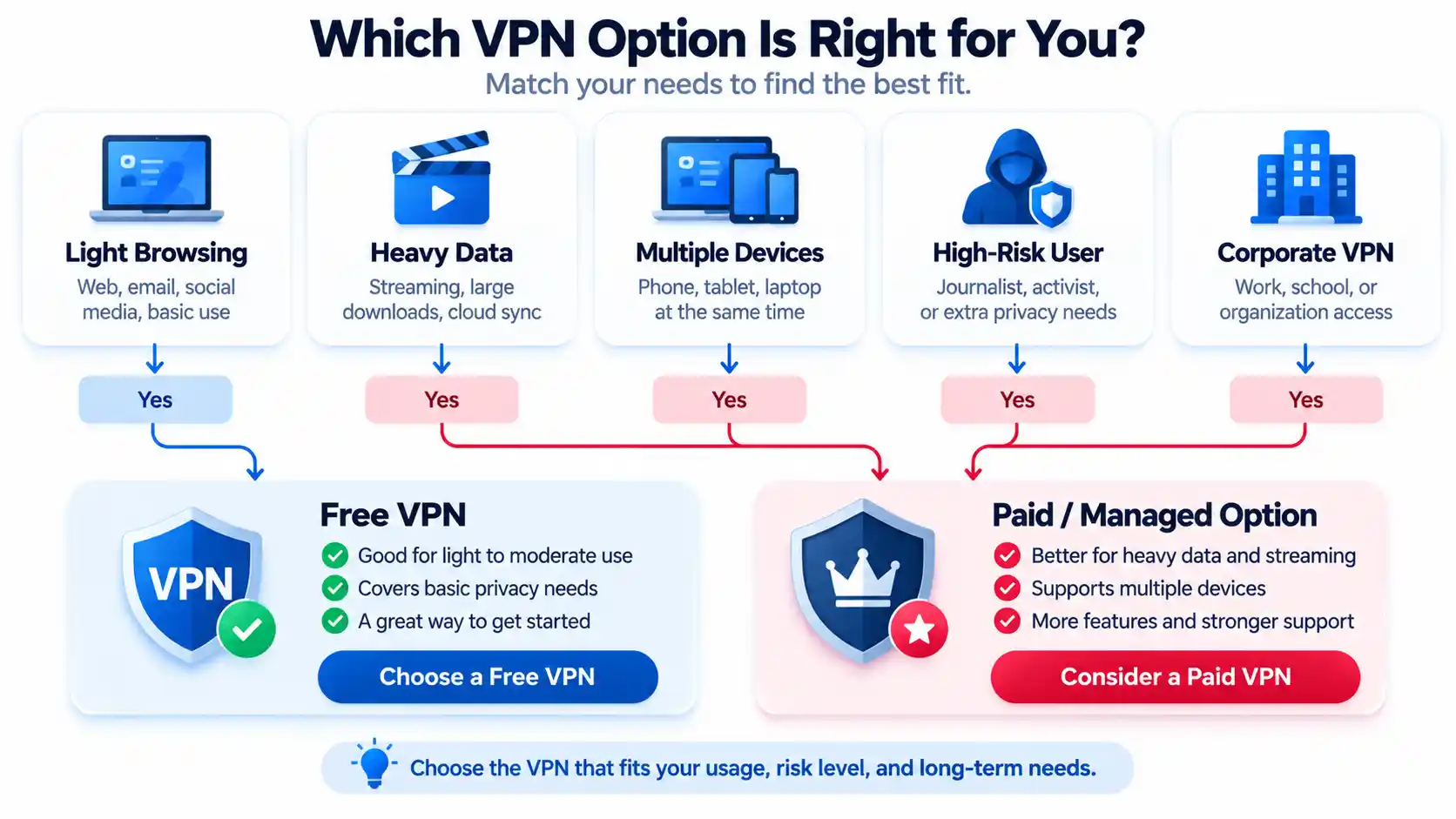
A free VPN is useful when the workload fits its limits. There are cases where choosing one primarily because it costs $0 creates more friction than value.
Warning
- You regularly transfer large volumes of data.
Monthly caps can make a free plan impractical, while speed-restricted unlimited tiers may not meet the workload. - You need several devices connected continuously.
A one-device plan creates repeated disconnect-and-reconnect management. - You require a specific exit country.
Automatic assignment or a small location pool may not provide the jurisdiction you need. - You depend on business support. A paid or managed service is normally more appropriate when downtime affects work.
- Your employer provides a managed VPN.
A company’s remote-access VPN is designed to connect authorized devices to company systems. It serves a different purpose from a consumer privacy VPN. - You face a high-risk targeted threat.
Journalists, activists, political targets, or people facing sophisticated surveillance should use threat-model-specific professional guidance rather than assume that any general consumer VPN provides complete protection.
Public Wi-Fi is another case where the VPN should be only one layer. You should still confirm the correct network, update your device, disable unnecessary automatic connections, and protect important accounts with multi-factor authentication. Our public Wi-Fi safety guide covers those precautions separately.
If you routinely exceed free-tier limits, compare the restrictions against a full consumer VPN plan rather than creating multiple free accounts or constantly switching providers.
How to Choose a Free VPN
The simplest way to choose is to identify the restriction you are least willing to accept.
- Decide whether you need unlimited data.
If yes, start with Proton VPN Free or hide.me rather than a capped plan. - Count the devices that must be connected at the same time.
Windscribe is the clearest choice here because its free tier supports unlimited personal devices. - Decide whether you want to provide an email.
hide.me requires no signup, while Windscribe works without an email at a reduced 2 GB allowance. - Check server control.
Do not choose Proton Free if manually selecting a specific country is essential to the workflow. - Inspect the privacy evidence.
Prefer published audits, transparent logging explanations, and open-source software where available. - Check your operating system.
Confirm that the provider supports the exact Windows, macOS, Linux, Android, iOS, browser, TV, or router environment you plan to use. - Identify what happens at the limit.
Some VPNs stop normal usage, while others provide restricted fallback connectivity. - Download from an official source.
Avoid lookalike websites, unofficial APK repositories, and sponsored search results whose domain does not match the provider.
For a concrete example, a person protecting one laptop during a month-long trip can prioritize Proton’s unlimited allowance. Someone switching among a phone, tablet, and laptop may prefer Windscribe even though the monthly cap is lower. A user who wants no email attached to the service may prefer hide.me.
If speed becomes the main problem after installation, that is a separate diagnostic issue involving server load, route distance, protocol choice, local congestion, and device performance. Check our VPN slowdown troubleshooting guide to fix the issue.
Key Takeaways
- Proton VPN Free is the strongest overall option when unlimited data on one device matters most.
- Windscribe Free is the better choice for several personal devices, but its standard allowance is 2 GB without an email or 10 GB with a confirmed email.
- hide.me combines unlimited data with no-email signup, although the free tier restricts speed and location choice.
- PrivadoVPN provides a useful 10 GB full-speed allowance but restricts users to one active free connection and limited locations.
- TunnelBear’s 2 GB plan is best treated as an occasional-use tier rather than an always-on free VPN.
- Do not assume that “no logs” means no operational account data at all. Read what a provider actually retains.
- A free VPN should explain how it funds the service and what changes between free and paid accounts.
- No consumer VPN makes you completely anonymous or replaces device security, account protection, HTTPS, or safe browsing habits.
Frequently Asked Questions
Which free VPN does not require a credit card?
None of the five services in this comparison requires a credit card merely to use the standard free tier. Account requirements differ, however. hide.me does not require an email or payment information, Windscribe can be used without an email at the lower 2 GB allowance, and PrivadoVPN requires a verified email.
Is there a free VPN with unlimited data?
Yes. Proton VPN Free and hide.me currently provide unlimited data. They impose different restrictions instead. Proton limits the free account to one device and automatically assigns servers from its free pool. hide.me permits one connection and limits free users by speed and server choice.
How long will 10 GB of free VPN data last?
There is no single duration because usage depends on what your applications transfer. Reading websites and messaging generally consume much less data than high-resolution video, game downloads, cloud backups, or operating-system updates. A 10 GB allowance may cover substantial lightweight browsing but can be consumed quickly by large media or file transfers.
Can I use one free VPN account on several devices?
It depends on the provider’s simultaneous-connection rule. Windscribe Free supports unlimited personal devices. Proton VPN Free and hide.me allow one active free connection, while PrivadoVPN allows installation on multiple devices but only one connection at a time. Always distinguish how many devices can install an app from how many can remain connected simultaneously.
Will a free VPN work if my internet provider blocks VPN connections?
Possibly, but there is no universal result. Some providers offer obfuscated or stealth protocols designed to make VPN traffic less obvious to restrictive networks. Blocking methods vary, and a protocol that works on one network may fail on another. Free tiers may also expose fewer anti-censorship options than paid plans.
Can a free VPN see my passwords?
A reputable VPN normally cannot read passwords sent through a properly configured HTTPS connection because HTTPS encrypts the content between your browser or app and the destination service. The VPN provider can still occupy an important position in the network path and may observe some connection metadata depending on its architecture and logging practices. This is another reason to choose a provider carefully rather than trusting any free VPN application.
Is a free VPN browser extension the same as a full VPN app?
Not always. A full VPN application can route traffic from the operating system and multiple applications through the encrypted tunnel. A browser extension may protect or proxy only browser traffic. Some extensions described as VPNs operate as proxies rather than full device-level VPN tunnels, so check the provider’s documentation before assuming the protection covers every application on the device.
Is a free VPN better than a paid VPN for occasional travel?
It can be. If you need VPN protection only for light browsing during a short trip, a reputable free plan may provide enough data and locations without a subscription. Paid service becomes more useful when you need predictable location choice, several devices, large transfers, advanced routing features, or consistent long-term support.
You must be logged in to post a comment Login