


Connect with us
DAPA Banner
DAPA Coin
DAPA
COIN PAYMENT ASSET
PRIVACY · BLOCKDAG · HOMOMORPHIC ENCRYPTION · RUST
ElGamal Encrypted MINE DAPA
🚫 GENESIS SOLD OUT
DAPAPAY COMING

Tech

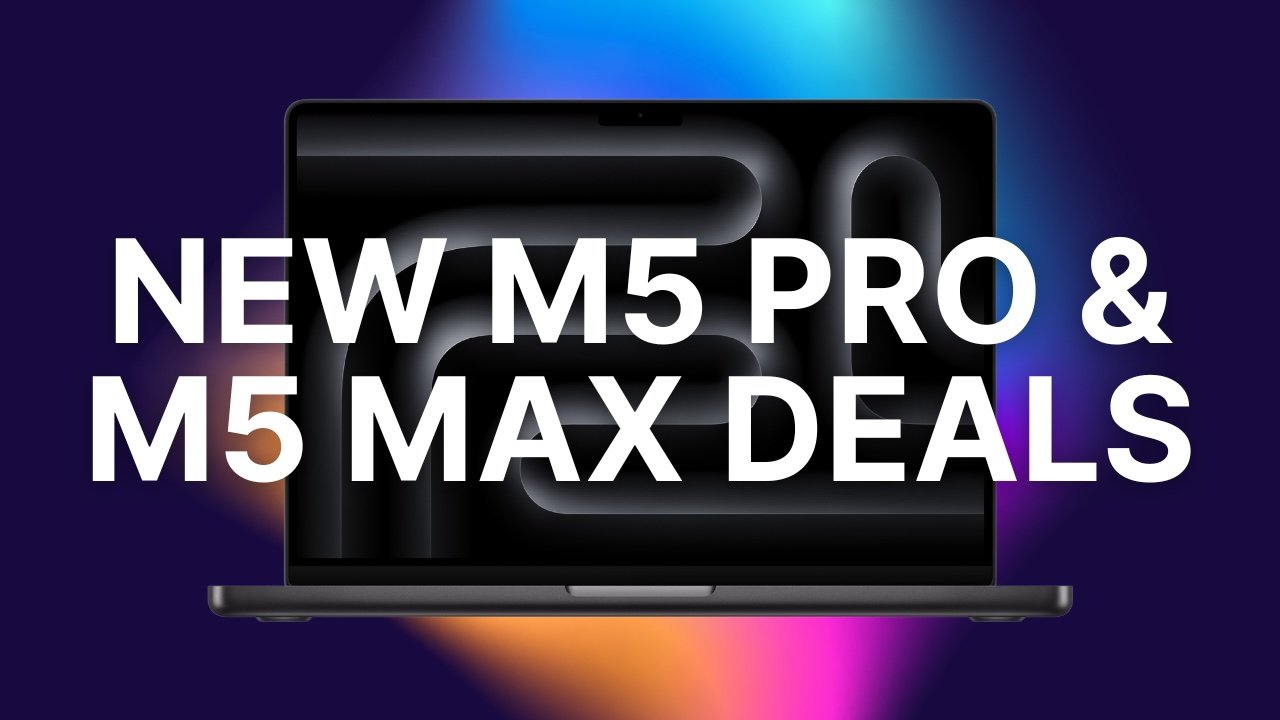
B&H WWDC MacBook Pro Sale Save Up to $300 on M5 Pro, Max

Published

on

B&H is celebrating WWDC with steeper discounts on MacBook Pros, and a variety of 14-inch and 16-inch models are in stock and up to $300 off.

You can shop the full selection of MacBook Pro savings at B&H. We’ve also rounded up top picks from the sale in the bulleted list below.

Shop B&H’s MacBook Pro sale

Top 14-inch MacBook Pro deals at B&H

  • M5 Pro, 15C CPU, 16C GPU, 48GB RAM, 1TB SSD, Standard Display, Space Black: $2,299 ($300 off)
  • M5 Pro, 15C CPU, 16C GPU, 48GB RAM, 2TB SSD, Standard Display, Space Black: $2,799 ($200 off)
  • M5 Pro, 18C CPU, 20C GPU, 24GB RAM, 1TB SSD, Standard Display: $2,199 ($200 off)
  • M5 Pro, 18C CPU, 20C GPU, 48GB RAM, 1TB SSD, Standard Display, Space Black: $2,499 ($300 off)
  • M5 Pro, 18C CPU, 20C GPU, 64GB RAM, 1TB SSD, Standard Display: $2,799 ($200 off)

Best 16-inch MacBook Pro discounts at B&H

  • M5 Pro, 18C CPU, 20C GPU, 48GB RAM, 2TB SSD, Standard Display, Space Black: $3,199 ($300 off)
  • M5 Pro, 18C CPU, 20C GPU, 64GB RAM, 1TB SSD, Standard Display, Space Black: $2,999 ($300 off)
  • M5 Pro, 18C CPU, 20C GPU, 24GB RAM, 1TB SSD, Nano-texture, Space Black: $2,549 ($300 off)
  • M5 Pro, 18C CPU, 20C GPU, 48GB RAM, 1TB SSD, Nano-texture, Space Black: $2,949 ($300 off)
  • M5 Max, 18C CPU, 40C GPU, 64GB RAM, 2TB SSD, Standard Display: $4,299 ($300 off)
  • M5 Max, 18C CPU, 40C GPU, 128GB RAM, 2TB SSD, Standard Display, Space Black: $5,099 ($300 off)

Each of the configurations above is in stock at press time, with B&H throwing in free shipping within the contiguous U.S.

Source link

Advertisement
Continue Reading
Click to comment

You must be logged in to post a comment Login

Leave a Reply

Tech

Reid Hoffman leaves Microsoft board to go ‘founder mode’ with AI drug startup Manus

Published

on

TL;DR

Reid Hoffman is leaving Microsoft’s board after a decade to focus on Manus, his AI drug discovery startup. The company has raised over $50 million.

Reid Hoffman is stepping down from Microsoft‘s board of directors after nearly a decade. The company disclosed the departure in a regulatory filing on Thursday. Hoffman said he wants to go “founder mode” with Manus, his AI-powered drug discovery startup.

Hoffman joined the board in 2016 after Microsoft bought his company LinkedIn for $26.2 billion. His tenure overlapped with some of the most consequential AI deals in the company’s history. He was a board member when Microsoft invested its first $1 billion into OpenAI in 2019, a bet that reshaped the company’s trajectory.

Hoffman was also one of OpenAI’s original investors and served on that company’s board until 2023. He stepped down citing too many potential conflicts of interest. Those conflicts multiplied further when Microsoft struck a $650 million acqui-hire deal with Inflection AI, the AI startup Hoffman co-founded.

Advertisement

That deal brought Inflection co-founder Mustafa Suleyman into Microsoft, where he now leads a narrower AI division focused on superintelligence. It also raised regulatory questions about conflicts on Big Tech boards.

Advertisement

Hoffman’s next chapter is Manus, a drug discovery company he co-founded. The startup has raised over $50 million across two seed rounds, with backing from General Catalyst. Its CEO is Dr. Siddhartha Mukherjee, a physician, biologist, and Pulitzer Prize-winning author of “The Emperor of All Maladies.

Hoffman holds the title of co-founder and chairman, not CEO. But he signalled on a recent episode of his “Possible” podcast that he plans to be far more hands-on.

One of the things I realized over the last month was that, we’re seeing such progress with Manus. I need to get back to founder mode,” he told Microsoft CEO Satya Nadella during the conversation.

Hoffman said Manus is making progress on what he calls “Move 37” AI. The term refers to AI that supersedes human creativity, borrowed from AlphaGo’s famous move against world champion Lee Sedol. He believes the concept applies to chemistry, particularly in discovering novel compounds to combat cancer.

Advertisement

The departure comes as AI drug discovery heats up across the industry. ByteDance’s Anew Labs recently presented its first AI-designed therapy, and Google DeepMind’s Isomorphic Labs has AI-designed drug candidates entering clinical trials.

Source link

Advertisement
Continue Reading

Tech

‘Steve Jobs In Exile’ Remembers the Birth of the Web and ‘Making Unix Taste Sweet’

Published

on

Ars Technica shares some anecdotes from Steve Jobs in Exile, a new book released last month:

[Author Geoffrey] Cain reminds us, in stunning detail, that Jobs’ “exile” era at NeXT was not only critical to his evolution as a man and an entrepreneur, but that it mattered for the rest of us, too. The technological innovations that came out of NeXT — notably, the NeXTSTEP OS — continue to live on in what we now call both macOS and iOS. As Cain puts it, “NeXTSTEP was Steve’s attempt to make Unix taste sweet….”

[W]hile many tech nerds know that Tim Berners-Lee created the first World Wide Web server on a NeXT machine while working in Switzerland in 1990, few know that NeXT employees were wary of bringing the news to Jobs. Why? They feared his wrath “and that he would dismiss [the web] as ‘shit.’” (In another timeline, NeXT might itself have capitalized on this world-changing innovation….)

Perhaps one of the wildest anecdotes that Cain uncovered was how one voicemail changed computer history forever. In 1996, when Apple was solidly in its mediocre Performa era — and considering buying BeOS as the basis for its new operating system — a mid-level NeXT product manager asked aloud, “Why don’t we just frickin’ call Apple?” (NeXT was also struggling during this period.) And so someone did. As Cain writes:

Advertisement

Garrett left the group of managers, walked back to his office, and took a risk. He picked up his designer phone and called the head of software at Apple. He left what he described as “one of my more inspired sales pitches” on the man’s voicemail, explaining why Apple should be looking at NeXT instead of Be… In any other universe, Garrett’s call might have gotten him fired. But in this timeline, it worked out. And thanks to him, Steve [Jobs] was about to enter Apple’s airspace once again.

Thanks to long-time Slashdot reader destinyland for sharing the article.

Source link

Continue Reading

Tech

The coolest things we saw at Computex 2026, from space-ready motherboards to fan-cooled mice

Published

on

Computex 2026 is over, and as usual, the show floor was packed with more laptops, PCs, components, peripherals, and oddball gadgets than any one person could properly process in a few days. There were sleek ultrabooks, massive gaming rigs, AI PCs, experimental designs, and plenty of products that looked like they were built mainly to make people stop and stare.

A handful of products stayed on our minds long after we left the show floor. They weren’t always the most practical, powerful, or important announcements, but each had something memorable about it. So, in no particular order, here are the coolest things we saw at Computex 2026.

ASUS ROG Rapture GT-BN98 Pro Wi-Fi router

The ASUS ROG Rapture GT-BN98 Pro immediately caught our attention on the show floor. It looks absolutely wild, with a spider-like design that feels more like a sci-fi gaming prop than a router you would place next to your setup.

Once you get past the spider-like design, the bigger surprise is that this is already a Wi-Fi 8 router. That sounds slightly unreal considering most households still rely on Wi-Fi 6 or even Wi-Fi 5, while Wi-Fi 7 remains a relatively premium upgrade. Instead of chasing higher throughput speeds, Wi-Fi 8 focuses more on connection reliability and efficiency.

It has Adaptive QoE for intelligent traffic prioritization, Wi-Fi Insight for real-time network monitoring, AI Game Boost, and dual 10G ports. Do most people need a Wi-Fi 8 router right now? Probably not. But as a piece of future-facing gaming hardware, it was hard to ignore.

Pulsar Feinmann F01 Noctua Edition mouse

The Pulsar Feinmann F01 Noctua Edition is exactly the kind of thing that makes Computex fun. It is a gaming mouse with a tiny Noctua fan built into it, which sounds ridiculous at first, but makes much more sense when you actually try it.

Advertisement

The mouse was shown earlier, but after delays, it now appears much closer to launch. It is based on Pulsar’s Feinmann F01, but weighs slightly more due to the added Noctua NF-A4x10 5V PWM fan. It has a 42,000 DPI sensor and 8K polling. The fan can spin at up to 5,000 RPM, but because it is so small, its noise is hardly noticeable. It blows a gentle breeze toward your palm to help keep your hand from getting sweaty during long gaming sessions.

When it was first revealed last year, we thought the gimmick was pretty cute. After trying it in person, though, the idea started to make a lot more sense. Anyone who has spent hours gaming with sweaty hands will immediately understand the problem Noctua is trying to solve. It is definitely a little unusual, but we can see the practical appeal. That said, we only had a short time with the mouse on the show floor, so we did not get the chance to properly test how effective it is over a long gaming session or in a warm room where sweaty hands would really put the concept to the test.

Noctua also had its first liquid cooling AIO on display, and we saw a demo from the brand. It looks like a worthwhile AIO to keep an eye on for PC builders and Noctua fans who want to bring liquid cooling into their brown-and-beige themed setups.

Alienware AW3926QW monitor

Alienware’s AW3926QW was one of the more polished showpieces at Computex. It is a 39-inch curved Tandem OLED monitor, and at $1,099, it is obviously not cheap. But considering the size, 5K2K resolution, and RGB stripe OLED technology, the price starts to sound a little less outrageous.

The RGB stripe layout improves text clarity and color performance compared with some older OLED monitor layouts. The monitor runs at 5120 x 2160 with a 165Hz refresh rate, but it also has a dedicated mode for competitive players. You can switch it into a 27-inch mode with black bars, dropping the resolution to 2560 x 1080 and pushing the refresh rate up to 330Hz.

That basically makes the monitor a jack of all trades. You can use it as a large, immersive curved display for cinematic gaming or productivity, then switch to a faster esports-focused screen when needed. It also looked great in person without being too flashy.

Gigabyte X870E AORUS INFINITY NEXT motherboard

It is Gigabyte’s 40th anniversary, so we expected the brand to do something special for the occasion. However, we were not prepared for the brand to turn the engineering madness up to eleven with the X870E AORUS INFINITY NEXT motherboard.

It immediately grabbed our attention with its almost biological-looking hollow structures. We soon discovered that this is not just a cosmetic choice, but something far more bizarre. These “gyroid” structures are actually heatsinks, created using advanced 3D metal printing and “thruster-grade thermal materials” to cool the components and VRMs of the motherboard in low Earth orbit.

Yes, you read that right. This motherboard is meant to function in space. Since there is no airflow available to wick heat away from the components in those conditions, these structures are Gigabyte’s solution to the problem. The brand has also 3D-printed a vapor chamber for the chipset and added a honeycomb-style metal backplate to push cooling to the extreme.

Advertisement

Then there is the power delivery. This thing has 64 power phases and uses Low Earth Orbit and data center-grade Quad OptiMOS technology to deliver up to 5,120 amps of total current. That is beyond overkill for a gaming PC, and honestly, we think Gigabyte made this motherboard just to show that it can.

Gigabyte did not say when or if it plans to launch this motherboard to market. However, we did learn that manufacturing it alone costs about $3,000, so even if it ever does go on sale, it will be extremely expensive.

Framework Laptop 13 Pro

The Framework Laptop 13 Pro was announced a few months back, and we were eager to get our hands on the laptop to see if it actually delivers on its advertised promises, and it did not disappoint. The first thing that stood out to us is how sturdy the laptop felt. The brand has taken a page out of Apple’s playbook and used an aluminium unibody chassis in the 13 Pro.

The latch has also been improved so removing or plugging in the expansion cards can be done with one hand, which is a good quality-of-life change. Framework has also moved to LPCAMM2 memory on the Laptop 13 Pro, allowing it to use LPDDR5x while still keeping memory upgradeable. This is significant because laptops that use LPDDR memory are typically not upgradeable.

It has a 13.5-inch display with 2.8K resolution that finally offers touch support, though the laptop can only bend backward up to 180 degrees, so it can’t be flipped into a tablet. The other big upgrade is the 74Wh battery, which is 22% larger than the previous generation, with the brand claiming more than 20 hours of Netflix 4K streaming. We could not verify that claim during our brief hands-on time.

That said, the Framework Laptop 13 Pro is not cheap. The pre-built model starts at $1,499 with an Intel Core Ultra 5 325 processor, so there is an upfront premium. But that price is easier to accept because this is a laptop you can upgrade over time rather than replace entirely.

Advertisement

Source link

Continue Reading

Tech

US States Are Reportedly Planning To Sue To Block Paramount’s Warner Bros. Takeover

Published

on

California’s attorney general Rob Bonta launched a probe into the deal shortly after it was announced.

Amid widespread opposition to Paramount’s $110 billion acquisition of Warner Bros., multiple US states are reportedly working together to fight the merger. According to a Reuters report, California and New York are among states preparing a lawsuit to block the deal.

The deal has faced scrutiny since it was announced back in February, when Paramount officially beat out Netflix in its attempt to buy Warner Bros. following multiple bids. California Attorney General Rob Bonta in particular has voiced concerns about the potential consequences, saying in a statement at the time, “Further consolidation in markets that are central to American economic life does not serve our economy, consumers, or competition well. In fact, consolidation of markets has led to increased unaffordability, a loss of good-paying job opportunities, and fewer choices for consumers.” Bonta added that the deal “must receive a full and robust review,” and said the state is “committed to fighting market consolidation that we find unlawful.”

We don’t know yet what other states are involved in the lawsuit alongside California and New York. But according to Reuters‘ source, the suit is expected to be filed within the coming weeks.

Advertisement

Source link

Advertisement
Continue Reading

Tech

8849 Tank Pad Ultra rugged tablet review

Published

on

Why you can trust TechRadar


We spend hours testing every product or service we review, so you can be sure you’re buying the best. Find out more about how we test.

8849 TANK Pad Ultra: 2-minute review

The 8849 Tank Pad Ultra arrives as the company’s most ambitious device to date. It builds on the original Tank Pad’s projector concept and refines it considerably. Where the first Tank Pad offered a dim 100-lumen DLP unit running at sub-HD resolution, the Ultra steps up to 260 lumens and native 1920×1080 output. That is a 2.6x improvement in brightness in one generation, and it matters enormously in practice.

The hardware underneath is a MediaTek Dimensity 8200 paired with 16GB of LPDDR5 RAM and 512GB of storage. This is not the fastest platform available in 2026, but it is more than sufficient for field work, document management, and media playback. Android 15 ships out of the box, which is a refreshing improvement over the Android 14 found on many rivals.

Advertisement

Source link

Continue Reading

Tech

The AI Robot Air Hockey Player That Skipped Every Practice Session on the Actual Table

Published

on

AI Robot Air Hockey Player
Engineering physics students at the University of British Columbia finished a capstone project that produced something unusual in robotics. Their air hockey robot learned every move inside a computer simulation and then stepped onto real hardware ready to face human opponents with no further adjustments. The approach bypassed the usual slow and risky process of training directly on physical equipment.


Over the course of around two years, multiple student teams worked together to complete the project. Hudson Nock, Ian Hartley, and Mauro Ferraz led the last assault. They took over an early iteration of the hardware foundation, with the primary purpose of narrowing the gap between virtual training and real-world performance. The whole code and two pretty lengthy technical reports are now available on GitHub for anyone who want to read everything and understand every decision they made.

For any automated system, air hockey presents some significant issues. The table surface is never completely smooth, the puck travels at high speeds, bounces vary depending on where it hits the wooden rails, and motor efficiency degrades when the power supply voltage lowers under strain. Conventional physics models frequently fall short of adequately capturing these differences in order to transition from simulation to reality. Instead than relying just on a generic engine, the UBC team chose to meticulously measure the actual hardware and then mimic its unique characteristics within the code.

AI Robot Air Hockey Player
All the sensing is controlled by a single camera above. The puck is marked with retroreflective tape, while the opposing mallet is marked with a unique marker. Even when the camera uses very short exposures of only 100 microseconds to stop the movement, some bright LEDs close to the lens make both objects appear exceptionally clear and crisp. In order to keep the position error down to nearly precisely one millimeter over the entire surface, they also performed some calibration work using markers around the table edges. This is quite astounding given the little warping that would otherwise be an issue. A contour tracker can follow the puck all the way through even when the gantry obstructs the view. The human player’s mallet can be found by the same camera at a scorching 120 frames per second.

A Core XY gantry positioned high above one side of the table generates movement. The mallet is guided by two belt-driven motors and an STM32 Blue Pill microcontroller. During system testing, the team went to the trouble of determining how the mallet reacts to various voltage signals and recording it all as a third order transfer functions. They used a combination of feedforward controls and PID feedback to keep the mallet on track and virtually perfectly aimed. A sizable supercapacitor is also used to stabilize the voltage during rapid accelerations.

AI Robot Air Hockey Player
Custom code designed for speed and accuracy powers the simulation itself. The application employs analytical solutions to simulate both puck and mallet motion, reducing the need for time-consuming numerical integration stages. They use an adaptive collision timing technique to ensure that no impacts are missed. When the puck strikes the wooden rails, a small neural network with only 112 parameters kicks in, predicting both the departing velocity and angle, as well as a measure of uncertainty. The simulator then draws from that uncertainty distribution at random throughout each run, so the learning agent should expect slightly unfair and noisy bounces rather than flawless ones.

Vectorization allows a standard laptop to run thousands of game instances at the same time. On a normal Intel i5, the entire simulation runs approximately 230 times faster than real time, which is rather impressive. That kind of pace makes it absolutely practical to run extensive training sessions. To account for issues such as camera lag and control input latency, the agent is given a state that includes the most recent puck and mallet action over a variety of delays. It then outputs the voltage parameters for the motion profile together with the intended final mallet position.

Advertisement

AI Robot Air Hockey Player
The Soft Actor Critic reinforcement learning technique was used to train networks with about 200,000 parameters. The squad took action since self-play alone can result in one-dimensional strategies. After training, they just applied the policy to the actual controller without any further fine-tuning in the real world, resulting in some deviation. The round trip delays are all kept in sync while the entire system runs on a 60-Hz loop.
[Source]

Source link

Continue Reading

Tech

Google tests making AI Mode the default in Search, then says it was an error

Published

on


As spotted by Windows Report, a flag in the new Chrome Canary release called Fulfill Searchbox Queries in AI Mode appeared to confirm people’s worst fears.
Read Entire Article
Source link

Continue Reading

Tech

Attacks Are Living in the Browser

Published

on

Laptop warning

Every year, the Verizon Data Breach Investigations Report serves as a ground-truth benchmark for the industry. Its value comes not just from the headline numbers but from the convergence signals: when multiple independent data sources point to the same structural shift in how attackers operate, that convergence is worth paying attention to.

This year, as a contributor to the Verizon 2026 DBIR, the Keep Aware team had early visibility into that convergence.

This post breaks down the specific areas where the 2026 DBIR data and Keep Aware’s own browser telemetry align — and where browser-layer data reveals what network and endpoint tools miss entirely.

Shadow AI Has Become a Mainstream Enterprise Risk

Shadow AI was identified in the Verizon DBIR as the third most common non-malicious insider action observed in Data Loss Prevention (DLP) datasets, representing a fourfold increase from the previous year.

Advertisement

Employees are not typically trying to exfiltrate data; rather, they are using the fastest available tool for a task, which increasingly means pasting internal documents or source code into a personal ChatGPT session before their organization has had time to approve and provision a governed alternative.

The scale of unauthorized AI usage in enterprise environments is one of the report’s most significant findings: 67% of users are accessing AI services on corporate devices through personal, non-corporate accounts, and 45% of employees are now considered regular AI users.

Keep Aware’s browser telemetry further provides insight into how these AI services are being used. Over half of AI prompt inputs are sent to personal accounts, and 23% of sensitive prompt uploads involve data transiting through personal or unverified accounts (i.e., outside the reach of any corporate DLP policy or logging infrastructure), conveying the real risks of AI usage.

Figure 9 from the Verizon 2026 Data Breach Investigations Report

Employees are pasting and uploading confidential data into ChatGPT, Gemini, and dozens of other AI tools every day.

Keep Aware’s free AI audit shows you exactly what’s leaving, and from which apps, before it becomes a breach.

Advertisement

Get your free AI audit

Credential Abuse and the Browser’s Detection Gap

The 2026 DBIR found that 39% of breaches involved credential abuse. Keep Aware’s attack data from 2025 puts browser-based credential theft as the number one browser-based attack, accounting for approximately 41% of observed threat activity, implying that credential theft in the browser will later contribute to successful future breaches.

Compounding this attack vector is the fact that the vast majority of these attacks are invisible to traditional tooling, as our data illustrates.

In Keep Aware’s analysis, 63% of Microsoft-themed phishing sites were not flagged by any VirusTotal vendor at the time of employee exposure, showing a glaring detection gap in intelligence feeds and endpoint tools.

More pointedly, 100% of the credential theft attempts Keep Aware observed passed through existing non-browser security controls unblocked — network proxies, DNS filters, and endpoint agents alike.

Advertisement

None of them caught it. The only reliable detection point is inside the browser itself, where the page is rendered and the user interaction actually occurs.

Browser Extensions: Privileged, Ungoverned, and Expanding

Add-ons can read, modify, and interact with any page’s content, and exfiltrate data from within the browser context, enabling extensions to operate with a level of browser privilege that should dictate regular scrutiny—yet data tells a different story.

The 2026 DBIR flagged that the average enterprise had more than 15% of users with unauthorized AI extensions installed. However, the extension problem is broader than AI tooling alone.

Keep Aware’s extension telemetry additionally shows that 13% of unique browser extensions observed across our customer base were classified as high or critical risk.

Advertisement

The more operationally significant finding: 93% of poor-reputation extensions were labeled as “productivity” tools by browser marketplaces — the exact category most allowlisting policies treat as safe. For this threat class, that makes category-based allowlisting functionally useless.

ClickFix and Browser-Native Social Engineering

Both the 2026 DBIR and Keep Aware’s State of Browser Security Report call out ClickFix as an emerging technique worth tracking.

The Verizon DBIR found ClickFix accounted for 2.7% of browser-detected attacks—a small share that nonetheless signals an evolution in browser-based social engineering.

Figure 57 from the Verizon 2026 Data Breach Investigations Report

ClickFix is a deceptive social engineering tactic used to get a user to unknowingly execute malicious code from the browser and on the host machine.

This threat begins in the browser—often by encountering compromised websites and sometimes through LLM chat responses—but quickly continues on the endpoint, compromising the machine with info stealers and remote access to attackers.

Advertisement

The endpoint bears the impact, but the browser is the social engineering medium—and the first line of defense.

The Human Element Continues to be a (Browser) Problem

The 2026 DBIR found that 62% of breaches involved the human element, with phishing initiating 16% of incidents. Keep Aware’s browser-layer data shows phishing and social engineering accounted for 46% of browser attacks observed across 2025.

The human element finding is often framed as a training and awareness problem. But attackers are constantly evolving browser-based social engineering tactics—phishing links to benign intermediary sites, redirect chains, pages that render differently for automated scanners, hosting content on legitimate websites, and silent clipboard injections.

Browser-level visibility does not solve the human element problem, but it shifts the detection point to where the human interaction is actually occurring, rather than looking for downstream artifacts after the interaction has already been exploited.

Advertisement

What This Means for Security Teams.

Shadow AI, credential theft, malicious extensions, and browser-native social engineering techniques like ClickFix share a common characteristic: they all execute inside the browser, and they all produce artifacts that are most visible, if not only visible, at the browser layer.

Security programs that rely exclusively on network, endpoint, and identity telemetry will continue to have blind spots in exactly the places attackers have learned to operate.

The browser is no longer just an application. For most enterprise users, it is the work environment. Securing it is no longer optional.

If your security stack lacks visibility into what’s happening inside browser sessions, that gap is worth understanding before attackers exploit it. Request a demo of Keep Aware to see what your current tools are missing

Advertisement

Keep Aware contributed data to the Verizon 2026 Data Breach Investigations Report. Keep Aware’s 2026 State of Browser Security Report is available here.

Sponsored and written by Keep Aware.

Source link

Advertisement
Continue Reading

Tech

EU trade chief wants a new tool to break Europe’s dependence on Chinese chips and rare earths

Published

on

TL;DR

EU trade chief Šefčovič wants a new law forcing companies in sensitive sectors to have at least three suppliers, modelled on the Energy Union.

EU trade commissioner Maroš Šefčovič has called for a new “diversification instrument to reduce Europe’s dependence on single suppliers of chips and rare earths. He made the proposal at the European Policy Center’s Brussels Economic Security Forum on Friday. The tool would force companies in sensitive sectors to source from at least three different suppliers.

If it’s critical supplies, you have to have three different suppliers to make sure that you cannot be punished because of a political reason,” Šefčovič said. He cited the Energy Union as his model, an initiative he previously led to wean Europe off Russian energy after the 2014 annexation of Crimea.

The urgency is real. The EU relies on China for more than 90% of its rare earth supplies. Beijing imposed export controls on rare earth magnets last October during a tariff dispute with the United States, and halted chip shipments from Chinese-owned Nexperia after the Dutch government seized control of the company.

Advertisement

Those disruptions hit European carmakers and exposed the bloc’s vulnerability. “Recent industrial cases, in particular supplies of chips and rare earths, have reinforced my conviction that a step change is necessary,” Šefčovič said. “Every high-risk sector must be weaned off single-supplier dependence.

The EU has since joined forces with Washington and other nations to find alternative sources. Sweden’s discovery of Europe’s largest rare earth deposit offered a long-term glimmer, but mining timelines stretch well beyond a decade. In the meantime, Europe remains exposed.

The proposal comes a day after Šefčovič urged Brussels and Beijing to address the EU’s “unsustainable” trade deficit with China. That deficit widened to €360 billion last year, up 18% from 2024. EU leaders are set to discuss China’s industrial overcapacity and subsidised exports at a summit on 18-19 June.

Šefčovič will also meet Chinese counterpart Wang Wentao in Brussels later this month. He told reporters the next step is a formal legal proposal. “We have to specify what to really do with the legal proposal,” he said.

The broader push to reduce chip dependency has already produced the EU Chips Act, which aims to double Europe’s share of global chip production to 20%. A Chips Act 2.0 was proposed by the Commission in June 2026 with new measures to cut strategic dependencies further.

Advertisement

Source link

Continue Reading

Tech

JBL scales the hi-fi mountain with next-gen Summit Everest and K2 speakers

Published

on

JBL has taken the wraps off its most ambitious home speakers yet. The company is launching the next-generation Summit Everest and Summit K2 models as part of a new flagship Summit Series. This series was unveiled at High End Vienna 2026.

These aren’t just updates to existing speakers. They continue JBL’s long-running “Project” lineage — a designation reserved for the brand’s most technically advanced loudspeakers. In addition, they arrive as part of the company’s 80th anniversary celebrations.

The new range sits at the very top of JBL’s line-up, joining models like Makalu, Pumori, and Ama. However, the Everest and K2 are the clear headline acts. They are reference-level systems for listeners who want no-compromise performance at home.

The Summit Everest sits at the top of the stack, carrying forward the legacy of four previous Everest generations. It uses a redesigned mid and high-frequency system built around JBL compression drivers and a large-format HDI horn.

Advertisement

This is supported with dual 10-inch mid-bass drivers and dual 15-inch woofers, with the intent on delivering deep bass while maintaining precision across the full frequency range.

Advertisement

JBL Summit speaker familyJBL Summit speaker family
Image Credit (JBL)

Slightly lower in the range, the Summit K2 follows a similar design philosophy but scales things back into a more “accessible” flagship format. Still, it uses JBL’s compression driver system and HDI horn design, paired with a 15-inch woofer and 10-inch mid-bass driver. This approach aims for the same sense of scale and clarity in a smaller footprint.

Both models share JBL’s updated internal architecture, including a redesigned crossover system intended to reduce signal loss and improve power handling. They have also reworked the cabinets, adding heavy internal bracing and damping to minimise unwanted resonance.

Furthermore, new isolation feet decouple the speakers from the floor, delivering cleaner bass response and sharper imaging.

Advertisement

Finish options lean fully high-end, with either high-gloss black with platinum accents or Macassar ebony veneer with gold detailing. Even the hardware has been treated as part of the design, using premium binding posts and high-grade internal wiring throughout.

Advertisement

Pricing underlines exactly where these sit in the market. The Summit Everest comes in at $159,990 per pair. Meanwhile, JBL prices the Summit K2 at $99,990 per pair, firmly placing both models in the ultra high-end territory when they arrive later in 2026.

Advertisement

Source link

Continue Reading

Trending

Copyright © 2025