








Standing desks have gone from being niche ergonomic upgrades to mainstream workspace essentials, driven by growing awareness of the risks associated with long, uninterrupted hours of sitting.
Alternating between sitting and standing throughout the day can help reduce back strain, improve posture, and encourage better circulation, while also helping users stay more alert during extended work sessions. For many people working from home, the standing desk has become a central part of creating a healthier, more flexible workspace.
Article continues below
Designers have to consider everything from materials and structural integrity to long-term reliability and ease of use. Even small decisions — such as desktop thickness, frame construction, or component tolerances — can impact on how stable, quiet, and durable a desk feels over years of daily adjustments.
Ergonomics, durability, sustainability
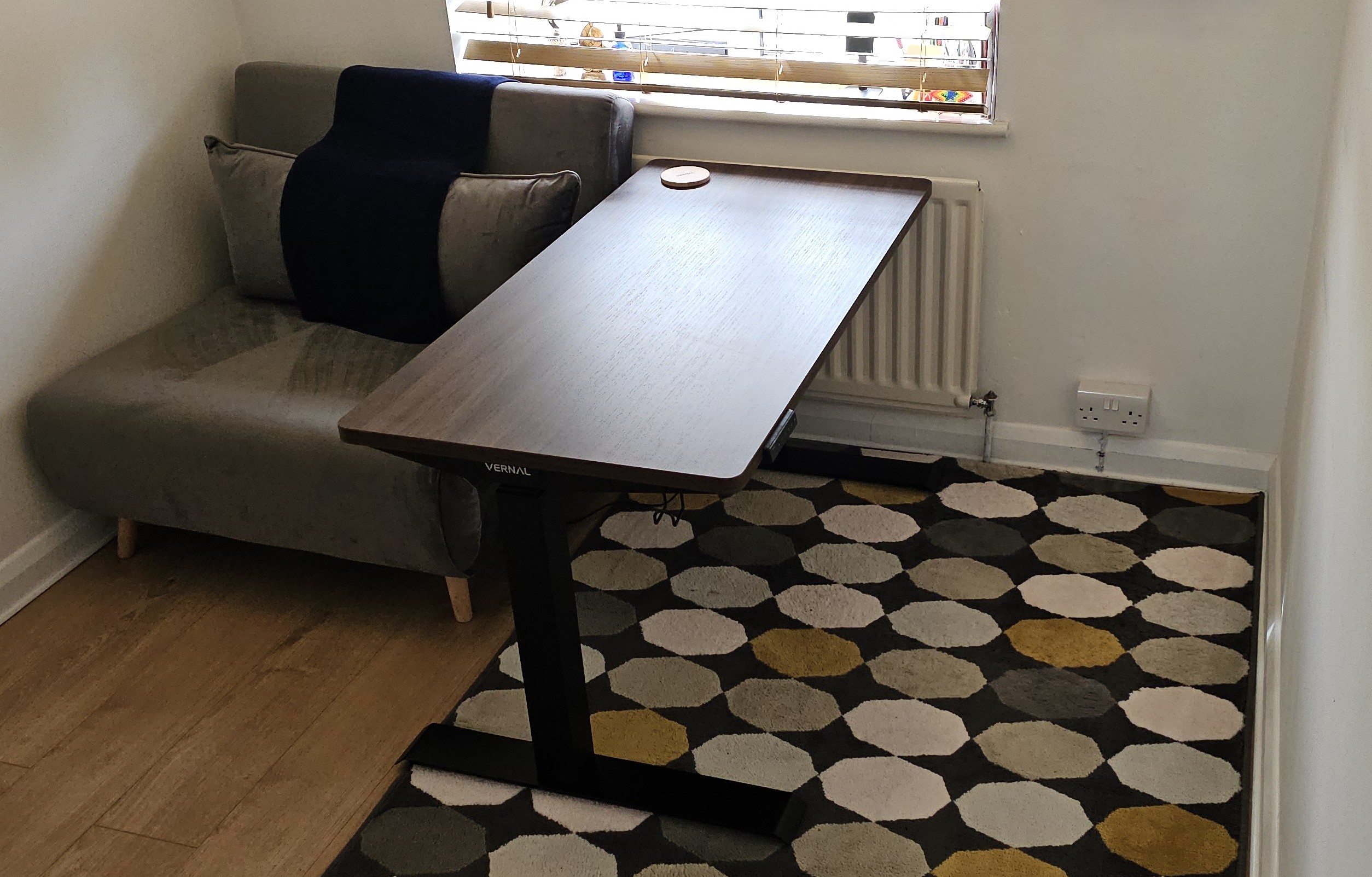
Vernal focuses heavily on this intersection of ergonomics, durability, and home-friendly design. With more than a decade of experience in the home furnishing industry, its team approaches desk development with a strong emphasis on quality control across every stage, from research and design through testing and manufacturing.
The company also places a welcome importance on sustainability, using FSC-certified materials, recyclable packaging, and responsibly sourced desktop materials such as bamboo and recycled wood.
Its goal is to create ergonomic products that not only support healthier working habits but also blend seamlessly into modern home environments.
Having tested some of the best standing desks around, I wanted to better understand what actually goes into designing a modern standing desk — and the engineering decisions that shape performance, usability, and long-term reliability.
So, I spoke with Colin Han, CEO and product team lead at Vernal, about the company’s approach to building desks for today’s evolving home office.
- When Vernal begins designing a new desk from scratch, what’s the absolute first technical hurdle your engineering team tackles? Do you immediately attack the industry’s ultimate curse – the ‘wobble’ at maximum height? And when solving that sway, how much of the solution comes down to frame geometry versus the raw manufacturing tolerances of the telescopic legs?
Stability is indeed the design starting point for Vernal. How stable a desk remains at its maximum height is the first challenge our engineering team set out to conquer.
Through modeling and analysis, we broke down the key factors affecting stability into the following three parts: the columns themselves account for approximately 50% of the impact, the structural stability of the feet-to-column connection accounts for approximately 30%, and the structural stability of the frame-to-column connection accounts for approximately 20%.
We focus on systemic optimization in both materials and structure. For material reinforcement, we increased the steel tube thickness of the crossbeams and longitudinal beams, and increased the thickness of the die-cast feet to reduce the risk of structural deformation at the source.
For structural optimization, we introduced reinforcing ribs at key joints and adopted a “grid-style” frame with integrated welding to enhance overall rigidity.
We also rigorously test our products. For instance, we perform a 100% maximum height wobble test on our column modules — a standard stricter than the industry average — to ensure every column meets our stability requirements.
Vernal fully complies with BIFMA X5.5:2021 standards and has fully benchmarked its static stiffness against the industry leader, Uplift V3 (a brand we highly respect).
In the future, we will continue to optimize for even lower wobble levels. Technologically, we aim to further utilize one-piece molded frames to reduce the number of manually assembled parts, thereby increasing structural strength. After all, wherever there is a joint, there are tiny gaps that can affect the perception of stability.
Beyond stability, design aesthetics is our other starting point. We are currently researching new alloy materials to achieve more elegant designs while maintaining the same stability experience. Vernal focuses on home office scenarios, and we look forward to bringing users more “warm” designs that blend seamlessly into the home.
- Our bedrooms and living rooms are becoming home offices. How has the ‘resimercial’ shift influenced Vernal’s design decisions? How do you design a standing desk that’s robust enough to survive a corporate environment, but aesthetic enough that someone actually wants it in their home?
Thank you for this question; it is the “soul” of the Vernal brand. When setting up a workspace at home, many people’s first instinct is: “How do I make this desk as rugged and multi-functional as a corporate cubicle?”
In Vernal’s view, this is a dangerous misunderstanding. The home is a spiritual sanctuary; we cannot allow a cold “efficiency machine” to rudely invade our bedrooms and living rooms. Our design North Star is simple: In the home, the identity of “furniture” must always precede the identity of “tool.”
We do not claim to have invented some flawless “black tech.” Instead, we are practicing what I call a difficult “exercise in restraint.” We are working hard to strip away the jarring, industrial, and anxiety-inducing elements of traditional office gear.
This includes rounded-corner designs for safety and comfort, and semi-recessed hand-controllers that are intuitive yet anti-collision. Improving cable management to hide clutter is also vital. It is essential that people feel a sense of well-being; otherwise, one might as well go back to a corporate office.
To be honest, merging “tool efficiency” with “home aesthetics” is a challenging journey, and Vernal is still evolving.
We are no longer spending all our energy on a “one-size-fits-all” desk. Instead, we have split our team into specialized exploration groups: some focus on blending desks with popular styles like Mid-Century Modern (MCM); others obsess over the precision of desktop organization; and others explore new alloys that are easier to shape while balancing cost.
Most importantly, we maintain deep, ongoing dialogues with home-office users to ensure we perceive their true pain points and aspirations. This deep connection with real individuals is Vernal’s core secret.

- People often assume a standing desk is a magic cure for back pain, but the reality is we often slump, slouch, and lean against the edge. How does Vernal design its desks to encourage healthier habits, and how do you approach ‘micro-ergonomics’ to accommodate how people actually behave versus how they ‘should’ stand?
We are currently focusing on two areas. The first is desktop depth. A standing desk solves the problem of sedentary lumbar fatigue. However, other micro-experiences are often ignored. For example, while 21-27 inch monitors are common, a 24-inch deep desk is only reasonable for a 21-inch screen.
For a 27-inch monitor, a distance of about 26 inches is required. We found that many users use 24-inch depths, which fails to meet the need for a healthy distance between the eyes and the screen to reduce ocular fatigue.
This is a crucial issue that Vernal has specifically addressed in our blog post, How Deep Should Your Desk Be?. We do not sacrifice desk size to reduce packaging or shipping costs; our L-shaped desks remain consistently large to ensure a great experience even with large monitors.
The second area is Computer Vision for posture alerts, which is currently under research. Most people lose track of their posture when deeply focused, and by the time you feel pain, it is often too late.
We are exploring the use of Computer Vision (CV) to monitor and record user posture via their home-office webcams. Based on professional ergonomic advice and user feedback, the system provides proactive alerts and guidance to help users form healthier working habits.
- Choosing the right material for a standing desk is a brutal compromise between weight, durability, aesthetic appeal, and cost. How does Vernal navigate the technical decision-making process when selecting materials – from the grade of steel in the legs to the core density of the desktop – to make sure it can survive a decade of coffee spills, monitor mounts, and constant movement?
Vernal does not blindly pursue exaggerated specs. We focus on real-world usage. For example, a 200kg weight capacity costs more than 160kg, but we found that most users’ equipment does not exceed 100kg.
Therefore, we choose a 160kg capacity and invest the saved costs into craftsmanship or the R&D of accessories that actually improve the home-office experience. This makes our accessory system streamlined yet highly effective.
Similarly, with the desk sizes mentioned earlier: larger boards mean heavier packages and higher shipping costs. However, because the experience provided by the correct size is so critical, we refuse to cut costs there.
Our decision-making is simple: Invest money where it creates a real, positive experience for the user.
- Your line-up includes the Core3 and Executive models. How does the team decide which features are fundamental for a standing desk and which justify a ‘premium’ jump?
We do not segment products by “Basic, Mid, or Advanced” functions. Every series includes what we consider essential performance: stability, durability, and load capacity. Instead, we plan our series based on user preferences and needs. We make the “tool” attributes the best they can be within our capability, then distinguish series by scenario and aesthetics.
For example, Core3 is designed for those who prefer minimalist and modern styles, while the Executive Series is intended for users who want to maintain a professional “business image” while working from home.
That said, certain professions — like designers, creators, and those who demand high levels of spatial order — have higher functional requirements. For them, standard specs like “stability and noise” are just the baseline.
They need products that eliminate cold industrial design, use “breathing” materials like solid wood or fabric, and provide extreme cable management. These products are our “Flagships” because these users need more than just a desk — they need “fuel for inspiration.” Developing such products is far more difficult than refining a design style.
Our logic is not “low performance to high performance,” but rather: “What environment are we trying to curate for this specific individual?”
- In our review of your desk, our managing editor actually sat his entire 100kg body on the desktop and rode it upwards to test your 160kg weight limit. When Vernal is testing motors and frame stability behind closed doors, what is the most extreme or ridiculous real-world stress test your engineers put these desks through before signing off?
It is always fun to see reviewers challenge the limits in the real world! At Vernal, we also perform extreme tests to understand the “redundancy” of our designs. We have established a comprehensive testing system covering mechanical structure, electronics, environment, packaging, and user experience, with over 130 cumulative test items.
Typical tests include lifting life of 10,000+ cycles under a 160kg load, desktop deflection strictly kept under 15mm under a 75kg load and returning to <5mm once released, button life of 100,000+ cycles (exceeding the 73,000 needed for 10 years of use), and control box testing with a failure rate of <0.1%, significantly better than the industry standard of 0.2%–0.5%.
With the launch of the new Core3 this year, we have released our comprehensive testing report. We want to be transparent and show the world exactly what a standing desk must endure — the engineering rigor it goes through—before it is deemed ready to leave our factory.

Follow TechRadar on Google News and add us as a preferred source to get our expert news, reviews, and opinion in your feeds. Make sure to click the Follow button!
And of course you can also follow TechRadar on TikTok for news, reviews, unboxings in video form, and get regular updates from us on WhatsApp too.









































You must be logged in to post a comment Login