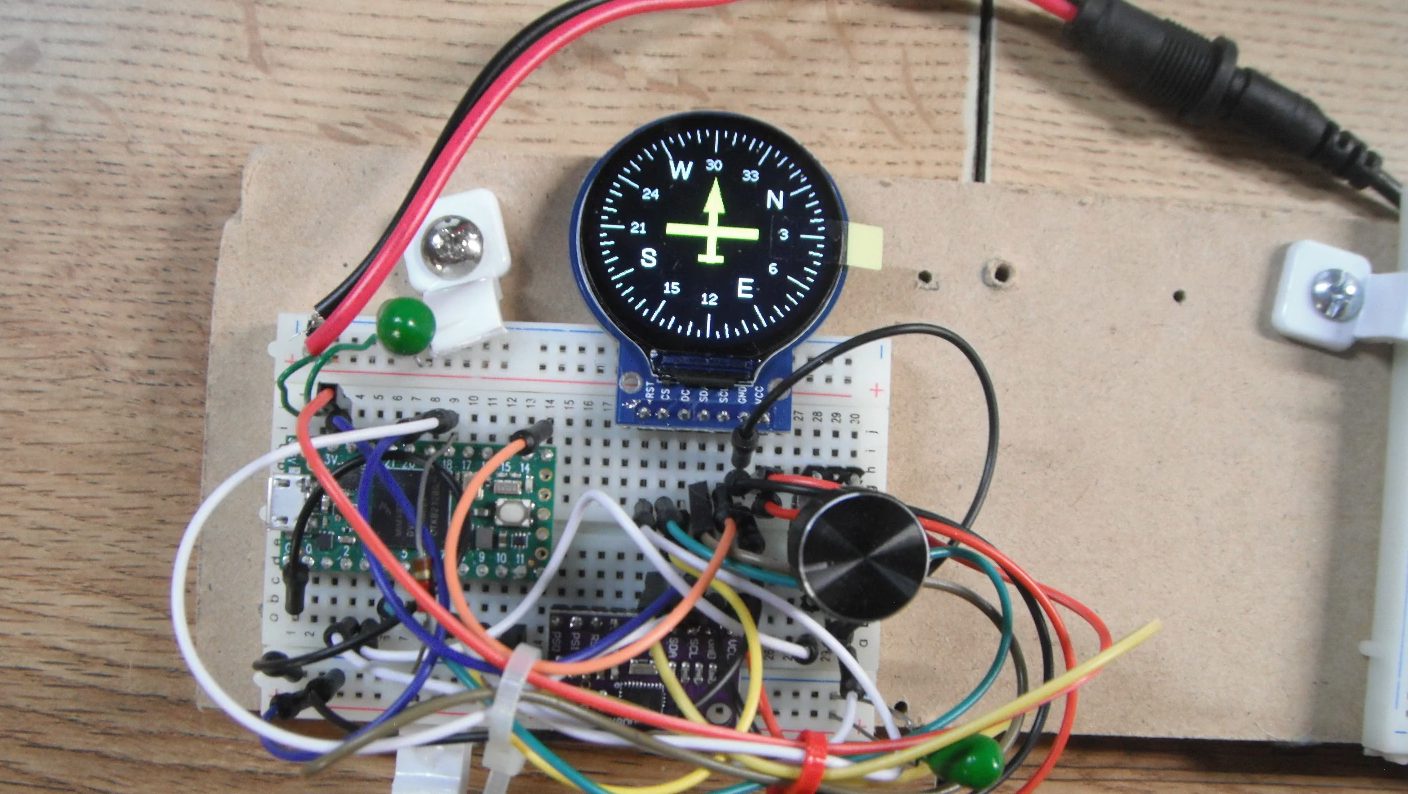
Light aircraft often use a heading indicator as a way to know where they’re going. Retired instrumentation engineer [Don Welch] recreated a heading indicator of his own, using cheap off-the-shelf hardware to get the job done.
The heart of the build is a Teensy 4.0 microcontroller. It’s paired with a BNO085 inertial measurement unit (IMU), which combines a 3-axis gyro, 3-axis accelerometer, and 3-axis magnetometer into a single package. [Don] wanted to build a heading indicator that was immune to magnetic disturbances, so ignored the magnetometer readings entirely, using the rest of the IMU data instead.
Upon startup, the Teensy 4.0 initializes a small round TFT display, and draws the usual compass rose with North at the top of the display. Any motion after this will update the heading display accordingly, with [Don] noting the IMU has a fast update rate of 200 Hz for excellent motion tracking. The device does not self-calibrate to magnetic North; instead, an encoder can be used to calibrate the device to match a magnetic compass you have on hand. Or, you can just ensure it’s already facing North when you turn it on.
Advertisement
Thanks to the power of the Teensy 4.0 and the rapid updates of the BNO085, the display updates are nicely smooth and responsive. However, [Don] notes that it’s probably not quite an aircraft-spec build. We’ve featured some interesting investigations of just how much you can expect out of MEMS-based sensors like these before, too.
Data removal services have appeared as an answer to a growing unease about the privacy of our personal information, especially online. They help people manage the visibility of their data and reduce what’s circulating in the hands of data brokers, companies that collect and sell personal data.
However, for many users, this sounds too good to be true, and so they ask themselves: Does the service actually work? Is it legitimate? How effective is it? And which is the best among so many data removal services?
Two popular options are Incogni and DeleteMe. Both promise to reduce your online footprint, but they approach the task differently. This comparison breaks down, for example, how each service works, how it actually performs, how easy it is to use, and what the differences in coverage are. This may help you decide which provider fits your privacy needs.
Incogni vs DeleteMe: Quick Comparison (2026)
Category
Incogni
DeleteMe
Prices
from $7.99/month when billed annually
from $6.97/month when billed biennially
Removal model
Fully automated, recurring opt-out requests
Manual and automated, team-assisted removals
Broker coverage
420+ data brokers, both private and public listings, custom removal, and additional sites on higher plans
85-100+ automated, 850+ with custom removals (depending on the plan)
Recurring follow-ups
60-90 days
Quarterly
Dashboard & reports
Ongoing status dashboard
Quarterly reports, updates
Independent verification
Deloitte Limited Assurance Report
No third-party verification
Customer support
Live chat, E-mail, Tickets, Phone with Unlimited Plans
Phone, Live chat, E-mail, Web form
Best for
Hands-off ongoing process
More user involvement, people-search focus
Data as of February, 2026
DeleteMe vs Incogni: How They Work
Incogni is an automated data removal system. After signing up, you need to verify your identity, and the platform starts sending deletion requests to hundreds of data brokers, covering also the “invisible” parts, i.e., information shared for marketing or profiling. Requests are repeated every 60 days for public brokers and every 90 days for private ones. The service also tracks responses, shows progress on a dashboard, and sends follow-ups when required.
DeleteMe combines automated and manual removal processes. Its team finds public listings with your information and manually sends opt-out requests periodically. DeleteMe’s focus is mainly on people-search sites that can be easily found. Users receive detailed reports on what was sent and what the answers were.
Coverage and Scope
Data removal service involves two layers:
Advertisement
Visible public listings (people-search sites)
Commercial broker databases (behind the scenes)
DeleteMe emphasizes visible listings and provides reports on those results, which can feel more tangible for users who want to be involved in the process. 85-100+ of these sites are reached automatically, but there are also an additional 850+ listings for custom removals (depending on the plan).
Incogni’s automated system reaches 420+ data brokers, including private databases that don’t appear in search results. Higher plans allow custom removals for 2,000+ sites, broadening the reach.
To sum up, Incogni focuses on broad, diverse, recurring suppression, while DeleteMe is more about systematic, manual management.
Availability and Compliance
Both services offer their services in multiple countries, but their regional reach and legal frameworks are different.
DeleteMe has been assisting users since 2010 and advertises the removal of 100+ million listings over the years. The company emphasizes its longevity in the industry. It primarily serves users in the US, with some international capability depending on listing type and broker location. Its international locations include Australia, Belgium, Brazil, Canada, France, Germany, Ireland, Italy, the Netherlands, Singapore, and the UK.
The provider maintains compliance with AICPA SOC 2 Type 2 (an audit standard by the American Institute of Certified Public Accountants), the EU’s GDPR, and various privacy laws passed in the US.
Advertisement
Incogni, on the other hand, is more widely available. As of now, it can be used by users in the US, the UK, all EU countries, Canada, Switzerland, Norway, Iceland, Liechtenstein, and the Isle of Man.
It operates under privacy laws like GDPR (EU), CCPA/CPRA (California, US), and similar, where applicable. Deloitte has verified that Incogni has processed 245+ million removal requests since 2022, up to mid-2025.
Transparency and Credibility
Incogni
Through its limited assurance report, Deloitte confirmed that Incogni’s removal process works as described by the provider. Deloitte verified key operational claims around recurring cycles, sending requests, and reaching brokers.
What’s more, PCMag and PCWorld awarded Incogni their Editors’ Choice awards, highlighting its automation, coverage, and ease of use. At the same time, user reviews on Trustpilot mainly show positive results with a gradual reduction in broker listings. Incogni’s overall rating stands at 4.4.
Advertisement
DeleteMe
DeleteMe is an already established removal service with generally warm feedback from many users over the years. It holds the rating of 4.0 on Trustpilot, the average of almost 200 reviews, with around ¾ being positive. Users praise data removal and ongoing checks, though there are some who describe slow results or incomplete removals.
When it comes to industry reviews, DeleteMe is appreciated for removing personal data from aggregators, allowing custom removal requests, and providing instructions for free DIY removal. However, they often mention that its coverage is quite narrow, and reports are too rare (they come out quarterly).
User Experience
Incogni
Users love Incogni for its simplicity and automation. After setup, which takes no more than 10 minutes, the dashboard will display all the necessary information without unnecessary, complicated details. You will be able to determine which brokers have been contacted, which requests are pending, and which sites already deleted your data.
For the most part, users don’t have to manually intervene in the process; everything happens in the background. Weekly or periodic progress summaries will come straight to your email and keep you informed without logging in daily. Removal cycles are also automated and handled every 60-90 days.
Advertisement
DeleteMe
DeleteMe’s user experience reflects its human-assisted model. After selecting a plan and uploading your personal details, the team will run periodic scans of dozens to hundreds of listing sites. Instead of following a live dashboard, users get regular reports, typically quarterly, that outline what was found and removed. These reports are more detailed, including context and explanations, such as site name, removal date, status, etc.
Some users may appreciate the clear narrative, while others prefer dashboards and less engagement.
Across both services, reviews suggest clarity. Incogni is praised for automation and ongoing protection with minimal effort from the user, while DeleteMe’s biggest strengths are human-handled processes and detailed reports.
Customer Support
Both providers offer structured support, but their channels differ.
Advertisement
Incogni offers:
Email/ticket-based support
Help Center documentation
Live chat support through its website
Phone support only for Unlimited plans
Users often describe Incogni’s support team’s responses as clear and process-oriented. They also say that the process is quite quick.
DeleteMe offers:
Phone support
Live chat
Email support
Web contact forms
User feedback praises DeleteMe’s helpful human interaction and explanations in its reports. However, many reviews mention slower response times, especially during peak periods.
Pricing
Incogni Pricing
Plan
Billing frequency
Monthly cost
Features
Standard
Annually
$7.99
Automated broker removals, dashboard tracking
Standard
Monthly
$15.98
Everything above for a higher overall cost
Unlimited
Annually
$14.99
Everything above, unlimited custom removal requests, 2,000 additional sites coverage, live phone support
Unlimited
Monthly
$29.98
Everything above for a higher overall cost
Family Standard
Annually
$15.99
Standard for up to 5 members and family account management
Family Standard
Monthly
$31.98
Everything above for a higher overall cost
Family Unlimited
Annually
$22.99
Unlimited for up to 5 members and family account management
Family Unlimited
Monthly
$45.98
Everything above for a higher overall cost
For American users, there’s an additional option – the Protect Plan, which is all-in-one data removal and identity-theft protection. For $41.48/month, you can get everything in Incogni Unlimited plus identity theft protection with NordProtect. Incogni is also included with Surfshark’s One+ plan from $4.19/month.
Both DeleteMe and Incogni have custom offers for businesses. None of them includes a free trial, but Incogni comes with a 30-day money-back guarantee for risk-free testing, while DeleteMe can be canceled with a full refund only before the first privacy report. However, you can get a free scan with DeleteMe.
Final Verdict: Two Solid Approaches for 2026
Incogni and DeleteMe are among the most popular data removal service providers, but they fit different privacy needs:
Incogni is an excellent choice for users who don’t want to get too engaged with the data removal process. It also offers wider broker coverage, with recurring cycles that keep sending removal requests. Incogni has also been independently assessed and received editorial recognition.
DeleteMe will suit users who prefer a human-assisted removal process and detailed reports about contacted brokers and their responses.
In 2026, both services can be effective, but when you prioritize automation, scale, and long-term work, Incogni’s approach will suit you better.
FAQ
Which platform provides broader data broker coverage?
Advertisement
Incogni covers over 420 brokers on its standard plan. DeleteMe claims coverage for 750+ sites, but its standard tier often defaults to around 100 high-impact brokers, with the remainder requiring manual custom requests.
Should I prioritize human-assisted removals over AI automation?
DeleteMe employs human privacy experts to handle complex manual opt-outs, which may offer higher precision for difficult cases. Incogni uses advanced AI to maintain a set-and-forget system that is generally faster and more affordable.
Advertisement
Which service is more effective for users living outside the United States?
Incogni is the stronger choice for global privacy, with a single subscription covering the US, UK, Canada, and 30+ European countries. DeleteMe historically focuses on the American market, though it has expanded to select international regions.
Advertisement
How frequently will I receive updates on my removal status?
Incogni sends progress updates every week. DeleteMe typically provides more comprehensive deep-dive reports, but issues them every quarter.
Nintendo of America is suing the US government, including the Department of Treasury, Department of Homeland Security and US Customs and Border Protection, over its tariff policy, Aftermath reports. The video game giant already raised prices on the Nintendo Switch in August 2025 in response to “market conditions,” but has so far left the price of its newer Switch 2 console unchanged.
Nintendo’s lawsuit, filed in the US Court of International Trade, cites a Supreme Court ruling from February that confirmed a lower courts’ opinion that the Trump administration’s global tariffs were illegal. Nintendo’s lawyers claim that the video game company has been “substantially harmed by the unlawful of execution and imposition” of “unauthorized Executive Orders,” and the fees Nintendo has already paid to import products into the country. In response, the company is seeking a “prompt refund, with interest” of the tariffs it has paid.
“We can confirm we filed a request,” Nintendo of America said in a statement. “We have nothing else to share on this topic.”
While taxes and other trade policies are supposed to be set by Congress, President Donald Trump implemented a collection of global tariffs over the course of his first year in office using executive orders and the International Emergency Economic Powers Act (IEEPA), a law that gives the president expanded control over trade during a global emergency. The Trump administration has positioned tariffs as a way to punish enemies and bargain with trade partners, but many companies have passed the increased price of importing goods onto customers.
Advertisement
In upholding opinions from the US District Court of the District of Columbia and the US Court of International Trade, the Supreme Court removed the Trump administration’s ability to collect tariffs using IEEPA, but didn’t clarify how the tariffs the government had illegally collected should be returned to companies. Like Nintendo, other companies have decided filing a lawsuit is the best way to get refunded.
The Guardian reports that US Customs and Border Protection is already preparing a system to process refunds for affected companies, but that might not mark the end of Trump’s tariff regime. In a press conference held after the Supreme Court released its decision, the President announced plans to introduce tariffs using other, more constrained methods. Tariffs aren’t the only obstacle Nintendo faces, either. The company could also be forced to raise the price of its consoles in response to the current RAM shortage.
Enterprises and startups that use Anthropic Claude through Microsoft and Google products need not fear that the model will be ripped from their reach, Microsoft and Google confirmed to TechCrunch. AWS customers and partners can also reportedly continue to use Claude for their non-defense associated workloads.
Microsoft was the first big tech company to offer assurance that Anthropic’s models will remain available to its customers even though the Trump administration’s Department of War — formally known as the Department of Defense — has escalated its feud with Anthropic.
The Defense Department officially designated the American AI startup as a supply-chain risk on Thursday after the AI company refused to give it unrestricted access to its tech for applications the company said its AI could not safely support, such as mass surveillance and fully autonomous weapons.
The supply-chain risk designation is typically reserved for foreign adversaries. For Anthropic, the designation means that the Pentagon won’t be able to use the company’s products once it transitions Claude off its systems. It also requires any company or agency that works with the Pentagon to certify that they don’t use Anthropic’s models, either. Anthropic has vowed to fight the designation in court.
Advertisement
Microsoft sells an array of products, from Office to its cloud, to many federal agencies, including the Defense Department. A Microsoft spokesperson said that the company will continue making Anthropic’s models available within its own products and to Microsoft customers.
“Our lawyers have studied the designation and have concluded that Anthropic products, including Claude, can remain available to our customers — other than the Department of War — through platforms such as M365, GitHub, and Microsoft’s AI Foundry, and that we can continue to work with Anthropic on non-defense related projects,” the spokesperson said in an email. CNBC first reported on the comment.
Google, which sells cloud computing, AI, and productivity tools federal agencies, has also confirmed that it will continue to make Claude available to its customers.
Techcrunch event
Advertisement
San Francisco, CA | October 13-15, 2026
“We understand that the Determination does not preclude us from working with Anthropic on non-defense related projects, and their products remain available through our platforms, like Google Cloud,” a Google spokesperson said.
Advertisement
CNBC also reported that AWS customers and partners can keep using Claude for their non-defense workloads.
This echoes what Anthropic CEO Dario Amodei said in his statement vowing to fight the designation.
“With respect to our customers, it plainly applies only to the use of Claude by customers as a direct part of contracts with the Department of War, not all use of Claude by customers who have such contracts,” Amodei said, adding, “Even for Department of War contractors, the supply chain risk designation doesn’t (and can’t) limit uses of Claude or business relationships with Anthropic if those are unrelated to their specific Department of War contracts.”
Out of all of Batman’s massive array of tools which turn a relatively ordinary person into a superhero, perhaps his most utilitarian is his grappling gun — allowing him the ability to soar around his city like Spiderman or Superman. [John Boss] isn’t typically fighting crime, but he did develop his own grappling gun of sorts which gives him another superpower: the ability to easily scale snowy hills to quickly get back to the top.
The grappling gun takes inspiration from a commonly used tool called a power ascender, which is often used in industry applications where climbing is required. This one is held in the hand and uses a brushless motor with a belt-driven 3:1 reduction for increased torque. The pulley system, bearings, and motor are all housed in a 3D printed enclosure and are powered by rechargeable Milwaukee power tool batteries. During prototyping the rope intake and output feed locations had to be moved to increase the pulley’s grabbing ability, and with a working prototype he swapped a lot of the plastic 3D printed parts out for metal to increase the sturdiness of the device.
The grappling gun was originally designed for a smaller child to get hoisted up a hill on a sled, but when stress testing the device [John] found out that it actually has more than enough capability to haul even an adult up a hill on skis. As an added bonus, the outfeed for the rope can be put into a bag and used to automatically coil the rope up when he’s done at the hill. Although this is a great solution for a portable rope tow, for something more permanent and more powerful take a look at this backyard rope tow that was built from spare parts.
Meze Audio has introduced the ASTRU ($899), a new top of the line single dynamic driver in-ear monitor (IEM) created for listeners who want true high end performance without venturing into the stratospheric pricing that now defines many flagship IEMs. Built around a focused design philosophy, ASTRU relies on a single dynamic driver to deliver a visceral, full bodied presentation that Meze says can rival the layering, imaging, and resolution typically associated with complex multi driver designs.
The new model will make its first public appearance at CanJam NYC 2026 this weekend. Meze says ASTRU will be available starting March 20 through mezeaudio.com, mezeaudio.eu, and selected retailers worldwide.
While Meze Audio is widely known for its award winning headphones such as the Empyrean II, 99 Classics 2nd Generation, 109 Pro, and the recently introduced STRADA, the Romanian brand has also shown it can build compelling in ear monitors as well. Its ADVAR IEM, which we reviewed favorably, stood out for its musical balance, solid build quality, and distinctive industrial design. With ASTRU, Meze appears ready to push further into the high end IEM space while sticking with a simpler single driver approach rather than joining the industry’s escalating multi driver arms race.
Meze Audio ASTRU
Advanced Multilayer Dynamic Driver Architecture
At the center of the ASTRU is a custom multilayer composite 10 mm dynamic driver designed to balance speed, control, and tonal weight. The diaphragm dome is constructed using more than 80 ultra thin layers of gold, applied through a 48 hour physical vacuum DC magnetron sputtering process. This technique allows extremely thin metallic layers to be deposited with high precision, helping maintain diaphragm rigidity while keeping mass low.
The gold layered dome is bonded to a titanium layer and mounted on a PEEK base, materials chosen for their strength, stability, and resistance to unwanted resonance. The result is a driver structure intended to deliver fast transient response, extended treble, and the fuller low frequency presence that dynamic drivers are known for, while maintaining clarity and control across the frequency range.
Advertisement
Titanium Construction, Accessories, and Specifications
ASTRU’s housing reflects Meze Audio’s focus on durability, precision manufacturing, and long term comfort. The shell geometry has been carefully shaped to provide a secure and stable fit during extended listening sessions. Each earpiece is CNC machined from a single block of pure titanium and finished through a multi stage electroplating process that results in a smooth satin surface. According to Meze, producing each matched pair of shells requires up to seven days of precision machining and finishing, highlighting the level of manufacturing detail behind the design.
ASTRU is delivered as a complete listening package designed for portable high end audio use. The IEM includes a premium balanced cable equipped with CNC anodized aluminum hardware and a gold plated 4.4 mm balanced termination. This type of connection is commonly used with modern digital audio players and portable amplifiers because it offers improved channel separation and lower noise compared to standard single ended outputs. A 4.4 mm to 3.5 mm adapter is also included for compatibility with more traditional headphone outputs on Dongle DACs that may not offer a balanced output.
Additional accessories include five sizes of ear tips ranging from XS to XL to help users achieve a secure seal and proper acoustic performance. Meze also includes two carrying solutions: a protective pouch for everyday transport and a soft PU leather envelope designed for additional protection during travel or storage.
In terms of specifications, ASTRU offers a frequency range of 5 Hz to 35 kHz with a nominal impedance of 32 ohms and a sensitivity rating of 111dB SPL per milliwatt at 1 kHz. Total harmonic distortion is specified at less than 0.1 percent at 1 kHz. The IEM uses a standard 2-pin connector for cable attachment and weighs 13.4 grams (0.47 oz). These specifications indicate that ASTRU should be easy to drive with most modern digital audio players, portable DACs, and headphone amplifiers while still benefiting from higher quality source components.
Advertisement
The Bottom Line
The Meze Audio ASTRU arrives at an interesting moment for the high end IEM market. With Empire Ears recently shutting down operations, one of the category’s most recognizable boutique brands has exited the stage, leaving more room for companies like Campfire Audio, Noble Audio, 64 Audio, and Astell&Kern to battle it out in the upper tier of the segment. Most of those competitors lean heavily into complex driver arrays, packing multiple balanced armatures, electrostatics, or hybrid configurations into increasingly elaborate designs.
Meze is taking a different path. Rather than joining the escalating multi driver arms race, ASTRU sticks with a single dynamic driver architecture and focuses on materials, diaphragm engineering, and acoustic tuning. The titanium housing, multilayer gold coated diaphragm, and balanced cable package suggest a product built with the same attention to industrial design and materials that has defined Meze’s headphone lineup.
Advertisement. Scroll to continue reading.
What ASTRU offers is a simpler approach to high end IEM performance aimed at listeners who prefer the coherence, bass weight, and natural timbre that dynamic drivers are known for. What it does not offer is the kind of driver count marketing that dominates much of the $800 to $1500 IEM category. At $899, that places it in direct competition with multi driver models from several established brands. Whether buyers prioritize driver complexity or the sonic character of a well executed dynamic design will ultimately determine where ASTRU lands in this crowded field.
Advertisement
Price & Availability
ASTRU will be available for purchase starting March 20, 2026, on mezeaudio.com, mezeaudio.eu and in selected retailers worldwide, with a suggested retail price of $899.
Gov. Bob Ferguson delivered his State of the State address in Olympia, Wash., on Jan. 13. (Governor’s Office Photo)
Gov. Bob Ferguson said Friday that he will sign the latest version of Washington’s proposed “millionaires tax,” paving the way for legislation that has sparked intense debate within the state’s tech and business circles.
In a statement, Ferguson said the revised proposal met his desire to send more revenue back to working families and small businesses.
“I strongly encourage the Legislature to pass this bill with all of these investments in affordability included,” he said. “It represents a historic step forward in rebalancing our unfair system and making life more affordable for Washington families and small business owners.”
Ferguson earlier this month criticized Senate Bill 6346 for doing too little for small businesses and lower-income residents in the state. He had suggested the measure could be pushed to next year if lawmakers could not strike the right balance.
Ferguson said the latest revision would expand the Working Families Tax Credit, preserve sales-tax exemptions on items such as diapers and hygiene products, add a sales-tax exemption for over-the-counter medicines, support free school meals, and dedicate 5% of revenue to child care and early learning.
Advertisement
The bill, which passed the Senate last month and still needs approval from the House, would impose a 9.9% tax on Washington taxable income above $1 million, beginning Jan. 1, 2028.
SB 6346 represents one of the most significant efforts in years to establish a personal income tax in Washington.
The bill has drawn opposition from some tech leaders and entrepreneurs who worry it could undermine the sector by souring Washington’s relatively favorable tax laws for startup founders, investors and high-wage earners.
Earlier this week, a group of AI researchers, founders, and investors sent a letter to Ferguson, arguing that higher taxes on high earners and investment gains would push top talent and future startups elsewhere. They urged the state to “pause” work on the tax, as well as an increase to Washington’s capital gains tax.
Advertisement
Supporters argue those fears are overblown and say the bill helps correct the state’s regressive tax code, which relies heavily on property, sales and business taxes to fund education and other public programs.
The bill is expected to generate an estimated $3.7 billion annually.
The action comes as the state is struggling to plug a more than $2 billion budget hole with spending cuts and a slate of potential tax changes, while at the same time some of Washington’s largest employers are cutting thousands of jobs from their payrolls.
Lawmakers have also advanced an amendment that would repeal, in 2030, part of a recent sales‑tax expansion on select services that drew criticism from tech companies and prompted a Comcast lawsuit. However, the higher tax on advertising services would remain in place.
IT Search’s Karla O’Rourke discusses her career in recruitment and how candidates can make themselves more attractive to organisations looking to hire.
Ask anyone who has applied for a new job lately and they will likely tell you that the application process is almost a full-time role in itself as you spend weeks, sometimes even months, amending cover letters, submitting documents and interviewing, only to not be considered the ‘right fit’. Then the routine starts up again, until you finally land a job.
“One of the most common mistakes is applying for roles that are not aligned with a candidate’s experience,” explained Karla O’Rourke, an associate director and technology recruiter at Irish recruitment agency IT Search, which is a member of the Vertical Markets Group.
She said: “While it is natural to explore opportunities, submitting applications for a large number of roles that are not a close match rarely leads to positive outcomes. Another issue is failing to tailor a CV to the role being applied for. If a job description highlights specific technologies or responsibilities, candidates should ensure that their relevant experience is clearly reflected in their CV.”
Advertisement
Unsurprisingly, she finds that more and more, recruiters are coming across CVs that have been created using AI technologies, which is leading to a rise in generic applications.
Artificial intelligence can be useful in assisting with format and structure. However, she noted that hiring managers are quick to recognise when a CV has not been written solely by the individual, often because AI-generated descriptions will lack detail and provide little clarity around the applicant’s specific contributions or achievements. The strongest CVs, she said, will offer a clear outline and understanding of responsibilities and projects, and how this translates to measurable results.
So, how does an IT or technology recruiter utilise their skills to ensure that the person behind the CV is matched to a role that suits their goals and ambitions?
Don’t rush to judgement
In her own role, as someone who evaluates applications to assess whether they match the expectations of the organisation and if there is a likelihood that the person could be fulfilled working there, O’Rourke said effective recruitment depends heavily on solid judgement, communication skills and possessing a deep understanding of both the organisation and the candidate.
Advertisement
“A key part of the process is looking beyond the job description to understand what the organisation truly needs. While technical capability is obviously critical in technology roles, long-term success often depends on additional factors such as adaptability, communication style and how someone fits within a team,” she said.
“Equally, understanding a candidate’s motivations and career ambitions is essential. A CV can provide a snapshot of someone’s experience, but conversations often reveal much more about how a person approaches their work and the type of environment where they will perform best.”
She is of the opinion that strong networks also play a crucial role, as recruiters who actively engage with their market build a deep understanding of the talent landscape, which allows them to introduce candidates who are not only technically capable but also well aligned with the organisation’s culture and objectives.
When it comes to technical prowess – having noted that AI should be used sparingly (if at all) in the creation of a CV – for tech and IT experts looking to move ahead, O’Rourke encourages the use of opportunities to include genuine skills in AI on their documentation.
Advertisement
“Unsurprisingly, AI is one of the biggest topics across the technology sector at the moment. Organisations are actively exploring how they can integrate AI into their systems, development processes and wider business operations. At the same time, many companies are also navigating the learning curve that comes with implementing these technologies effectively.
“While the demand for AI expertise is extremely high, the pool of professionals with deep, practical experience in this area remains relatively small. Many organisations want to incorporate AI into their platforms and workflows, but there are fewer individuals who have the experience required to genuinely lead those initiatives.”
At the end of the day, IT and tech recruiters have the same end goal as someone looking to begin or continue their career in the IT and tech space. Both want to show the organisation that the application put forth is representative of the person best suited to the position. To achieve this, O’Rourke explained that applicants should find what makes them unique.
“When many candidates have similar technical skills on paper, differentiation becomes increasingly important. Rather than listing every technology you have encountered, it is often more effective to focus on the areas where you have genuine depth of experience and can clearly demonstrate value.”
Advertisement
And perhaps above all else, be prepared. She finds that the candidates who can confidently stand over projects, showcase the challenges they have resolved and highlight the impact of their work are significantly more likely to stand out in a positive way during the interview process.
The career labyrinth
Knowing the direction you want to go in professionally can make the route to get there simpler, but that is by no means the only way to reach your target, nor is it as common as we might tell ourselves. Typically, the route towards a desired career diverts occasionally, and it is important to be aware and accepting of that.
“My route into recruitment was actually quite unexpected,” noted O’Rourke, who explained that initially, she was employed at Dunnes Stores as a brand manager, with the assumption that she would eventually take up a position in the human resources division.
“Interestingly, the opportunity came from someone who had ‘mystery shopped’ me several times while I was working there. Their full-time role was in recruitment and after a number of visits, they reached out to ask whether I would consider exploring a career in agency recruitment.
Advertisement
“At that stage I had very little awareness of the industry, but I was open to the conversation. Looking back, it proved to be one of the best decisions I have made professionally.”
Don’t miss out on the knowledge you need to succeed. Sign up for the Daily Brief, Silicon Republic’s digest of need-to-know sci-tech news.
Glasco, a co-founding developer of both Infinity Ward and the Call of Duty franchise, now works as a consultant in the video game industry. He shared his recollection of Activision’s pressure on social media, joining an ongoing discussion about the unusually blunt way the Trump administration is embedding video game… Read Entire Article Source link
Ancient Slashdot reader ewhac writes: The maintainers of the Python package `chardet`, which attempts to automatically detect the character encoding of a string, announced the release of version 7 this week, claiming a speedup factor of 43x over version 6. In the release notes, the maintainers claim that version 7 is, “a ground-up, MIT-licensed rewrite of chardet.” Problem: The putative “ground-up rewrite” is actually the result of running the existing copyrighted codebase and test suite through the Claude LLM. In so doing, the maintainers claim that v7 now represents a unique work of authorship, and therefore may be offered under a new license. Version 6 and earlier was licensed under the GNU Lesser General Public License (LGPL). Version 7 claims to be available under the MIT license.
The maintainers appear to be claiming that, under the Oracle v. Google decision, which found that cloning public APIs is fair use, their v7 is a fair use re-implementation of the `chardet` public API. However, there is no evidence to suggest their re-write was under “clean room” conditions, which traditionally has shielded cloners from infringement suits. Further, the copyrightability of LLM output has yet to be settled. Recent court decisions seem to favor the view that LLM output is not copyrightable, as the output is not primarily the result of human creative expression — the endeavor copyright is intended to protect. Spirited discussion has ensued in issue #327 on `chardet`s GitHub repo, raising the question: Can copyrighted source code be laundered through an LLM and come out the other end as a fresh work of authorship, eligible for a new copyright, copyright holder, and license terms? If this is found to be so, it would allow malicious interests to completely strip-mine the Open Source commons, and then sell it back to the users without the community seeing a single dime.
While this headset isn’t nearly as fancy as some of our other favorite over-ear headsets, it makes up for it with classic Beats styling and a sound profile that the brand has become known for among its fans. They’re bass-forward and punchy, a fact you’ll just have to live with whether you like it or not, because they lack a dedicated equalizer. Thankfully they aren’t as bold and brash as the Beats of old, but it’s still something to keep in mind if your normal beat isn’t hip-hop or rock.
They’re technically produced by Apple, but the Beats Studio Pro have a feature set that’s decidedly cross-platform, with one-touch pairing for both Apple and Android mobile devices, and an impressively large wireless range in case you like to leave your phone on the porch while working in the yard. If you don’t mind being physically connected to your device, you can even use the USB-C mode to enjoy some high-resolution audio. There’s also head tracking for spatial audio, a trick we’ve seen on some other headsets that sometimes ends up being more of a gimmick, although it is neat to use while watching movies in apps that support it like Disney+ and Netflix.
They get up to 24 hours of battery life with the ANC on, or closer to 40 without, which is fine, but not quite as good as some of its more expensive counterparts. Speaking of active noise-canceling, our reviewer Ryan Waniata said “it holds its own against competitors from Sony and Bose, and outdoes rivals like Sennheiser’s Momentum 4 Wireless.” It works just as well for calling as it does for catching some tunes, and has a microphone that folks on the other hand of the call described as clear and detailed.