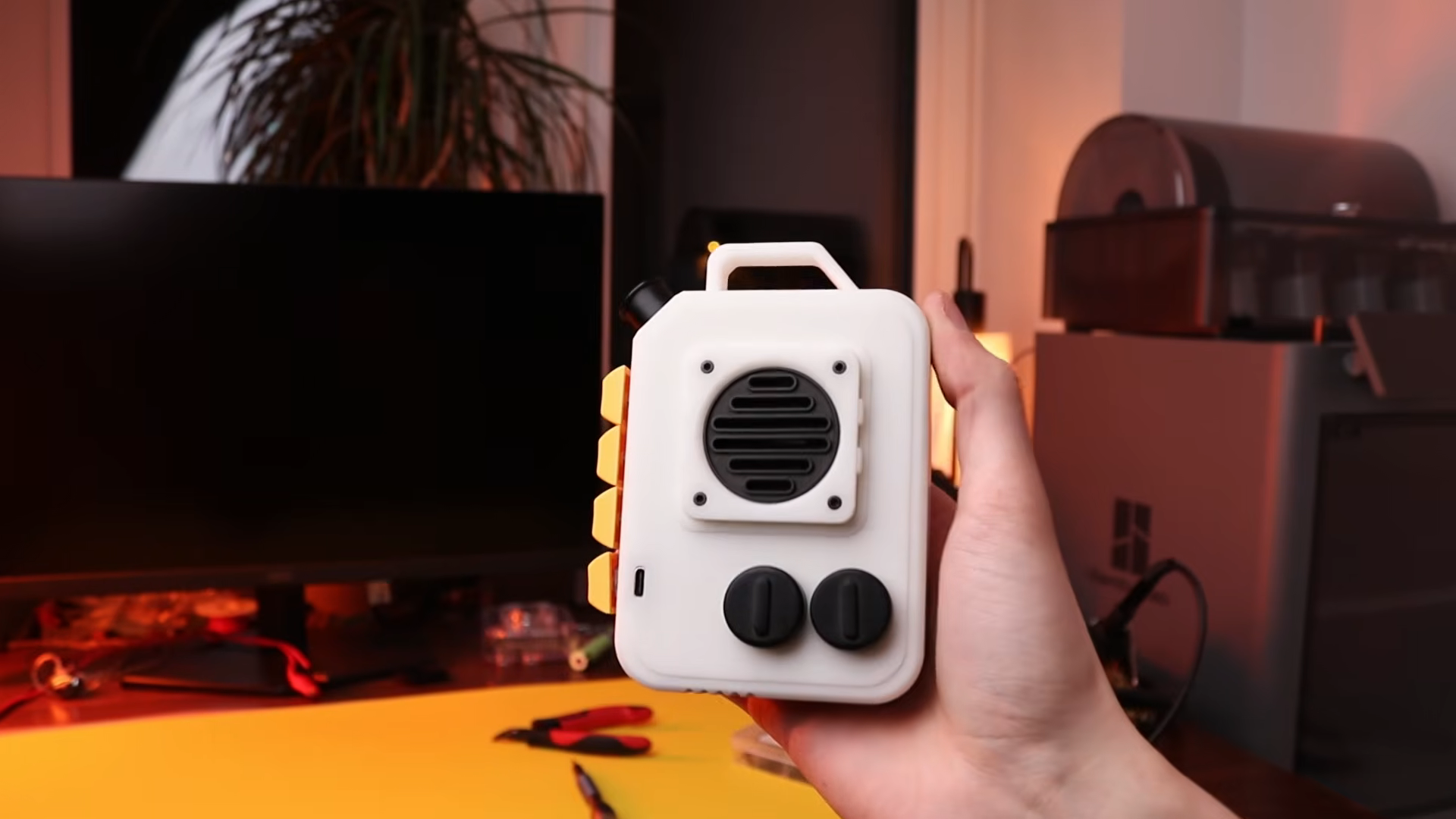
[Nick] came across an awesome Bluetooth speaker online, only, there was a problem. It didn’t really exist—it was just a render of a device that would be nice to have. Of course, there was an obvious solution—[Nick] just had to build the device for real!
The key to the aesthetic of the build is the external case. [Nick] was able to recreate the rough design of the rendered device in SolidWorks, before having the components produced on a resin 3D printer which provided excellent surface finish. Internally, the Bluetooth audio receiver was cribbed from an old pair of wireless headphones. However, a little more oomph was needed to make the speaker really usable, so [Nick] hooked the audio output up to a small MAX98306 amplifier board and a pair of 3 W speakers. The tiny tactile buttons from the headphone PCB wouldn’t do, either. For a nicer feel, [Nick] hacked in a set of four hall effect keyboard switches to control the basic functions.
The result is a Bluetooth speaker that looks as rad as the rendered unit, only you can actually take it outside and bump some tunes! It recalls us of some fine up-cycling work we’ve seen done to vintage 80s radios in a similar vibe.
HandBrake is one of the most popular free video tools around, offering a powerful way to convert and compress video files. The open-source transcoder supports Windows, macOS, and Linux and can convert almost any video format into widely compatible codecs like H.264, H.265, AV1, MP4, or MKV.
It was published by O’Reilly and by the FSF under the GNU Free Documentation License (GNU FDL). This is a free license allowing use of the work for any purpose without payment.
Obviously, the right thing to do is protect computing freedom: share complete training inputs with every user of the LLM, together with the complete model, training configuration settings, and the accompanying software source code. Therefore, we urge Anthropic and other LLM developers that train models using huge datasets downloaded from the Internet to provide these LLMs to their users in freedom.
Advertisement
We are a small organization with limited resources and we have to pick our battles, but if the FSF were to participate in a lawsuit such as Bartz v. Anthropic and find our copyright and license violated, we would certainly request user freedom as compensation. “The FSF doesn’t usually sue for copyright infringement,” reads the headline on the FSF’s announcement, “but when we do, we settle for freedom.”
iGarden’s claims of providing 10 hours of running time in floor-only mode were accurate in my testing; however, I achieved only about seven hours of operation in the more power-intensive full coverage mode. That’s still plenty of juice for two or three full cleanings before a recharge is needed. Officially, iGarden specs the robot to clean pools of up to 1,274 square feet in size.
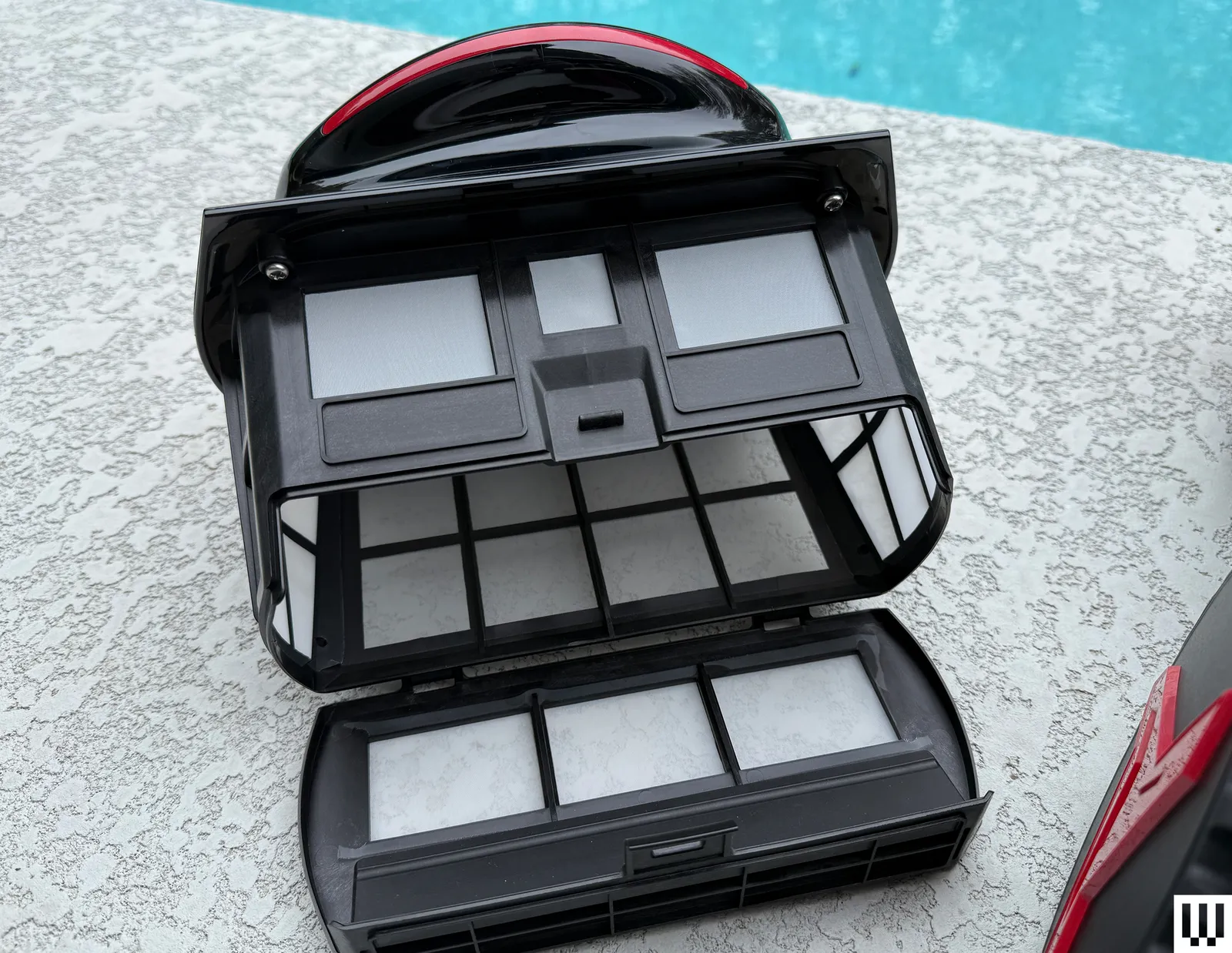
I was less enamored with the cleanup process after operations were complete, and not just because the robot must be retrieved with a pole instead of coming to the surface when done. The filter basket is plenty large, but it can only be accessed through a relatively small hatch. It’s tough to get all the debris out through this hatch by hosing it down, particularly since the shape of the basket includes a kind of shelf on the inside, where debris is both hard to reach and hard to see. A more open basket design or a larger hatch would be a huge help come cleanup time.
Photograph: Chris Null
The basic box is designed with a fine-mesh filter on all sides, but this can be enhanced with a reusable second filter, included in the box, that snaps onto the outside of the basket. This filter has a finer mesh count than the filter on the basket itself, but despite that, most users probably won’t need it. I didn’t find it made much of a difference in my tests, but those facing problems with lots of fine-grained dirt and sand may find it helpful.
A Massive Price Cut
At $1,599, iGarden has aggressively priced this robot, knocking $1,000 off the price of last year’s K Pro 150 while keeping performance more or less the same. That makes this a much more enticing buy than the K series, and while it’s still a bit on the high side, it’s now roughly in line with a number of other top-shelf robots on the market. If you don’t mind getting a little wet when it comes time to retrieve and clean out the robot, it should be a very strong candidate for the job as your robotic pool guy.
Anyone who saw Back to the Future II was disappointed when 2015 rolled around with nary a hoverboard in sight. There have been various attempts to fake it, but none of them quite have the feel of floating about wherever you’d like to go that the movie conveys. The little-known YouTuber [Colin Furze] has a new take on the idea: use magnets. Really big magnets.
If you’re one of [Colin]’s handful of subscribers, then you probably saw his magnetic-suspension bike. We passed on that one, but we couldn’t resist the urge to cover the hoverboard version, regardless of how popular [Colin] might be on YouTube. It’s actually stupidly simple: the suspension is provided by the repulsive force between alarmingly large neodymium magnets. In this case, two are on the base plate that holds the skateboard ‘trucks’, and two are on the wooden ‘deck’ that [Colin] rides upon.
Of course magnetic repulsion is a very unstable equilibrium, so [Colin] had to reduce the degrees of freedom. In his first test, that was with a pair of rods and linear bearings. That way the deck could only move in the z-axis, providing the sensation of hovering without allowing the deck to slide off its magnetic perch. Unfortunately those pins transferred too much vibration from the ground into the deck, ruining the illusion of floating on air.
After realizing that he’d never be able to ollie (jump) this massive beast of a skateboard, [Colin] decides he might as well use a longboard instead. Longboards, as the name implies, are long skateboards, and are for transportation, not tricks. The longboard gets the same massive magnets, but after a couple of iterations to find a smoother solution — including a neat but unsuccessful tensegrity-inspired version — ends up with a pair of loosely-fitted pins once again, though relocated to the rear of the board. From the rider’s perspective, it looks exactly like a hoverboard, since you can’t see underneath from that angle. According to [Colin], it feels like a hoverboard, too.
Advertisement
The only way to do better would be with eddy currents over copper, or superconductors over a magnetic track, but both of those methods limit you to very specific locations. This might be a bit of a fakeout, but its one with a degree of freedom. One, to be specific. You have to admit, it’s still less of a fake than the handle-less Segway we got in 2015, at least.
Apple is continuing to up its social game, with the brand launching a new Instagram handle to help highlight the creator community, and show what it’s like inside the company.
A glass “hello” sculpture inside Apple Park
The new Instagram account, @helloapple, is where Apple will share a variety of news and information in one place that is easily accessible. This is alongside the official Apple newsroom and other accounts it operates on various social platforms. Users can expect to see stories from creators around the world, highlighting how Apple products change their lives. It sounds like a mini, social media version of Apple’s inspiring videos that play before its major events. Continue Reading on AppleInsider | Discuss on our Forums
Looking for the most recent Mini Crossword answer? Click here for today’s Mini Crossword hints, as well as our daily answers and hints for The New York Times Wordle, Strands, Connections and Connections: Sports Edition puzzles.
Need some help with today’s Mini Crossword? I started slow, because 1-Across stumped me, but the rest of the answers came quickly. Read on for all the answers. And if you could use some hints and guidance for daily solving, check out our Mini Crossword tips.
If you’re looking for today’s Wordle, Connections, Connections: Sports Edition and Strands answers, you can visit CNET’s NYT puzzle hints page.
It’s already smartphone season. Samsung’s annual deluge encompasses three new phones for 2026: the frontier-pushing S26 Ultra ($1,300) with its innovative Privacy Screen, the S26 ($899) and the S26+ ($999). The smaller flagships, yet again, are iterative versions of what came before, with the major differences centering on bigger batteries and brighter screens.
I’m getting waves of deja vu as I review the Galaxy S26, because at times I was writing exactly what I wrote last year — including the part about it being a little too similar to what came before.
Samsung/Engadget
Samsung’s smallest flagship phone is a solid if safe addition to the Galaxy series. However, it’s far too similar to its predecessors.
Advertisement
Pros
Bigger battery
A flagship phone that isn’t huge
More AI assistant options
Cons
Too similar to last year’s S25
Cameras could be improved
Perplexity integration is limited
Hardware
Image by Mat Smith for Engadget
Let’s focus on the changes. The Galaxy S26’s screen size is a little bigger than its predecessor’s; 6.3 inches, up from 6.2 inches on the S25. However, it still has the same FHD+ (2,340 x 1,080) resolution. Given the slight size difference, there’s no particular drop in sharpness. The screen can also go slightly brighter, topping out at 3,000 nits, which is always welcome — especially when Samsung has increased the battery to 4,300mAh from the S25’s 4,000mAh. (The S25 already impressed us with its battery longevity.)
The design, however, is largely unchanged. The camera trio now sits on a unified circular island and, well, that’s all I really have to say. Once again, it’s premium Samsung hardware, but otherwise I’d just be reiterating what I said last year… and our review from the year before that.
Advertisement
Inside, Samsung increased the base RAM to 12GB and the storage to 256GB on the S26, doubling the space found on the S25. With the S26’s processor, Samsung split the device into two different builds depending on region. In the US, you’ll get the Snapdragon 8 Elite Gen 5 for Galaxy, like the S26 Ultra. Elsewhere, including my review device in the UK, the S26 and (S26+) have the in-house Exynos 2600.
Samsung’s Exynos 2600 SoC is its first 2nm chip and should offer power-efficiency improvements over larger alternatives. This year’s S26 didn’t struggle with any of the games I played or video-editing tasks. Samsung says its new chip delivers around 50 percent better performance across single- and multicore tasks. The Exynos 2600 includes a new Xclipse 960 GPU, which casubtlenuan deliver double the graphical performance of the Exynos 2500.
On Geekbench 6, the Exynos S26 scored 3151 on single-core tests and 10,664 on multicore tests (not far behind the Snapdragon-powered S26 Ultra). Similarly, the GPU score (24425) didn’t lag far behind — all pleasant surprises. There is a but coming.
Comparing battery rundown tests between a Snapdragon S26 and my Exynos version revealed a gap. Watching a looped video at 50 percent brightness, the Exynos iteration lasted almost 28 hours, while the Snapdragon 8 Elite S26 lasted nearly 30 hours. Sure, that’s great longevity regardless of which S26 model you get. But this year’s flagship does have a bigger battery, so why is the Exynos-powered version only matching last year’s phone?
Advertisement
Cameras
Image by Mat Smith for Engadget
Not much has changed in the composition (or resolution) of the camera trio: there’s a 50-megapixel main, a 12MP ultrawide and a 10MP telephoto. That means that any improvements in photos and video are subtle, to put it kindly.
It’s hard to discern the improvements this year without really scrutinizing dark shots and zooming right in. The S26 does seem a little faster at capturing bursts and high-res video. And while I prefer the no-nonsense shooting of the Pixel 10a, the S26 offers a little more versatility with its zoom and ultrawide cameras. Cropped zoom, for example, lets you get closer to subjects beyond the 3X optical zoom, though more detail is lost than with the S26 Ultra and its larger resolution sensors.
Image by Mat Smith for Engadget
Once you’ve taken the shot, Samsung’s bundle of AI tools can take over. Photo Assist attempts to corral all of these editing features into one place, offering quick ways to reduce reflections or edit out photobombers. You can now use natural language text prompts to guide your photo editing.
For example, I attempted to adjust the lighting more evenly on a photo of me taken outdoors with a flash. I could do it with my rudimentary photo-editing skills, but Samsung’s tools are fast and, crucially, very easy to use. It’s a feature where natural language interfaces really make sense.
Advertisement
With the front-facing camera, Samsung has added its Object Aware Engine, promising better, more accurate rendering of skin tones and hair, as well as an improved portrait mode. But again, I noticed marginal differences. The S26 seemed to have better color accuracy than its predecessor, resulting in slightly warmer selfies.
For videos, Samsung Super Steady mode is now more versatile, maintaining a consistent horizontal lock no matter how much you move around. As I mentioned during my hands-on, it’s an interesting addition, the kind of feature you typically see on action cams and gimbals. It works well, too, although the footage does pick up a bit of focus-pumping as it fights to stabilize everything.
Rounding out the new additions is an Autoframing mode that crops in on your tracked subject as they move around. There’s a degree of auto-detection for faces and pets, but you can tap to apply tracking to anything, to which it locks on well. It works particularly well with tripods, but there is a slight floating effect as the S26 tries to keep up with the phone’s movement. I also noticed warping at the edge of the lens when the camera app kept my subject centered in the frame.
Software
Image by Mat Smith for Engadget
Samsung’s S26 launch event suggested this was the era of agentic AI, with assistants now positioned to connect the dots between tasks themselves. We’re not quite there, though.
Advertisement
The company has slightly expanded many of the features introduced last year. Now Brief is capable of pulling data from more apps to generate more comprehensive daily summaries, but I mostly saw the usual suspects: weather, calendar reminders and not much else.
Across the S26, a new Now Nudge feature will suggest actions with an unobtrusive icon, based on what’s happening on screen, such as sharing contact numbers with someone or suggesting calendar times while dealing with work emails.
Perplexity is an interesting addition. The S26 series is in a curious spot where it has hooks into no fewer than three AI assistants: Gemini, Bixby (bless its heart) and now Perplexity.
You do have to install the Perplexity app (and log in to use it), but you can then choose to make it your primary AI assistant. Odd things are missing: Samsung said Perplexity integration would work across the phone, including its own Browser app — something I was excited to test. Perplexity’s own browser, Comet, has a slick feature that lets it browse and summarize multiple tabs. I was in the middle of deciding where to eat during my recent trip to Barcelona, so I thought this was a great use case. However, that feature isn’t available in Samsung’s browser for now. According to Perplexity, Samsung will “integrate Perplexity’s APIs into the Samsung Browser, with agentic browser capabilities.”
Advertisement
Voice commands of “Hey Plex” also went unanswered. I found I had to manually grant permissions to the Perplexity app for it to work like Google’s Gemini. This could just be teething issues with a pre-release device and software, but Perplexity, for now, doesn’t offer enough utility beyond what I was already used to with Gemini.
Wrap-up
Image by Mat Smith for Engadget
The Galaxy S26 is a solid phone, with upgraded battery capacity and more base storage. Whether you get the Exynos or the Snapdragon S26, there’s fortunately no performance gulf as has happened in the past. However, the shorter battery life is a disappointing discovery from Samsung’s first 2nm chip.
For Samsung’s smallest flagships over the last three years, it’s all been very samey. Is the company now focused on its true flagship Ultra phone and foldables to generate buzz and make things exciting? That’s what it feels like. There’s nothing wrong with this safe, solid Android phone, but you could pick up last year’s S25 and get an experience that’s 99 percent the same for $99 less.
After a relatively quiet few months, Amazon is bringing back another of its famously invented shopping holidays. The Amazon Spring Sale is on its third year, and it’ll be arriving again on March 25. Amazon says the sale will run through March 31 and, like last year’s event, customers are promised thousands of deals across various daily themed categories.
Of course, as we’ve seen in the past with Prime Day, Black Friday, and Cyber Monday, the true discounts on good products will likely be buried among junk deals on shoddy wares. The WIRED Reviews team tests gear all year long, and we’ll be recommending fact-checked discounts on the products we actively recommend to our friends, family, and readers. We’ve highlighted early deals below, and we’ll be updating this story with more when the event officially arrives.
WIRED Featured Deals:
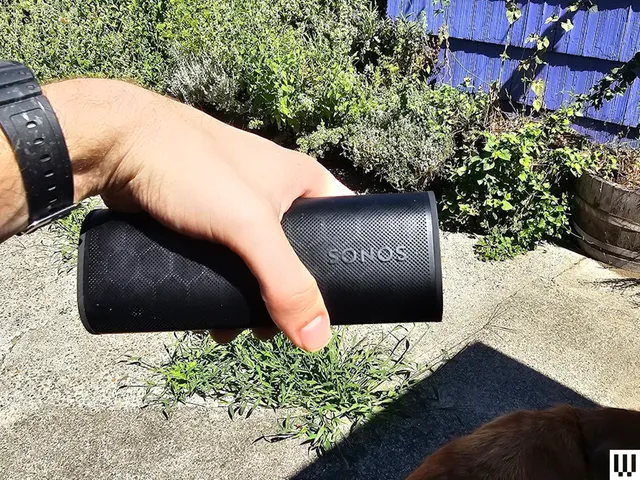
The Sonos Roam 2 is the best smart speaker on the market for most people. It’s portable but has impressive sound despite its small form factor. Bluetooth pairing is fast and simple, and it has IP67 dust and water resistance. The battery has up to 10 hours of listening time. It can also connect to your Sonos home system when you aren’t taking it on the go. The Roam 2 basically never sells for less than this.
The UK’s science minister is announcing details of a five-year, £2.5 billion investment in nuclear fusion, reports the Times of London, “including building one of the world’s first prototype fusion power plants in Nottinghamshire and developing a UK sector projected to employ 10,000 people by 2030.”
Despite the potentially transformative impact of fusion, which in theory could provide limitless clean energy and create a £12 trillion global market, no country has managed to use this fledgling technology to generate useable electricity… [T]he UK is backing a spherical tokamak design… investing an initial £1.3 billion into a prototype fusion power plant called Step (Spherical Tokamak for Energy Production) on the site of a decommissioned coal-fired power station at West Burton in Nottinghamshire. Paul Methven, chief executive of the government-owned UK Industrial Fusion Solutions, which is delivering the Step project, said the aim is to get the reactor operating early in the 2040s. “It’s quite an aggressive programme,” he said. “We need to show that we can achieve genuine ‘wall socket’ energy — which has not been done before.”
On Monday, [science minister] Vallance will also announce £180 million for a facility in Culham, Oxfordshire, to manufacture tritium fuel and £50 million for training 2,000 scientists and engineers in fusion-related disciplines. The government is also buying a £45 million fusion-dedicated AI supercomputer called Sunrise to model plasma physics. Scientists at the UK Atomic Energy Authority last year developed an AI model that can rapidly simulate how the ultra-hot fuel in a fusion power plant will behave, cutting calculations that previously took days down to seconds…
Vallance will also announce new support and collaboration for the many fusion, robotics, engineering and AI start-ups working in Britain, to develop a strong supply chain for a new fusion sector. One of those companies, Tokamak Energy, which spun out from the UK Atomic Energy Authority in 2009, has already built a smaller reactor that has informed the Step design. In March 2022, it became the first private organisation in the world to surpass 100 million degrees Celsius in its reactor.
After five years of trying, Revolut has finally secured a full banking licence to form Revolut Bank UK, just days after applying for a US licence.
Revolut has made no secret of its ambition to build “the world’s first truly global bank”, applying just last week for its US banking licence, but it has taken it five years to gain that licence in the UK. It originally applied for the licence in 2021 and in 2024 was given a banking licence “with restrictions”.
Now it has announced that it has secured its full banking licence from the Prudential Regulation Authority (PRA) in the UK, which will allow it to offer its 13m customers across the UK, including Northern Ireland, deposit protection of up to £120,000 from the FSCS. In Ireland, Revolut’s customers are served by its European-licenced entity Revolut Bank UAB.
Revolut describes the success as a “milestone”, and says that Revolut Bank UK will soon be able to start offering accounts as a fully licenced bank for both retail and business customers. It says it will gradually begin the process of rolling out current accounts to new customers in a few days, “starting with a small group and expanding over the coming weeks to ensure a smooth user experience”.
Advertisement
“Launching our UK bank has been a long-term strategic priority for Revolut, and marks a significant moment in our journey,” said Nik Storonsky, Revolut co-founder and CEO. “The UK is our home market and central to our growth. This is a vital step in our mission to build the world’s first truly global bank.”
“Securing this licence lays the foundation for our next chapter: expanding into a broader suite of products, including credit, to sit alongside the innovative services our customers already rely on every day,” said Francesca Carlesi, UK CEO at Revolut.
Revolut recently announced a global $13bn investment over five years, which it said would create 10,000 new jobs as it expands its global footprint. The company aims to launch in 30 new markets by 2030. One of the world’s biggest fintechs, Revolut currently operates across 40 markets globally, servicing around 70m customers.
The company recently expanded operations to Mexico, opened a new global headquarters in London and secured a payments licence in India. It hopes that this continued expansion can help it reach 100m customers by mid-2027.
Advertisement
Don’t miss out on the knowledge you need to succeed. Sign up for the Daily Brief, Silicon Republic’s digest of need-to-know sci-tech news.











.png)