Tech
Burson Audio Conductor Stellar Headphone Amp, DAC and Preamp Debuts: Thunder from Down Under

Burson Audio has been building serious headphone amplifiers since the early days of the Head-Fi revolution, long before personal audio became the center of gravity for the hi-fi industry. The Australian company earned its reputation the old-fashioned way: powerful Class A designs, fully discrete circuitry, and desktop components that deliver clean power, expansive soundstages, and connectivity options that make them easy to integrate into modern listening chains.
Now Burson Audio is expanding its lineup with the new Stellar Series, a range of compact Class A desktop components designed to bring more of the company’s flagship engineering to a slightly more approachable tier. The first model, the Conductor Stellar (Standard Edition), combines a high-resolution DAC, Class A headphone amplifier, and desktop preamp into a single chassis priced at $1,799.
Positioned between Burson’s entry-level Playmate 3 ($599 at Apos Audio) and the flagship Grand Tourer range, the Stellar line pulls key elements from the company’s top-tier Voyager Series; Class A muscle, discrete circuit architecture, and the unmistakable Burson house sound—while packaging it all into a more compact and accessible platform.
The timing also makes sense. We recently reviewed the Burson Audio Conductor GT4, and it remains one of the finest desktop DAC/headphone amplifier combinations currently available, delivering the kind of effortless power and wide open presentation that has long defined Burson’s approach to personal audio.

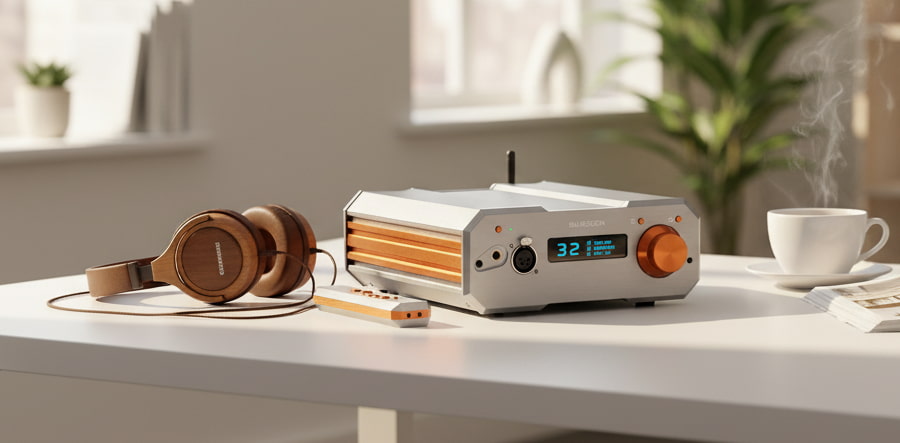
Burson Conductor Stellar: Class A Headphone Amp, DAC and Preamp
At the center of the Burson Audio Conductor Stellar is the ESS9039PRO DAC, paired with Burson’s fully discrete output stage and Max Current power supply architecture. Burson rates the unit at 8 watts of pure Class A output, which is substantial for a desktop headphone amplifier and enough on paper to handle a wide range of headphones, from more sensitive in-ear monitors to far more demanding full-size designs.
The headphone amplifier section has a 0.5-ohm output impedance, which should help it maintain better control with a broad range of headphone loads, while the pre-out and DAC-out stages are rated at 1 ohm and 20 ohms respectively.


Burson is also using a transistor-based amplification stage built around four Onsemi MJE15032 transistors per channel. Those output devices are configured for high Class A bias, which is consistent with Burson’s long-running design approach in the headphone category.
The company also says the Conductor Stellar includes a dedicated low-noise amplification module for IEMs, aimed at reducing hiss with high-sensitivity earphones. Supporting that is the new Silent Power Module 2, built around the LT3045 voltage regulator, which Burson specifies at 0.8 µV RMS noise. In practical terms, the goal here is lower background noise and cleaner low-level detail, especially with sensitive headphones or lower listening volumes.


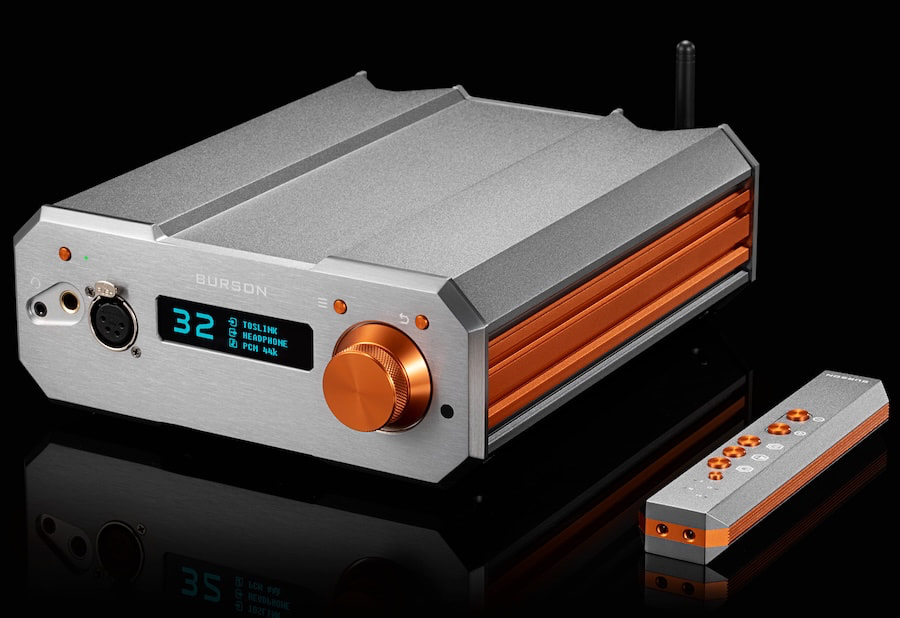
From a connectivity standpoint, the Burson Audio Conductor Stellar is built as an all-in-one desktop control center. Digital inputs include USB-C, optical Toslink, and coaxial SPDIF, with USB handled by an XMOS platform supporting up to DSD512 and PCM up to 32-bit/768kHz. Coaxial and optical inputs support up to 24-bit/192kHz. Wireless playback is handled by Bluetooth 5.0 using the Qualcomm CSR8675 chipset, with support for LDAC, aptX HD, and AAC. It is also listed as Roon Tested.
On the output side, users get balanced XLR and single-ended RCA preamp outputs, balanced XLR and single-ended RCA line outputs, plus headphone connections in 4-pin XLR, 6.35mm, and 3.5mm formats.
Burson’s published measurements point to a design focused on low noise and wide bandwidth. Physically, the unit measures 210 x 200 x 75 mm or 8.3 x 7.9 x 2.9 inches, and weighs about 5 kg or 11 pounds, which makes it compact by desktop Class A standards, though not exactly featherweight. Class A and “small desktop box” usually have a tense relationship. Physics always sends the bill.


The Three Versions Explained
The Standard version is the entry point into the Stellar range. It ships with NE5532 IC op-amps, the SP01 power module, and a 24V/5A power supply, and it does not include a remote control. This is the version aimed at buyers who may want to experiment later with Burson’s upgrade path rather than paying for everything upfront.
The Deluxe version moves things up with V7 Vivid Pro op-amps, the SP02 power module, Burson’s Super Charger 5A external power supply, and an included remote control. Based on Burson’s own positioning, this is the model intended for buyers who want a more fully optimized setup straight out of the box without stepping all the way to the top trim.
The Max version sits at the top of the range and includes the V7 Vivid Pro op-amps, SP02, and remote as well, but replaces the Super Charger with Burson’s Fusion Core power solution. That makes it the most fully loaded version in the Stellar lineup and the one aimed at users who want the highest-spec factory configuration without adding upgrades later.
All three versions share the same core platform, inputs, outputs, chassis dimensions, and overall functionality. The main differences come down to the op-amp configuration, power supply implementation, and whether a remote is included.

The Bottom Line
At $1,800 for the Standard version, the Burson Audio Conductor Stellar lands in a price tier where most competitors force you to start making trade-offs. Some offer excellent amplification but limited connectivity. Others focus on DAC performance but lack the power to properly drive demanding headphones. Burson is trying to avoid those compromises by delivering a true Class A desktop amplifier with 8 watts of output, a flagship-grade ESS9039PRO DAC, balanced and single-ended connectivity, Bluetooth with LDAC, and a dedicated low-noise IEM stage in one chassis.
The other differentiator is upgradability. Burson’s modular op-amp design and multiple versions mean users can start with the Standard configuration and evolve the system over time rather than replacing the entire unit. That approach remains relatively rare in this category.
Who is it for? Headphone listeners building a serious desktop system who want enough power to drive virtually any headphone, flexible digital connectivity, and a path for future upgrades without jumping immediately into the $3,000–$5,000 range.
What’s missing? Network streaming and a built-in display interface beyond the basics, both of which are appearing more often in this category.
Still, when you look at the landscape, it becomes clear where the Stellar fits. Getting this level of Class A power, connectivity, and upgrade flexibility from competitors such as Schiit Audio, Feliks Audio, Ferrum Audio, or Chord Electronics typically requires multiple components or a significantly larger investment. Burson’s pitch is simple: put most of it in one box, keep it upgradeable, and deliver the kind of clean Class A power the company has been known for since the early days of Head-Fi.
Where to buy:
For more information: bursonaudio.com