TL;DR
Canva launched its Connected App for Google Gemini at Google I/O, completing its integration across all four major AI assistants. The tool lets users generate on-brand, editable designs from Gemini prompts, with Magic Layers converting AI images into layered files.
Canva has spent the past year quietly embedding itself into every major AI assistant. First came Claude, then ChatGPT, then Microsoft Copilot. Now Google Gemini gets the same treatment, and the strategy is complete.
The company launched its Connected App for Google Gemini at Google I/O, giving Gemini users the ability to generate, edit, and search Canva designs directly from a conversation. The integration started rolling out with limited availability on 19 May and will expand to full availability in the coming weeks.
The pitch is straightforward. Type a prompt in Gemini, and Canva generates a design that arrives not as a flat image but as a fully editable file. If the user has a Canva Brand Kit configured, the output automatically applies stored logos, fonts, and colour palettes from the first prompt.
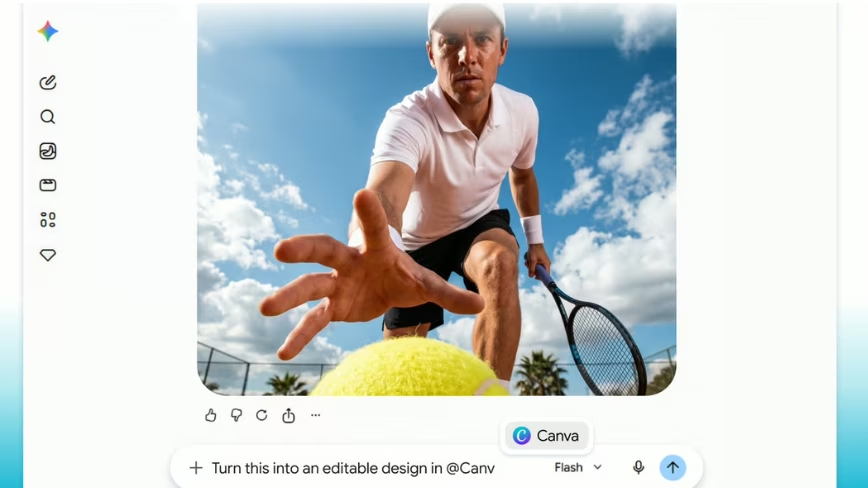
The most technically interesting piece is the integration with Google’s Nano Banana image model. Users can generate an image through Gemini’s native capabilities and then convert it into a layered, editable design using Canva’s Magic Layers tool. That solves a persistent frustration with AI-generated visuals: they are typically flat files that require re-prompting for every small change. Magic Layers analyses the image structure and separates it into individual, movable elements.
“We’re making design accessible wherever people start their work,” said Anwar Haneef, Canva’s head of ecosystem. The implication is clear. Canva no longer sees itself as a destination. It sees itself as infrastructure.
The Gemini launch means Canva’s design engine is now embedded in all four dominant AI assistants: Claude, ChatGPT, Copilot, and Gemini. Each integration works through Canva’s API, allowing the assistant to call design generation, brand kit lookup, and template search without the user leaving the conversation.
The timing matters. Google unveiled Pics at I/O 2026, a competing AI design tool built directly into Workspace that generates graphics from text prompts. Adobe’s Firefly holds 41 per cent business adoption. And Figma just launched its own AI agent that designs on the canvas. Canva’s response is to make its tools available everywhere rather than fight for a single surface.
That approach is paying off commercially. Canva reported that nearly every marketer in its latest survey uses AI for some part of their workflow, though consumers still want the human touch. The company now claims 220 million users globally and has positioned its AI 2.0 platform, launched in March, as a full operating system for visual content creation.
Canva AI 2.0 already connects to Slack, Gmail, Google Drive, Calendar, Notion, Zoom, and HubSpot through six intelligent workflows. It can generate meeting summaries from Zoom transcripts, turn customer emails into personalised sales materials, and build company newsletters. The Gemini integration adds another surface to that network.
The risk for Canva is commoditisation. If every AI assistant can generate decent visuals natively, the value of a dedicated design tool diminishes. Google’s Pics, OpenAI’s image generation, and Adobe’s Firefly are all improving rapidly. Canva’s bet is that brand consistency, editability, and template ecosystems still matter more than raw generation quality, and that being embedded everywhere makes it harder to replace.


You must be logged in to post a comment Login