Tech
Casino Withdrawal Pending or Rejected? Causes and Fixes

A casino withdrawal can remain pending because the operator is still reviewing the request, completing verification, checking the payment method, or handling another compliance issue. A rejected withdrawal means that particular payout request did not proceed, but you still need the operator’s specific reason to know whether the problem is verification, payment routing, account rules, or something else.
The useful first step is not to guess how many hours a withdrawal should take. Identify the exact status, find out whether the casino has actually sent the money, and determine who currently controls the next step.
First, identify what the withdrawal status actually means
Withdrawal labels can look similar while representing different stages. There is no universal naming system across online casinos, so use the descriptions below as a diagnostic guide and confirm how your operator defines its own statuses.
| Status | What it can indicate | Who may control the next step | Useful next action |
|---|---|---|---|
| Pending or processing | The request exists but has not completed internal review or payment processing. | Usually the casino or a payment processor acting for it. | Ask which stage is still incomplete and whether you need to provide anything. |
| Approved | The operator may have accepted the withdrawal internally, but that does not necessarily mean an external payment has been sent. | The casino or its payment processor. | Ask whether the payout has actually been sent and whether a transaction reference exists. |
| Sent | The operator says the payout has left its internal process. | A bank, card issuer, e-wallet, processor, or other payment provider may now be involved. | Request the payment details needed to trace the transaction through the relevant payment method. |
| Rejected or declined | The withdrawal request did not proceed in its current form. | Usually the operator or payment provider. | Ask for the exact reason and confirm what happened to the withdrawn balance. |
| Failed or returned | A payment attempt may have been unsuccessful or sent back. | The payment provider, receiving account, or operator may be involved. | Confirm whether the balance was restored and whether another eligible payout route is required. |
| Completed | The operator considers its part of the payout process finished. | If the money is still missing, an external payment provider may need to be involved in tracing it. | Get the available payment reference and compare it with your bank, wallet, card, or processor records. |
For example, a bank cannot trace an external transfer that the casino has not yet sent. Conversely, if the operator confirms that the payment was sent and provides traceable transaction information, repeatedly asking the casino to approve the withdrawal again may not address the actual problem.
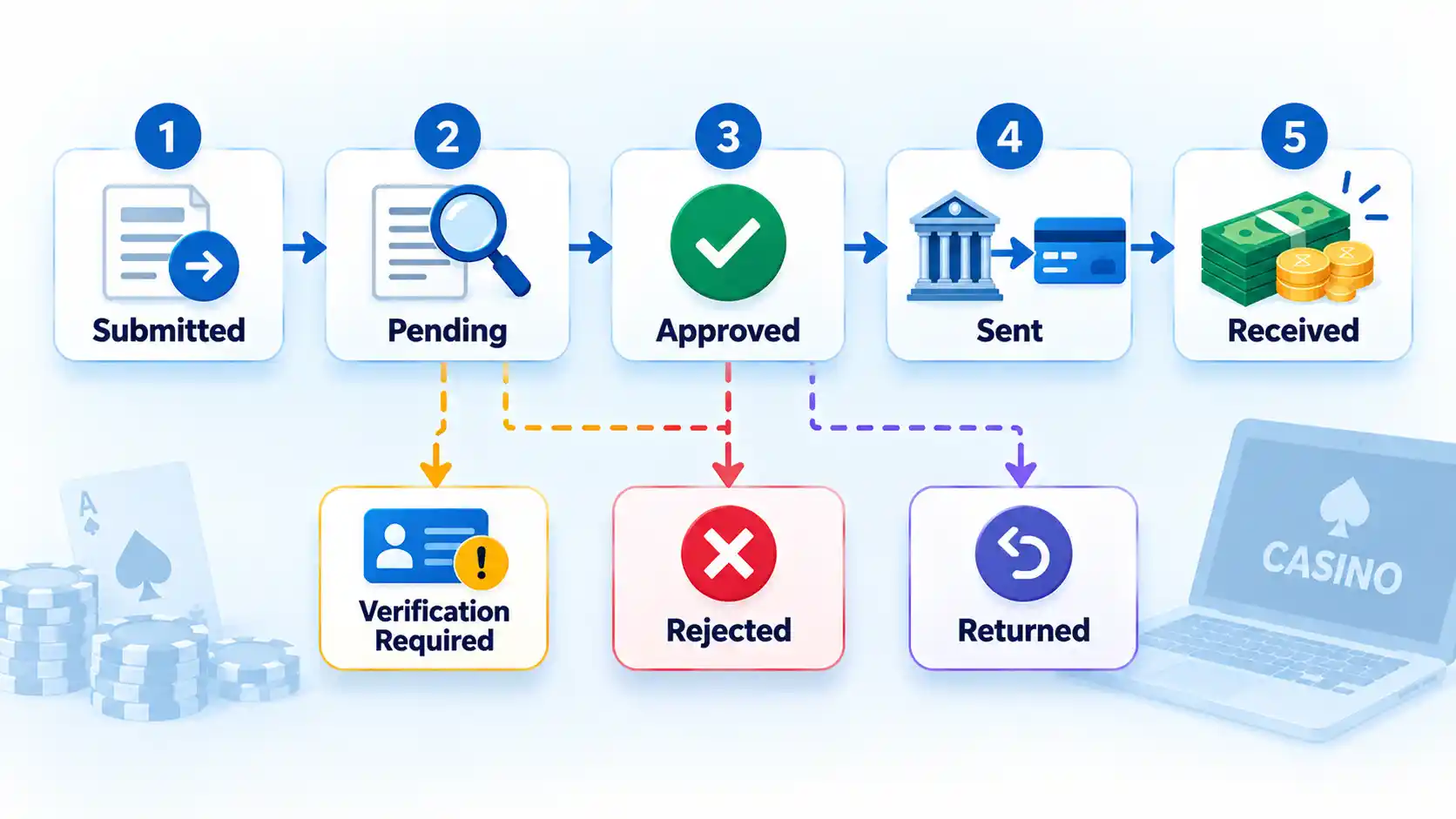

Pending or processing
A pending withdrawal generally means the request has not reached its final state. The unresolved step might involve routine internal review, Know Your Customer verification, a payment-method check, a source-of-funds review, or another account or compliance process.
Know Your Customer, usually shortened to KYC, is the process used to establish and verify who owns an account. In Great Britain, the Gambling Commission’s current customer identity verification condition requires covered remote licensees to obtain and verify information including the customer’s name, address, and date of birth before the customer is permitted to gamble. It also says a withdrawal request must not create an additional information requirement that the operator could reasonably have requested earlier, although information can still be requested later where another legal obligation requires it.
Approved or sent
Do not automatically treat “approved” and “sent” as the same event. An operator may use “approved” for an internal decision while “sent” indicates that a payment transaction has moved to the next part of the payment process. Because status terminology differs between operators, ask what each label means on the account you are using.
If the operator says the withdrawal has been sent, ask for the transaction or payment reference appropriate to the method, together with the sending date and destination. The exact reference format varies between banks, card systems, wallets, and payment processors.
A more focused process applies when a casino withdrawal is approved but not received: first establish whether the operator has actually handed the payment to an external provider, then trace that transaction rather than restarting the withdrawal process.
Rejected, declined, failed, cancelled, or returned
These labels should not be treated as interchangeable. A rejected request may reflect an account, verification, or payment decision. A failed payment may instead indicate that an attempted transaction could not reach its destination. A returned payment may have left one system and then been sent back.
Also check what happened to the balance. Rejection of a withdrawal request does not by itself prove that the money has been confiscated. The funds may have returned to the casino balance, remained restricted during a review, or been handled in another way that requires a specific explanation.
The main reasons a casino withdrawal stays pending
A delay becomes easier to investigate once you identify what the operator says it is checking. These causes occur at different stages, so the right response depends on which one actually applies.
Identity or account verification is incomplete
A casino may need to resolve an identity mismatch, unreadable document, outdated address, inconsistent account detail, or another verification issue. That does not mean every document request made after a withdrawal is automatically justified.
For British-licensed remote operators, the current identity-verification rule requires identity information to be obtained and verified before gambling and restricts operators from making a withdrawal conditional on information that could reasonably have been requested earlier. The rule still permits later information requests where another legal obligation requires them.
If verification is the stated blocker, ask which specific item is missing or cannot be verified. Do not repeatedly upload different documents without knowing what problem the operator is trying to resolve. A deeper explanation of casino KYC and source-of-funds checks can help distinguish ordinary identity verification from a separate financial-compliance review.
A source-of-funds or anti-money-laundering review is underway
Anti-money-laundering, or AML, controls are intended to identify and manage risks involving criminal proceeds and other prohibited financial activity. Source of funds refers to where money involved in a transaction came from. It is separate from simply confirming a customer’s identity.
The Gambling Commission’s 2026 risk assessment for remote casinos identifies issues including third-party payment methods, multiple payment methods, fraudulent identity documents, and open-loop payment arrangements among the risks relevant to the British remote-casino sector.
That does not mean a large or delayed withdrawal is automatically suspicious. AML controls are risk-based. The Gambling Commission has also said operators should not continue accepting deposits indefinitely and then rely on AML procedures to frustrate a withdrawal where relevant information should have been sought earlier.
There are circumstances in which an operator may be legally restricted from explaining an investigation in detail because disclosure could prejudice an anti-money-laundering matter. Outside such cases, the Commission says customers should generally be told why a withdrawal has been delayed and, where an operator decides not to process it, the basis for that decision should be explained in its guidance on account withdrawals.
The payment method does not match the account holder
A deposit funded through a payment method belonging to somebody else can trigger ownership and fraud concerns. Examples include a card in another person’s name or a bank or wallet account that cannot be matched to the casino account holder.
The Gambling Commission’s 2026 remote-casino risk assessment identifies use of a third-party payment method that is not in the customer’s name as a risk indicator. Its withdrawal guidance also notes that operators commonly use terms intended to prevent third-party payment methods or third-party funding.
If this is the problem, do not alter documents or create evidence to make the names appear consistent. Ask what ownership evidence the operator legitimately requires and provide it only through the operator’s official verification process.
The payout route cannot be reused
Some operators use a closed-loop payment model, which routes withdrawals and winnings back to the payment method used for the deposit. The Gambling Commission describes closed-loop payment systems as best practice for managing money-laundering risk and says open-loop systems can allow money to move between payment methods in ways that obscure the origin or destination of funds.
This should not be simplified into “every casino must always pay the exact same way you deposited.” Payment-method capabilities, operator rules, and applicable regulation can affect the available payout route. The useful question is whether your requested method is eligible and consistent with the operator’s verified payment policy.
The account or transaction is under review
An operator may review suspected duplicate or linked accounts, possible account takeover, inconsistent identity details, unusual payment activity, or an alleged breach of its terms. A review is not itself proof that the customer committed fraud or another breach.
For Great Britain, the Gambling Commission says an operator investigating a possible terms breach should normally explain that this is the reason for a withdrawal restriction. Where it decides not to process a withdrawal, it should generally provide the basis for the decision unless a legal restriction prevents disclosure.
Why a casino withdrawal can be rejected
A pending withdrawal remains unresolved. A rejected withdrawal has reached a decision or payment outcome that stopped that request in its current form. The next step is to identify which part failed.
Verification failed
The operator may have been unable to verify a document, account detail, payment-method owner, address, date of birth, or another required item. Ask for the failed requirement by name rather than assuming that “KYC failed” explains the problem.
The payment method or account owner does not match
A destination may be ineligible because the operator cannot establish that you control it, because the route conflicts with its payment controls, or because the method cannot accept the requested payout. If the casino proposes another route, verify that route through the operator’s official payment instructions before supplying financial details.
A contractual or promotional condition is disputed
The operator might claim that a promotion, account rule, wagering condition, payment restriction, or another contractual term affects the withdrawal. Read the exact term the operator says applies rather than relying on a generic support message.
For British licensees, a published term is not automatically beyond challenge merely because it appears in the terms and conditions. The Gambling Commission’s current fair and transparent terms condition requires covered operators to use contractual terms and consumer notices that satisfy applicable fairness and transparency requirements and to comply with their terms.
Historical Competition and Markets Authority enforcement also addressed withdrawal barriers including low withdrawal limits, arbitrary identity-verification deadlines, and promotional terms that restricted access to a player’s own deposited money. Those CMA enforcement findings provide British consumer-law context from the 2017–2019 enforcement programme and should not be treated as a universal rule for casinos licensed elsewhere.
A compliance or security review blocks the transaction
A rejected request can sometimes be one step in a broader account process rather than a final decision about the balance. For example, an operator may reject one payout destination while requiring legitimate additional verification. Ask whether the rejection is final, whether the balance remains available, and what process now applies.
The payment itself failed
A withdrawal can also fail after an attempted payout if the destination is closed, cannot accept the transaction type, contains incorrect details, or rejects the payment. In this situation, establish whether the casino actually attempted the transaction and whether the funds were returned.
Work through the withdrawal in order. The goal is to establish the current stage before sending more documents, contacting a payment provider, or escalating a complaint.
What to do when your casino withdrawal is pending or rejected
Verify the result
- You know the exact withdrawal status shown by the operator.
- You know whether the casino still controls the request or has sent a payment externally.
- Any outstanding verification or payment requirement has been identified specifically rather than described only as “under review.”
- If payment was sent, you have the available reference information needed to trace it.
- If the request was rejected, you know what happened to the balance and what reason the operator gave.
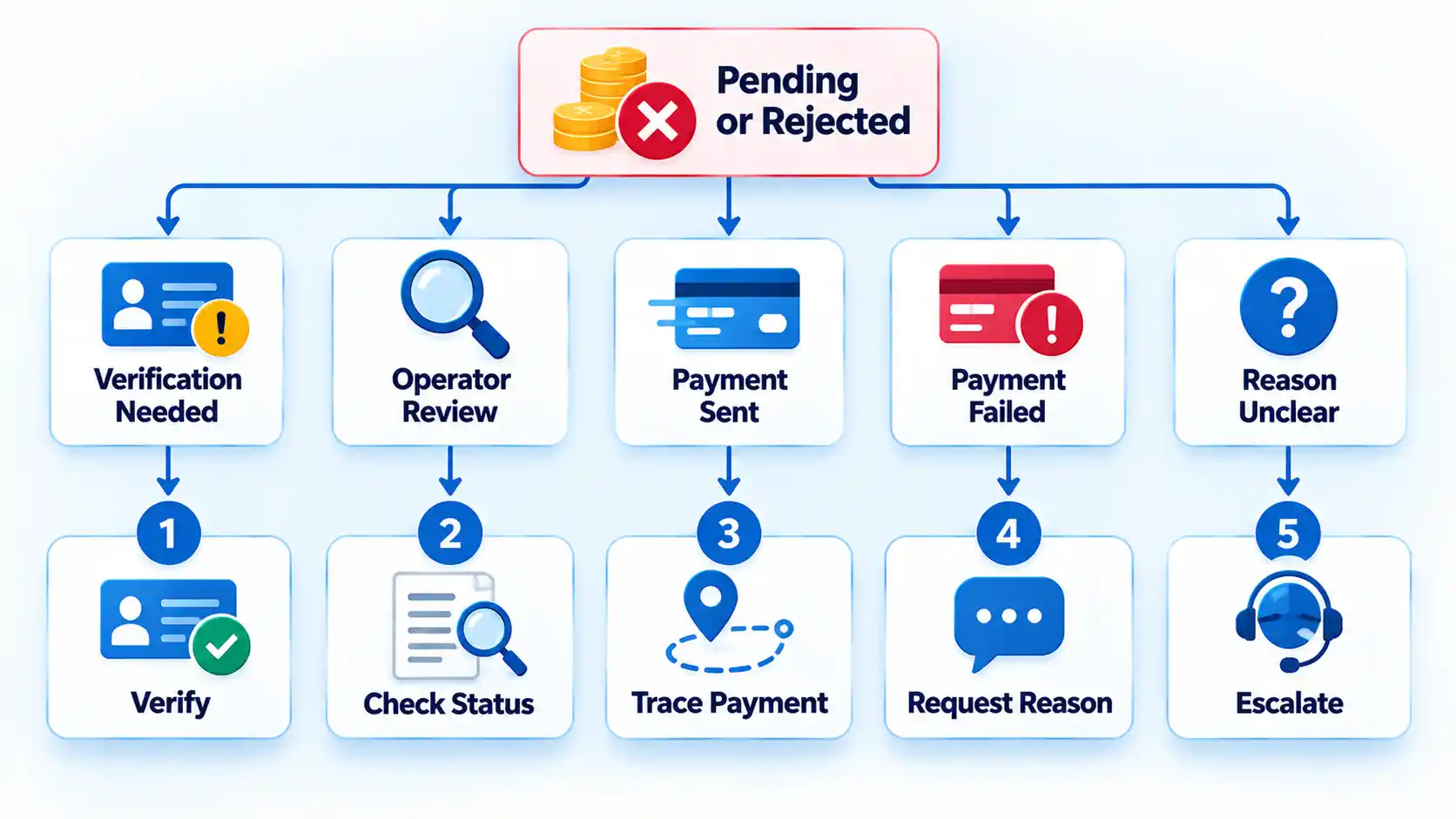
Casino withdrawal troubleshooting by symptom
The withdrawal is still pending and support gives no clear reason
Ask support to identify the unresolved stage: internal approval, identity verification, source-of-funds review, payment-method verification, account investigation, or payment-provider handoff. If the delay has exceeded the operator’s own published terms, ask what specifically is preventing completion. Preserve each written response in case the explanation changes.
The casino keeps asking for verification documents
Ask what exact information remains unverified, why the submitted evidence did not satisfy the requirement, and whether the request concerns identity, payment ownership, source of funds, or another obligation. Provide legitimate evidence only through the official verification process. For British-licensed remote operators, the Gambling Commission’s identity-verification rule restricts making a withdrawal conditional on information that could reasonably have been requested earlier, while allowing later requests required by another legal obligation.
The withdrawal was approved but the money has not arrived
Confirm whether “approved” means the transaction was actually sent. If it was, request the applicable transaction reference, sending date, destination, and payment-provider status. Then take those details to the receiving bank, wallet, card issuer, or payment service. If the casino has not created an outgoing transaction, the problem remains upstream of the receiving institution.
The withdrawal was rejected and the balance disappeared
Request a written explanation of the decision, the contractual or regulatory basis cited, and the current treatment of the funds. Do not assume that rejecting a payout request and confiscating an account balance are the same action. If the explanation remains unresolved, move to the operator’s formal complaint procedure.
The casino says you must deposit more money to release the withdrawal
Do not send an additional payment merely to “unlock,” “verify,” or “release” money already shown as withdrawable. Verify the operator’s licence, official contact details, and published payment rules independently. Legitimate compliance checks can require information or evidence, but an unexpected demand for more money simply to release an existing balance deserves heightened scrutiny.
When does a delayed withdrawal become a complaint?
There is no defensible universal number of hours or days after which every casino withdrawal becomes improper. Processing rules differ by operator, payment method, jurisdiction, verification state, and whether the transaction has actually left the casino.
A stronger test is to compare the delay with observable facts:
- Has the operator exceeded the processing period it published for that withdrawal method?
- Have you supplied every legitimate item the operator specifically requested?
- Can support identify the exact unresolved stage?
- Has the operator’s explanation changed repeatedly?
- Does the operator claim the payment was sent but fail to provide available information that would allow it to be traced?
- Has a rejected withdrawal left the balance in an unexplained state?
Withdrawal friction is a documented regulatory concern in Great Britain. In a July 2024 publication, the Gambling Commission said withdrawal delays were its largest complaint category and that its Contact Centre continued to receive around 2,000 complaints a year about delayed withdrawals. That is a 2024 regulator figure, not a measurement of complaint volume in 2026.
The same guidance says operators should not create unnecessary withdrawal friction or rely on anti-money-laundering procedures merely to frustrate a withdrawal where relevant information should have been obtained earlier. It also says customers should generally be told why a withdrawal is delayed or not processed, subject to legal limits such as avoiding prejudice to an anti-money-laundering investigation.
How to escalate an unresolved casino withdrawal dispute
Escalation depends on the casino’s actual licence and the jurisdiction governing the account. A complaints process published by one regulator should not be assumed to apply to an operator licensed somewhere else.
Use the operator’s formal complaints procedure first
Submit a concise chronology containing the account identifier, withdrawal amount, request date, transaction ID, current status, relevant verification history, and the outcome you are requesting. Attach only the evidence necessary to establish the dispute.
For Great Britain, the Gambling Commission’s consumer complaint procedure says customers should first complain directly to the gambling business and follow its complaints policy. The business has 8 weeks from receiving the complaint to resolve it.
Use the applicable independent dispute process
For a British-licensed operator, an unresolved eligible dispute may then proceed to an Alternative Dispute Resolution provider. Alternative Dispute Resolution, or ADR, is an independent dispute process outside the operator. The Gambling Commission’s ADR guidance, updated on 15 May 2026, says customers must first go through the gambling business’s own complaints procedure and describes ADR as a free, independent service. It says an unresolved complaint can be taken to an ADR provider after 8 weeks.
The Gambling Commission does not resolve every individual gambling dispute itself, and the British process should not be generalized to every country. Other jurisdictions can use different regulators, dispute bodies, eligibility rules, and complaint deadlines.
Verify which licence actually covers the casino
Before escalating, verify the operator’s gambling licence using the relevant regulator’s own register or another authoritative licensing record. A logo in a website footer does not by itself establish that the domain, company, or account you used is covered by that licence.
Once the regulator and licence holder are confirmed, follow the complaint path published by that authority. If you cannot establish a legitimate licence or company identity, treat the situation as a separate operator-verification or potential fraud problem rather than assuming a conventional licensed-casino dispute process applies.
What not to do while a withdrawal is unresolved
- Do not make another deposit simply to release the withdrawal. Verify any unusual payment demand independently before sending more money.
- Do not falsify KYC or payment-ownership evidence. False documents can create additional fraud and compliance problems rather than fixing the original withdrawal.
- Do not repeatedly cancel and recreate the withdrawal without a specific reason. Doing so can complicate the transaction history and may affect processing.
- Do not send passwords or authentication secrets. Do not give support your password, one-time login code, full card security code, crypto seed phrase, or remote-access credentials.
- Do not ask a bank to trace a payment that the casino has not sent. First establish whether an external transaction actually exists.
- Do not file a false payment dispute to recover legitimate gambling losses. A withdrawal dispute concerns money that should be paid or properly explained, not a way to reverse unrelated valid gambling transactions.
Bottom line
A pending or rejected casino withdrawal is best handled as a transaction-status problem rather than a guessing contest about payout speed. Find the exact stage, identify whether the casino or an external payment provider controls the next step, obtain the specific reason for any hold or rejection, and preserve the records that support your timeline.
If the operator has sent the payment, trace that transaction through the relevant payment route. If the operator still controls the request and cannot resolve or adequately explain it, use the formal complaint process that applies to the casino’s verified licence jurisdiction.
You must be logged in to post a comment Login