Tech
Cause of database sprawl. And also the proposed solution


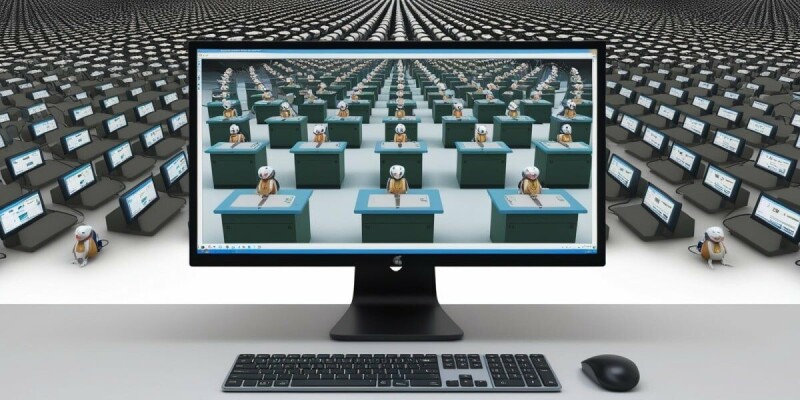
Database management work will soon be mostly automated by AI agents, just like coding, according to the CEO of Cockroach Labs, the company behind the distributed database of the same name.
Spencer Kimball told The Register that the proliferation of databases demanded by the explosion of AI agents in coding and business functions will mean that managing them in a largely manual way is out of the question.
“Nobody’s going to do manual work on a database, just like almost nobody’s doing manual coding anymore,” he said. “A lot of people don’t even know what’s within their code base anymore, like they only know the designs, specifications and guarantees. They’re still verifying the software, but in the end they’re just not down at the level of code, because it doesn’t make sense. It’s like nobody programs in Assembly,” he said.
Kimball is among the tech CEOs with the commensurate background in software engineering to make such statements. He helped build Google’s Colossus distributed file storage system and, as a computer science student at UC Berkely, developed FOSS image editor GIMP, which continues to this day.
You can imagine, the enterprise isn’t eager to turn over the keys to production to an agent. These agents are a second pair of eyes
In the time since, he has seen shifts in the level of abstraction before. “These cycles happen all the time. It’s pretty easy to see what’s coming next, because ultimately agents beyond coding are going to be increasingly complementing and supplementing human-driven workloads. They’re going to use tools, tools are using APIs, and APIs are talking to operational databases, every single one. If you think about the implications of this massive scale-up of traffic, it means that operational databases are going to get busier, and a lot busier. We’re talking about exponential scale-up,” he said.
Cockroach Labs is not the only database company to see the level of AI agent demand on the enterprise as an opportunity. It’s where many vendors are positioning themselves. For example, vector database vendor Pinecone’s idea is that by compiling a knowledge base of an organization’s data structure and content, its technology can avoid burning through tokens back and forth between the data and AI agents. Tiger Data, the company behind TimescaleDB, has built Ghost, a technology designed specifically for developers working with AI agents, charging by compute, rather than by database.
Cockroach Labs, whose customers include OpenAI, CoreWeave, Booking.com, and Cisco, is pitching the idea of an Agentic Database Cloud to address this demand. Among the elements will be elastic compute and storage separation, unified estate management, database virtualization and agentic operations. It expects to announce a product around this idea later this year.
Nonetheless, in database estates, Kimball expects AI agents to act in an advisory role to avoid disruptions to operations. “You can imagine, the enterprise isn’t eager to turn over the keys to production to an agent. These agents are a second pair of eyes,” he said.
To this end, Cockroach has been building its own agents to improve its operations and how it manages databases.
Kimball said it had built AI agents in a layered approach, giving agents sub tasks to perform and then allowing agents to manage those agents, and other agents that verify the approach taken.
“There’s all kinds of hand-offs, there’s agents that help with migrations, agents that help with slow queries, agents that can diagnose problems with clusters, because they’ve been given the institutional knowledge. For example, our entire Zendesk history for the last two years — every customer ticket, every issue, the resolutions — has been digested and cross-indexed. The agents we’re building are the engineering of the prompts, the handoffs and the quality control,” he said.
The “thinking” is done by foundation models, he said. “We have some open-source ones we use that are very, very fast and inexpensive. Those do more… prosaic and mundane tasks that you do a lot of, quickly.”
Kimball said Cockroach also uses proprietary models including OpenAI gpt-oss and Claude Opus.
“We’re trying to provide a replacement for a lot of human labor. We provide corporate ‘Artificial General Intelligence’ for database roles, that once you used to have to hire humans for, but you simply cannot do that at 10x the scale, much less 100x the scale. You have to find that way to get these agents to do extremely useful work, very consistently, at a level that is as good or increasingly better than humans. Frankly, there are things the agents can do that are so grungy you couldn’t hire a human to do it, such as constantly looking through log files, and investigating threads. It’s just too boring,” Kimball said.
As such, Cockroach expects to be able to increase the scope of its products and the number of customers it serves, but only modestly increase its workforce.
“You can do different things right now with your resources. You can try to scale the human teams, or you can figure out how to make the human teams more efficient, and that’s what we’re doing internally. Fundamentally, this is what we’re going to do for our customers, because if you anchor yourself to what’s possible today, then you might say, ‘Oh, the AI is not completely ready,’ but like the speed at which these things are changing makes it all but inevitable at some point in the near future,” he said.
Whether Cockroach’s vision will become reality or not, the database market will have to respond to AI in the enterprise, spending on which shows no sign of letting up. Nonetheless, if agents need databases, and databases need agents to manage them, maybe it’s going to be turtles all the way down. ®
You must be logged in to post a comment Login