Tech
CEDIA Says the U.S. Smart Home Market Is Worth $33.8 Billion and Audio Is Still Huge

CEDIA Expo 2026 gave us plenty of expensive things to stare at in Denver. Our Best in Show selections included a $215,000 Alcons Audio home theater system with 38,000 watts of amplification, enormous MicroLED displays, premium projectors, new architectural loudspeakers and enough automation technology to make a reasonably well-equipped house feel somewhat inadequate.
The more important story, however, might be what actually pays the bills when nobody is standing in a darkened demonstration room watching explosions.
CEDIA’s newly released 2026 Professional US Smart Home Market Analysis, conducted with The Farnsworth Group, estimates the U.S. professional residential technology integration market at $33.8 billion, spread across approximately 23,000 establishments. And despite all of the attention being paid to AI, video walls and increasingly elaborate home theaters, the three largest categories are considerably less exotic; home networking, distributed audio and lighting/shading.
That is worth paying attention to because the numbers offer a much clearer picture of what the custom installation business actually looks like when you step away from the show floor.
Related Reading:
How Did CEDIA Arrive at $33.8 Billion?
The new study is based on 287 completed interviews conducted between May 26 and June 30, 2026, covering custom electronics integrators, security and alarm installers, home networking and IT professionals, electrical contractors, remodelers and general contractors involved in residential technology.
Respondents had to meet specific qualification requirements, including having influence over purchasing or installation decisions, spending at least half of their time working with A/V, networking or security, generating at least 21% of their business from residential projects and completing at least three residential technology installations during the previous year.
CEDIA and The Farnsworth Group then used reported residential revenue across 13 categories, weighting the results according to company size before scaling them against the estimated population of U.S. firms. Small companies were defined as having one to five employees, medium firms six to 20 employees and large firms more than 20.
That methodology is important.
CEDIA’s 2023 Professional Smart Home Market Analysis estimated the U.S. market at approximately $29 billion and roughly 20,000 integrators, but the earlier research used a different methodology that incorporated more than 1,000 integrators along with specification and sales pipeline data from D-Tools, Portal, manufacturers and distributors. Consequently, it would be misleading to simply subtract $29 billion from $33.8 billion and declare that the professional smart home industry grew by that amount over three years.
The new figure is better treated as a fresh benchmark.
Networking Is the Biggest Business
Home networking represents approximately 15% of the market, or $5.2 billion, making it the largest category measured in the study. Distributed audio follows at 11%, or $3.8 billion, while lighting and shading account for another 11%, or approximately $3.7 billion.
There is something wonderfully unglamorous about that.
A 20-foot MicroLED wall makes a much better photograph from CEDIA Expo than an equipment rack full of network switches, access points and Cat 6 cable, but the network has become the foundation underneath almost everything else in a modern connected home. Streaming audio, video distribution, lighting, security, automation, HVAC integration and increasingly AI-driven services become considerably less impressive when the network falls over during dinner.
The study reinforces that reality from another direction. Eighty-eight percent of firms reported installing home networking during the previous year, compared with 77% for integrated control systems and media rooms, 76% for distributed audio, 72% for security systems and 70% each for outdoor A/V and lighting/shading.
In other words, networking is no longer the plumbing sitting behind the exciting part of the installation.
It is the exciting part if you happen to be the person getting paid to install it.

Distributed Audio Is Still a $3.8 Billion Business
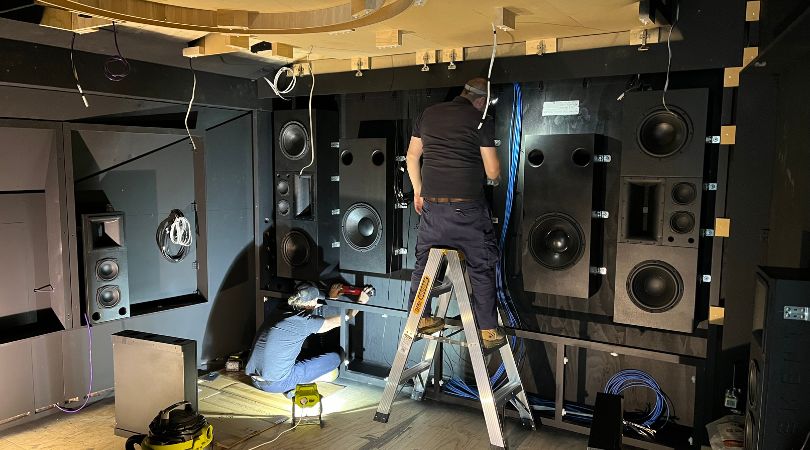
We spend a lot of time talking about two-channel high-end audio, active wireless loudspeakers, Dolby Atmos, soundbars and increasingly sophisticated home theater systems, but CEDIA’s research provides a useful reminder that distributed audio remains one of the largest segments of the professional residential technology market.
At approximately $3.8 billion, it trails only networking among the individual categories identified in the research. Whole-home integration projects also continue to revolve heavily around audio, networking and video, which CEDIA found were “always” or “frequently” included in the vast majority of projects regardless of company size, type or geographic region.
That also helps explain a lot of what we saw at CEDIA Expo 2026.
KEF expanded aggressively into outdoor audio, James by Sonance introduced loudspeakers designed to visually integrate with Samsung’s Frame televisions, Coastal Source continued combining outdoor sound and lighting, and Theory Audio Design demonstrated how the same core loudspeaker platform can be deployed across in-wall, in-ceiling, pendant, surface-mount and outdoor installations.
The market is not moving away from audio. Audio is simply appearing in more places and increasingly becoming part of a larger integrated system rather than a collection of black boxes occupying one corner of the living room.
Lighting Is No Longer the Side Business
Lighting and shading now represent approximately $3.7 billion of the market, virtually level with distributed audio, and integrators identified lighting as their largest business opportunity for the coming year.
That was impossible to miss in Denver. CEDIA added a dedicated lighting education track for 2026, and lighting, shading and control companies occupied considerably more oxygen at the show than they did a decade ago. CEDIA had already identified lighting as an expanding opportunity before the show, with education focused on system design, deployment, troubleshooting and building a profitable lighting practice.
For A/V dealers who still regard lighting as something electricians handle before they arrive with the speakers, the revenue numbers suggest it might be time to reconsider that division of labor.
AI Is Growing but Skilled Humans Remain the Bigger Problem
Artificial intelligence was attached to almost everything at CEDIA Expo this year, occasionally with good reason and occasionally because apparently every product announcement in 2026 requires an AI garnish.
The research suggests there is substance underneath some of the marketing. Seventy-nine percent of firms reported increased use of AI in their own business operations during the past year, while 58% reported an increase in customer requests for AI-related products or features. Larger firms and companies outside the traditional integrator category were more likely to report increasing customer demand.
But CEDIA also identified a considerably less futuristic problem that the industry has been struggling with for years.
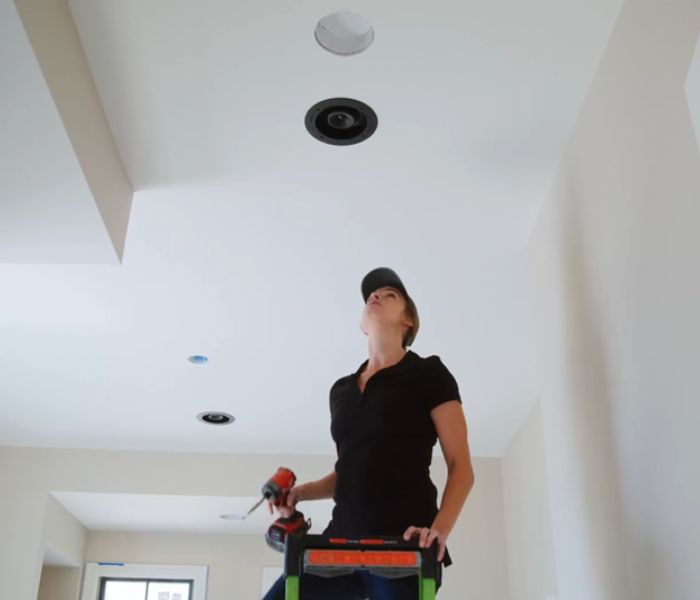
Finding skilled employees was cited by 27% of respondents as their biggest business challenge, almost three times the percentage who selected either finding new clients or keeping current with technology, which were tied at 8%. CEDIA has been expanding its workforce development efforts for precisely that reason, including programs designed to connect the industry with technical schools and younger workers entering skilled trades.
AI might help an integrator write a proposal faster.
It still cannot crawl through an attic in July and terminate 40 network cables correctly.

Integrators Are Surprisingly Optimistic
The broader economic environment is hardly perfect. Housing activity has softened, construction material costs have increased and tariffs continue to affect the cost of some building materials and components.
Despite those pressures, nearly 78% of firms surveyed expect their revenue to increase during the next 12 months, while only 4% anticipate a decline. Companies expecting growth most commonly cited increased customer demand, followed by homeowners adding more technology and businesses expanding the products and services they offer.
How those customers arrive is equally revealing.
Direct client referrals remain the largest source of new business, cited by 76% of firms, followed by general contractors at 55%, interior designers at 25% and architects at 16%. For all of the money being spent on marketing platforms, social media and increasingly sophisticated lead generation, somebody telling their neighbor that the installer actually showed up on time and made everything work remains remarkably effective.
Technology may change quickly.
Human beings apparently still ask their friends who wired the house.
The Bottom Line
CEDIA Expo naturally directs attention toward the biggest screens, most elaborate theaters and newest automation platforms because those are the products people travel to Denver to see. CEDIA’s $33.8 billion market estimate tells a more useful story about where the business actually lives.
Networking has become the foundation of the modern connected home, distributed audio remains an enormous category, and lighting is now too large for traditional A/V integrators to treat as somebody else’s business. AI will increasingly influence both the products being installed and the companies installing them, but finding qualified people to design, install and support these systems remains a more immediate problem.
The six-figure video walls will continue getting the photographs.
The network rack, loudspeakers, lighting system and technician who knows how to make all of it work are still paying the bills.
You must be logged in to post a comment Login