Tech
Celero raises $275m to bring coherent optics inside AI data centres

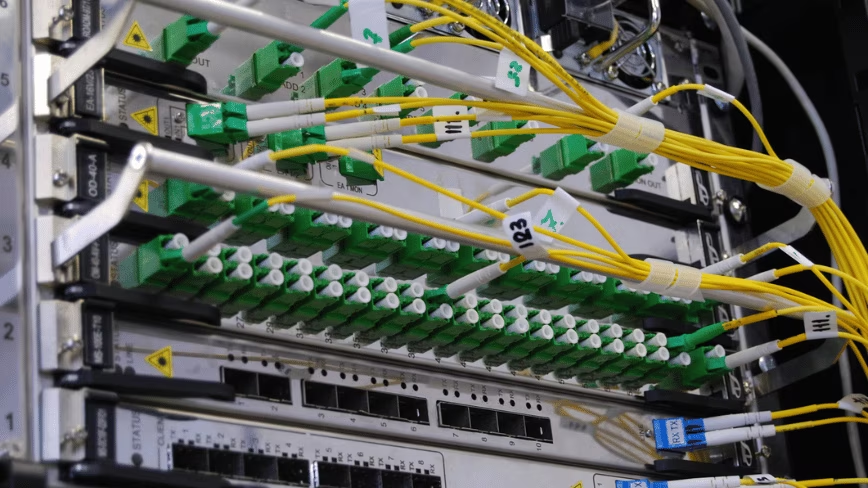

Celero Communications, a two-year-old chip startup, has raised $275m in a Series C round that values it at more than $3bn. It makes the processors that push data down fibre optic cables between AI chips, racks and whole data centres. Atreides Management, Valor Equity Partners and CapitalG, Alphabet’s growth fund, co-led the round.
Dina Bass of Bloomberg reported the round on 8 September, ahead of the company’s own announcement the same day. Existing investors Sutter Hill Ventures and Maverick Silicon also took part. Celero has now raised $415m in total. Gavin Baker, managing partner and chief investment officer at Atreides, joins its board.
All three lead investors were already on the cap table. CapitalG led Celero’s $100m Series B last November. That took its funding to $140m at the time, according to the company’s earlier announcement. Valor, Atreides, Sutter Hill and Maverick Silicon took part in that round too. The November announcement gave no valuation, so the size of the step up is not public.
The company is based in Irvine, California, with design centres in Canada and Argentina. Its founders are Nariman Yousefi, the chief executive, and Oscar Agazzi. The pair previously worked as executives at Marvell, and Yousefi spent 17 years at Broadcom, where he ran its networking unit.
What Celero makes
Celero builds coherent digital signal processors, or DSPs. These chips encode data onto light using the phase and polarisation of the signal as well as its brightness. That lets more data travel further down the same strand of fibre. Networks have long used coherent optics for links between cities. Inside data centres, a simpler and cheaper method called PAM4 has done most of the work.
Celero argues that PAM4 is running out of room as AI clusters grow. Its pitch is that coherent optics should now run at every scale, from racks inside one building to links between neighbouring data centres.
“The transition to coherent technology is absolutely required to enable all this future scaling for AI,” Yousefi told Bloomberg.
The company says it has validated what it calls the industry’s first coherent DSP made on a 2-nanometre process. It uses TSMC’s 2nm technology, the most advanced commercially available. Celero says the chip sets up a roadmap from 1.6 terabit connections to 3.2 terabit ones.
Not shipping yet
Celero says the new money will go on its product roadmap, research and development, and production readiness. The validation is a milestone, not a product. Yousefi told Bloomberg that Celero still has to finalise the design and start production, and aims to make that move next year. The company has not named any customers. It is targeting the biggest cloud providers.
It will also have to sell into a crowded market. Celero will compete with Marvell, Broadcom and Cisco, Bloomberg reported. At the same time its chips must plug into equipment made by others. Marvell owns Inphi, one of the companies in the founders’ own history. Cisco bought coherent optics specialist Acacia in 2021.
The Alphabet link adds a twist. Last month, Marvell gave Google a warrant to buy up to $12.2bn of its shares as part of a custom chip deal. Marvell supplies Google with chips that sit around its TPUs, including controllers for storage and networking. CapitalG has backed Celero since before that deal. With this round it is doubling down on a startup that plans to compete with Marvell in optical networking.
The wiring bet keeps growing
Celero is the latest in a run of large rounds for companies that move data between AI chips.
“When we founded Celero, we started with a simple belief: AI infrastructure would become one giant distributed supercomputer, and networking would become the bottleneck,” Yousefi wrote on LinkedIn after the round.
The logic is simple. Buying more GPUs helps only if they can talk to each other fast enough, and the links are becoming the limit.
The spending behind that demand is large. Celero’s announcement cites a McKinsey projection that data centres worldwide will need nearly $7tn of investment by 2030. About $5.2tn of that would support AI workloads.
Atreides has made this bet before. It co-led the $700m round for Lumilens, which builds optical interconnects for both short hops inside a rack and longer runs between racks. Maverick Silicon, another Celero backer, invested in Point2, which takes a different route. Point2 sends radio signals over plastic and claims lower power and latency than optics.
Light, radio or copper
Others are working on the cable itself. Relativity Networks raised money for hollow-core fibre that carries light faster than glass. In London, Olix tripled its valuation to $3.3bn with an optical AI chip of its own.
CapitalG’s James Luo made the case for light directly. Some of Nvidia’s racks still rely largely on copper, he said, and too much information risks getting lost as data needs grow.
“Light is just way more efficient,” Luo told Bloomberg, even over short distances.
Some investors are backing more than one answer. Maverick Silicon has money in both Point2’s radio links and Celero’s coherent optics. Atreides’ Baker put Celero’s claim at its widest in the company’s announcement. “Every data center will need coherent optics, no matter the accelerator or networking protocol,” he said.
The test comes next year, when Celero moves from validated silicon to production. The first cloud provider to sign up will show whether coherent optics can make the jump from links between cities to links between racks.
You must be logged in to post a comment Login