Tech
China formalises tougher outbound-investment rules after the Meta-Manus blockade

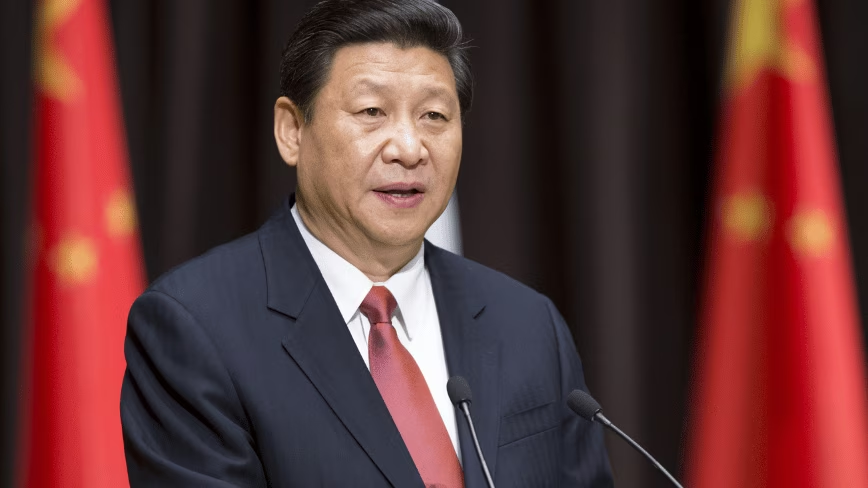

Beijing’s new framework codifies the technology-tracing approach the NDRC used to unwind Meta’s $2bn Manus acquisition, making cross-border AI deals materially harder.
China has formalised a tougher framework for outbound-investment review, codifying the legal-and-administrative posture the National Development and Reform Commission used to unwind Meta’s $2bn acquisition of AI-agent startup Manus in April.
The updated rules, reported by Reuters on Monday, give Chinese regulators a substantially expanded toolkit for blocking cross-border AI and technology transactions, particularly those that involve technology, talent or intellectual property with Chinese origin even if the relevant company is incorporated outside China.
The Meta-Manus case is the template the new framework formalises. Manus, the Chinese-founded AI-agent startup that relocated its corporate headquarters to Singapore before announcing the Meta acquisition in December 2025, was blocked by the NDRC on national-security grounds in April.
The regulator’s reasoning was structurally aggressive: rather than focusing on the company’s current legal domicile, the NDRC examined where Manus’s technology was developed, where its engineering team accumulated expertise, and how the underlying IP was transferred out of the original Chinese corporate entity.
The new rules codify this technology-tracing approach, asserting Chinese jurisdiction over cross-border deals on the basis of technological origin rather than corporate registration.
The substantive consequence is that the Singapore-or-Cayman-Islands restructuring playbook many Chinese AI startups have used over the past five years no longer reliably protects companies from Chinese regulatory review when they accept foreign acquisition offers.
The previous strategic pattern, founded in China, restructured offshore, sold to a US buyer, has been the standard exit route for Chinese AI talent looking to monetise their work in the global market.
The NDRC’s technology-tracing approach, now formalised, means Beijing retains effective veto power over those exits regardless of which jurisdiction the relevant corporate entity sits in at the time of the deal.
The Manus block was the first publicly confirmed use of China’s foreign-investment security-review mechanism to unwind a cross-border AI transaction.
The new rules now make that approach the default rather than the exception, with the NDRC’s framework explicitly covering technology, IP, and key personnel as triggers for review even when the formal acquisition target is non-Chinese.
The framework sits inside a broader 2026 Beijing push that has included expanded travel restrictions on top AI researchers at private firms, instructions to leading AI startups including Moonshot and StepFun to reject US-origin capital without prior clearance, and the parallel push to anchor Chinese AI firms inside mainland-incorporated corporate structures.
The contrast with the US side is the cleaner editorial layer. Washington has spent the past three years tightening outbound-investment rules and expanding semiconductor export controls in an explicit attempt to slow Chinese AI development.
Beijing’s response, on the evidence of the new framework, is to codify a mirror restriction running in the opposite direction: outbound exits, not inbound capital, are the channel China is now closing.
The US is building a wall to stop AI capability from flowing to China; China is building a wall to stop AI capability from flowing out. Both are conditioning their respective technology workforces on the explicit assumption that the bilateral commercial pipeline is no longer trusted infrastructure.
For Meta specifically, the Manus situation now appears to be permanently unwound. The company has reportedly written off the $2bn position in the most recent quarter and abandoned operational integration plans.
For other US tech companies that had been contemplating Chinese-origin AI acquisitions through offshore-incorporated targets, the new rules effectively close that route. Several similar pending deals are reportedly being restructured or abandoned in response.
The broader Chinese AI commercial map is recomposing accordingly. Moonshot AI, StepFun and others that had used offshore-incorporated entities are considering reincorporation onto the mainland, partly because the offshore-protection thesis is now weaker than it was six months ago and partly because Beijing’s domestic-IPO regime offers a clearer exit pathway for companies willing to anchor inside China.
The Chinese AI talent base, for the same reason, is being more aggressively retained inside the country.
The new outbound-investment rules take effect immediately. Foreign acquirers contemplating Chinese-AI-origin assets now face a substantially higher regulatory bar than even four months ago.
You must be logged in to post a comment Login