TL;DR
UK sales of Chinese-made cars hit 285,000 in 2025, up from 384 in 2015. No additional tariff on plug-in hybrids makes the UK more open than the EU or US.




UK sales of Chinese-made cars hit 285,000 in 2025, up from 384 in 2015. No additional tariff on plug-in hybrids makes the UK more open than the EU or US.
Brits bought 384 Chinese-made vehicles in 2015. Last year, they bought 285,000, according to automotive consulting firm Mobility Global. The growth is accelerating. BYD nearly doubled its UK sales in the first half of 2026 to over 37,000 units, and Chinese brands collectively hold roughly 13% of new car registrations in Britain, double their share a year ago.
The reason is a tariff gap. The EU charges countervailing duties of up to 35.3% on Chinese battery-electric vehicles and is preparing additional tariffs on plug-in hybrids. The US charges 100%. The UK charges neither. Britain applies no additional tariff on Chinese plug-in hybrid vehicles, which has made it the easiest major Western market for Chinese automakers to enter at scale. “It becomes an excellent size market that’s progressing well towards electrification and is in demand for some cheaper vehicles with that void to fill,” said Will Roberts of Benchmark, an automotive consultancy.
The price gap is stark. A Volkswagen Tiguan plug-in hybrid built in Germany sells in the UK for just over £43,000 ($58,000). The BYD Seal U built in China costs almost £10,000 less. Buyers at a Geely dealership in Maidstone told CNBC the value proposition was obvious: better equipment, lower price. Canada opened its market to Chinese EVs in January with a 49,000-unit cap, but the UK’s approach is more permissive, with no quota and no additional duties.

The 💜 of EU tech
The latest rumblings from the EU tech scene, a story from our wise ol’ founder Boris, and some questionable AI art. It’s free, every week, in your inbox. Sign up now!
China’s domestic auto market is cooling. Retail sales fell 26% in the first half of 2026 while exports rose 72%, according to the China Association of Automobile Manufacturers. That export surge has to go somewhere. Former GM board member Jon McNeill told CNBC that Chinese automakers are entering Europe “with really attractive cars at really attractive prices with technology that sort of blows away what they can buy from a European manufacturer.” Geely has already stopped building new factories and is using Volvo’s existing plants instead to sidestep tariffs and absorb overcapacity. The UK’s open door may not last: if Chinese market share keeps climbing, pressure to align with EU tariff policy will follow. For now, 285,000 cars in a single year tells its own story.

The “AI” label no longer makes companies special. In today’s world, that is a fact that needs to be accepted.
Even just a year ago, if a business simply mentioned being “AI-powered” it was enough to immediately gather attention and appear innovative. Investors quickly grew excited, and media outlets were quick to pick up the next “hot story.”
Founder and CEO of Drofa Comms.
Of course, that didn’t always mean that there was truth to such statements. The concept of AI washing — when companies misrepresented or even outright lied about the use of AI tools in their operations — had certainly done its share of damage to this industry while it stayed prevalent.
But today, even without such lies, the effect of AI novelty is disappearing. Every fintech company now has some kind of AI story. Compliance platforms use AI monitoring. Banks and fintechs talk about AI-driven service personalization. Chatbots and AI assistants are utilized practically by every other platform, no matter which industry we look at.
At this point, saying your company uses artificial intelligence feels almost the same as saying you have a website. People have learned to expect it almost by default. And this creates a very different communications environment.
The first wave of AI companies mostly had to convince their audience that the technology was possible. That task has certainly been accomplished. Now, the second wave faces the task of convincing people that their particular implementation of AI is trustworthy, useful, and worth the attention in a market that’s beyond overcrowded already.
That is much harder.
AI investment has exploded over the last two years. Enterprise spending on gen AI jumped from $11.5 billion in 2024 to $37 billion in 2025. That’s a whole 220% YOY increase. AI-focused startups continue to dominate venture capital conversations, to the point where nearly every technology company now feels the pressure to position itself as part of this race.
But something else happened along the way: consumers became more educated. If at first, AI sounded like something magical, now people have actually used it. They have seen hallucinations and strange outputs, and they’ve dealt with incorrect recommendations. They’ve had time to realize that AI can be useful, but also that the technology comes with its own frustrations and limitations.
As such, being “AI-powered” is no longer enough to stand out. Consumers have already moved past that stage. One of the biggest mistakes I see today is when companies still assume they have not.
Now, the conversation revolves around a much deeper point: “What does your AI actually improve for me?” For AI-focused companies vying for attention, the benefits of their specific approach are now the key battlefield where they have to win.
This is particularly important for financial and fintech companies, because financial services are built on trust. People may tolerate or even find humor in mistakes from an entertainment app, but they will not be pleased when their money or personal data are put at risk because of AI malfunctions.
The numbers clearly show this trust gap. While AI adoption continues growing, only 13% of consumers truly trust AI systems, and about 30% remain neutral rather than confident. Many people are still uncomfortable giving AI fully autonomous control over important decisions, especially in areas connected to finance or personal data.
At the same time, enterprises themselves also often contribute to the problem of trust by rolling out AI models before building the necessary structures to govern them.
A recent survey by McKinsey discovered that less than 15% of organizations obtain full security and IT approval before deploying AI agents. Or, to put it in other words, the vast majority of these systems come out without proper oversight and responsibility frameworks around them.
This very reality has now become the defining challenge of the next AI adoption phase. The market is no longer asking whether companies can use artificial intelligence. It’s asking whether they can use it responsibly. And that is precisely why I am of the opinion that AI communication from here on out needs to be very different from what we saw during the first hype cycle. It’s no longer about who shouts the loudest.
The main victory condition will be for companies to explain — clearly and realistically — how their systems work and how they benefit their users. And then they will have to continue proving that through sustainable action.
One important area to account for is transparency around AI limitations. Now that the broad public already has enough context and experience to understand that AI can fail, pretending otherwise would only damage a company’s credibility.
To earn trust, strong, honest communication is necessary that will openly acknowledge those points of failure. When a business wishes to present its own AI solution, it will need to explain upfront where its model works well and where its shortcomings lie. Customers should have clear expectations and understanding of the risks before they engage with the technology.
Some might think that admitting to shortcomings would be a mistake, a vulnerability. But honesty can yield more results than those people expect.
Clients are generally much more comfortable using services when they understand where the borders are. When they know how decisions are made, that safeguards exist, and that human oversight is still involved in the process, so if something goes wrong, they have someone real to talk to.
This is where competent governance enters the picture.
Be it to partners, clients, or regulators, businesses increasingly need to demonstrate that they are responsible about how they employ AI in operations. Whether decisions can be audited.
A few years ago, these topics were often hidden deep inside technical documentation, if they were brought up at all. Now, explainability of AI models is one of the biggest signals of trustworthiness that a company can project.
And honestly, I think this is healthy for the industry.
By now, AI has stopped being a mere marketing decoration and is leaning more and more toward becoming a full-on infrastructure layer in corporate operations. That means it needs to be properly managed, so that possible mistakes do not create reputational and monetary damage to countless involved parties.
We’ve featured the best AI website builder.
This article was produced as part of TechRadar Pro Perspectives, our channel to feature the best and brightest minds in the technology industry today.
The views expressed here are those of the author and are not necessarily those of TechRadarPro or Future plc. If you are interested in contributing find out more here: https://www.techradar.com/pro/perspectives-how-to-submit


Attackers have begun exploiting a critical vulnerability (CVE-2026-6875) in the ServiceNow AI Platform, according to threat intelligence company Defused.
Formerly known as the Now Platform, ServiceNow AI Platform is an enterprise-grade Platform-as-a-Service (PaaS) that helps businesses integrate AI into core enterprise workflows.
Cybersecurity company Searchlight Cyber, which found this critical vulnerability and reported it on April 1st, says that it allows unauthenticated threat actors to escape the sandbox and execute code remotely within the ServiceNow platform in high-complexity attacks.

ServiceNow addressed the flaw across hosted instances and released CVE-2026-6875 security updates for self-hosted instances one week ago, on July 13th.
Over the weekend, Defused security researchers confirmed that attackers have begun exploiting the vulnerability in the wild, with the first attempts being observed on Friday, days after ServiceNow issued patches.
“We are observing in-the-wild exploitation of the ServiceNow pre-auth sandbox-escape RCE (CVE-2026-6875),” Defused warned in a Saturday tweet.
“The payloads hit the same pre-auth sink @SLCyberSec documented (/assessment_thanks.do), but the sandbox-escape gadget reaches the same code-execution primitive by a different route than their published PoC.”
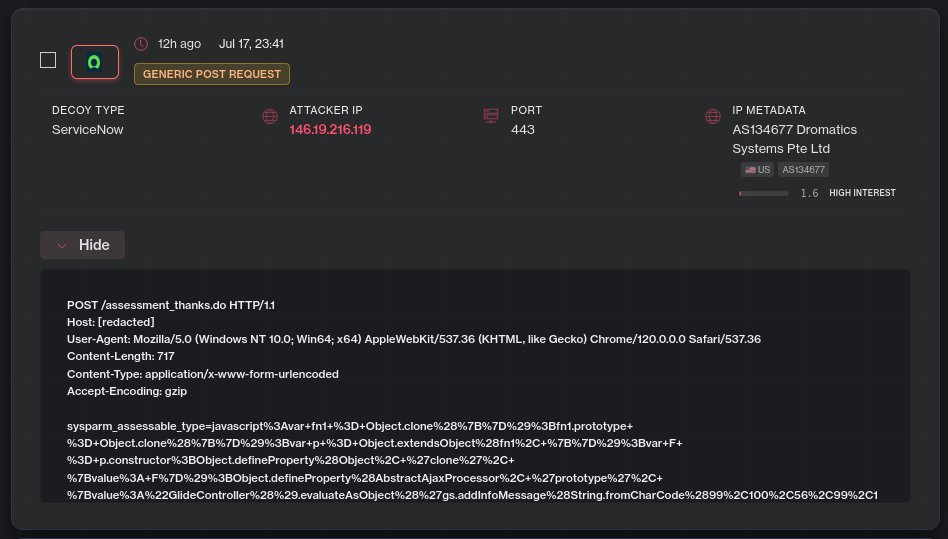
ServiceNow has yet to flag this security as actively abused and, in the official advisory, still states that it is “not currently aware of exploitation against ServiceNow instances.”
However, the company advises all customers who have not already done so to secure their systems against attacks by upgrading to a patched release as soon as possible.
A ServiceNow spokesperson was not immediately available for comment when BleepingComputer reached out to confirm Defused’s report that CVE-2026-6875 is now actively exploited.
Last month, ServiceNow also privately disclosed a security incident in which attackers queried data from customer instances by exploiting an unauthenticated access flaw via a vulnerable API endpoint.
In a subsequent advisory, it tied the incident to security researchers or customer-led research linked to bug bounty submissions rather than to malicious threat actors.
ServiceNow says that its AI Platform runs more than 100 billion workflows each year and powers over 100,000 enterprise AI apps at 85% of all Fortune 500 companies.

Security teams log 54% of successful attacks and alert on just 14%. The rest move through your environment unseen.
The Picus whitepaper shows how breach and attack simulation tests your SIEM and EDR rules so threats stop slipping by detection.
We may receive a commission on purchases made from links.
Google’s Pixel series has crafted a name for itself by offering a clean Android experience, day-one software updates, and computational photography that’s often only rivaled by the iPhone or Samsung’s most expensive flagships. They also have a signature design philosophy, exemplified by the Pixel 10 and 10 Pro’s flat screens, polished or stain-finished aluminum frames, and distinct camera bars to house all the hardware.
Other perks of the Pixel phones include up to seven years of Android updates to newer Pixel models, which include frequent Pixel Drops and security patches. Google is also doing AI in its smartphones a bit better than other manufacturers: You get built-in Gemini models that run directly on the device and offer you features such as enhanced call screening and faster recorded transcriptions.
All that said, Pixel phones don’t always have the best reputation when it comes to value. For starters, the in-house Tensor G5 that powers the Pixel 10 Pro is considerably slower than what the competition is using. Battery life, too, isn’t Pixel’s strong suit, with many users complaining of poor endurance even after just a few months of use. Fortunately, the Android segment is packed to the brim with alternatives that may prove to be a better value for your money. Here are five cheaper alternatives to the Pixel 10 Pro that either offer similar features or much better performance.
If you like the Pixel experience but want a phone that offers better value than the 10 Pro, you can just step down a few notches in Google’s own lineup. The Google Pixel 10a is the company’s budget offering, but it packs in nearly everything good about the flagship Pixel experience at a fraction of the cost. Priced at $500 for the 128GB model, the Pixel 10a is powered by last year’s Tensor G4 chip and 8GB of RAM.
It still offers a 120Hz OLED display with a peak brightness of 3,000 nits. At 6.3 inches, the screen is also the same size as that of the Pixel 10 Pro, albeit with ever so slightly larger bezels all around. The Pixel 10a does cut a few corners in the camera department, though: Apart from a smaller main sensor with a slightly lower resolution, you lose out on the 5x telephoto lens that the Pixel 10 Pro provides. You retain the ultrawide lens, but it’s 13 MP instead of the 10 Pro’s 48 MP.
What remains the same is the software experience, beyond a few on-device AI features like Magic Cue that probably require more RAM. The 10a will also receive up to seven years of OS updates. It also has support for wireless charging for the 5,100 mAh battery, but Pixelsnap compatibility is not present.
Samsung’s flagship S Ultra device enjoys most of the attention during every launch cycle, but the base variant is no less of a premium experience. Not only does the Samsung Galaxy S26 start at $900, which is $100 less than the Pixel 10 Pro, but it also offers twice the storage capacity at 256GB by default — which we’d like to see Google do with its future phones. This is important considering these flagship smartphones are equipped with cameras that can churn out multi-gig video files if you’re shooting in 4K.
The Galaxy S26 is powered by Qualcomm’s Snapdragon 8 Elite Gen 5, which will be a much better chip if you’re planning on gaming. According to NanoReview, the Snapdragon processor offers up to 2.7 times better performance than the Tensor G5 in AnTuTu benchmarks. You may not notice the difference in regular day-to-day use, but the Galaxy S26 is better equipped to handle heavier workloads or console-quality games like “Alien Isolation” that are becoming increasingly common on mobile devices.
You’re also not losing out on any of the software benefits by picking a Samsung phone over a Pixel, either. Like Google, Samsung offers up to seven years of Android updates to its smartphones. One UI is also one of the most feature-packed variants of Android and comes with a Galaxy AI suite that’s comparable to what Pixel phones have to offer.
OnePlus is known for its performance-first phones that undercut the competition, and the OnePlus 15 is no different. It starts at $900, for which you get 256GB of UFS 4.1 storage and 12GB of RAM. For $100 more, you can double the storage and up the RAM capacity to 16GB — and it will still be cheaper than the base variant of the Pixel 10 Pro XL. The OnePlus 15 is also a large phone, sporting a 6.78-inch AMOLED display that can hit refresh rates of up to 165Hz in supported apps and games. It has slim bezels, support for Dolby Vision and HDR10+, and a touch sampling rate of 3,200Hz.
Being powered by the Snapdragon 8 Elite Gen 5 means the OnePlus 15 also has the Pixel 10 Pro comfortably beat on the performance front. The phone can easily handle any modern game you throw at it, and its screen’s higher-than-usual refresh rate actually makes it comparable to dedicated gaming phones. OnePlus didn’t cut any major corners with the 15, either, despite its very competitive pricing: The 50-megapixel cluster of sensors delivers excellent results and offers videos up to 4K 120fps or 8K 30fps.
When we reviewed the OnePlus 15, though, the feature that impressed us the most was its battery life. Not only does its 7,300 mAh silicon-carbon battery dwarf what the Pixel 10 Pro offers, but OxygenOS’ aggressive battery optimization also makes for a phone that comfortably lasts a day and a half on a single charge.
If you must have the quintessential Pixel experience with all the goodies, the regular Google Pixel 10 could prove to be a great middle ground between the 10a and Pro. It shares the same SoC as the more expensive Pixel 10 Pro, though you get less RAM at 12GB. It sports a similar 6.3-inch OLED 120Hz display with the same Gorilla Glass Victus 2 protection and an IP68 rating. The phone is priced at $800 for the 128GB variant, which makes it $200 cheaper than the Pixel 10 Pro.
The Pixel 10 offers a triple-camera system as well, including a 5x telephoto lens for your zoom photos — just with smaller, lower-megapixel sensors. Design-wise, it’s really difficult to tell the two models apart. Some users actually prefer the matte aluminum frame on the Pixel 10 over the polished finish of the Pixel 10 Pro’s frame.
As expected, you get the same software experience with seven promised Android versions and frequent Pixel Drops. Also, unlike the Pixel 10a, the regular Pixel 10 doesn’t skimp on any AI features. You also get support for Pixelsnap, which is Google’s version of MagSafe. If you’ve owned an iPhone before, you can use any MagSafe accessories you already have with your Pixel 10. As long as you’re willing to compromise on the cameras, the Pixel 10 offers the same performance and software experience as its elder sibling at a much more compelling price.
You don’t need to spend $1,000 if you want to play demanding games on your smartphone, and especially not on a Pixel 10 Pro. Instead, you’ll want to turn to a phone like the Nubia RedMagic 11 Air. This gaming-centric phone is powered by the Snapdragon 8 Elite SoC, 12GB of RAM, and 256GB of storage. Although it uses an older chip, the 8 Elite still outperforms Google’s Tensor G5 by quite a margin. More importantly, the RedMagic 11 Air offers considerably better value thanks to its $530 price tag.
A factor that differentiates the RedMagic 11 Air from pretty much every other smartphone being currently sold is its notchless, full-screen display. Yes, that does come at the cost of a lower-quality image from the under-screen front-facing camera, but that’s a sacrifice hardcore gamers might be willing to make. The display itself is an AMOLED panel that refreshes at 144Hz with a touch sampling rate of 2,592 Hz. The phone also offers a large 7,000 mAh silicon-carbon battery with support for up to 80W of wired charging.
Unfortunately, RedMagic is only promising two years of major Android updates and three years of security patches. If you’re looking for more horsepower, you can stay within the RedMagic family and get the RedMagic 11S Pro. It sports the latest Snapdragon 8 Elite Gen 5 chipset and a slightly larger battery with support for wireless charging — while still being cheaper than the Pixel 10 Pro.

The already tense relationship between Apple and OpenAI reaches a breaking point as trade secret accusations emerge, plus your hosts discuss EU regulations, the future of gaming, and public betas on the AppleInsider Podcast.
Apple restarted its AI efforts with new Apple Foundation Models built with Google’s Gemini Frontier models at the foundation. While Google’s involvement seemed obvious in the long run, the move away from OpenAI’s ChatGPT may have been a long time coming.
Not only is OpenAI building hardware products meant to directly compete with Apple’s, but the company has poached over 400 employees in recent years. Apple finally showed its hand with a trade secrets lawsuit that could upend OpenAI’s hardware ambitions and hopes for sustainable post-AI revenue.
While that’s the main topic of the show, William and Wesley also talk about how the EU battery regulations might affect Apple, if at all. There’s also a lot to contend with as memory and storage prices continue to climb.
One of the industries affected by these high prices is the video game industry. As gaming PCs and consoles become increasingly expensive, people will have to turn to the products they already have for entertainment.
It’s interesting that the first attempt at a full Madden football game on Apple products, coming to Apple Arcade, would arrive now. Apple already owns gaming in terms of the size of its user base and how much is spent on gaming apps.
There may be a future where Apple owns AAA gaming as well, if only because people might be priced out of owning both an iPhone and gaming console. If that’s the choice people have to make, it’ll be iPhone.
BONUS: Subscribe via Patreon or Apple Podcasts to hear AppleInsider+, the extended edition. This time, the discussion focuses on where your hosts land on whether multiple smaller utilities are better than one super app.
Tune in to our Smart Home Insider podcast covering the latest news, products, apps, and everything HomeKit related. Subscribe in Apple Podcasts, Overcast, or just search for HomeKit Insider wherever you get your podcasts.
Podcast artwork from Basic Apple Guy. Download the free wallpaper pack here.
Those interested in sponsoring the show can reach out to us at: [email protected].
Keep up with everything Apple in the weekly AppleInsider Podcast. Just say, “Hey, Siri,” to your HomePod mini and ask for these podcasts, and our latest HomeKit Insider episode too. If you want an ad-free main AppleInsider Podcast experience, you can support the AppleInsider podcast by subscribing for $5 per month through Apple’s Podcasts app, or via Patreon if you prefer any other podcast player.
Common Sense Media rated Google’s AI Search an “unacceptable risk” for students. AI Mode uses age-gated Gemini models. Google offers no way to disable AI without blocking Search.
Common Sense Media concluded that Google’s AI-powered Search poses an “unacceptable risk” to young users and recommended that students stop using it entirely until schools can disable the AI features. The child safety watchdog found that AI Mode readily completed homework assignments for minors, repeated misinformation with an air of authority, and exposed children to generative AI experiences powered by Gemini models that are age-gated in every other Google product.
The problem is structural. Google launched AI Mode for Search last year and made it available to everyone immediately, including education accounts. There is no toggle to disable AI features while keeping Search accessible. Parents can block Google.com entirely for child accounts. School administrators could do the same for Workspace for Education users. But as Amanda Bickerstaff of AI for Education put it: “What are you going to say? That kids can’t search the web?” Google dominates classroom technology. It helmed a 1:1 device movement that put Chromebooks in schools across the US and now has millions of Workspace for Education users from kindergarten to postgrad.
“Google’s AI Overview and AI Mode are undermining kids’ education, supplying them with dangerous disinformation, and putting their very lives at risk,” said David Monahan of child safety nonprofit Fairplay for Kids. “If Google is not even willing to disable AI features for students, schools should stop using Google products altogether.” Google’s AI search overhaul has already drawn criticism for undermining the open web by replacing links with AI-generated summaries. In classrooms, the same design replaces the act of searching with the act of receiving an answer, which is the opposite of what education is supposed to teach.
The 💜 of EU tech
The latest rumblings from the EU tech scene, a story from our wise ol’ founder Boris, and some questionable AI art. It’s free, every week, in your inbox. Sign up now!
Google told Mashable that Common Sense Media’s testing was “narrow and ambiguous” and not an effective way to measure product safety. The watchdog tested consumer accounts, not education accounts, but Google confirmed that the AI experience is the same for all users. A German court ruled in April that Google is legally liable for the content of its AI Overviews, treating them as Google’s own statements rather than third-party results. If the same logic applies in the US, schools using Google Search may be exposing themselves to liability every time a student receives a hallucinated answer that Google’s design presents as fact.


We may receive a commission on purchases made from links.
One of the most exciting parts of fixing up your home and adding some personality is painting. However, it’s also one of the most time-consuming tasks, since it involves extensive preparation and cleanup. When working with houses, there are bound to be all kinds of surfaces that need to be treated individually before a can of paint can even be opened. There are also many environmental factors outside your control that affect the overall look, such as humidity, drying rates, and temperature. And of course, you may even realize too late that the paint didn’t stick very well or you got the wrong color. Because of this, many homeowners are always looking for ways to make sure they get everything right on the first application.
For spray painting, there are game-changing accessories, like inlet strainers, gravity-feed spray gun stands, and air paint shakers. However, these aren’t your only options when it comes to painting tools, especially smart ones. While most people already know that you can use your drills with paint-mixing attachments, there are other painting tools that might be worth your time. For your consideration, we’ve rounded up several options, including paint holders, roller cleaners, spray booths, and even tools to help you choose colors. To understand why we chose them, see the end of the article for our full methodology. But if you’re ready to shop for your next home makeover, keep reading.
When it comes to painting walls, it can be challenging to get the exact color because factors like lighting and texture can affect how it looks. In the past, people used color fan decks, which were basically swatches of a paint brand’s available products. But if you don’t have the best eyes for detecting colors, there are now color-matching tools that can reduce your chances of error. By combining a compact color reader with a smartphone app, color-matching tools let you scan surfaces and identify the closest possible paint match. Typically, they’ll be able to display different values and have access to different paint brand libraries for your reference, so you can choose what is available at your local hardware store.
On Amazon, the best-selling lab colorimeter is the COLOR MUSE series, which has been rated 4.1 stars by more than 1,300 people. Depending on your needs, it offers different models and packages that include cases and app subscriptions, priced between $69.99 and $174.99. Alternatively, if you want something known to be a little more durable, there’s the $129 Nix Mini 3, which is also highly rated, with a 4.2-star average from 600+ people. Unlike other similar options, it has an IPX4 rating, which means it can handle water splashes, and a durable design to protect against dust and debris. However, if you have a larger budget, the brand also sells higher-end options, such as the Nix Spectro L and Nix Spectro 2.
If you’ve invested in a home with plenty of high walls or ceilings, a ladder paint tray might just save you time and your back. Unlike normal paint trays, ladder paint trays like the ROLLINGDOG Multifunction Paint Tray can be conveniently hooked onto ladders. This option has a 3-liter capacity and measures 16.7 inches by 14 inches by 6.7 inches. Designed for rollers up to 10.6 inches, it also comes with reinforced legs, a textured loading grid, and a slot that can hold rollers. However, it doesn’t work for all ladders, so before you check out, make sure your ladder rung is 1.1 feet wide and 2.5 inches thick. It weighs just 1.6 pounds without paint, so it can even be held by hand. Retailing for $32.99, the ROLLINGDOG multifunction paint tray for ladders has been rated 4.6 stars by over 220 people.
Alternatively, you can also get the Little Giant Project Tray, which adds a tray to your ladder. Since it can hold up to 25 pounds, you can load heavy paint cans. Apart from paint container slots, it also has slots for power tools and hand tools, plus a magnetic dish for small parts. Priced at $35.94, it’s not just an Amazon’s Choice product, but it’s also highly rated with more than 2,200 people giving it 4.7 stars. The same brand also manufactures a larger-capacity paint roller tray under $40 that holds up to a gallon.
Whether you’re painting an entire wall or a small peeling area, you’ll often need to use different tools to get the job done, such as opening cans, cleaning surfaces, or even removing old nails. Thankfully, there are plenty of multi-functional painter’s tools, like the DeWalt 9-in-1 Painter’s Tool. Priced at $14.39, this carbon steel painter’s tool comes with a soft-grip handle and large hang hole. Apart from acting as both a straight and curved scraper, it also works as a paint roller gouger, can opener, and bottle opener. And if you need to pull a nail, hammer a few cans shut, or tighten a screw or two, it works for that too. As of July 2026, more than 2,300 people have rated it 4.8 stars.
If you’re looking for something even cheaper, there’s also the $6.95 Bates 10-in-1 Painter’s Tool, plus it’s also sold in a pair ($11.99) and a 3-pack ($14.99). An Amazon’s Overall Pick product, it boasts a 4.7-star average rating from more than 6,800 reviewers. But for those with a larger budget, the $17.99 RED Devil 6-in-1 Painter’s Tool might be worth the money. Designed for professionals, it uses a high-carbon precision-ground steel blade combined with a brass-plated, solid steel nail setting head. Not to mention, its black nylon handle is made to withstand solvents. You’ll still need to be mindful of paint-related health risks, especially if you’re working with spray paint.
While you can use drop cloths and tarpaulins, one convenient way to spray paint items like furniture with less fuss is a spray paint booth tent. With the same purpose of reducing cleanup time, it also involves a much shorter setup period. On Amazon, you can get the PLANTIONAL Spray Shelter, which comes in multiple sizes: small (3.1 ft by 3.2 ft by 3.3 ft), medium (7 ft by 4 ft by 4 ft / 4.9 ft by 4.5 ft by 4.3 ft), or large (8.4 ft by 6 ft by 5.5 ft). Each tent shares many of the same core features, such as tear resistance, waterproofing, and a built-in floor. They also have added features, like protective mesh screens, Velcro, and rear ventilation. Plus, they come with portable storage bags. With prices that range between $29.99 and $49.99, many people feel quite satisfied with their collective performance, with more than 1,200 people who rated them around 4.4 stars.
To be able to hit all the right angles, you might want to augment your spray paint booth setup with other accessories as well. For example, there’s the 11-inch diameter Wagner Spraytech Turntable, which has an average rating of 4.5 stars from 5,600+ people and retails for just under $15. Capable of holding up to 15 pounds, it can rotate the items you want to paint for a smoother spray-paint experience. It functions similarly to what bakers use to decorate cakes.
One of the most annoying aspects of painting is the cleanup and storage process, especially when you’re working with paint rollers. When cleaning paint rollers, you’ll want to make sure you don’t waste paint, which you can do with a paint roller scraper, like the Touch Up Cup Roller Saver. Capable of removing extra paint with just a single swipe (and without messy hands), the tool is available in two colors (blue and pink) and retails for just under $12. You can also get a pair for $21.25. Weighing just 3.84 ounces, it’s a little over 9 inches on its longest side, so it’s easy to store when not in use. On Amazon, you can get the Touch Up Cup’s paint roller cleaner tool, which works with three roller sleeve sizes: ¼ inch, ⅜ inch, and ½ inch. An Amazon’s Choice product, it has been rated 4.4 stars by more than 360 people on average. And if you want to support local products, it’s also made in the United States.
If you tend to have a lot of leftover paint, the same brand also sells leftover paint containers that have a special mixing ball that keeps it from clumping. Afterward, you can get something like the $9.99 Scottchen PRO drill driver attachment, which lets you spin the paint roller at high speeds and reduce washing time. It’s compatible with rollers between 9 inches and 18 inches. Another Amazon’s Choice product, it has an average rating of 4.3 stars from 420 customers.
When making this list of painting tools for smart homeowners, we considered the various pain points of the painting experience, including preparation, application, cleaning, and storage. Next, we looked into the different tools designed to address each issue. We made sure to take into account different homeowners’ budgets, so we included tool recommendations ranging from $7 to $175. In addition, each product must have had an average rating of at least 4 stars from more than 200 reviewers. Although it didn’t affect their placement on the list, we also mentioned whether they were highlighted in other ways, such as being Amazon’s Choice or top-selling items in their product category. When possible, we also mentioned alternative products that may have specific functions that you might prefer.

WTF?! The first potential steps toward another profession being wiped out by AI are being taken in New York. When students in the Salamanca City Central School District in Western New York return to school in the fall, they will find a new teaching assistant: a robotic one powered by artificial intelligence. If that doesn’t sound weird enough, the company behind the machine, Realbotix, is the parent of a hyperrealistic sex-doll manufacturer.
Located on the Seneca Nation reservation, the rural district will be one of the first to use the humanoid robot, part of Realbotix’s M-Series and named Sally. It’s integrated with Optio, Realbotix’s AI-powered teaching assistant, which can be accessed by students off-site for out-of-hours learning.
One could argue that Realbotix’s connection to sex robots is apparent in Sally. The machine has silicone skin, a human-like body, and concerningly plump lips. It also uses natural conversation, facial expressions, and real-time interaction to “create engaging, hands-on learning experiences.” Each robot will cost $57,590, which is discounted from the $95,000 list price.
The robot doesn’t walk around the classroom like some kind of Detroit: Become Human android; it stays seated and stationary, other than some upper-body movements.
An easily accessible AI in any school is going to raise concerns, but Realbotix promises that its program features strong school-specific safeguards for content and privacy, removing the risk of exposure to inappropriate, inaccurate, or biased information. It also has protections against inappropriate responses and unreliable outputs and operates under full district oversight.
Sally runs on a closed network with no public internet connection, and won’t access personally identifiable student data. Users have to provide their student ID numbers to use the robot, which will then bring up personalized learning data.
Salamanca City Central School District is a designated Woz ED STEM Pathway district, an initiative founded by Steve Wozniak to prepare students for careers in STEM and emerging technologies. The initial Optio rollout will serve high school students enrolled in Woz ED AI and robotics courses, with plans to expand access to around 500 students during the fall semester.

Toronto-based Realbotix acquired Simulacra Corporation, the parent company of sex-doll maker RealDoll, in April 2024. Realbotix says its education division shares no employees, technology, or facilities with RealDoll – maybe it should have made Sally look a little less like a sex toy, then?

There’s obviously plenty of controversy over the plan. Researcher Julie Carpenter points out that 79% of students on the Seneca Nation reservation are economically disadvantaged, which makes it an easier target for companies to sell their “innovative” tech at a discounted rate. She also notes that despite the safeguards, student data is being stored somewhere. The presence of cameras and microphones in a room full of minors, supplied by a company that also runs a sex-doll firm, is a bit of an eyebrow-raiser, too. And will kids form unhealthy attachments to these machines, preferring them over their human teachers?
As a robotics researcher, learning scientist, and author who has followed Realbotix for years, I’m compelled to do a Bluesky thread on this whole pivot that Realbotix is now trying, turning from humanoid sex robots to classroom “education” robots. Buckle up. nysfocus.com/2026/07/14/n… 🧵
– Julie Carpenter, PhD (@jgcarpenter.com) 16 July 2026 at 00:08
Finally, there’s the question of where this will lead. Realbotix and the school district emphasize that Sally is a teaching assistant who will not replace educators, but that’s the same message we’ve heard ever since ChatGPT burst onto the scene and generative AI took thousands of jobs. Teaching is one of those professions considered least at risk from AI replacement, but people never expected nurses to be replaced by AI, either.

Magnets are awesome, so it’s no wonder we love to add them to our 3D prints. Doing so in a way that will actually last is harder, with thermal creep being one reason a simple friction fit will loosen over time, and using super glue to hold a magnet in place can be messy. In a recent video, [Slant 3D] covers seven ways to install magnets in 3D prints without resorting to glue, along with the advantages and disadvantages of each.
With friction, the argument is that you can still use them, but you’d want to use something like cylindrical magnets rather than flat magnets to increase the friction with the thermoplastic. Using an arbor press rather than human primate hand power is also beneficial.
Rather than installing magnets halfway through a print with all the logistics that entails, you can use side slots to install said magnet into, which is much easier, but as with all embedded magnets, you get that plastic barrier between the magnet and its target.
Other methods involve using a bit of extra material that you need to push the magnet past, using something like an arbor press, so the magnets should never just fall out. A wildcard here: spherical magnets, which can be locked in using a similar method, while automatically orienting themselves to an opposing magnet.
The final tip is to never use two magnets in a magnetic lock. Instead, use a cheaper ball bearing or a similar plain metal part on one side instead. Magnets tend to be much more brittle than whatever stainless steel ball bearing or washer you can use on the other side.
Of course, people will always try to install magnets during an FDM print, but before they try to do that anyway, they really should learn about the fascinating ways in which magnets can ruin print beds, destroy nozzles, and otherwise make a total mess of a print. Magnets seem magical. Maybe they are.

What just happened? Researchers have synchronized 105,000 tiny magnetic oscillators in just 45 nanoseconds, creating the largest network of its kind ever built, and a real sign that this odd corner of computing might actually scale. To put that number into perspective, the previous record was 64 oscillators. This new experiment increased that number to 105,000, more than 1,600 times as many, and the sync time barely moved. With 100 oscillators, synchronization took 10 nanoseconds. With 105,000, it took 45 nanoseconds. That’s the part researchers care about most. Usually, adding more components slows a system down. Here, the system barely slowed down.
Each oscillator is tiny, just 10 to 20 nanometers wide. There’s no external clock running the show. Once the grid gets nudged, the oscillators fall into sync on their own, using nothing but their natural magnetic spin. Think of ripples spreading across a pond until the whole surface moves the same way. And they do it using very little power.
Why does this matter? Because a grid of synchronized oscillators can solve certain problems just by settling into place. Anything involving waves, statistics, approximation, or pattern recognition tends to fit.
Two applications already mentioned in the research are Ising machines, which are used for optimization problems, and reservoir computing, which processes time-based data using the natural behavior of a physical system rather than traditional logic circuits.
The next step is making these grids programmable – adjusting each oscillator’s frequency, phase, and coupling strength so the whole array settles into a specific answer. You’d read the result straight from how the grid synchronizes, no separate decoding required. If that works at scale, people are eyeing applications such as high-speed networking, financial modeling, real-time analytics, and AI acceleration.

Speed is the other draw. The paper says grids like these could run at tens of gigahertz while using comparatively little energy. And that 45-nanosecond settling time for all 105,000 oscillators is roughly the time a regular CPU takes to perform one calculation across a full matrix.
There’s also a clear contrast with quantum computing, which needs heavy error correction just to keep working. This system doesn’t have that problem. Once it settles, the signal it produces is sharp and stable. The quality factor measured in the experiment was over a million, meaning the resulting frequency was about as clean and precise as the tone from a tuning fork.
The study, published in Nature Nanotechnology, was conducted by researchers from the University of Gothenburg, IIT Bhubaneswar, and Tohoku University.


Wind turbines turn flowing air into electricity, but how much can be difficult to predict. A good starting point is to determine a wind turbine’s efficiency by its rated wind speed.
This refers to the wind speed required to generate a wind turbine’s maximum power output without overworking its components, like the blades and generators. Engineers need to understand a wind turbine’s rated wind speed to ensure it is operating as expected without impacting its durability and reliability (they should be able to last 30 years with proper maintenance). On top of ensuring structural integrity, wind turbines should also have the proper rated wind speed to reduce noise.
Rated wind speed also determines if it can consistently produce more electricity, leading to higher revenue. The usual range is between 11 and 15 meters per second, but this is often considered the peak production — you may want to use power curves to estimate a more realistic output, which is how much electricity the wind turbine produces at given wind speeds. You can then calculate how much electricity will be produced at that average wind speed.

The rated wind speed of a wind turbine can be impacted by a lot of factors. First, you should consider the turbine’s size and components. A turbine’s blades will impact the rated wind speed. For example, longer blades can capture more wind energy at lower spinning speeds. The Department of Energy has stated that “the bigger the better” is true for wind turbines, “since they can sweep more area, capture more wind, and produce more electricity.” Some wind turbines are getting quite large.
The wind turbine may also have some technological upgrades. Certain materials and control systems may make a wind turbine more efficient. Different blade designs could be more aerodynamic, allowing the wind to travel over the curved side and then under the flatter side, creating a pressure pattern that creates more lift. The Department of Energy has worked on longer, lighter blades, as well as tall towers and upgraded drivetrains and control systems.
The wind turbine’s location can also impact rated wind speed. Every area has a different average wind speed — and wind turbines should be designed to work with the wind conditions. Naturally, a location with higher wind speeds needs wind turbines with a higher rated wind speed to take create the most electricity possible.




London Mayor Sadiq Khan handed a peerage by Keir Starmer alongside 15 other Labour figures… just days before the PM leaves No10


Weekend Open Thread – Corporette.com


The House | The City of London can help the new chancellor deliver growth in every postcode


Young campaigners urge incoming PM to act on outdoor junk food ads


CFTC blocks Kalshi from unwinding Michigan trades after court order

Two July Windows Left: The CLARITY Act’s Senate Fight and What Failure Means


Nvidia Stock Slips After Big Tuesday Rally as Huang Confirms Vera Rubin Chip Is Now in Production Today


Ripple Payments Joins MiCA With 14 Firms, Does It Mean Anything For XRP?


Democrats look to World Cup watch parties to register thousands of voters


Ripple wins EU-wide access as ESMA adds it to MiCA register

Disney’s Most Ambitious Failed Star Wars Attraction Is Coming to SDCC


Palantir Shares Rise After Expanded Nvidia Partnership and Fresh Analyst Upgrades Ahead of Earnings Day


Injective Submits SEC Transfer-Agent Registration to Onchain Ownership Records


Get Your ESP32 Sunny Side Up With This Solar Dev Board


XRP BOMBSHELL… XRP OMBOARDED FOR TRANSACTIONS!!!


Registration is now open for March for Men with Kev 2026


Dark Secrets Emerge When Jailbreaking LLMs

New Cornerback Enters Vikings Trade Rumor Mill


Money | Class 12 Economics | CBSE Board Exam 2026-27


Banco Bilbao Vizcaya Argentaria, S.A. (BBVA) Discusses Global Macro Environment and Economic Outlook for Core Markets Transcript




You must be logged in to post a comment Login