Tech
Congress has three AI bills and no timetable for a vote on any of them


Three senators will put AI legislation in front of Congress this week, and none of them can say when it might be voted on.
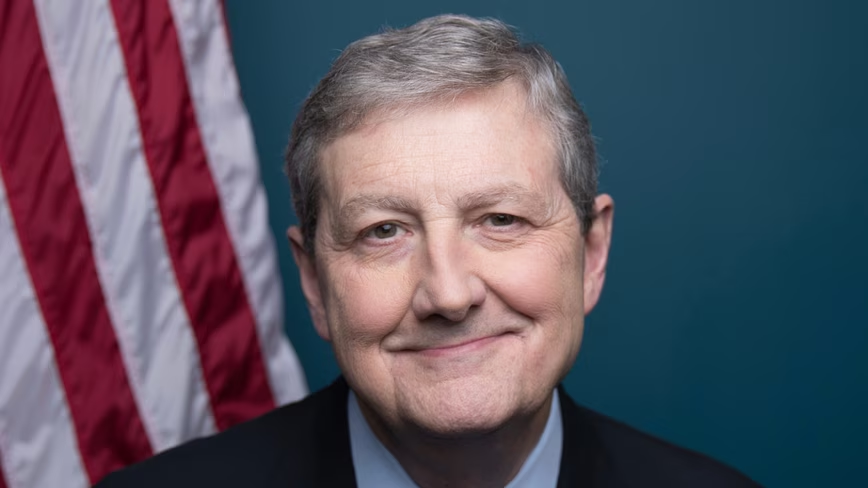
John Kennedy, a Republican from Louisiana, plans to introduce a measure on Wednesday requiring developers to build a shutdown mechanism into their systems.
Bernie Sanders is hosting a briefing with AI researchers the same day and has a bill that would ban artificial superintelligence outright. Josh Hawley has already introduced bipartisan legislation covering national security, civil liberties and labour protections.
The Associated Press canvassed Congress on Tuesday and found the same answer in both parties, which is that nothing will move. Rick Scott, a Republican from Florida, ran through the list of things Congress has not finished, election security and a budget among them, and asked:
“So you think we’re going to get AI done?”
Mark Warner, Democrat of Virginia, put it as a rule: “We never do anything until we have a holy heck moment.”
What makes the stall unusual is who is asking. Dario Amodei said on Saturday that the industry must slow down, Sam Altman agreed the same day, and Elon Musk added his support. Rahm Emanuel, who ran Barack Obama’s White House, told the AP that in his whole career he had never seen it:
“I’ve never had an industry or a CEO ask for regulation and oversight.”
Donald Trump has answered the request repeatedly and in the negative. He called the case for limits a conspiracy on Monday, having dismissed extinction fears the week before, and one of his first acts upon returning to office was to rescind Joe Biden’s 2023 executive order on AI oversight.
JD Vance has been cautious about regulation. Mike Johnson said legislatures reflexively cover things in red tape, and suggested Trump summon the AI companies to a meeting rather than pass a law.
Senate Republicans are not uniformly with him. John Thune, the majority leader, told the AP that Congress can set guardrails around the more consequential threats “without harming our ability to stay ahead in the AI race”, and he is working with Amy Klobuchar on a bill that would give Washington power to block unsafe models and impose a duty of care on developers.
Hawley wants protections for workers, for children online and for people living near data centres, while saying plainly that frontier models will not blow up the world.
A bipartisan working group led by Chuck Schumer reported in 2024 that the United States should spend at least $32bn over three years on AI development and safeguards. Almost none of it followed.
Pressure from outside Congress has kept rising throughout it. Obama has been telling candidates they need an AI policy of their own; Max Stier of the Partnership for Public Service told the AP that delay will prove costly, and researchers at the labs have spent the summer warning publicly about what their employers are building.
David Sacks, until recently Trump’s AI adviser, told the same companies on Sunday to slow down quietly and stop asking Washington for anything in return.
None of the three bills has a committee date, a floor date, or a companion in the House. Kennedy’s kill switch arrives on Wednesday into a chamber whose own leader has said the votes are not there for the broader bill he is already negotiating.
You must be logged in to post a comment Login