Tech
Craft Recordings and Bluesville Records Reissue Brownie McGhee and Sonny Terry Classics on 180-Gram Vinyl

Sonny Terry and Brownie McGhee spent decades being treated as a single musical unit, which makes these two upcoming Bluesville reissues more interesting than another pair of titles pulled from the Prestige vaults.
Recorded just one week apart at Rudy Van Gelder’s Englewood Cliffs studio in October 1960, Brownie’s Blues and Sonny’s Story shifted the spotlight onto each musician individually. McGhee leads the former, with Terry appearing on harmonica, while Sonny’s Story puts Terry firmly out front with Sticks McGhee on guitar, J.C. Burris on harmonica, and Belton Evans on drums. The sessions offer a different perspective on two musicians whose names became almost inseparable during their long partnership.
Craft Recordings and Bluesville Records will return both albums to vinyl on November 20, 2026, with mastering from the original analog tapes by Matthew Lutthans at The Mastering Lab. The 180-gram LPs are being produced in partnership with Acoustic Sounds, pressed at Quality Record Pressings, and packaged in reproduction tip-on jackets with new obi notes from GRAMMY-winning producer and writer Scott Billington.
That combination has become familiar to anyone following the revived Bluesville series. Craft and Acoustic Sounds have been digging through the Prestige, Bluesville, Riverside, Vanguard and related catalogs with an emphasis on original tapes, heavyweight QRP pressings and substantially better packaging than these recordings have received during many previous trips back to vinyl.
Sonny’s Story and Brownie’s Blues will also be available in hi-res and standard digital formats on November 20.
Related Reading:
Sonny Terry Steps Out Front on Sonny’s Story
Sonny Terry’s harmonica was never merely accompaniment. His whoops, train whistles, animal cries, and sharply rhythmic playing became one of the most recognizable sounds in Piedmont blues. Born in Georgia in 1911, Terry lost his sight following childhood accidents and turned increasingly to music as a means of supporting himself. By the 1930s, he was performing alongside Blind Boy Fuller in North Carolina, and his appearance at John Hammond’s celebrated 1938 From Spirituals to Swing concert at Carnegie Hall helped introduce him to a much larger audience.


Terry’s partnership with Brownie McGhee would eventually span decades and make the pair one of the most familiar blues duos of the 20th century. But Sonny’s Story gives Terry considerably more room to stretch out on his own. Recorded by Rudy Van Gelder at his Englewood Cliffs studio on October 13, 1960, and released on Prestige’s Bluesville imprint in 1961, the album features Terry on vocals and harmonica alongside Sticks McGhee on guitar, Belton Evans on drums, and J.C. Burris on harmonica.
The ten-song album consists entirely of Terry compositions and makes a strong case for viewing him as far more than one half of a famous duo. “High Powered Woman” and “My Baby Done Gone” showcase the infectious rhythmic attack that made his harmonica playing so distinctive, while “Telephone Blues” and “I Ain’t Gonna Be Your Dog No More” reveal a more emotionally direct side of his singing and songwriting. The twin-harmonica interplay with Burris is another highlight and gives portions of the record a character quite different from Terry’s recordings with Brownie McGhee.
Terry’s career ultimately extended well beyond the blues circuit. He appeared in the original Broadway production of Finian’s Rainbow, worked in film, and received a 1982 National Heritage Fellowship from the National Endowment for the Arts alongside McGhee. But Sonny’s Story captures something particularly useful for anyone who knows him primarily through that partnership: Sonny Terry without Brownie McGhee standing beside him, and with nowhere for his considerable personality to hide.
Brownie McGhee Stretches Beyond Piedmont Blues on Brownie’s Blues
Brownie McGhee was one of the defining guitarists of Piedmont blues, but reducing him to that description misses a substantial part of what made him such an interesting musician. Born in Knoxville, Tennessee, in 1915, McGhee grew up in a musical family and developed a fingerpicking style built around syncopated melodies and a thumb-driven bass line. By 1940, he had landed his first recording session through Okeh Records and soon began working with Sonny Terry following the death of Terry’s previous partner, Blind Boy Fuller.

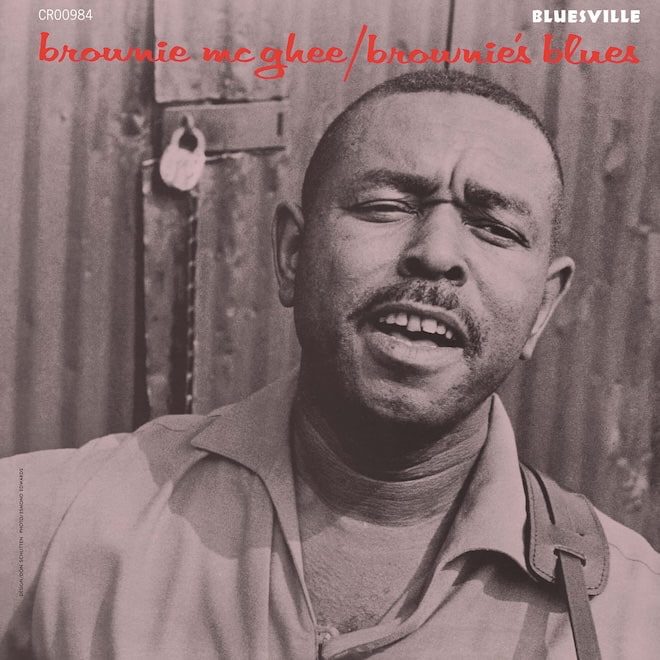
The partnership with Terry would define much of McGhee’s career, but Brownie’s Blues gives the guitarist considerably more room to demonstrate just how broad his musical vocabulary had become. Recorded by Rudy Van Gelder at his Englewood Cliffs studio on October 6, 1960, and released by Bluesville in 1962, the album features McGhee on vocals and guitar, Terry on harmonica, and Bennie Foster on second guitar.
There is plenty of Piedmont blues in the mix, but McGhee also pushes into jump blues and more jazz-inflected territory. “Jump, Little Children,” “Lonesome Day,” and “The Killin’ Floor” have considerably more rhythmic drive, while his interpretations of “Trouble in Mind” and “Every Day I Have the Blues” give him room to show off the sophisticated single-note playing that often gets overlooked when his name is automatically paired with Terry’s.
That broader range is really the point of Brownie’s Blues. McGhee sounds relaxed, confident, and far less constrained by the expectations of the duo format, with Foster and Terry filling out the arrangements without crowding him. Van Gelder’s recording also keeps the focus where it belongs: on McGhee’s guitar work and warm, conversational vocals.
McGhee was hardly confined to the blues circuit either. He performed on Broadway in Finian’s Rainbow, Cat on a Hot Tin Roof, and Langston Hughes’ Simply Heavenly, worked extensively in film and television, and continued touring and recording for decades. In 1982, he and Terry were among the inaugural recipients of the National Endowment for the Arts’ National Heritage Fellowships, cementing their place well beyond the folk revival that had helped introduce them to another generation of listeners.
Where to buy:
Both albums are available for pre-order now, and will be released on November 20, 2026.
You must be logged in to post a comment Login