Tech
Denon DP-500BT Review: This Gorgeous Turntable Made Me a Bluetooth Believer

Denon offers a solid selection of turntable styles and budgets, but the new DP-500BT, introduced alongside the company’s latest multi-room Home speakers, is arguably its most intriguing. Designed to inhabit two audio worlds at once, the DP-500BT is a belt-driven, semi-automatic turntable with the build quality and pricing you’d expect from the brand’s “hi-fi” tier, while also offering Bluetooth support for wireless streaming.
It’s no coincidence that the DP-500BT arrives with Denon’s new multi-room speakers. You don’t usually expect a turntable at this level to cater to the limitations of a Bluetooth signal, but Denon’s system makes it remarkably easy to switch from a wired connection to streaming your records wirelessly to any of its new speakers, which can, in turn, like Sonos and other multi-room speakers, broadcast your stacks of wax throughout the home over Wi-Fi.
On paper, it’s a best-of-both-worlds scenario, and it works out pretty well in practice, too. While you’re certainly paying extra for wireless convenience, the DP-500BT stands out with impressive sound and build quality, and its sleek matte plinth, offset by glittering aluminum components, provides sterling style. If you don’t need Bluetooth, you can get more for your money elsewhere, and there’s no shortage of great turntables out there, but for a certain kind of listener, this flexible deck could be the perfect way to take your records to new heights.
Setup: Shockingly Easy

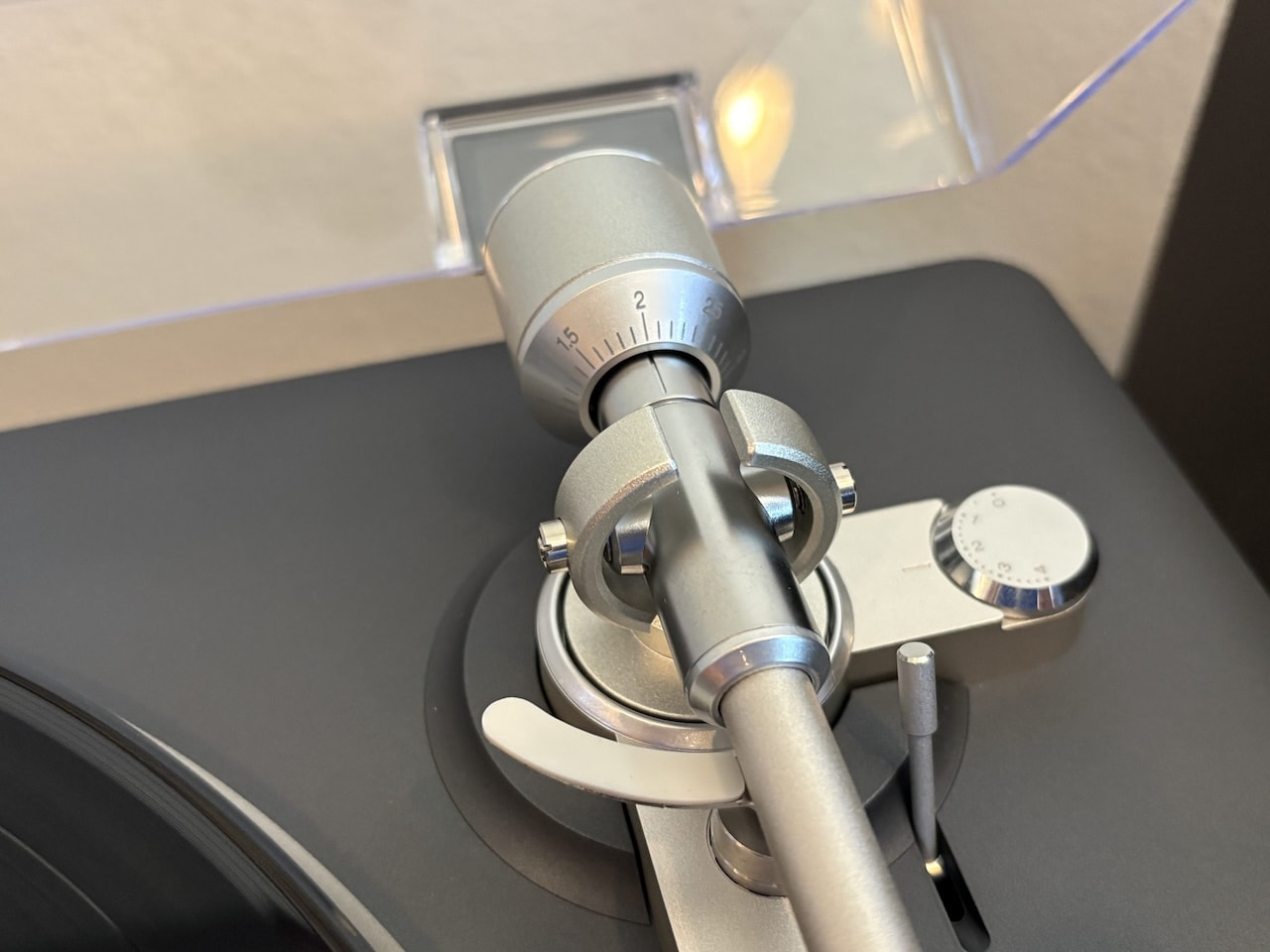
Even though I’ve put together my fair share of turntables over the years, every time I unbox one, it’s a little intimidating. All those separate, delicate components spread out in a blanket of foam, with only my decidedly uncrafty hands to put it all together. Luckily, it gets easier with time, and Denon’s latest deck may just be the simplest high-end model I’ve assembled yet.
Each piece is carefully arranged, while the quick-start manual provides a step-by-step walkthrough that even first-time turntable users should have no trouble following. You’ll get an included RCA cable with a ground (not necessary for most setups) and, of course, a power cable. As a global brand, I was particularly impressed by Denon’s inclusion of an adaptable DC power supply with attachable connections for all the major global output types. You may never move to London, but if you do, the DP-500BT has you covered.
Installing a turntable belt can sometimes feel dicey, but Denon’s attached red ribbon makes it virtually foolproof to slip it over the pulley. The quick-connect moving-magnet cartridge and detailed counterweight instructions had me set up and listening in minutes. I especially appreciated the pivoting stylus protector, which slides up or down so you can balance the tonearm above the platter without sweating needle carnage. Even the included dust cover has easy-slide hinges that only fit one way, so try as I might, I couldn’t attach it backward.
Build and Design: Style Meets Flexibility
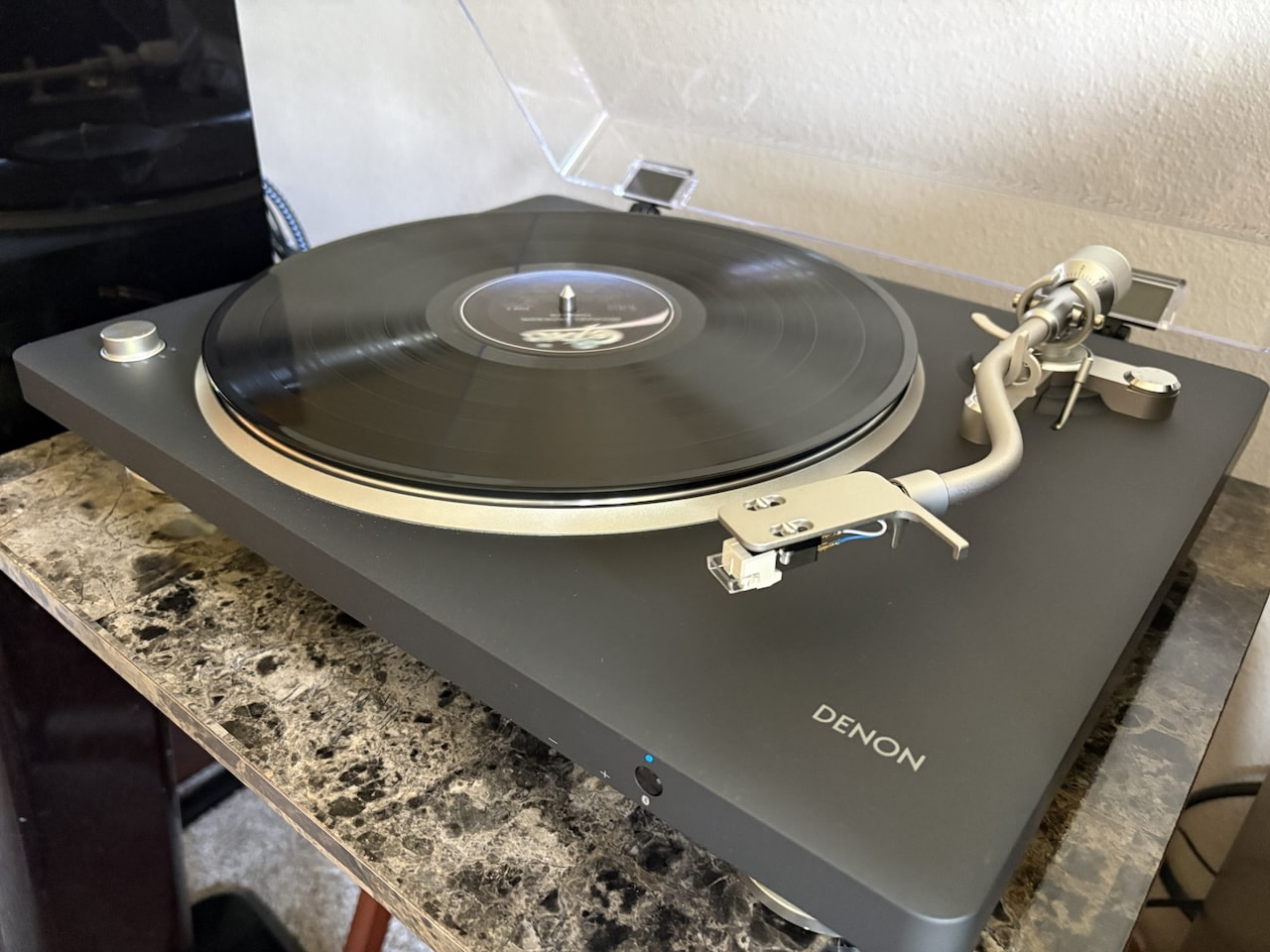
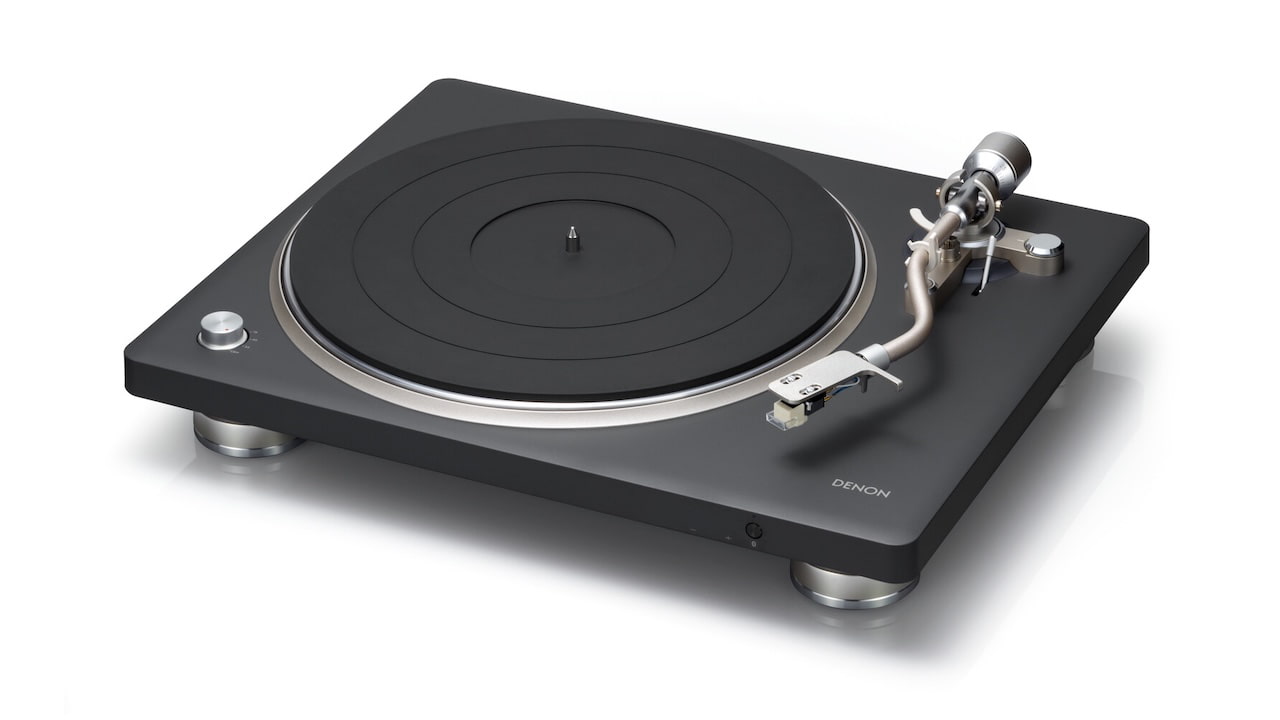
Once assembled, the DP-500BT is, in a word, gorgeous. A modern counterpoint to my more retro-styled wood-plinth U-Turn Orbit Theory reference table, Denon’s industrial elegance is no less striking. Little touches like the beaded silver tonearm and machined-aluminum control dials set against the slate gray chassis catch the eye without looking ostentatious.
Speaking of the control dial, this is one of the few turntables I’ve tested that supports all record sizes and types you’ll come across, including 78, 45, and the more common 33 1/3 RPM. You’re not likely to find many 78s these days, but it’s nice to have options for older shellac records, am I right? On the plinth’s right side, you’ll find a key for engaging and pairing Bluetooth and, underneath, mercurial control keys for volume output. More on that later.
The DP-500BT’s semi-automatic operation doesn’t fully return the tonearm, but it will pause the motor and raise the DSN-85 stylus when it reaches the lead-out groove at the end of the side, which is particularly useful if you plan to connect it to a multi-room system like Denon’s HEOS speakers over Bluetooth.
An internal phono-preamp at the back (labeled “Equalizer”) is another obvious inclusion for this design, raising the turntable’s phono output to line level for connection to newer audio systems by default. You can bypass it if you’re connecting a high-end preamp or amplifier with a quality phono preamp built in, but in testing, the internal option proved solid enough, roughly on par with my Rolls VP-29 outboard preamp.
The table’s die-cast aluminum platter, hefty and stable chassis, and S-shaped tonearm are all designed to minimize distortion and vibration for clean reproduction of your catalog.
Listening
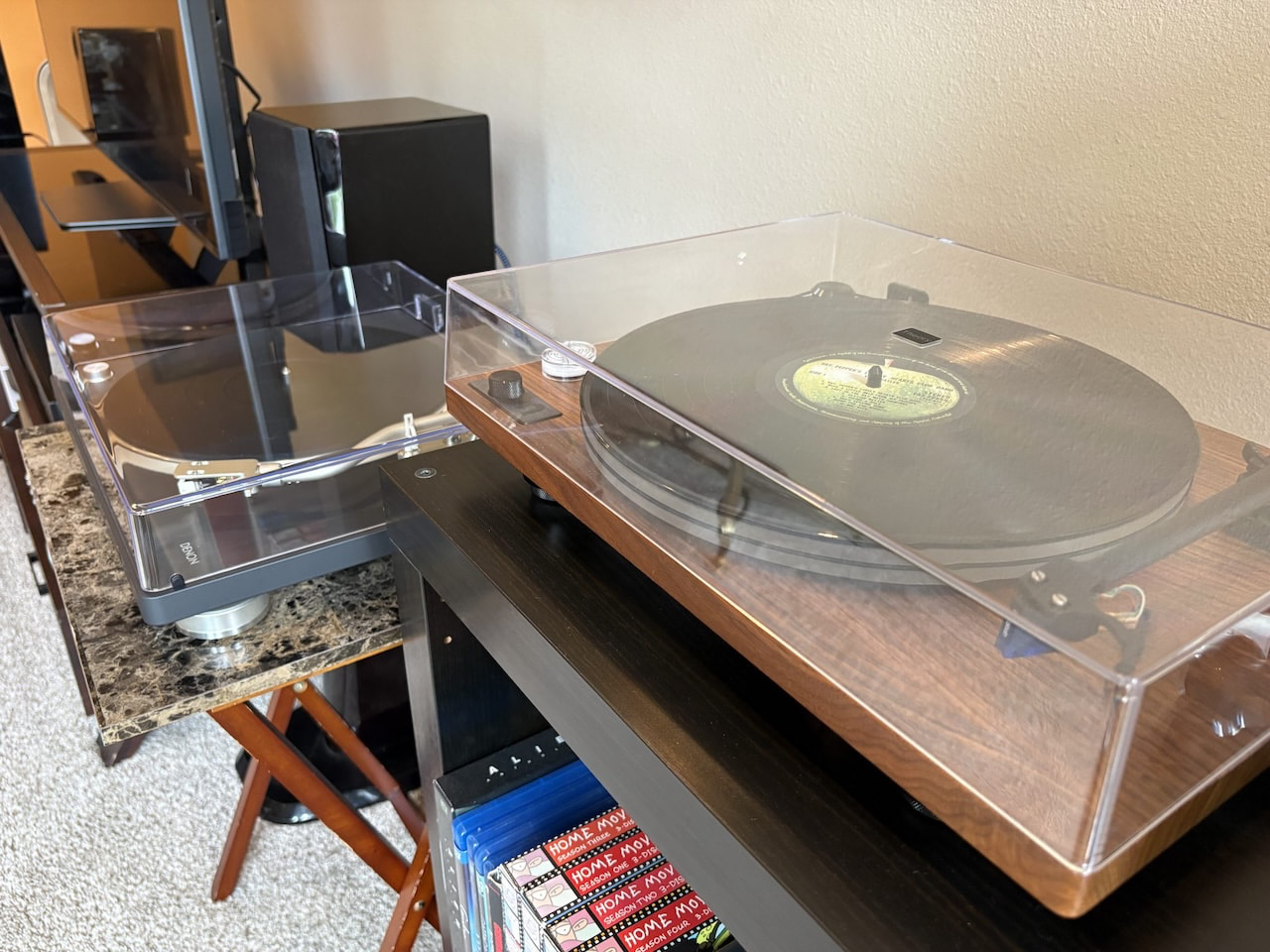
The DP-500BT sounded quite good across my collection, though it was clear right away that it doesn’t offer the same level of expression, instrumental definition, or overall dimensionality as the Orbit Theory that holds court on my console. That’s not too surprising considering that the Theory costs $180 more with the included phono preamp and comes fitted with the Ortofon 2M Blue, a better-quality moving magnet cartridge than Denon’s bundled DSN-85.
What the Theory does not offer, however, is the DP-500BT’s semi-automatic tonearm operation or Bluetooth support, which are the features that make Denon’s table more flexible for a different kind of listener.
For its part, the DP-500BT did a relatively impressive job with my favorite reference records over my midrange SVS 2.1-channel listening station, including a pair of Prime Wireless Pro speakers and a 3000 Micro Subwoofer. Hallmarks include smooth tonal delivery, good balance from bass through treble, and enough touch and articulation to elevate your best pressings.
My modern pressing of Brubeck’s Take Five is always a good starting point, and the deck didn’t disappoint. There was plenty of vibrant color to Joe Morello’s snazzy snare and firm gravitas to his tom rolls and bass drum, matched by sweet yet creamy resonance in the middle keys of Dave’s piano. The first track, “Blue Rondo,” readily reveals the breathy reed work of Desmond’s sax solo and standout tracking of the little tonal shifts as he moves around the mic.
Throwing on some indie rock in Fruit Bats’ Absolute Loser, I was pleased by the stereo spread, providing clear delineation between the many dual guitar lines, some lovely jangle to the banjo in “Humbug Mountain Song,” and extended swells from the album’s many pad synths for an immersive overall soundstage.
Moving to more challenging, warped records, like my vintage pressing of Magical Mystery Tour, the DP-500BT did well limiting wow fluctuation, or the little tonal variations on dodgier records that are easily revealed by budget turntables, even as I could see the needle riding the waves up and down. There was a lovely sweep as the bus flies across the stereo image in the title track, a crisp crunch to the left-side percussion with just enough psychedelic swirl, and a cohesive presentation of the bright, slightly playful brass in the right channel.
Again, switching to the Orbit Theory provided a more engaging and expressive performance, bringing out more color and definition to each guitar and vocal line, better crunch in the snare and cymbals, and more satiny flavor to the horns. Still, the DP-500BT does a fine job and is well suited for a mid-tier audio setup, with enough ceiling to step up as needed, especially if you’re willing to swap out the cartridge down the line for something fancier.
Bluetooth/Multi-Room Streaming: I Finally Get It

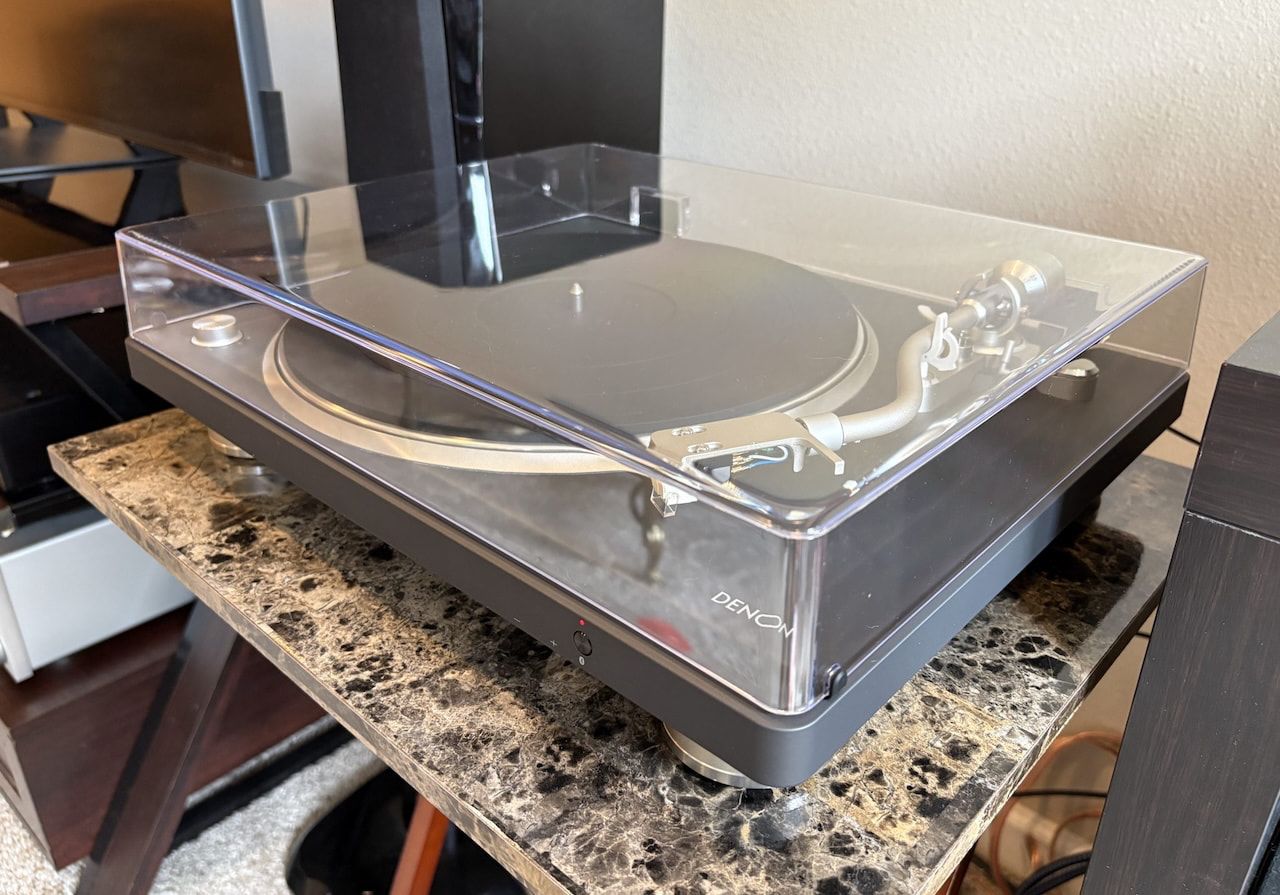
I’ve long been baffled by mostly budget turntables designed to stream over Bluetooth. Even in the digital age, when the latest pressings often cater to music recorded in 1s and 0s, it always seemed counterintuitive to me to listen to analog media through a digital format that, by its nature, runs against the whole point of playing records in the first place. After spending a few weeks with the DP-500BT, I started to understand the appeal.
For starters, connecting to a Bluetooth speaker is surprisingly simple. Just hold down the Bluetooth key until the blue pairing light flashes, do the same on your desired speaker or system, and they should automatically pair. The only issue I ran into when using Denon’s Home 400 speaker was that the volume was too low at first, and both times I tried to use the table’s onboard volume, it shot up way too loud. Suffice it to say, I controlled volume from the speaker directly or via Denon’s HEOS multi-room app from then on.
Otherwise, while Bluetooth will never be my preferred way to experience vinyl, it does offer real convenience while preserving much of what makes playing records appealing in the first place. You’re getting the core of vinyl’s tactile ritualism: diving through the original artwork and lyrics, going hands-on with the media, and dropping the needle in a groove, all big parts of the appeal.
Moreover, vinyl’s demand for album-forward listening provides a very different experience from streaming services that cater to singles or playlists, essentially forcing you to cover deeper musical territory.
From a performance standpoint, regardless of the limitations of compressed streaming, what isn’t lost here is the original mix and pressing of each record, providing a distinctive sonic experience that preserves its time and place. My 1984 reissue of Michael Jackson’s Thriller sounds very different from the latest remaster, with smoother, fuller bass and a more rounded midrange, while still providing that fabulous snap to the snare on its seminal classic, “Billie Jean.”
My older and more worn-down records sound soft and fuzzy. My brighter and cleaner pressings, from Brubeck to my ‘70s Japanese Beatles pressings, all sounded, well, brighter and cleaner.
To take things up a level, the DP-500BT supports aptX, aptX HD, and aptX Adaptive, designed for “HD quality” audio. That’s especially great for aptX-ready wireless headphones, like Bowers & Wilkins’ Px7 S3 or high-end Bluetooth setups. Oddly, Denon’s own Home speakers do not appear to support aptX (the turntable’s LED goes from Blue to Purple with aptX). Even so, they did well with the basics, and more notably, connecting to Denon’s Home 400 allowed me to pass the sound over its HEOS multi-room system to other speakers via Wi-Fi, like the Home 200, for a whole-home experience.
And thanks to the table’s semi-automatic return, you can step away and control volume remotely without having to worry about the needle getting trashed if you can’t get back to change it right away. When supplementing a traditional wired setup, the system’s versatility had me listening in more ways, more often.

The Bottom Line
Denon’s DP-500BT is an incredibly flexible turntable, offering multiple ways to play, especially with a compatible whole-home audio setup, without skimping on performance. You can get superior sound quality at similar pricing with options like the U-Turn Orbit Theory, but few turntables I’ve encountered provide such a good balance between versatile playback and hi-fi performance, all at a relatively attainable price point.
Better still, listeners using the wired output can improve performance further by upgrading to a higher-quality moving magnet cartridge, such as the Ortofon 2M Blue or the new Grado Prestige Gold4.
For serious vinyl fans looking to stretch out into wireless streaming, and especially those already invested in options like Denon’s latest Home speakers, the DP-500BT is a great buy that sounds nearly as good as it looks.
Pros:
- Excellent build quality
- Intuitive setup and operation
- Gorgeous design
- Clear and balanced tonal performance
- Versatile wireless playback with aptX
Cons:
- Oddly touchy volume control over Bluetooth
- Sound is bested by similar wired-only turntables
- Included phono pre and cartridge are good not great
Our Ratings
★★★★★★★★★★ Performance
★★★★★★★★★★ Usability
★★★★★★★★★★ Build Quality
★★★★★★★★★★ Value
You must be logged in to post a comment Login