Tech
Do We Need an 8K Media Player? Kaleidescape Says, “YES!” with New Strato K

As TVs and projectors have evolved over the years, detail or “native resolution” was one spec that drove the market forward. 480i analog CRT TVs were replaced by 720P and 1080i digital HDTVs, which soon were replaced by 1080p HDTVs as the standard in around 2005. Just under 10 years later, 4K TVs were introduced to the consumer market, leading to a new wave of upgrades. More pixels meant more detail, and more detail meant a sharper picture, particularly as screen sizes grew from 27 inches to 55 inches to 85 inches to over 100 inches. FOMO on the highest resolution TVs drove a lot of TV owners to upgrade to the latest, greatest, biggest, most pixel-packed new models.
Just How Many Ks Do You Need?
But a funny thing happened on the road to “more Ks.” As 4K TVs became more common, and increased competition lowered the profit margins, TV makers tried their hands at the resolution upgrade game again with the introduction of 8K TVs. To put things in perspective, 4K TVs (3840×2160 pixels) have four times the detail of 1080p TVs (1920×1080 pixels). And 8K TVs (7680×4320 pixels) have four times the detail of 4K TVs. But it turns out that consumers were quite happy with 4K resolution and most were not willing to pay the premium for an 8K TV, particularly with no native 8K content to play on them.
Consumers started to notice that other picture quality elements – like contrast, black levels, color saturation and color gamut – mattered more than resolution for overall picture quality, even on massive 100+ inch screens. So most TV and projector makers, pulled back on 8K support, focusing instead on other differentiating factors like Quantum Dots, Local Dimming, Micro LED backlighting and RGB backlighting for LCD TVs and, of course, OLED and QD-OLED technology for pixel perfect black levels. Projector makers mostly switched from lamp-based illumination to laser lighting engines, which not only improves peak brightness and contrast, but also lasts much longer than traditional bulbs.
Putting the HIGH in High Dynamic Range
With the introduction of 4K/UHD standards, another important element of picture quality was improved, called “Dynamic Range.” This is the difference between the darkest black and the brightest white or color that can be encoded into the movie or TV show. Standard Definition movies and High Definition movies, even those on physical media such as Blu-ray Disc, are significantly limited in their dynamic range, with most movies encoded and mastered for a a peak brightness of only 100 nits. This means the picture can only get so bright, limited by the content itself.
Meanwhile 4K/UHD content supports a much higher range of values between deepest black and peak brightness. This is known as HDR (High Dynamic Range) and it allows 4K movies and TV shows to be much more dynamic, with fine details visible on screen in both the dark shadows and in the brightest areas of the screen. 4K/HDR titles are frequently mastered for a peak brightness of 1,000 nits or 4,000 nits. There are even some HDR titles mastered for 10,000 nits of peak brightness.
Today, TV manufacturers’ support for 8K resolution has virtually disappeared, at least in North America. There are still some displays that support native 8K resolution but they’re few and far between. On the flat panel side, Samsung still has a few TVs that offer native 8K resolution. On the projector side, select home theater projectors from JVC also support native 8K video, displaying it in 8K resolution via pixel shifting technology on their native 4K projectors with 8K eShift.
But there is still apparently some support for 8K from within the industry itself, manifesting itself in the shape of an industry trade group, formed in 2019, known as the “8K Association.” The “8KA” is dedicated to establishing standards and increasing adoption of 8K resolution in all aspects of the video reproduction chain, from the software itself to media players to display devices including TVs and projectors.
Not Just 8K, But Better 4K
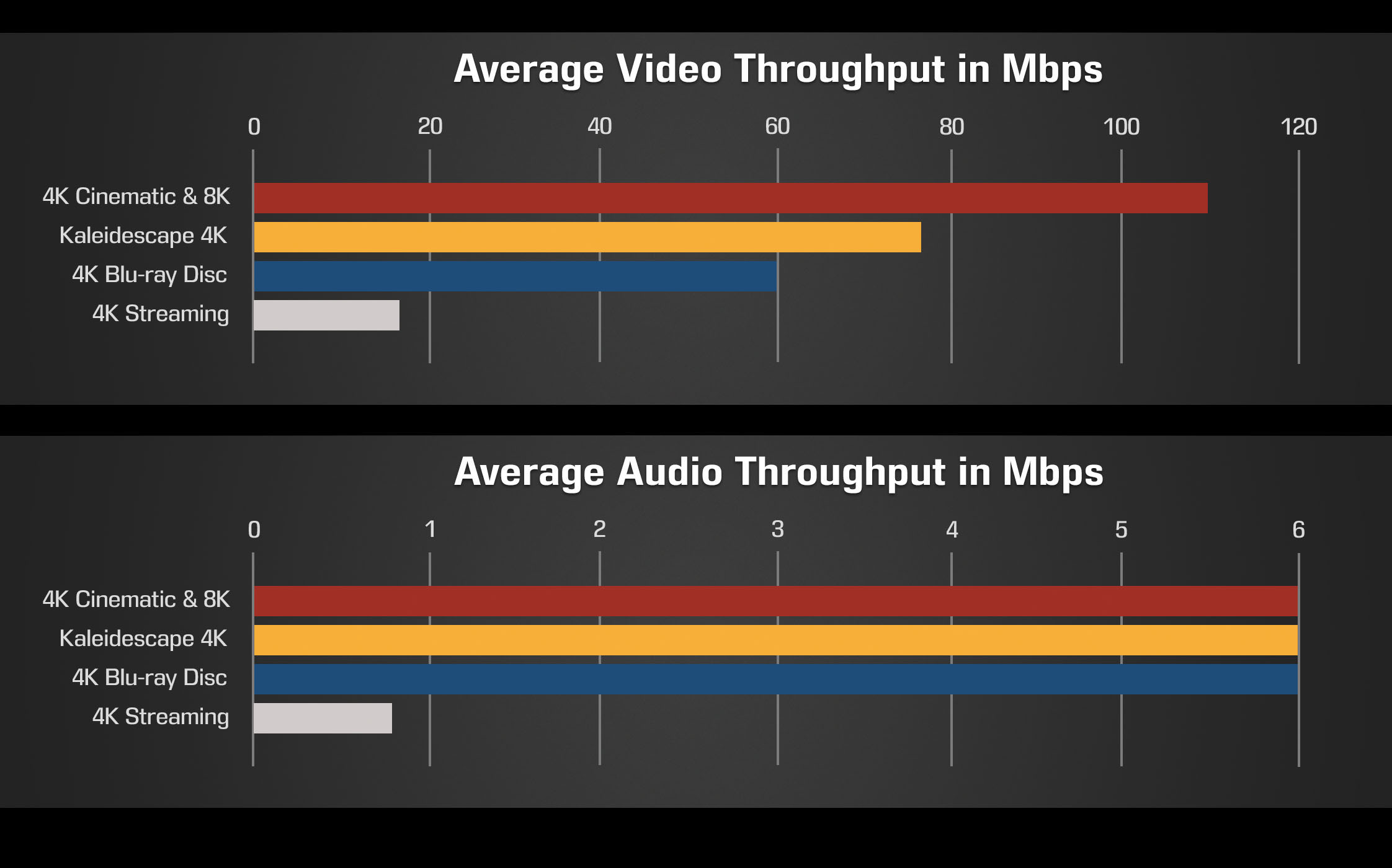
Today, Kaleidescape, provider of premium media players and its own digital movie ecosystem, has just announced its first 8K-capable media player, the Strato K ($4,995). The Strato K is not only the first Kaleidescape player to support native 8K movies and TV shows, but it also supports a new higher fidelity 4K media format, called “4K Cinematic.” 4K Cinematic mode offers full 4:4:4 chroma encoding, and much higher bitrates, even compared to Kaleidescape’s current 4K UHD offerings. 4:4:4 chroma encoding and higher bitrates lead to better color detail, crisper images and fewer of the egregious video artifacts that plague low quality streaming sources.

The new Kaleidescape Strato K is the first movie player certified by the 8K Association that meets the performance and interoperability requirements developed by the Association’s Technical Working Group. In addition to Kaleidescape, 8KA members include leading companies such as Panasonic, Samsung and Xperi, along with other contributors to the 8K ecosystem.
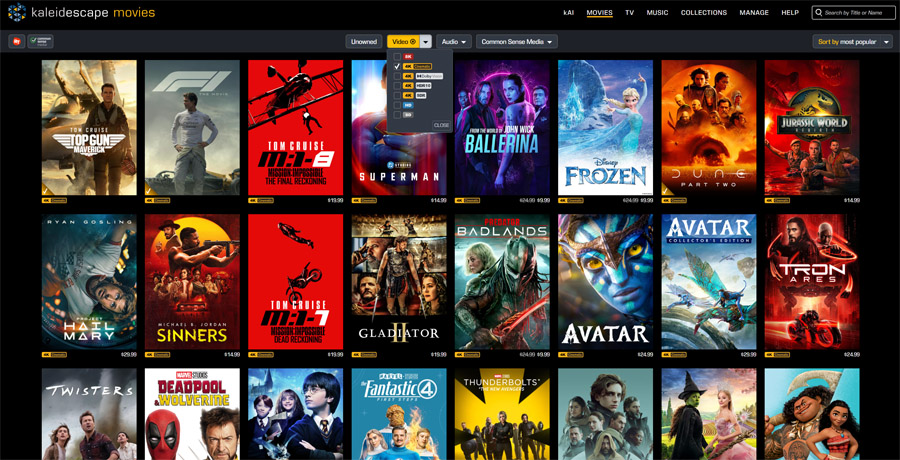
According to Kaleidescape, there are already over 150 titles available in the Kaleidescape movie store in 4K Cinematic format. 8K content licensing is also in the works, but 8K title selection is very limited at this time.

In Kaleidescape CEO Tayloe Stansbury’s words, “Kaleidescape’s Strato K is the world’s highest-fidelity movie player. It brings movie lovers closer to the filmmaker’s intent, with cleaner detail, true-to-life color, and a more natural presentation that dramatically improves the viewing experience of any display.”

Strato K is available now for pre-order, at $4,995 US MSRP. In addition, with Strato K’s release, the current flagship Strato V player’s price has been lowered from $4.495 to $3,995 (US MSRP).

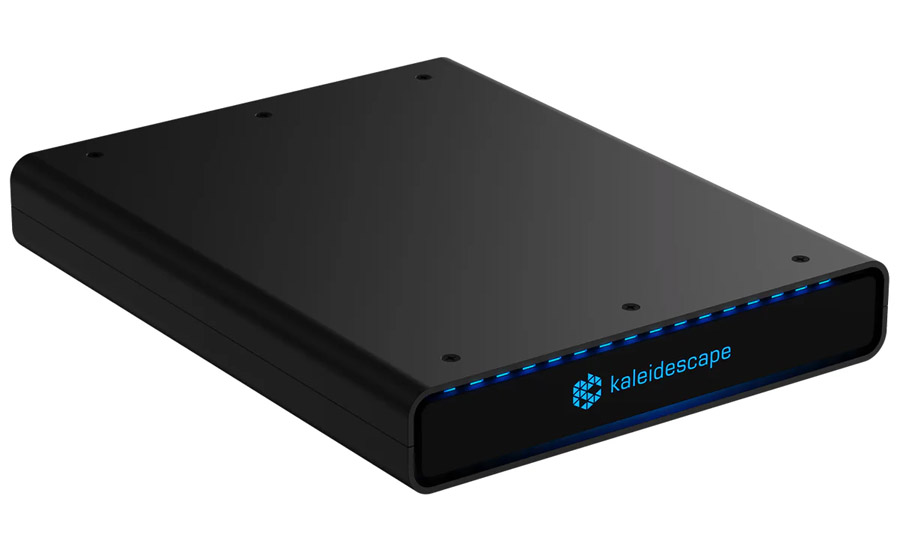
The Strato K features a compact form factor, similar in size and general design to the Strato V, but not quite as compact as the Strato E and Strato M. Like the other recently introduced players, the Strato K can operate as a standalone player. Its internal one terabyte (1 TB) solid state drive can store a handful of movies in 4K, 4K Cinematic or 8K formats. For more dedicated movie lovers and collectors, Strato K can be grouped with one or more Kaleidescape Terra movie servers to add movie storage and provide whole-home entertainment.
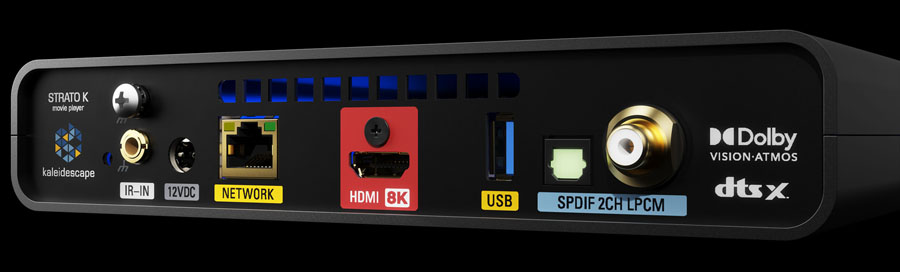
Like the Strato V, the Strato K supports Dolby Vision dynamic HDR as well as HDR10. Movies and TV shows are available in the Kaleidescape movie store in 8K, 4K Cinematic, 4K, and 2K with lossless multichannel and object-based audio, including Dolby Atmos and DTS:X.
The Kaleidescape Strato K player will make its public debut later today (June 18, 2026) at a special event hosted by the SMPTE Hollywood Section and the 8K Association in the Amazon Culver Theater’s 8K screening room.
Comparison Highlights


| STRATO E | STRATO M | STRATO K | STRATO V | |
| Product Type | Entry-Level 4K Movie Player | Reference 2K Movie Player | 8K Movie Player | Flagship 4K Movie Player |
| Price | $2,995 | $1,995 | $4,995 | $3,995 |
| Internal Storage | 480GB | 480GB | 960GB (SSD) | 960GB (SSD) |
| Group Storage | Compatible with content stored on a Terra Server when connected and grouped via a local network | Compatible with content stored on a Terra Server when connected and grouped via a local network | Compatible with content stored on a Terra Server when connected and grouped via a local network | Compatible with content stored on a Terra Server when connected and grouped via a local network |
| Media | Kaleidescape movie store downloads: 4K Dolby Vision, 4K HDR10, 4K SDR, HD, SD | Kaleidescape movie store downloads: HD, SD | Kaleidescape movie store downloads: 8K, 4K Cinematic, 4K Dolby Vision 4K HDR10, 4K SDR, HD, SD |
Kaleidescape movie store downloads: 4K Dolby Vision 4K HDR10, 4K SDR, HD, SD |
| Video Resolution Input Compatibility | 2160p60/50/30/25/24
1080p60/50/24 1080i60/50 720p60/50 576i, 576p, 480i, 480p |
2160p60/50/30/25/24
1080p60/50/24 1080i60/50 720p60/50 576i, 576p, 480i, 480p |
4320p60/50/30/25/24
2160p60/50/30/25/24 1080p60/50/24 1080i60/50 720p60/50 576i, 576p, 480i, 480p |
2160p60/50/30/25/24
1080p60/50/24 1080i60/50 720p60/50 576i, 576p, 480i, 480p |
| Video Output (HDMI) | HDMI 2.1 (with HDCP 2.3 Copy-Protection | HDMI 2.1 (with HDCP 2.3 Copy-Protection | HDMI 2.1 (with HDCP 2.3 Copy-Protection | HDMI 2.1 (with HDCP 2.3 Copy-Protection |
| Output Resolution | Up to 4K (3840×2160 pixels) | Up to 2K (1920×1080 pixels) | Up to 8K (7680×4320 pixels) | Up to 4K (3840×2160 pixels) |
| HDR Support | Dolby Vision (standard and low latency) and HDR10 (SMPTE ST 2084, 2086) | Dolby Vision (standard and low latency) and HDR10 (SMPTE ST 2084, 2086) | Dolby Vision (standard and low latency) and HDR10 (SMPTE ST 2084, 2086) | Dolby Vision (standard and low latency) and HDR10 (SMPTE ST 2084, 2086) |
| Audio Output | HDMI 2.1 (combined with video) | HDMI 2.1 (combined with video) | HDMI 2.1 (combined with video) Digital Audio (coaxial RCA and TOS link connectors) |
HDMI 2.1 (combined with video) Digital Audio (coaxial RCA and TOS link connectors) |
| Audio Format / Surround Sound Support via HDMI | Dolby Atmos
Dolby TrueHD Dolby Digital Plus Dolby Digital DTS:X DTS-HD DTS-HD High Resolution Audio DTS Digital Surround PCM (up to 7.1ch, 96kHz/24-bit)PCM (up to 7.1ch, 96kHz/24-bit |
Dolby Atmos
Dolby TrueHD Dolby Digital Plus Dolby Digital DTS:X DTS-HD DTS-HD High Resolution Audio DTS Digital Surround PCM (up to 7.1ch, 96kHz/24-bit)PCM (up to 7.1ch, 96kHz/24-bit |
Dolby Atmos
Dolby TrueHD Dolby Digital Plus Dolby Digital Dolby MAT PCM DTS:X DTS-HD Master Audio DTS-HD High-Resolution Audio DTS Digital Surround PCM (up to 7.1ch, 96kHz/24-bit) |
Dolby Atmos
Dolby TrueHD Dolby Digital Plus Dolby Digital Dolby MAT PCM DTS:X DTS-HD Master Audio DTS-HD High-Resolution Audio DTS Digital Surround PCM (up to 7.1ch, 96kHz/24-bit) |
| Audio Format Support via Digital Coaxial/Digital Optical | – | – | Dolby Digital DTS Digital Surround PCM (2ch, up to 96kHz/24-bit) |
Dolby Digital DTS Digital Surround PCM (2ch, up to 96kHz/24-bit) |
| Control Support | Kaleidescape remote (not included) Front-panel IR receiver window IR input (1/8in mini plug) Kaleidescape control protocol over Ethernet (supported by Josh.ai, Crestron, AMX, Control4, Savant, the Kaleidescape apps, and other apps & control systems) |
Kaleidescape remote (not included)
Front-panel IR receiver window IR input (1/8in mini plug) Kaleidescape control protocol over Ethernet (supported by Josh.ai, Crestron, AMX, Control4, Savant, the Kaleidescape apps, and other apps & control systems) |
Kaleidescape remote (not included)
Front-panel IR receiver window IR input (1/8in mini plug) Kaleidescape control protocol over Ethernet (supported by Josh.ai, Crestron, AMX, Control4, Savant, the Kaleidescape apps, and other apps & control systems) |
Kaleidescape remote (not included)
Front-panel IR receiver window IR input (1/8in mini plug) Kaleidescape control protocol over Ethernet (supported by Josh.ai, Crestron, AMX, Control4, Savant, the Kaleidescape apps, and other apps & control systems) |
| Dimensions (WHD) | 6.4 x 1.1 x 6.4 inches | 6.4 x 1.1 x 6.4 inches | 7.87 x 1.52 x 10 inches | 7.87 x 1.52 x 10 inches |
| Weight | 1.6 lbs | 1.6 lbs | 4.2 lbs | 4.2 lbs |


The Bottom Line
While interest and excitement around 8K resolution has waned (perhaps for good reasons), we’re happy to see Kaleidescape pushing the quality of media toward to its current limits. With support for both 8K resolution and for higher quality “4K Cinematic” content, and with bit rates and color reproduction that exceed even the highest quality physical media, the Strato K looks like an impressive addition to the line. If you’re looking for a high quality movie player with an eye toward the future, the Strato K is worth checking out.
You must be logged in to post a comment Login