Tech
Do You Need To Sharpen Both Sides Of A Lawn Mower Blade?


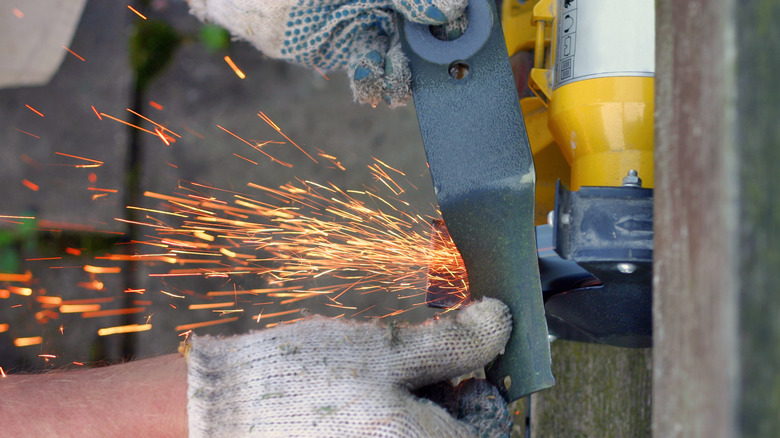
A conventional mower blade has one defined cutting edge. That is the only edge that needs to remain sharp for the proper functioning of the mower. This means there’s no need to sharpen both sides of a lawn mower blade, just its single cutting edge. That said, it does not mean the overall shape and structure of the rest of the blade is unimportant. The temptation when sharpening is to grab a grinder, knock the burr down to a roughly eyeballed edge, and leave behind a “near enough is good enough” bevel. It looks sharp, so it must be good to go, right? Well, unfortunately, that’s not necessarily the case.
A mower blade has a particular shape and weight distribution for a reason. The leading, bladed edge has to cut grass, but the remainder of the blade also has to move air, lift grass into the cutting path, and propel the clippings toward the discharge chute or catcher. Changing its shape unnecessarily can create an imbalance affecting how it performs, and more crucially, how smoothly it spins.
This is why sharpening a mower blade is so much more than simply putting a rough edge on a simple blank. You are maintaining the balance and structural integrity of a critical piece of a high-speed rotating system. The cutting edge needs to be sharp, but it also needs to remain within the necessary bounds of the manufacturer’s intended specifications. Changing angular geometry through tapering can lead to asymmetrical chord length (the distance from the blade’s leading edge to its trailing edge) and have disastrous follow-on effects, as can removing significantly more material from one blade than another.
Sharpen the cutting edge, not both sides, but also do not mistake that simple answer for a simple job. Underneath that mower deck, there is considerably more going on than meets the eye.
Bernoulli’s principle in action under the deck
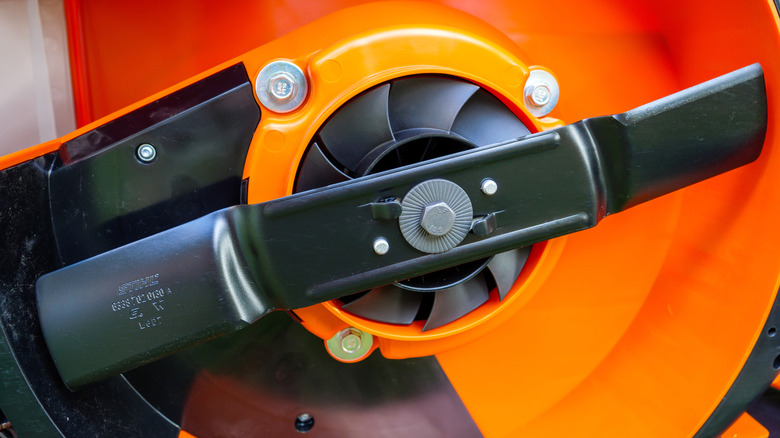
A frequent misconception about lawn mowers is that the ubiquity of their presence is misconstrued as simplicity in their design and operation. People tend to assume that because every yard has a Stihl or a Craftsman to keep the grass trimmed that the production and operation of a lawn mower is inherently simple. The engine runs the spindle, the spindle rotates the blades, the blades cut the grass; it’s hardly rocket science. This isn’t helped by the fact that the complex work the mower is doing is generally hidden away under the deck.
However, mower blades are far more than jagged lumps of pig iron. In reality, the cutting edge is generally the simplest aspect of the blade. While it just has to stay sharp and balanced, the trailing edge of a mower blade is shaped specifically to move air, generating a pressure differential as it rotates. Using the same process that an aircraft’s airfoil applies to generate lift, lawn mowers use Bernoulli’s principle to pull individual blades of grass upward, ensuring a smooth, even cut with each pass.
This is where the complexity of mower blade design lies. Lifting grass for cutting and clearing it once the blade has made its pass requires a smooth and controlled flow of air. With a basic, unshaped cleaver blade, a mower would more than likely push the grass flat rather than cut it, or very quickly fill the deck with clippings that had nowhere to go.
Balance matters at 3,000 RPM

Lawn mowers rely on extreme rotational velocity. Unlike more controlled or deliberate cutting mechanisms, lawn mower blades rely on impulse shearing. This style of cutting is where materials are severed or partitioned using a sudden and highly concentrated burst of localized energy far beyond the shear strength of the object. For something as light and flimsy as individual blades of grass, achieving an impulse cut before they have the chance to sway or bend away from the cutting edge is essential.
To achieve this, a typical mower blade will rotate at approximately 3,000 rpm, with blade-tip speeds potentially exceeding 200 mph depending on the blade’s length and the mower’s operating speed. At those velocities, a blade weighing only a couple of pounds is capable of generating considerable force, which is why you need to be careful what you run over with a lawn mower. Anyone familiar with high-speed rotors will know that when these kinds of forces are in play, balance matters.
This means sharpening one side of the blade doesn’t involve simply attacking it with a grinder until it looks sharp. A botched edge causing a tiny difference in weight or shape can generate a significant imbalance. That imbalance can have devastating consequences, anywhere from operator discomfort and excessive machine wear to a blade being thrown with 2,100 foot-pounds of kinetic energy. That’s three times the muzzle energy of a .357 Magnum.
Lawn mower blades have one cutting edge that requires sharpening. They have a lift wing or trailing edge that does not require sharpening, but should be checked for damage or warping. The entire blade should also be balanced to ensure safe operation. 2,100 foot-pounds is a lot of uncontrolled energy should your mower decide to throw a blade. Don’t give your Cub Cadet the opportunity to outperform a Colt Python.
You must be logged in to post a comment Login