Connect with us

Tech

Don’t Get Used To Cheap AI

Published

on

AI services may not stay cheap for long, as companies like OpenAI and Anthropic are currently subsidizing usage to rapidly grow market share. As these companies move toward profitability and potential IPOs, Axios reports that investors will likely push them to increase prices and improve margins. An anonymous reader shares an excerpt from the report: Flashback: Silicon Valley has seen this movie before. The so-called “millennial lifestyle subsidy” meant VC money helped underwrite cheap Uber rides and DoorDash deliveries. Before that, Amazon built its base with low prices, free shipping and, for years, no sales tax in most states. Eventually, all of these companies had to charge enough to cover costs — and make a profit.

Follow the money: The current iteration of AI subsidies won’t last forever. Both OpenAI and Anthropic are widely expected to go public. Public investors will demand earnings growth and expanding margins. Even as chips get more efficient, total spending keeps rising. Labs need more capacity, more upgrades and more supply to meet demand.

The bottom line: The costs of AI will keep going down. But total spend from customers will need to keep going up if AI companies are going to become profitable and investors are ever going to get returns on their massive investments.

Source link

Advertisement
Continue Reading
Click to comment

Leave a Reply

Your email address will not be published. Required fields are marked *

Tech

Irish workplace benefits market defined by accessibility, finds Morgan McKinley

Published

on

The research shows that younger cohorts often find the path towards greater workplace benefits inaccessible in comparison to their older peers.

Global talent services firm Morgan McKinley has today launched the Ireland 2026 Benefits Guide, which is a comprehensive national study of the way in which benefits are offered by employers, as well as how they are experienced and valued by employees across Ireland’s labour market. 

To compile the data, Morgan McKinley gathered 1,222 employee and employer responses across more than 32 sectors, from organisations dispersed all across Ireland.  What was discovered is that while benefits are often an expectation and technically available, there are issues of accessibility, raising questions about visibility, trust and awareness. 

Mutually beneficial?

Younger cohorts in particular were found to have significantly less access to pension or health schemes, despite 90pc of participating employee respondents reporting being enrolled in an employer-sponsored pension plan. The report said, “This points to a benefits model that remains strongest for established employees, rather than consistently supporting talent from the earliest stages of employment.”

Advertisement

Nearly 62pc of Baby Boomer generation employees said that they have access to a pension plan, as did 77pc of Gen X and 72pc of millennials, compared to just 54pc of Gen Z. 

The report said: “While this pattern may partially reflect variances in tenure and contractual stability, for example temporary versus permanent roles, it is likely also influenced by eligibility criteria or employer matching structures that defer enrolment for junior or early-career employees. 

“In  certain organisations, minimum service requirements or mandated contribution thresholds can act as a barrier, preventing younger employees from fully utilising pension benefits during their early career stages.”

The opportunity for hybrid work was also shown to be unequally distributed among employees, with those in the Gen X (63pc) and millennial (62pc) categories reporting higher availability than their younger Gen Z (44pc) and older Baby Boomer (29pc) peers. 

Advertisement

“This difference suggests that access to hybrid working may vary by role or level within organisations, with younger employees less likely to report receiving these benefits. The findings indicate that, even where hybrid working is available at an organisational level, it may not be experienced equally across all employee groups,” the report said. 

Bonus and incentive schemes also highlighted the disparity in the access to benefits between certain age demographics. For those in the middle of their careers – Gen X (63pc) and millennials (64pc) – the report indicated that there is better access to bonus and incentive schemes.  

But to the detriment of the Baby Boomer (48pc) and Gen Z (42pc) employees, the research indicated that there is a concentration of performance-related pay within mid-career roles, where professionals are more likely to hold positions directly linked to business outcomes.

Interestingly, benefits considered to be specialised, such as menopause leave, menstruation leave, childcare benefits, rental support and unlimited paid time off, were shown to have a limited uptake across all generations, suggesting minimal exposure.

Advertisement

The report said, overall, that generational analysis suggests that patterns of employees receiving benefits are closely linked to career stage and the way eligibility is applied within organisations. 

“Although core benefits are widely reported across the workforce, variation in access among younger and more junior employees points to the need for employers to review eligibility rules and how benefits are communicated, so that entitlements are easier to understand and more consistently experienced across a multi-generational workforce.”

Long-term impact

More than two-thirds of participating employees (68pc) stated that the benefits provided by their employer, as part of the compensation for their work, play a significant role in their loyalty, compared to the 32pc who reported that benefits do not influence this aspect of their career. 

This, according to Morgan McKinley, indicates that, for the majority of employees, benefits form a meaningful part of the overall employment proposition and can influence decisions to remain with an organisation for the long-term. 

Advertisement

But the report also suggested that it isn’t enough to just have benefits available. It is critical that they be relevant to the workforce in question, with “a notable minority expressing dissatisfaction”.

“More than one in four employees (26.8pc) report being either somewhat dissatisfied (17pc) or very dissatisfied (10pc) with their benefits. Given the strong stated link between benefits and loyalty, this dissatisfied cohort represents a potential retention risk, particularly in competitive labour markets where benefits are increasingly used as a differentiator.”

Commenting on the findings of the report, Trayc Keevans, global FDI director at Morgan McKinley, said: “This report shows that the Irish benefits market is no longer defined by how many benefits an employer can list. It is defined by whether those benefits are accessible, understood and aligned with what employees actually value.

“What stands out most is the contradiction. The benefits employees value most for long-term security, particularly pensions and health insurance, are not always reaching people early enough in their careers. In a market shaped by an ageing population and by lifetime community rating in health insurance, that is a strategic issue for employers, not just a design detail.”

Advertisement

Don’t miss out on the knowledge you need to succeed. Sign up for the Daily Brief, Silicon Republic’s digest of need-to-know sci-tech news.

Source link

Advertisement
Continue Reading

Tech

Meta reportedly considering layoffs that could affect 20% of the company

Published

on

Meta is considering major layoffs that could affect 20% or more of the company’s workforce, according to Reuters.

These layoffs could help the Facebook parent company offset its aggressive spending on AI infrastructure, as well as AI-related acquisitions and hiring. Meta employed nearly 79,000 people as of December 31, according to a recent filing.

“This is speculative reporting about theoretical approaches,” a Meta spokesperson said in a statement.

The report comes as many tech companies — most recently Block — have announced sweeping layoffs that they say are necessary as AI automates more work. But some pundits, and even executives like OpenAI’s Sam Altman, have suggested that many of these cuts are “AI-washing,” where executives use AI as cover for other issues, such as over-hiring during the pandemic.

Advertisement

The last time Meta announced layoffs of this scale was in November 2022, when it cut 11,000 jobs, followed by another 10,000 in March 2023.

Source link

Continue Reading

Tech

Colin Furze Gives Skateboarding a Magnetic Lift

Published

on

Colin Furze Magnet Suspension Skateboard
Colin Furze, a self-taught engineer, has a flair for coming up with new ways to use magnets. One comment from a viewer spurred an idea, and he set to work transforming a regular skateboard into something that appears to be just hovering above the ground. He’d already built a bike with magnetic suspension, but he wanted to apply the concept to four wheels, giving the ride a gentle, floating feel without needing standard springs or shocks.


Furze began the project with a standard skateboard, removing the trucks and creating a custom base plate out of aluminum using his trusty plasma cutter. He then used a 3D printer to create customized holders for the magnets at the bottom end. Large disc magnets, roughly 100mm across and 30mm deep, were placed in pairs to push against each other.

Sale


Maxshot Electric Scooter, 8.5″ /10″ /14″ Tire, 16/19/22 Mph Top Speed, 12/16/21/27/28/49/50 Miles Long…
  • 【Dual Suspension and Solid Tire】The 10”honeycomb tires, along with the shock absorbing system, make this electric scooter adults for a smooth…
  • 【LED Display & Smart Control &Lockable】You can check your speed, modes and battery level on the LED digital display. check and control the…
  • 【Powerful Motor & Long Range】The electric scooter for adults with a 500W brushless hub motor allows for speed up to 22mph. High-capacity…

Colin Furze Magnet Suspension Skateboard
The upper deck received identical holders, and when the two were combined, the repelling forces lifted the riders platform away from the foundation. The problem was getting everything to stay in one piece while still allowing steering. Furze tried several ways. At first, he just used pins to connect the two halves of the board, but this was not very smooth. Then he tried utilizing square guide tubes with bearings inside to reduce friction. Even attempted attaching a hinge on one end and running tensioned cables between the layers.

Colin Furze Magnet Suspension Skateboard
It took a lot of trial and error; the boards first flexed under weight, so he had to double the base material. He also had to tweak the guides to get them to work properly, as turning requires precise alignment. After a couple complete rebuilds, he was able to resolve the issue, as the connections allowed the top to bounce vertically while passing the twist forces through to appropriately guide the trucks.

Colin Furze Magnet Suspension Skateboard
Riding it seems very different, as if you’re gliding around on an invisible cushion. Road bumps rarely reach your feet. Furze went so far as to glue a glass of water to both the magnetic and conventional boards before rolling them over some rough concrete. The magnetic version kept the water quiet, but the standard board sloshed all over the place.

Colin Furze Magnet Suspension Skateboard
Steering still works by shifting your body around, so it’s not too different from a typical ride on flat ground. The one drawback is that the entire contraption feels lighter than it is, which makes climbing hills difficult, and stopping requires some preparation because there are no brakes.

Advertisement

Source link

Continue Reading

Tech

Instagram is getting rid of its most secure chatting feature

Published

on

Meta is pulling the plug on one of Instagram’s most secure messaging feature, and the company has a good reason for you to accept it. End-to-end encryption (E2EE) in DMs is going away from the popular photos and videos sharing platform after May 8, 2026, i.e., in less than two months. 

For those catching up, E2EE is a feature that encrypts messages so that only the sender and the receiver can see them. No platform, no advertiser, and no government agency gets to peek inside; just the two people messaging each other.

The feature everybody needed, but nobody used?

The feature is widely considered as the most secure form of digital communication that is available to the general public. However, here’s the catch. Critics have long argued that E2EE creates a digital blind spot which isn’t accessible by the tech firms or the police, even when they’re the front for crimes.

A Meta spokesperson said that “very few people were opting in,” for the feature in the first place, which is why the platform has decided to remove it. Further, anyone who wants encrypted chats can switch to WhatsApp

To be real, Meta never made E2EE the default standard on Instagram. It was available as an optional feature in some regions. To activate it, users had to tap on the recipient’s name at the top, select Privacy & safety, and tap on Use end-to-end encryption. Clearly, not a lot of users would appreciate going through a three-step process to enable the feature.

Advertisement

Privacy vs. safety: The E2EE pros and cons debate

The debate has been playing out loudly in a New Mexico child safety trial, where internal Meta documents have revealed executives debating the trade-offs between privacy (encryption) and safety. Even Mark Zuckerberg has acknowledged that safety concerns were among the primary reasons encryption took so long to reach Messenger.

While Instagram is removing the feature it already had, TikTok has refused to add E2EE entirely, specifically citing the risk it poses to safety teams and the law enforcement bodies, who wouldn’t be able to access the messages. 

I remember the backlash that WhatsApp had to face back in 2021 when it decided to share users’ conversations with business accounts to advertisers, but what’s happening with TikTok now is a rare event. Critics are actually appreciating the company for not introducing E2EE conversations. 

Advertisement

Source link

Continue Reading

Tech

Off-Grid Electricity And Hot Water From Scrap Wood

Published

on

Cooking with charcoal is a fairly common human activity, as much as others have come to prefer fuels like propane and propane accessories for their outdoor, summertime grilling. Although it’s made from wood, it has properties that make it much more useful for cooking — including burning at a higher temperature and with more consistent burn rates. It can also be used as a fuel for generating heat and electricity, but since it’s not typically found lying around in the forest it has to be produced, which [Greenhill Forge] has demonstrated his charcoal production system in one of his latest videos.

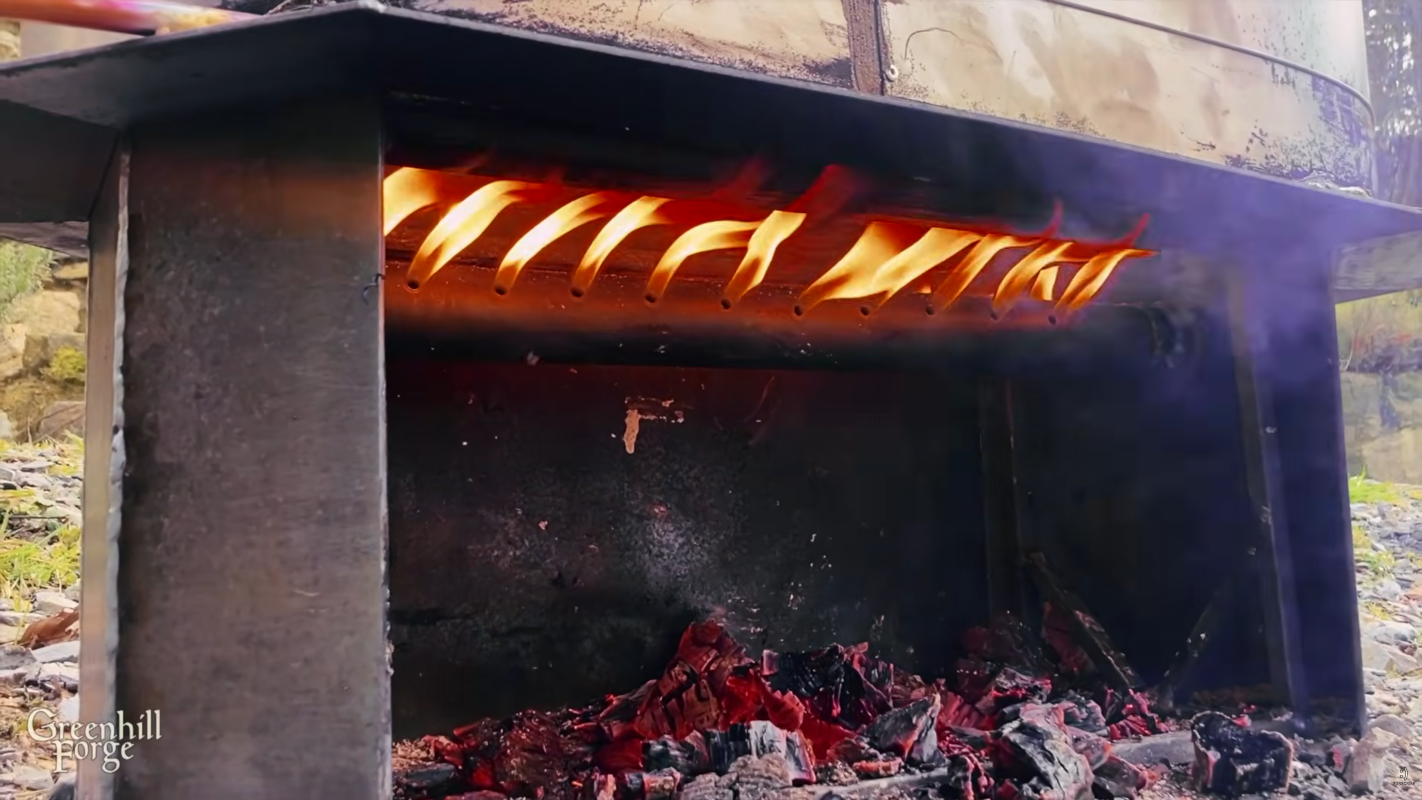
The process for creating charcoal is fairly simple. All that needs to happen is for wood to be heated beyond a certain temperature in the absence of oxygen. At this point it will off-gas the water stored in it as well as some of the volatile organic compounds, and what’s left behind is a flammable carbon residue. Those volatile organics are flammable as well, though, so [Greenhill Forge] uses them to heat the wood in a self-sustaining reaction. First, a metal retort is constructed from a metal ammo box, with a pipe extending from the side and then underneath the box. A few holes are drilled in this part, and the apparatus is mounted above a small fire on a metal stand. With the fire lit the wood begins heating, and as it heats these compounds exit the pipe and ignite, adding further fuel to the fire. Eventually the small fire will go out, allowing the retort to heat itself on the gasses released from the wood alone.

To generate the hot water, [Greenhill Forge] has taken an extra step and enclosed the retort in a double walled metal cylinder. Inside the cylinder is a copper tube packed in sand, which harvests the waste heat from the charcoal production for hot water. In his test runs, the water in a large drum was heated to the point that the tubing he used for the test began to melt, so it is certainly working better than he expected.

Advertisement

After the retort cools, [Greenhill Forge] uses the charcoal in another process that generates about a days’ worth of electricity and hot water. It’s part of a complete off-grid system that’s fairly carbon neutral, since trees are an abundant renewable resource compared to fossil fuels. Heating with wood directly is still common in many cold areas around the world, with the one major downside being the labor required to keep the stove running. But we’ve seen at least one project which solves this problem as well.

Advertisement

Source link

Continue Reading

Tech

David Pogue reveals why Tim Cook wouldn't be interviewed for his book

Published

on

As part of promoting his new book, “Apple: The First 50 Years,” author David Pogue spoke to the AppleInsider Podcast about writing it and just what Apple itself would and would not do to help.

Middleaged man with short gray hair smiling warmly at the camera, wearing a blue blazer and pink shirt, standing outdoors in front of a light-colored house with large windows
David Pogue — image credit: Jesse Ditmar

David Pogue joined William Gallagher for an in-depth discussion of “Apple: The First 50 Years” — now available on Amazon, how it was written — and why. Hear the interview on the latest AppleInsider Podcast, or read this lightly edited transcript.
David Pogue: Guess what? You are the very first person, the very first person not involved with the book to read it and tell me what you think. So that that means the world.
Continue Reading on AppleInsider | Discuss on our Forums

Source link

Continue Reading

Tech

Daily Deal: Luminar Mobile for iOS And Android

Published

on

from the good-deals-on-cool-stuff dept

Luminar Mobile is your all-in-one creative companion designed for iOS, Android OS, and Chrome OS. Powered by an intuitive, touch-responsive interface, it lets you enhance photos effortlessly—anytime, anywhere. Whether you’re adjusting lighting, perfecting portraits, or adding artistic flair, Luminar Mobile delivers pro-level results in the palm of your hand. It’s on sale for $20.

Note: The Techdirt Deals Store is powered and curated by StackCommerce. A portion of all sales from Techdirt Deals helps support Techdirt. The products featured do not reflect endorsements by our editorial team.

Filed Under: daily deal

Source link

Advertisement
Continue Reading

Tech

iFixit MacBook Neo teardown confirms that it is Apple's most repairable laptop since 2012

Published

on

Whether you’re a right-to-repair activist or a school system hoping for the magic combination of power, macOS, and a repairable laptop, the MacBook Neo is a surprisingly satisfying breath of fresh air.

Closed light green Apple MacBook Neo resting on a concrete ledge outdoors, with blurred green grass and scattered leaves in the background
MacBook Neo proves to be quite repairable by Apple’s standards

Apple’s MacBook Neo has already been proven to be quite inexpensive to repair and easy to disassemble. That said, the tech industry was still holding its breath for iFixit’s verdict on the laptop.
As was expected, iFixit found the MacBook Neo to be one of Apple’s most reparable laptops since 2012, if ever. It’s easily accessed, sectioned, and lacks any overly aggressive glue.
Continue Reading on AppleInsider | Discuss on our Forums

Source link

Continue Reading

Tech

Microsoft is bringing an AI helper to Xbox consoles

Published

on

Microsoft’s Gaming Copilot AI Assistant is coming to the Xbox Series X and Series S consoles by the end of this year. It will improve your console experience  by adding an AI-powered helper or assistant.

The announcement comes from Xbox’s gaming AI partner group product manager, Sonali Yadav, at the Game Developers Conference panel. While the feature is already available (in beta) on computers, mobile, and the ROG Xbox Ally, it will, for the first time, expand to consoles (via GamesRadar). 

What does Microsoft’s Gaming Copilot AI Assistant do?

For those catching up, the Gaming Copilot AI assistant is like a friend who has already watched all the walkthrough and the mission videos, never gets tired of your silly questions, and doesn’t judge you for being stuck on the same level or mission for hours. 

Apart from answering your questions about the game or the quest you’re currently on, the gaming assistant can pull up personalised player history and Game Pass subscription details (whenever you need them). 

If you’ve been following our news feed, you already know that Google has already begun rolling out a similar feature.

Advertisement

Xbox isn’t the only one doing this

It’s called the Play Games Sidekick — a Gemini-backed in-game assistant for Android games. It can also provide tips, tricks, and real-time guidance about the game you’re playing. 

Whether it is the Gaming Copilot AI Assistant or the Play Games Sidekick: both of them place a live AI inside your game that lives and breathes alongside your character. It wouldn’t be a stretch to say that the AI gaming assistant arms race, as it turns out, is pretty much on. 

While Microsoft’s Gaming Copilot has been running in beta on non-console platforms, reaching the Xbox console audience is a significant step. Even though we don’t have a specific launch date, it’s clear that Microsoft wants you to leverage its AI gaming assistant and do better.

Source link

Advertisement
Continue Reading

Tech

Meta is reportedly planning to cut up to 20 percent of its staff in upcoming layoffs

Published

on

Meta could be preparing for one of the largest layoffs in its history, according to a Reuters report. The tech giant is planning to cut about 20 percent of its workforce, according to the outlet’s sources. According to the report, neither a date nor the exact number of layoffs has been finalized yet.

However, Reuters reported that Meta’s top executives have told “other senior leaders” to start “planning how to pare back.” In its latest financial report, the company’s employee headcount was 78,865 as of December 31, 2025, while revenue reached nearly $60 billion for the fourth quarter and more than $200 billion for the entire year. A Meta spokesperson told Reuters that this was “speculative reporting about theoretical approaches.”

Meta is no stranger to major layoffs. Earlier this year, Meta targeted about 1,000 employees in its layoffs with the Reality Labs division that’s responsible for the company’s virtual reality and metaverse efforts. Early last year, Meta laid off about five percent of its workforce, following a smaller round of firings that same month. Meanwhile, the company has been spending heavily to acquire AI startups, like Moltbook, a social network designed for AI agents, and Manus, a startup focused on AI agents for task automation.

Source link

Advertisement
Continue Reading

Trending

Copyright © 2025