

























Connect with us
DAPA Banner

Tech

Dune Part Three Trailer Reveals the Weight Paul Atreides Carries After Victory

Published

on

Dune Part Three Trailer
Crowds flocked to the AMC Century City theater in Los Angeles this morning for a special IMAX event featuring the first look at the concluding chapter in Denis Villeneuve’s “Dune” saga. Zendaya, Robert Pattinson, Javier Bardem, and Anya Taylor-Joy came out to meet the fans in person, while Timothée Chalamet sent in a video greeting via his phone. The energy in the room altered suddenly, as this plot picks up 17 years after the previous film finished and revolves around what happens when someone gains too much power.


The footage starts with Paul and Chani having a private conversation about what they could name their future child. Ghanima for a girl and Leto for a male, but even it felt tight, a result of how they’d begun to drift apart in the last film. Within seconds, the screen was filled with broader pictures of Paul and Stilgar exploring the cosmos on new planets, as their reach for the Atreides empire grew rapidly. Large sights of fleets of ships slicing across alien sky, as well as soldiers moving across rocky terrain far from Arrakis.

Sale


LEGO Icons Dune Atreides Royal Ornithopter 10327, Collectible Dune Inspired Model for Build and Display…
  • Dune building set for adults – Collectible LEGO Icons Dune Atreides Royal Ornithopter building project for fans of the Dune 2021 movie
  • What’s in the box? – Everything you need to craft a LEGO replica of the Dune Atreides Royal Ornithopter aircraft with foldout, flappable wings and…
  • Minifigure character lineup – Includes Paul Atreides, Lady Jessica, Gurney Halleck, Chani, Leto Atreides, Liet Kynes, Duncan Idaho and Baron…

Dune Part Three Screenshot
Chani showed up shortly, this time fighting her way through a violent battle scene. A sandworm can be spotted in the midst of it all, balancing on its back before diving into the melee. Just as Chani was in the middle of it, Alia, now all grown up and played by Anya Taylor-Joy, stepped into several critical frames of her own.

Dune Part Three Screenshot
Paul himself provides some of the low, echoing vocals that run under the music throughout, while Robert Pattinson appears as Scytale, the shape-shifter who is as slick as ever and whose loyalties are impossible to read. Jason Momoa has also returned, and Duncan Idaho was seen briefly. Returning cast members include Rebecca Ferguson (Lady Jessica), Florence Pugh (Princess Irulan), and Javier Bardem (Stilgar), who join an already impressive group.

Dune Part Three Screenshot
Villeneuve described this installment as a fast-paced thriller centered on action and pressure. Note how, even in the midst of all that upheaval, Paul and Chani’s link remains strong, as he describes it as a steady pulse that runs through everything, with a focus primarily on the two of them. He also emphasizes how the large jump in time allows Alia to become much more vital to the tale, which the previous films just hinted at. Also, it appears that Hans Zimmer has returned to the soundtrack. Fans who left the theater today are already counting down the days until December 18, 2026, when the film is released.

Advertisement

Source link

Continue Reading
Click to comment

You must be logged in to post a comment Login

Leave a Reply

Tech

Arizona Charges Kalshi With Illegal Gambling Operation

Published

on

Arizona has filed criminal charges against Kalshi, accusing it of operating an illegal gambling business. “Kalshi may brand itself as a ‘prediction market,’ but what it’s actually doing is running an illegal gambling operation and taking bets on Arizona elections, both of which violate Arizona law,” Arizona Attorney General Kris Mayes said in a statement. The case could ultimately head to the Supreme Court to decide whether federal oversight by the Commodity Futures Trading Commission overrides state gambling laws. Bloomberg reports: While state regulators have taken steps to crack down on what they say is unlicensed betting on Kalshi’s site, Arizona appears to be the first state to escalate to criminal charges. The charges cited in the complaint are misdemeanors, which carry less serious penalties than felonies. […] Prediction market exchanges like Kalshi have said they should continue to be regulated by the US Commodity Futures Trading Commission despite opposition from some state officials, who argue the trading should come under state gambling laws.

Arizona’s criminal complaint follows Kalshi’s move last week to block the state’s gaming department from taking enforcement action against the company. “These are the first criminal charges of any kind filed against Kalshi in any court in the United States, but it will likely be the first of several,” said Daniel Wallach, a sports and gaming attorney.

Source link

Continue Reading

Tech

GlassWorm malware hits 400+ code repos on GitHub, npm, VSCode, OpenVSX

Published

on

GlassWorm malware hits 400+ code repos on GitHub, npm, VSCode, OpenVSX

The GlassWorm supply-chain campaign has returned with a new, coordinated attack that targeted hundreds of packages, repositories, and extensions on GitHub, npm, and VSCode/OpenVSX extensions.

Researchers at Aikido, Socket, Step Security, and the OpenSourceMalware community have collectively identified 433 compromised components this month in attacks attributed to GlassWorm.

Evidence of a single threat actor running the GlassWorm campaigns across multiple open-source repositories is provided by the use of the same Solana blockchain address used for command-and-control (C2) activity, identical or functionally similar payloads, and shared infrastructure.

GlassWorm was first observed last October, with attackers using “invisible” Unicode characters to hide malicious code that harvested cryptocurrency wallet data and developer credentials.

Advertisement

The campaign continued with multiple waves and expanded to Microsoft’s official Visual Studio Code marketplace and the OpenVSX registry used by unsupported IDEs, as discovered by Secure Annex’s researcher, John Tuckner.

macOS systems were also targeted, introducing trojanized clients for Trezor and Ledger, and later targeted developers via compromised OpenVSX extensions.

The latest GlassWorm attack wave is far more extensive, though, and spread to:

  • 200 GitHub Python repositories
  • 151 GitHub JS/TS repositories
  • 72 VSCode/OpenVSX extensions
  • 10 npm packages

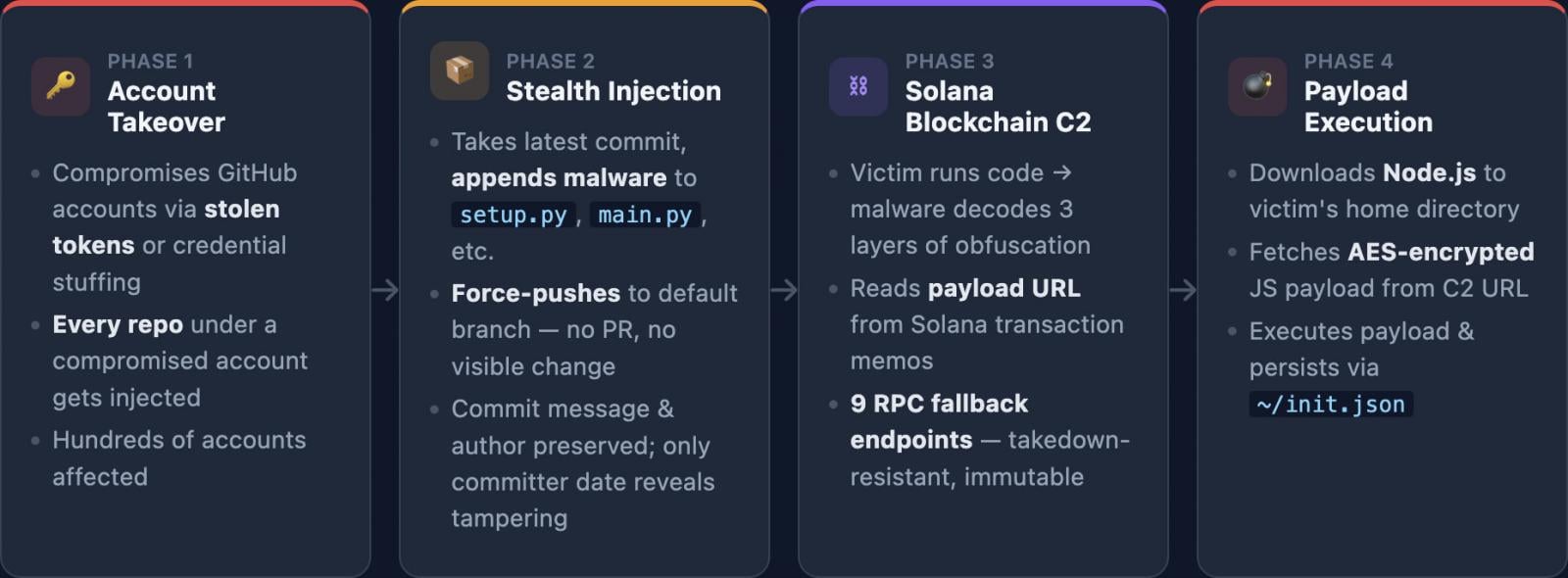
Initial compromise occurs on GitHub, where accounts are compromised to force-push malicious commits.

Then, malicious packages and extensions are published on npm and VSCode/OpenVSX, featuring obfuscated code (invisible Unicode characters) to evade detection.

Advertisement
Malicious package on OpenVSX
Source: Aikido

Across all platforms, the Solana blockchain is queried every five seconds for new instructions. According to Step Security, between November 27, 2025, and March 13, 2026, there were 50 new transactions, mostly to update the payload URL.

The instructions were embedded as memos in the transactions and led to downloading the Node.js runtime and executing a JavaScript-based information stealer. 

GlassWorm attack chain
Source: Step Security

The malware targets cryptocurrency wallet data, credentials, and access tokens, SSH keys, and developer environment data.

Analysis of code comments indicates that GlassWorm is orchestrated by Russia-speaking threat actors. Additionally, the malware skips execution if the Russian locale is found on the system. However, this is insufficient data for confident attribution.

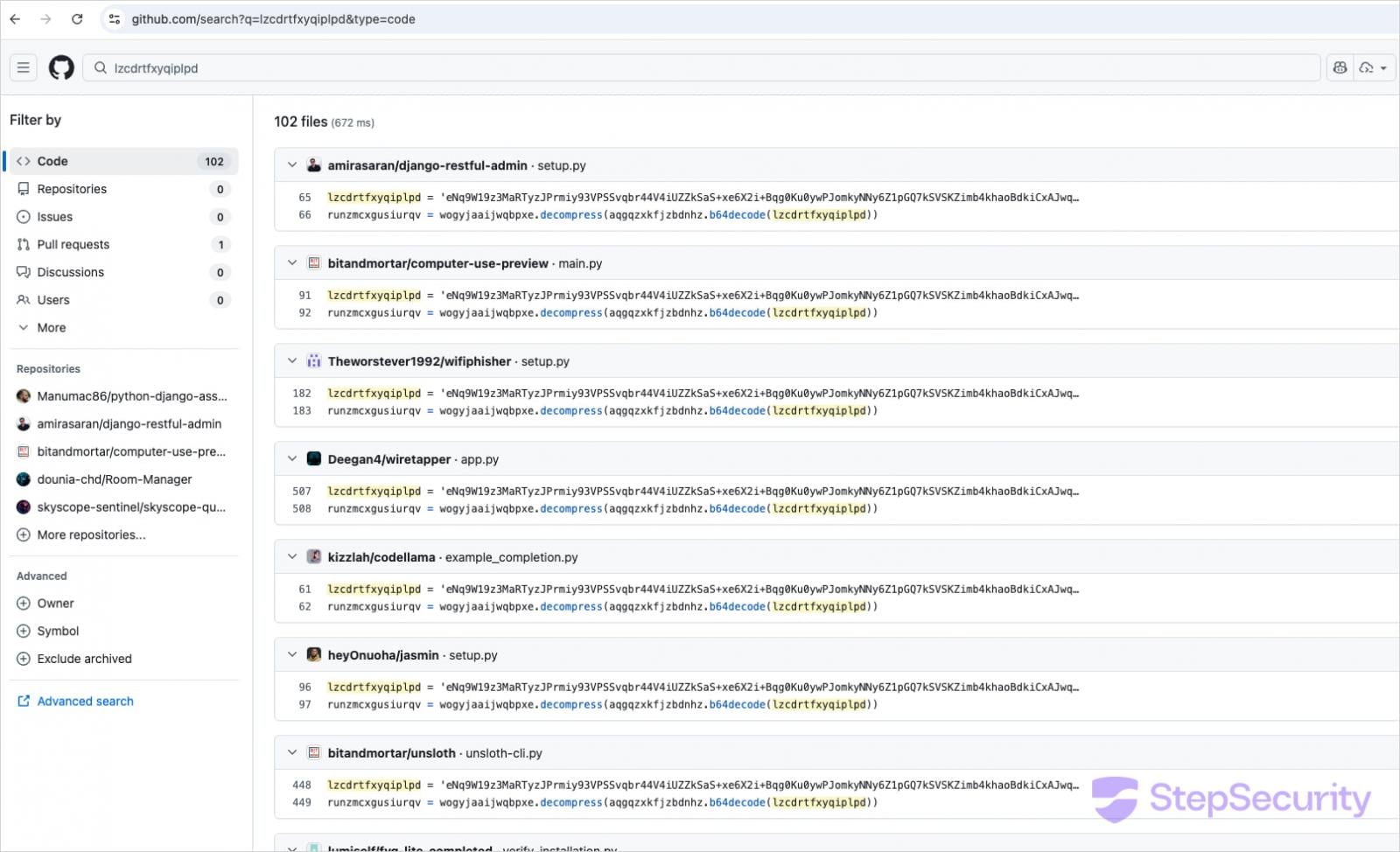
Step Security advises developers who install Python packages directly from GitHub or run cloned repositories to check for signs of compromise by searching their codebase for the marker variable “lzcdrtfxyqiplpd,” an indicator of the GlassWorm malware.

Malicious GitHub files
Source: Step Security

They also recommend inspecting systems for the presence of the ~/init.json file, which is used for persistence, as well as unexpected Node.js installations in the home directory (e.g., ~/node-v22*).

Additionally, developers should look for suspicious i.js files in recently cloned projects and review Git commit histories for anomalies, such as commits where the committer date is significantly newer than the original author date.

Advertisement

Malware is getting smarter. The Red Report 2026 reveals how new threats use math to detect sandboxes and hide in plain sight.

Download our analysis of 1.1 million malicious samples to uncover the top 10 techniques and see if your security stack is blinded.

Source link

Continue Reading

Tech

Techdirt Podcast Episode 446: Mike & Karl Talk AI

Published

on

from the not-so-opposed dept

There’s a notion that pops up in the comments here on Techdirt that Mike and our writer Karl Bode are deeply opposed in their opinions on AI and engaged in an epic ongoing debate. Alas, the truth is a little less spectacular: while they might have some differences of opinion here and there, they actually agree on most things, and would both prefer to hear (and have) more thoughtful and nuanced discussions about the technology without going to the extremes. By way of demonstration, Karl joins this week’s episode of the podcast for a long conversation with Mike all about AI, its role in our society, the challenges it raises, and where things go from here.

You can also download this episode directly in MP3 format.

Follow the Techdirt Podcast on Soundcloud, subscribe via Apple Podcasts or Spotify, or grab the RSS feed. You can also keep up with all the latest episodes right here on Techdirt.

Advertisement

Filed Under: ai, artificial intelligence, podcast

Source link

Advertisement
Continue Reading

Tech

Fascinating Look Back at the Akai PJ-11, an Innovative Mini Stereo with Rotating Speakers from 1984

Published

on

Akai PJ-11 Mini Stereo Rotating Speakers 1984
Back in 1984, Akai released the PJ-11, a compact stereo system that brought some fresh ideas to portable audio. Small enough to slip into a bag, it came with two independent speakers connected by cables that carried both power and audio signals, and those speakers could detach from the unit, lock into position at various angles, and be adjusted however the situation called for.


Each speaker could be swiveled precisely into position using 45 degree markers, giving you full control over where the sound was directed. Point them straight ahead for a traditional stereo image, tilt them upward for cleaner vocals, or angle them downward depending on the room. Flip them backward and the left and right channels swap, creating a surprisingly interesting effect in smaller spaces. The whole point was to put the sound where you actually were, rather than just firing it blindly forward the way most systems of the era did.

Sale


JBL Boombox 3 Black Portable Bluetooth Speaker with Massive Sound, Deepest Bass, IPX7 Waterproof, 24H…
  • Massive sound and deepest bass: Enjoy your music with massive JBL Original Pro Sound. The new 3-way speakers deliver higher sensitivity of our…
  • 24 Hours of play time: Celebrate every moment with the sounds you love. From your early morning workout to a late-night hang with friends, we’ve added…
  • IP67 dust and water proof: To the pool. To the park. The JBL Boombox 3 is IP67 dustproof and waterproof, so you can bring your speaker anywhere, rain…

Akai PJ-11 Mini Stereo Rotating Speakers 1984
Battery power came from four C-cells tucked inside each speaker, meaning the full system ran on eight batteries when you were out and about. That added some noticeable weight, but it also gave the speakers a reassuringly solid feel in your hands. Back at home a separate power adapter plugged into the rear of the main unit, sliding into place on a dedicated rail to keep everything sitting level and stable on a shelf or table. Pull the adapter and speakers off and the whole thing becomes a genuinely compact grab and go setup with no extra bulk to worry about.

Akai PJ-11 Mini Stereo Rotating Speakers 1984
The front panel features four sliders that allow you to make rapid adjustments on the fly. On the left is your overall level, and the following three are a super simple graphic equalizer that allows you to shape the bass, midrange, and treble with a twiddle. One of the buttons opens the cassette door, but the mechanism itself is turned upside-down, so you may have to squint to figure out what’s what, especially if some of the labels on the controls appear a little strange as a result. There’s a separate metal tape playback lever, and the built-in mono microphone can easily record speech or ambient sound, automatically adjusting the settings so you don’t have to.

Akai PJ-11 Mini Stereo Rotating Speakers 1984
Tuning in is handle by a four-band radio component with AM, FM, and shortwave reception that can pull in distant broadcasts when conditions are favorable. The FM side is very sensitive, and it includes a mono mode and a beat-cut filter to reduce interference. There’s a 3.5 millimeter connection on the front panel that allows you to connect signals from external players or recorders, allowing you to play them via the speakers or record them directly into the cassette without having to look for hidden ports.

Akai PJ-11 Mini Stereo Rotating Speakers 1984
Many users were caught off guard by the PJ-11’s unusually full and rich sound despite its small size. Voices came through clearly on angled up speakers, and the overall balance was pleasing, rather than harsh and tinny like some other radios. During high solar activity years, you could pick up shortwave broadcasts loud enough to fill a room, and cassettes had a pleasant warmth that kept the listener listening in for longer than you’d expect from a budget model priced around one fifty at introduction in 1984.

Akai PJ-11 Mini Stereo Rotating Speakers 1984
Akai only produced a small number of PJ-11s before going on to larger models such as the PJ-33, which is probably why they are so hard to come by now. You had all these convenient features, such as detachable speakers that spun around, a front-facing aux in, and the ability to run on batteries. All of this combined to create a design that felt refreshingly practical for ordinary listeners in 1984, and forty years later, it retains a certain attractiveness because it solved simple difficulties in a way that appears to have been completely forgotten these days

Advertisement

Source link

Continue Reading

Tech

Researchers disclose vulnerabilities in IP KVMs from four manufacturers

Published

on

Researchers are warning about the risks posed by a low-cost device that can give insiders and hackers unusually broad powers in compromising networks.

The devices, which typically sell for $30 to $100, are known as IP KVMs. Administrators often use them to remotely access machines on networks. The devices, not much bigger than a deck of cards, allow the machines to be accessed at the BIOS/UEFI level, the firmware that runs before the loading of the operating system.

This provides power and convenience to admins, but in the wrong hands, the capabilities can often torpedo what might otherwise be a secure network. Risks are posed when the devices—which are exposed to the Internet—are deployed with weak security configurations or surreptitiously connected to by insiders. Firmware vulnerabilities also leave them open to remote takeover.

No exotic zero-days here

On Tuesday, researchers from security firm Eclypsium disclosed a total of nine vulnerabilities in IP KVMs from four manufacturers. The most severe flaws allow unauthenticated hackers to gain root access or run malicious code on them.

Advertisement

“These are not exotic zero-days requiring months of reverse engineering,” Eclypsium researchers Paul Asadoorian and Reynaldo Vasquez Garcia wrote. “These are fundamental security controls that any networked device should implement. Input validation. Authentication. Cryptographic verification. Rate limiting. We are looking at the same class of failures that plagued early IoT devices a decade ago, but now on a device class that provides the equivalent of physical access to everything it connects to.”

Source link

Advertisement
Continue Reading

Tech

Kalshi’s legal troubles pile up, as Arizona files first ever criminal charges over ‘illegal gambling business’

Published

on

Arizona Attorney General Kris Mayes has filed criminal charges against prediction market platform Kalshi, for allegedly operating an illegal gambling business in the state without a license and for election wagering.

The 20-count complaint, filed in Maricopa County court on Tuesday, accuses the company of engaging in unlicensed gambling activities, claiming that the site “accepted bets from Arizona residents on a wide range of events,” including state elections, a practice that is illegal in Arizona. The complaint charged Kalshi with four counts of election wagering for accepting bets from Arizona residents on the 2028 presidential race, the 2026 Arizona gubernatorial race, the 2026 Arizona Republican gubernatorial primary, and the 2026 Arizona Secretary of State race.

This is the first time a state has pursued such charges against the company, according to the Arizona Mirror, and marks a significant escalation in the battle between states and the prediction market industry.

“Kalshi may brand itself as a ‘prediction market,’ but what it’s actually doing is running an illegal gambling operation and taking bets on Arizona elections, both of which violate Arizona law,” Attorney General Mayes said in a statement. “No company gets to decide for itself which laws to follow.”

Advertisement

It’s worth noting that the charges are technically misdemeanors. They follow a small surge of cease-and-desist letters, lawsuits, and other official actions from states over Kalshi’s activities, in which numerous officials have complained that the company is skirting state gambling laws.

Conversely, prediction sites like Kalshi have argued that they are not in violation of state law because they are subject to federal regulation via the Commodity Futures Trading Commission.

Kalshi may be getting attacked left, right, and center, but the Kalshi has also taken its own, often preemptive, legal action.

Techcrunch event

Advertisement

San Francisco, CA
|
October 13-15, 2026

Kalshi sued Arizona’s Department of Gaming in federal court on March 12. The company’s lawsuit argued that Arizona’s regulatory attempts were intruding “into the federal government’s exclusive authority to regulate derivatives trading on exchanges.” Kalshi also recently sued Iowa and Utah on similar grounds.

Advertisement

Mayes’ office argues the company is merely trying to avoid accountability.

“Kalshi is making a habit of suing states rather than following their laws. In the last three weeks alone, the company has filed lawsuits against Iowa and Utah, and now Arizona,” Mayes said in a statement. “Rather than work within the legal frameworks that states like Arizona have established, Kalshi is running to federal court to try to avoid accountability.”

Elisabeth Diana, Kalshi’s head of communications, called the Arizona criminal charges “seriously flawed” and a matter of “gamesmanship” related to the company’s own litigation against the state.

“Four days after Kalshi filed suit in federal court, these charges were filed to circumvent federal court and short-circuit the normal judicial process,” Diana said. “They attempt to prevent federal courts from evaluating the case based on the merits – whether Kalshi is subject to exclusive federal jurisdiction. These charges are meritless, and we look forward to fighting them in court.”

Advertisement

Federal officials have signaled that they’re on the prediction industry’s side, setting up a potential regulatory showdown between states and the federal bureaucracy. Mike Selig, chair of the Commodity Futures Trading Commission, recently published an op-ed in the Wall Street Journal in which he accused state governments of having “waged legal attacks on the CFTC’s authority to regulate” such sites. Selig also claimed that his agency would no longer “sit idly by while overzealous state governments” undermined the agency’s “exclusive jurisdiction” over the industry.

Source link

Continue Reading

Tech

Shoe-Sized Dolphin Robot Swims Straight Into Oil Spills and Pulls Them Clean Out

Published

on

Bio Dolphin Robot RMIT Oil Spills
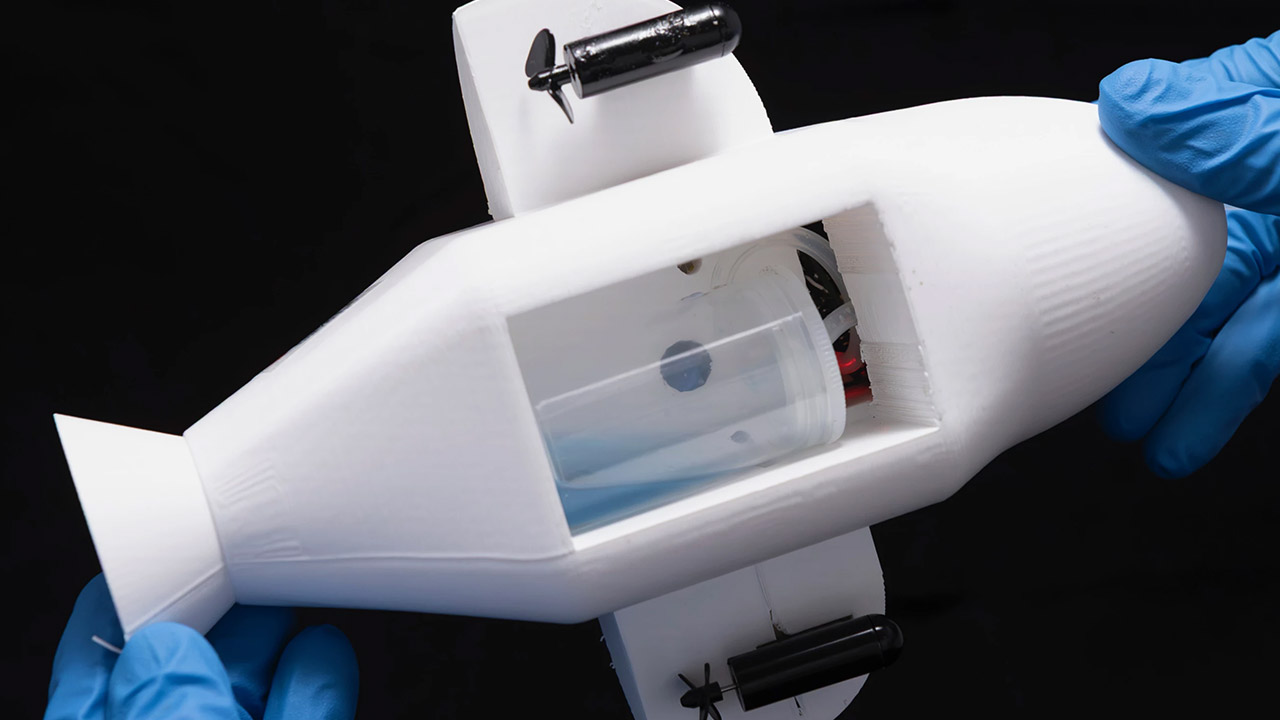
Researchers at RMIT University in Australia built a small robot shaped like a dolphin. About the size of a sneaker, the machine glides across the surface of polluted water and gathers oil with a pump mounted at the front. A filter inside separates the oil from everything else, sending only the slick into an onboard tank while the water flows away untouched.


Bio Dolphin Robot RMIT Oil Spills
The filter draws its clever design from sea urchins. Microscopic spikes coat the sponge-like surface, too small to see without an electron microscope. Those spikes hold pockets of air that push water aside so it beads up and rolls off. Oil, on the other hand, spreads across the spikes and soaks in right away. The coating mixes oleic acid-treated barium carbonate with thin sheets of reduced graphene oxide. No fluorine or silane chemicals go into it, which keeps the whole setup safer for the environment than many older filters.


DJI Neo, Mini Drone with 4K UHD Camera for Adults, 135g Self Flying Drone that Follows You, Palm Takeoff…
  • Due to platform compatibility issue, the DJI Fly app has been removed from Google Play. DJI Neo must be activated in the DJI Fly App, to ensure a…
  • Lightweight and Regulation Friendly – At just 135g, this drone with camera for adults 4K may be even lighter than your phone and does not require FAA…
  • Palm Takeoff & Landing, Go Controller-Free [1] – Neo takes off from your hand with just a push of a button. The safe and easy operation of this drone…

Lab tests put the robot through its paces using blue kerosene as a stand-in for real oil. It collected about two milliliters every minute, and the liquid that ended up in the tank measured more than 95 percent pure. The filter never clogged or soaked up water. One full battery charge keeps the machine running for roughly 15 minutes. The same material can absorb between 15 and 65 times its own weight in oil, then release most of it when squeezed and return to work with over 97 percent of its original performance intact. Salt water does not corrode it, and stray contaminants rinse away easily.


Dr. Ataur Rahman, who leads the project at RMIT’s School of Engineering, described the thinking behind the build. Oil spills bring heavy costs to nature and to economies everywhere. The team wanted a device that deploys fast, steers with precision, and reaches places too dangerous for crews on boats. PhD researcher Surya Kanta Ghadei, who developed the filter material, shared what drove his part of the work. Growing up in India, he watched spills harm marine life, especially turtles. That memory pushed him to find a way for responders to act quicker and shield wildlife from harm.

Bio Dolphin Robot RMIT Oil Spills
Right now the robot answers to a Wi-Fi remote. A larger version, closer to the actual size of a dolphin, sits in the plans. Its exact scale will depend on the pump and the tank it carries. In that future form the machine will run without anyone steering it. It will vacuum oil from the surface, head back to a base station to empty the tank and recharge, then return to the spill and start again. The cycle keeps going until the area clears.

Bio Dolphin Robot RMIT Oil Spills
Engineers see clear advantages over systems that simply float in place and wait for oil to drift their way. This robot moves through the slick on its own, collecting as it goes. The filter stays dry and ready for repeated use, so crews avoid the constant swaps and messy disposal that older setups demand. Next steps include scaling up the filter area, strengthening the pump, running field trials, and checking long-term durability in open water.
[Source]

Advertisement

Source link

Continue Reading

Tech

This wild iPhone 17 Pro case features a touchscreen for 48MP selfies

Published

on

The new Center Stage selfie camera is one of the best features of Apple’s iPhone 17 series — but why settle for 18MP snaps when 48MP selfies are possible?

That’s the question posed by Kickstarter case brand Dockcase, whose latest offering, the Selfix case, adds a touchscreen to the back of your iPhone 17 Pro for seamless, main camera-quality selfies.

Advertisement

Source link

Continue Reading

Tech

Gamers React With Overwhelming Disgust To DLSS 5’s Generative AI Glow-Ups

Published

on

Kyle Orland writes via Ars Technica: Since deep-learning super-sampling (DLSS) launched on 2018’s RTX 2080 cards, gamers have been generally bullish on the technology as a way to effectively use machine-learning upscaling techniques to increase resolutions or juice frame rates in games. With yesterday’s tease of the upcoming DLSS 5, though, Nvidia has crossed a line from mere upscaling into complete lighting and texture overhauls influenced by “generative AI.” The result is a bland, uncanny gloss that has received an instant and overwhelmingly negative reaction from large swaths of gamers and the industry at large.

While previous DLSS releases rendered upscaled frames or created entirely new ones to smooth out gaps, Nvidia calls DLSS 5 — which it plans to launch in Autumn — “a real-time neural rendering model” that can “deliver a new level of photoreal computer graphics previously only achieved in Hollywood visual effects.” Nvidia CEO Jensen Huang said explicitly that the technology melds “generative AI” with “handcrafted rendering” for “a dramatic leap in visual realism while preserving the control artists need for creative expression.”

Unlike existing generative video models, which Nvidia notes are “difficult to precisely control and often lack predictability,” DLSS 5 uses a game’s internal color and motion vectors “to infuse the scene with photoreal lighting and materials that are anchored to source 3D content and consistent from frame to frame.” That underlying game data helps the system “understand complex scene semantics such as characters, hair, fabric and translucent skin, along with environmental lighting conditions like front-lit, back-lit or overcast,” the company says. Nvidia’s announcement video and detailed Digital Foundry breakdown can be found at their respective links.

“Reactions have compared the effect to air-brushed pornography, ‘yassified, looks-maxed freaks,’ or those uncanny, unavoidable Evony ads,” writes Orland. “Others have noted how DLSS 5 seems to mangle the intended art direction by dampening shadows in favor of a homogenized look.”

Advertisement

Thomas Was Alone developer Mike Bithell said the technology seems designed “for when you absolutely, positively, don’t want any art direction in your gaming experience.”

Gunfire Games Senior Concept Artist Jeff Talbot added that “in every shot the art direction was taken away for the senseless addition of ‘details.’ Each DLSS 5 shot looked worse and had less character than the original. This is just a garbage AI Filter.”

DLSS 5’s “AI dogshit is actually depressing,” said New Blood Interactive founder and CEO Dave Oshry, adding that future generations “won’t even know this looks ‘bad’ or ‘wrong’ because to them it’ll be normal.”

Source link

Advertisement
Continue Reading

Tech

Mistral bets on ‘build-your-own AI’ as it takes on OpenAI, Anthropic in the enterprise

Published

on

Most enterprise AI projects fail not because companies lack the technology, but because the models they’re using don’t understand their business. The models are often trained on the internet, rather than decades of internal documents, workflows, and institutional knowledge. 

That gap is where Mistral, the French AI startup, sees opportunity. On Tuesday, the company announced Mistral Forge, a platform that lets enterprises build custom models trained on their own data. Mistral announced the platform at Nvidia GTC, Nvidia’s annual technology conference, which this year is focused heavily on AI and agentic models for enterprise.

It’s a pointed move for Mistral, a company that has built its business on corporate clients while rivals OpenAI and Anthropic have soared ahead in terms of consumer adoption. CEO Arthur Mensch says Mistral’s laser focus on the enterprise is working: the company is on track to surpass $1 billion in annual recurring revenue this year.

A big part of doubling down on enterprise is giving companies more control over their data and their AI systems, Mistral says. 

Advertisement

“What Forge does is it lets enterprises and governments customize AI models for their specific needs,” Elisa Salamanca, Mistral’s head of product, told TechCrunch. 

Several companies in the enterprise AI space already claim to offer similar capabilities, but most focus on fine-tuning existing models or layering proprietary data on top through techniques like retrieval augmented generation (RAG). These approaches don’t fundamentally retrain models; instead, they adapt or query them at runtime using company data.

Mistral, by contrast, says it is enabling companies to train models from scratch. In theory, this could address some of the limitations of more common approaches — for example, better handling of non-English or highly domain-specific data, and greater control over model behavior. It could also allow companies to train agentic systems using reinforcement learning and reduce reliance on third-party model providers, avoiding risks like model changes or deprecation. 

Techcrunch event

Advertisement

San Francisco, CA
|
October 13-15, 2026

Forge customers can build their custom models using Mistral’s wide library of open-weight AI models, which includes small models such as the recently introduced Mistral Small 4. According to Mistral co-founder and chief technologist, Timothée Lacroix, Forge can help unlock more value out of its existing models. 

Advertisement

“The trade-offs that we make when we build smaller models is that they just cannot be as good on every topic as their larger counterparts, and so the ability to customize them lets us pick what we emphasize and what we drop,” Lacroix said. 

Mistral advises on which models and infrastructure to use, but both decisions stay with the customer, Lacroix said. And for teams that need more than guidance, Forge comes with Mistral’s team of forward-deployed engineers who embed directly with customers to surface the right data and adapt to their needs — a model borrowed from the likes of IBM and Palantir. 

“As a product, Forge already comes with all the tooling and infrastructure so you can generate synthetic data pipelines,” Salamanca said. “But understanding how to build the right evals and making sure that you have the right amount of data is something that enterprises usually don’t have the right expertise for, and that’s what the FDEs bring to the table.” 

Mistral has already made Forge available to partners including Ericsson, the European Space Agency, Italian consulting company Reply, and Singapore’s DSO and HTX. Early adopters also include ASML, the Dutch chipmaker that led Mistral’s Series C round last September at a €11.7 billion valuation (approximately $13.8 billion at the time).

Advertisement

These partnerships are emblematic of what Mistral expects Forge’s main use cases to be. According to Mistral’s chief revenue officer Marjorie Janiewicz, these include governments who need to tailor models for their language and culture; financial players with high compliance requirements; manufacturers with customization needs; and tech companies that need to tune models to their code base.

Source link

Continue Reading

Trending

Copyright © 2025