Tech
Dynaudio Legend Bookshelf Speakers Debut at AXPONA 2026 With Hand-Matched Rosewood Cabinets that Will Seduce You: But That’s Not Why You’ll Want Them

At AXPONA 2026, where six-figure systems are aplenty and it’s not unusual to stumble into rooms pushing past $500,000 or even flirting with $1 million, most of what’s on display exists for a very small slice of the population. That’s part of the spectacle, but it’s not always where the story is. The Dynaudio Legend bookshelf speakers stopped me cold because they don’t rely on excess to make their point. Compact, handcrafted in Denmark, and built around real-world usability, they deliver the kind of scale, detail, and physical presence that makes a lot of those megabuck systems feel like overkill. In a show full of gear chasing perfection at any cost, this is the rare product that actually makes you question where that line should be drawn — which is $7,000 in this particular case.
Danish Craft, No Shortcuts: Why the Dynaudio Legend Stands Out
Listening to music should feel like a break from everything else. At a busy show, that’s harder than it sounds—but the Dynaudio Legend made a convincing case without trying too hard. That was clear before I even realized they’re using Dynaudio’s best tweeter here, which explains a lot about the control and refinement I was hearing.
Dynaudio doesn’t cut corners. It never has. That shows up here in a straightforward way: consistent parts, consistent tuning, and a compact design that doesn’t try to overreach. What changes from pair to pair is the finish.

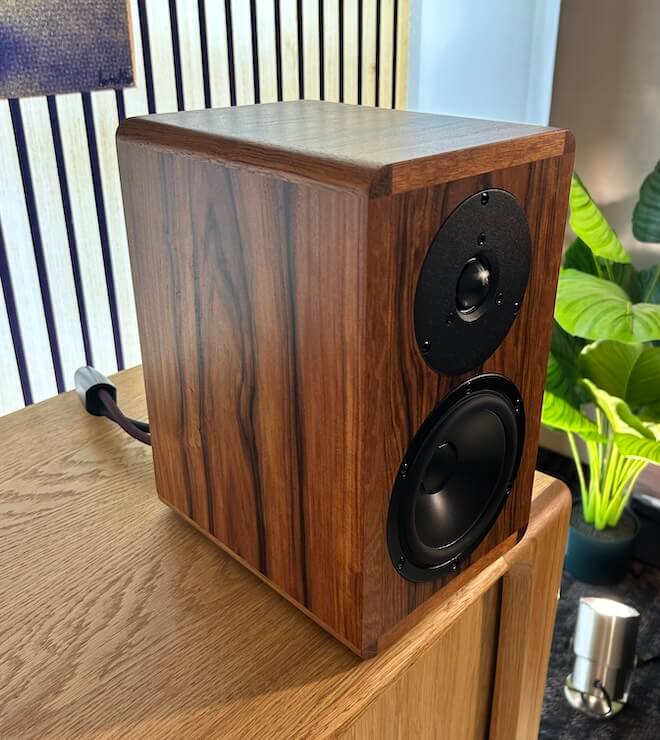
Each cabinet uses natural rosewood veneer that’s selected and matched by eye, paired with Jatoba hardwood corner pieces that complement the grain. Final assembly is done by hand in Denmark. No two pairs look exactly the same, but they’re all built to the same standard.
The finish deserves mention because it’s noticeably better in person than in photos—more depth, more texture, less “factory uniform.” It’s the kind of detail you notice up close, not from across the room. And for those losing their minds online because they don’t look like $7,000 loudspeakers—the reality is they look sensational in person, and that’s what actually matters.
I’ll admit they got my attention for practical reasons as well. As I think about building out a home office and splitting time between New Jersey, Florida, and Texas; this is the type of speaker that makes sense: compact, well-built, and visually distinct without being over the top.
There’s nothing complicated about the pitch here. Every pair is unique in appearance, but the approach is consistent. And that consistency is really the point.

Specifications and System Context
The Dynaudio Legend is a compact two-way, rear-ported bass reflex bookshelf speaker designed for smaller spaces and more focused listening setups. It uses a 28mm Esotar 3 tweeter with Hexis; Dynaudio’s top-tier high-frequency driver paired with a single 15cm MSP (magnesium silicate polymer) mid/bass unit. The crossover is set at 3,500Hz with a second-order topology, and the rated impedance is 6 ohms.
On paper, the sensitivity is a modest 83 dB (2.83V/1m), with frequency response specified from 60Hz to 28kHz. Power handling is rated at 150 watts, which tells you everything you need to know: these are not speakers you throw on the end of a budget integrated and call it a day. They need current, and they respond to it.
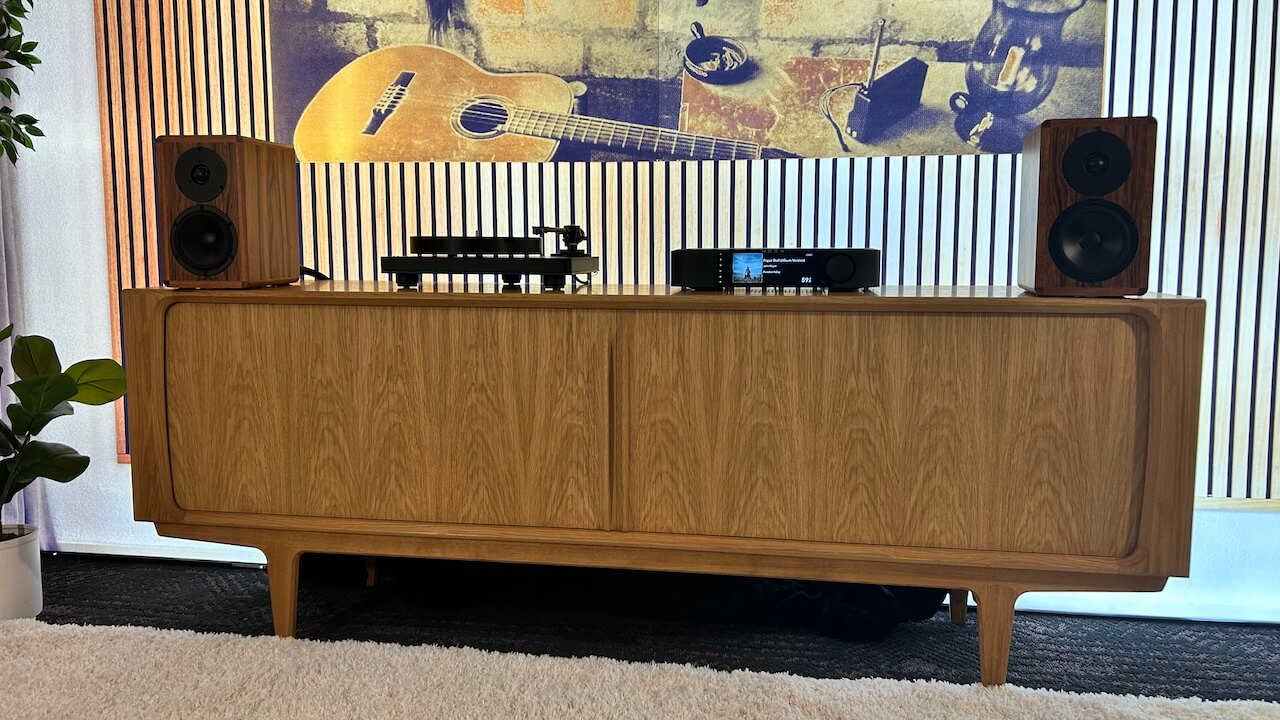
That explains the rather serious MOON by Simaudio network amplifier used in the demo system. Even in a relatively small room: think den, bedroom, or office, the pairing made sense. This wasn’t about filling a cavernous space; it was about control, headroom, and getting the most out of that low sensitivity.
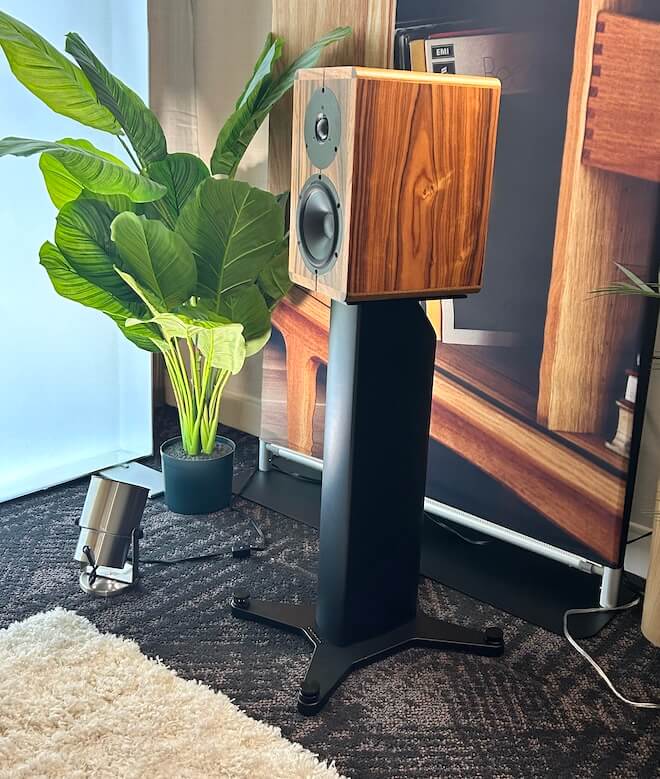
Physically, the Legend measures 31.1 cm (12 1/4 inches) tall, 18.6 cm (7 1/3 inches) wide, and 27.1 cm (10 2/3 inches) deep, with a weight of 6.3 kg (14 lbs) per speaker. In practice, that translates to an easy fit on proper stands or a solid shelf setup.
The system I heard leaned into nearfield listening from a leather sofa positioned fairly close to the speakers. In that context, the Legend’s scale and control made a lot of sense—this is a speaker designed to work in real rooms, not just showrooms pushing six figures.

The Danes Heard the Internet Naysayers and Carried On Anyway
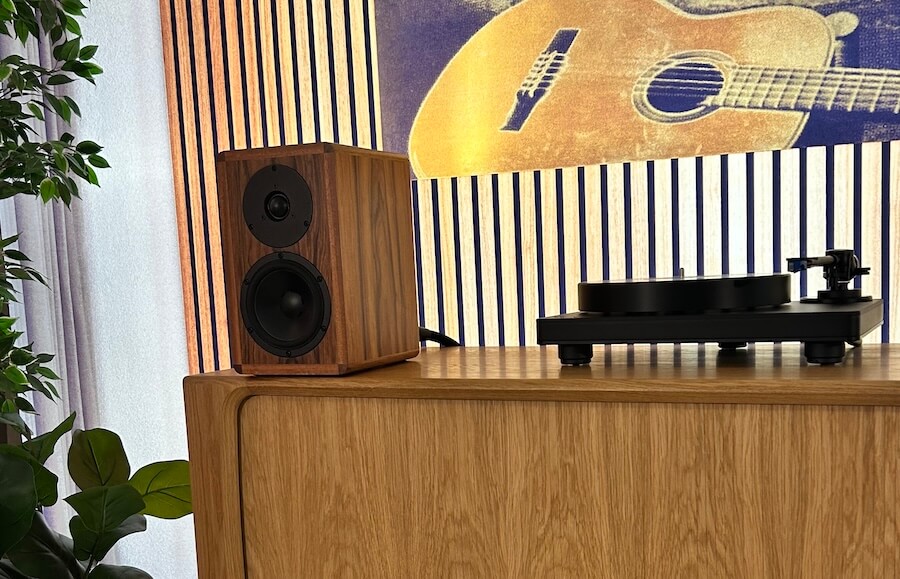
Right off the bat, what stood out was how composed they stayed at higher listening levels. These are passive bookshelf speakers, and while Dynaudio offers a dedicated stand, it felt a bit too low in this setup. I preferred them on a media credenza, which brought the drivers into a better position and made the overall presentation more convincing.
You can push these harder than you probably should. Not that you need to because they’re engaging at lower levels, but when the volume goes up, they don’t lose their grip. With electronic tracks that lean on impact and control, the Legend held together without sounding strained or thin.

That also puts to rest one of the louder online takes floating around from people who haven’t actually heard them: that there’s no meaningful bass below 60 or 70 Hz. That’s not what I heard. In-room, with proper amplification, there’s usable, convincing low-end extension. No, they’re not replacing a subwoofer on paper, but the idea that they fall off a cliff down low doesn’t line up with reality.
In fact, I found them to be rather hard hitting. For my listening; electronic, metal, new wave, and progressive synth rock, I wouldn’t feel the need to add a subwoofer.
The midrange leans warm, but it’s controlled and doesn’t drift into thickness. Vocals have weight, instruments have body, and nothing feels pushed forward just to grab attention. It sounds intentional, not romanticized.
Up top, this is where things separate quickly. Dynaudio is using its best tweeter here, and it shows. The treble is open and extended with real air, plenty of energy, and strong detail retrieval, but it never turns hard or brittle. You get resolution without edge, which is harder to pull off than it sounds.
What caught me off guard was the overall sense of scale. These don’t sound like small bookshelf speakers. The presentation is wider than expected, with a soundstage that stretches well beyond the cabinets and holds together even when things get busy.
And yes, there were moments where I actually laughed out loud with familiar tracks. Not because I forgot my meds, though thanks for the reminder, but because they delivered something I wasn’t expecting. These are better than they have any right to be based on size alone, and they make that point pretty quickly.
In the context of AXPONA 2026, where it’s easy to get desensitized by six-figure systems, the Dynaudio Legend stands out for a simpler reason: it makes sense. Solid engineering, real-world size, and performance that holds up under scrutiny. At $7,000, it’s not inexpensive, but most certainly one of the few speakers that I listened to so far that I would consider buying.
For more information: Dynaudio Legend
You must be logged in to post a comment Login