
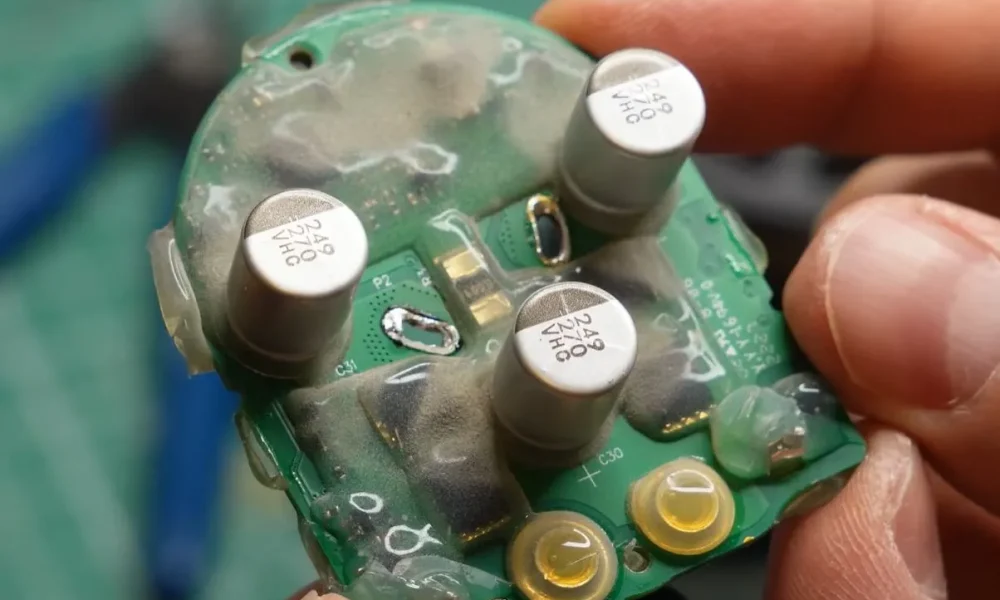
It seems to be becoming a bit of a theme that consumer electronics are dying not due to some critical fault, but due to Cooked Capacitor Syndrome (CCS). Case in point, Dyson handheld vacuums and the capacitors on its driver board. After having his $800 Dyson V15 handheld vacuum die after two and a half years of regular use, [LeftyMaker] found himself elbows-deep in the dusty innards of the vacuum just to replace some capacitors.
After initially trying a new battery and other common troubleshooting steps, he found that lots of people were having the same flaky behavior with their Dyson vacuums, all with the same underlying cause. On the driver board for the DC brushless motor, there are a couple of capacitors that seem to cause issues across models, with the standard response by Dyson being to ‘buy a new body’.
While it’s definitely possible to tear down the vacuum to get to the driver board, you’ll be doing effectively a full disassembly, all to see the capacitors located right next to the hot motor in a very confined space. [LeftyMaker] confirmed a very high ESR on the old capacitors before replacing them with 125℃ rated Rubycon 35PZF270MT810X9 polymer capacitors for $1 a pop.
Unsurprisingly, the vacuum worked fine after that fix, but it shows a trend where CCS has become so commonplace that it’s no wonder that the phrase ‘planned obsolescence’ is being uttered alongside it. For this particular series of Dyson vacuums, the issue is apparently so bad that [Hasan] created a custom driver board that might be superior in multiple ways. Maybe we need an OSHW vacuum cleaner, just to avoid such shenanigans.

You must be logged in to post a comment Login