Tech
EAT E Glo SB and CB Bring Flagship Balanced Phono Technology Starting at $4,599

Vinyl’s resurrection stopped being a charming nostalgia story years ago. U.S. vinyl revenue surpassed $1 billion in 2025, with 46.8 million records sold and the format recording its nineteenth consecutive year of growth. Luminate previously reported that annual U.S. vinyl album sales had increased from 13.1 million in 2016 to 49.6 million in 2023, an increase of nearly 300 percent.
That growth has transformed the turntable category along with everything connected to it. Consumers can now choose from inexpensive wireless record players, sophisticated direct-drive designs, restored vintage decks and turntables with genuinely balanced outputs. Phono preamplifiers have consequently become a serious battleground again rather than an inexpensive circuit manufacturers conceal beside the headphone jack.
EAT, or European Audio Team, has operated at the more ambitious end of that market for years. Its turntables, tonearms, cartridges, vacuum tubes and phono stages are not designed for shoppers searching Amazon for something to play the copy of Aja they bought at Target — an album whose reputation remains vastly more impressive than the music itself.
The new E-Glo CB and E-Glo SB continue that approach with full-width chassis, dual-mono construction, discrete circuitry, extensive cartridge adjustment and tube-based amplification. VANA Ltd., EAT’s North American distributor, has announced immediate availability at $4,599 for the E-Glo CB and $6,250 for the E-Glo SB.
Related Reviews:
The EAT and Pro-Ject Connection
EAT is owned and led by Jozefina Lichtenegger, who is married to Pro-Ject Audio Systems founder Heinz Lichtenegger. That relationship has inevitably resulted in some shared analog DNA, manufacturing resources and expertise, but the two companies are not merely different badges attached to the same products.
Pro-Ject has built its reputation by making serious analog playback accessible across a wide range of prices. EAT operates several floors higher, with heavier construction, more elaborate materials, tube-based electronics and products aimed at listeners assembling genuinely high-end vinyl systems.
That relationship also helps explain EAT’s interest in balanced phono playback. Pro-Ject has spent several years expanding its True Balanced ecosystem with compatible turntables, phono stages and cables, including the X1 B, X2 B and X8.


Two Models Built Around a Common Platform
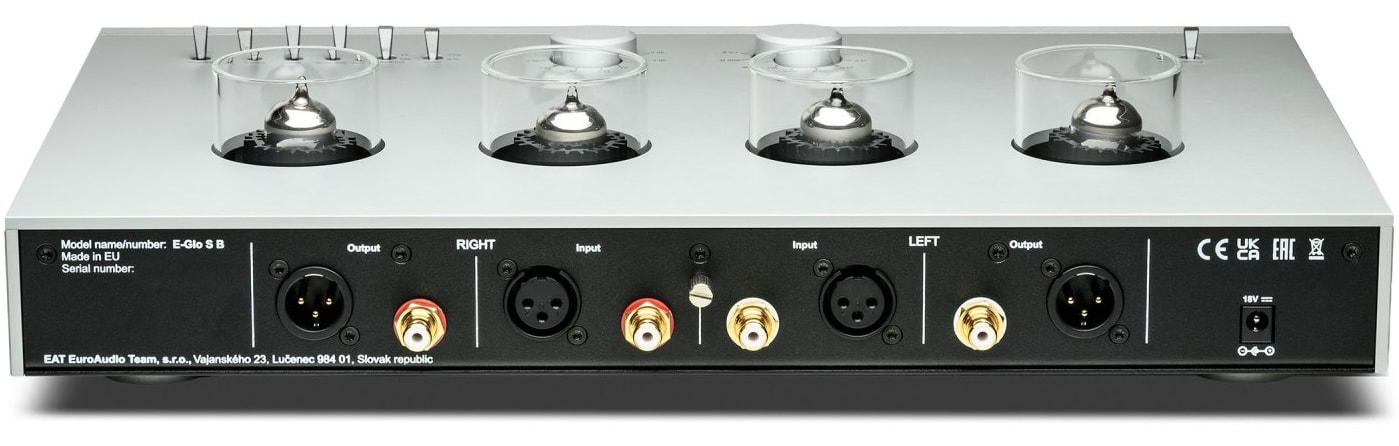
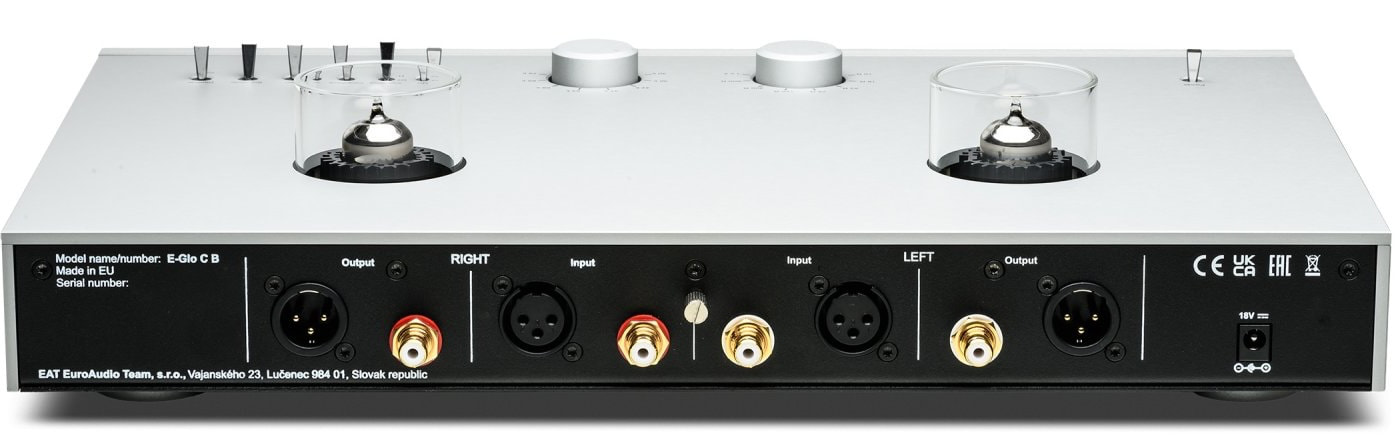
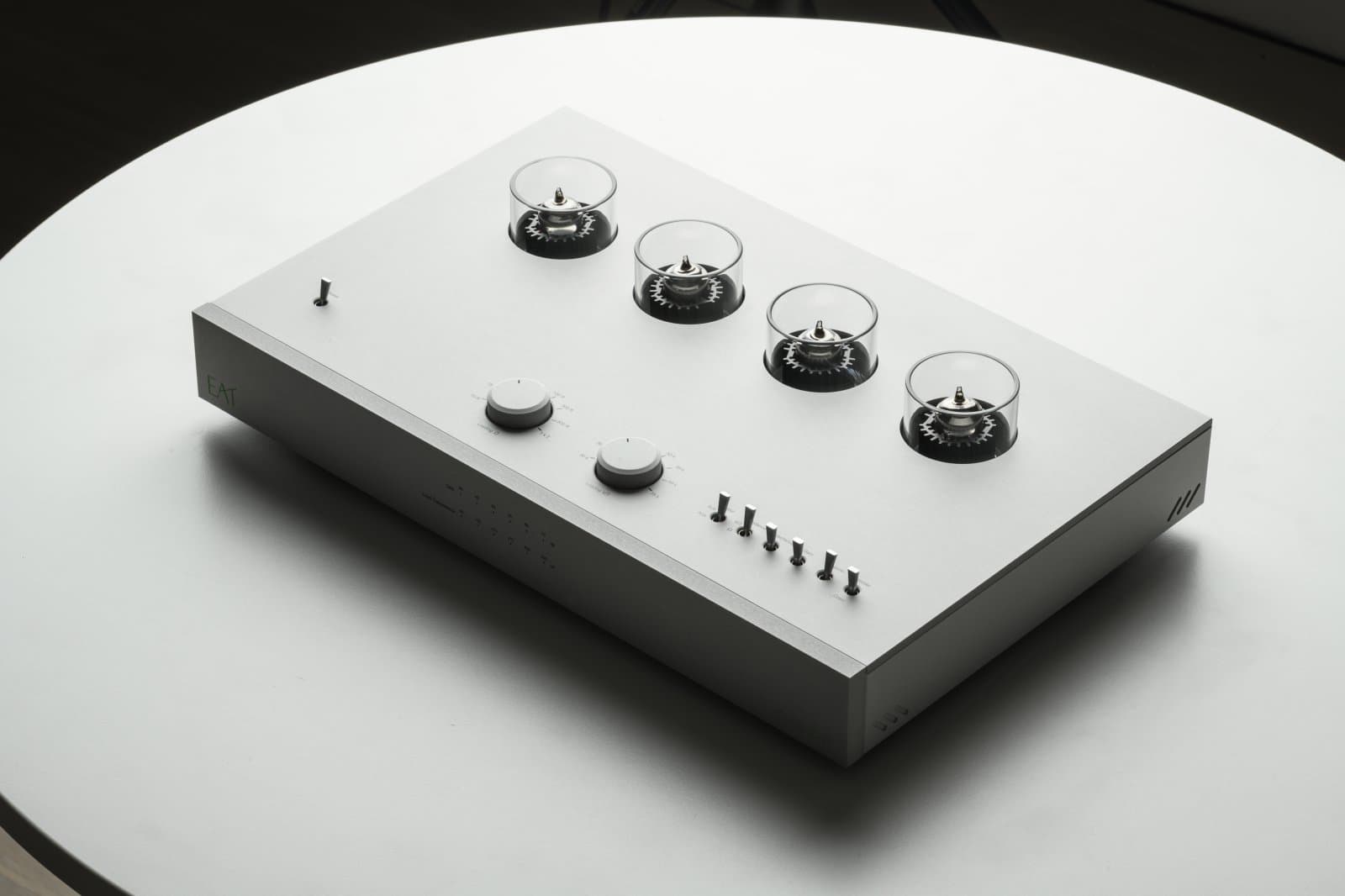
The E-Glo CB and SB occupy the space between EAT’s compact Petit B and flagship E-Glo FB. Both use three gain stages, discrete components rather than integrated-circuit op-amps, split passive and active RIAA equalization and dedicated DC servo circuitry to minimize offset at the outputs.
The first gain stage uses three discrete semiconductor amplifier circuits. Separate circuits handle the positive and negative phases, while a third sums the two signals to reject common-mode noise. The high-frequency portion of the RIAA equalization is also applied at this stage.
Both models accept moving-coil cartridges through their balanced XLR inputs, while the RCA inputs support both moving-magnet and moving-coil designs. Balanced XLR and single-ended RCA outputs can be used simultaneously.
EAT reserves the balanced input for MC cartridges, whose very low output makes common-mode noise rejection especially valuable. Although a phono cartridge is inherently a balanced signal source, the internal wiring of many MM designs prevents access to the complete differential signal. Purpose-built balanced MM cartridges exist, but the E-Glo CB and SB are not designed to accept them through their XLR inputs.

The Difference Is in the Second Stage
The two models diverge most significantly in their second amplification stages.
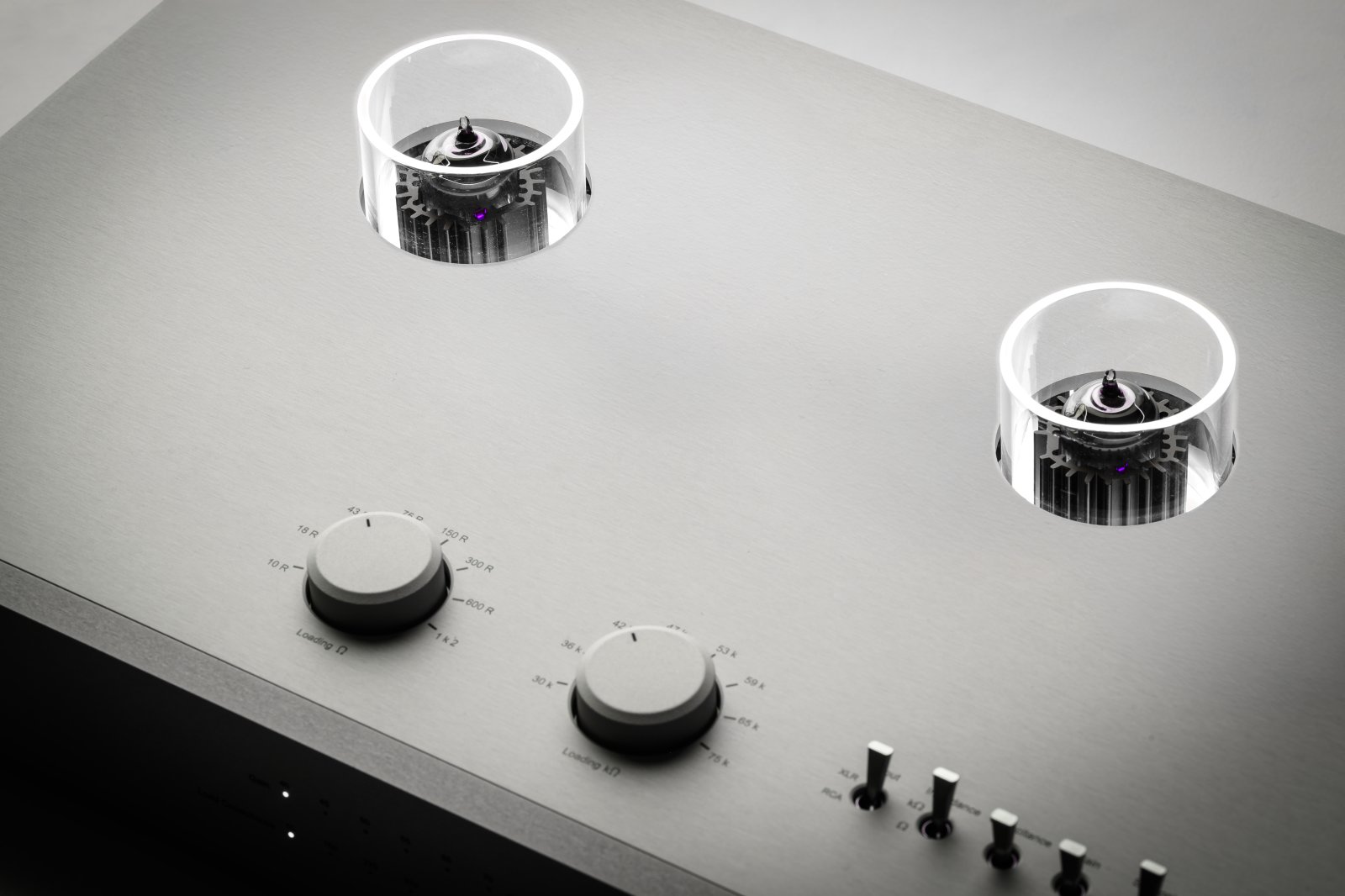
The E-Glo CB uses a hybrid, single-ended tube and transistor circuit composed of two ECC83S triodes and one transistor. This stage handles the low-frequency portion of the RIAA equalization and incorporates a switchable subsonic filter.
The more expensive E-Glo SB moves closer to the architecture of the flagship E-Glo FB. Its second stage is a symmetrical tube design using two ECC83S and two E88CC triodes. EAT also specifies higher-grade semi-crystalline hydrocarbon polypropylene capacitors in the gain and RIAA networks.
The difference is not simply one additional pair of glowing bottles behind the ventilation slots. The SB maintains balanced operation through its second gain stage, while the CB converts to a single-ended signal before its output stage creates the balanced output.
That does not make the CB badly designed, but it does mean that “balanced” requires some qualification. The CB provides a symmetrical MC input stage, common-mode noise rejection and balanced XLR output, but it is not a fully differential circuit from cartridge to output. An XLR socket is a connector, not a blessing from your rabbi.
The SB comes considerably closer to the flagship concept through its symmetrical tube stage and upgraded capacitor selection.
Cartridge Adjustment
Both models provide enough adjustment to accommodate a broad range of moving-magnet and moving-coil cartridges.
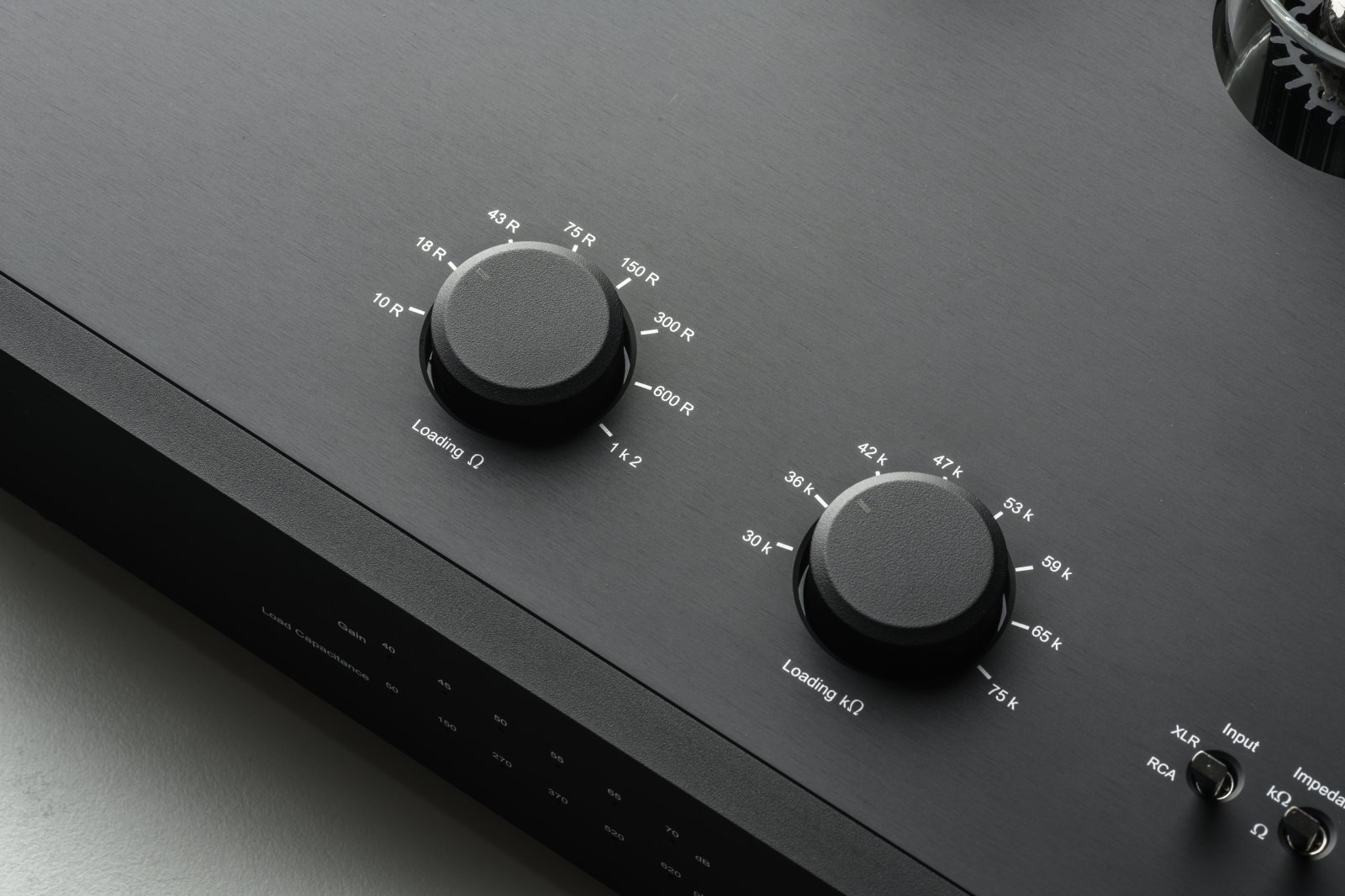
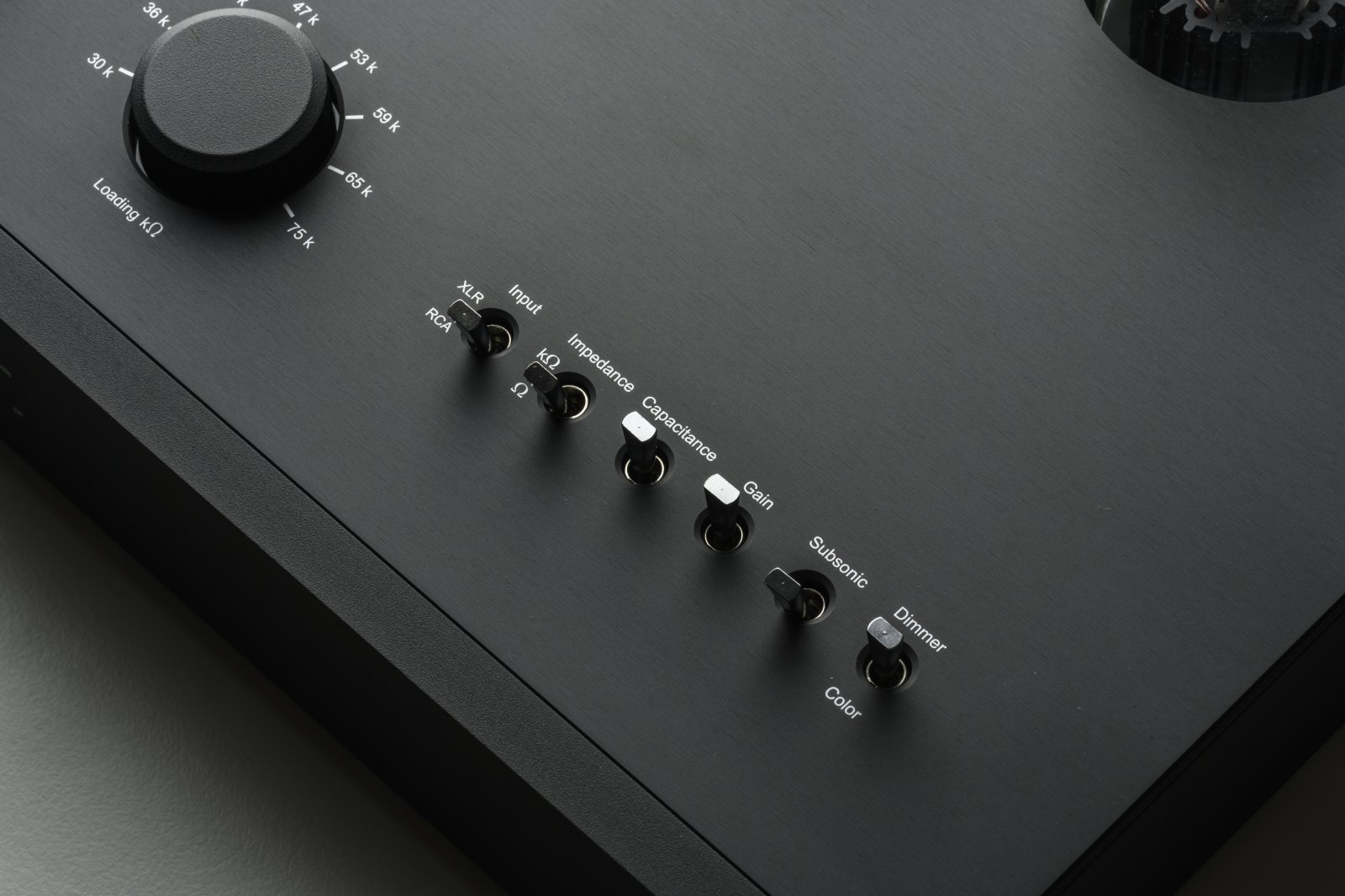
Moving-magnet resistance can be selected from 30,000 to 75,000 ohms, while capacitance settings range from 50 to 620 pF. Moving-coil loading options extend from 10 ohms to 1.2 kilohms.
Six gain settings are offered: 40, 45, 50, 55, 65 and 70 dB. According to EAT’s specifications, using the balanced XLR outputs adds another 6 dB.
Both models also include a 20 Hz subsonic filter with an 18 dB-per-octave slope. That will be useful for systems vulnerable to record warps, turntable suspension movement or subwoofers attempting to reproduce low-frequency information that was never part of the recording.
RIAA accuracy is specified within 0.5 dB from 20 Hz to 20 kHz. The CB claims an MM signal-to-noise ratio greater than 92 dBV and an MC figure greater than 80 dBV. The SB is rated at greater than 90 dBV for MM and greater than 80 dBV for MC.
Each measures 395 x 86 x 262 mm (15.6 x 3.4 x 10.3 inches). The E-Glo CB weighs 5 kg (11 pounds), while the E-Glo SB weighs 5.1 kg (11.2 pounds). Both use an external 18-volt power supply, keeping the transformer away from circuitry responsible for amplifying signals measured in fractions of a millivolt.
The Bottom Line
Neither model represents an attempt to make balanced tube phono amplification affordable in any conventional sense. The E-Glo CB costs $4,599, and the E-Glo SB raises the admission price to $6,250 before one buys the turntable, tonearm, cartridge, cables or records.
Welcome back to high-end analog, where the software occasionally costs $150 and the component amplifying it can cost more than the car used to bring it home.
The CB nevertheless fills a credible position for listeners using a serious moving-coil cartridge who want balanced input capability, extensive loading control and some tube character without climbing into five-figure phono-stage territory. Its hybrid architecture also gives EAT an alternative to competitors such as the Nagra Compact Phono, MoFi UltraPhono Pro and upper-tier phono stages from Rega, Musical Fidelity and Pro-Ject.
The SB is the more technically ambitious product. Its symmetrical tube-based second stage, upgraded capacitors and closer relationship to the E-Glo FB make it the logical choice for systems already built around a high-end balanced preamplifier and a low-output MC cartridge.
EAT has not simply removed parts from its flagship, installed cheaper capacitors and declared victory. The CB and SB are distinct implementations for different buyers, and their construction, flexibility and circuit design suggest products created for long-term analog systems rather than another brief ride aboard the vinyl revival train.
Vinyl, after nineteen consecutive years of growth, is no longer waiting at the station.
For more information: europeanaudioteam.com
You must be logged in to post a comment Login