Tech
Emotiva LXP-16 and LXR-11 Bring 9.4.6 Home Theater and Dirac ART to CEDIA 2026

Emotiva has spent more than two decades building its reputation around a fairly simple proposition: offer serious audio hardware without requiring customers to liquidate part of their retirement portfolio to pay for it.
The new LXP-16 Immersive Cinema Processor and LXR-11 Immersive Cinema Receiver push that philosophy considerably further up the home theater ladder.
Both models will make their public debut at CEDIA Expo 2026 in Denver before their scheduled October release. The LXP-16 is priced at $4,799, while the LXR-11 will sell for $5,999.
What makes the new LX Series interesting is not any single specification. Emotiva is combining 9.4.6-channel immersive processing, four independently managed subwoofer outputs, HDMI 2.1, streaming, and the complete Dirac Live room correction package in two products priced below a number of established high-end alternatives.
And in the case of the LXR-11, Emotiva has thrown eleven channels of Hypex NCOREx amplification into the same chassis.
That is a rather serious amount of hardware for the money.
Related Reading:
What Does 9.4.6 Actually Mean?

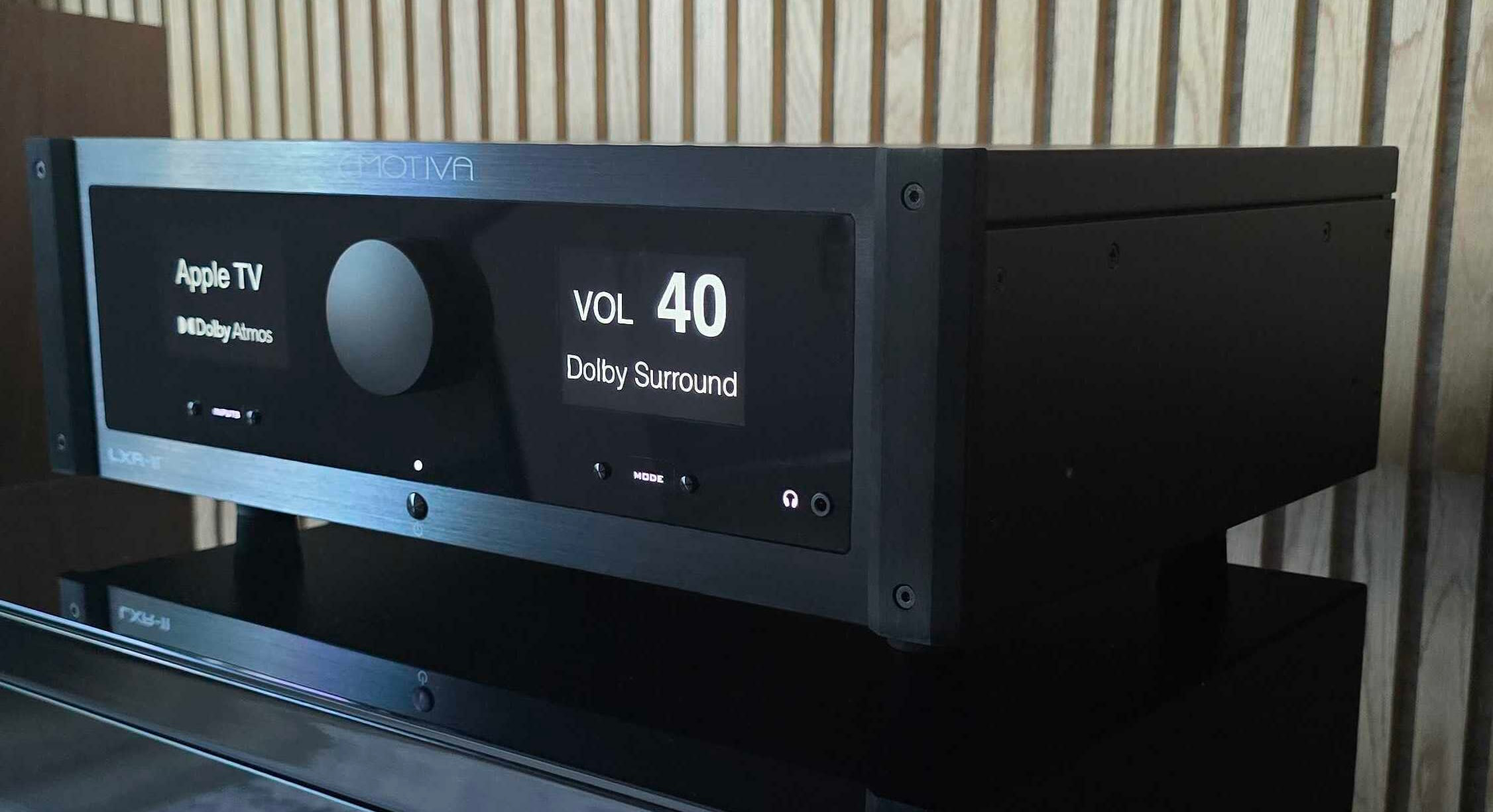
Both LX Series models can process a 9.4.6-channel system with left, center and right front channels, a pair of front wides, side surrounds, rear surrounds, four independently managed subwoofers and six height channels.
In practical terms, that means up to 15 independently processed loudspeaker channels plus four independent subwoofer feeds, with support for Dolby Atmos and DTS Pro.
More important for elaborate theater installations, those four subwoofer outputs are not simply four connectors carrying the same signal. Each is a balanced XLR output that can be independently adjusted for level and distance before being integrated by Dirac.
That distinction becomes increasingly important as systems move beyond one or two subwoofers. Multiple subs can improve bass consistency throughout a room, but only when placement, timing, level, and frequency response are properly managed. Four outputs are substantially more useful when the processor actually knows that four different subwoofers exist.
Dirac Live ART Is Included
This might be the most consequential part of the LX Series specification.
Both models include licenses for Dirac Live Room Correction, Dirac Live Bass Control, and Dirac Live Active Room Treatment, along with the required calibrated measurement microphone. There is no additional software purchase required to unlock the more advanced Dirac features.
Dirac Live handles frequency response and impulse correction. Bass Control coordinates the loudspeakers and multiple subwoofers around their crossover regions, while Active Room Treatment, or ART, treats the speakers as a coordinated acoustic system and uses their combined output to reduce low-frequency decay within the room.
ART support is becoming increasingly common on premium AV products, but inclusion in the purchase price is not.
ARCAM’s new Radia home theater components support Bass Control and ART as paid upgrades, while compatible Marantz AV receivers and processors also require users to purchase Dirac licenses separately. That gives Emotiva a meaningful advantage before anyone has connected a single loudspeaker.
Emotiva LXP-16 Immersive Cinema Processor

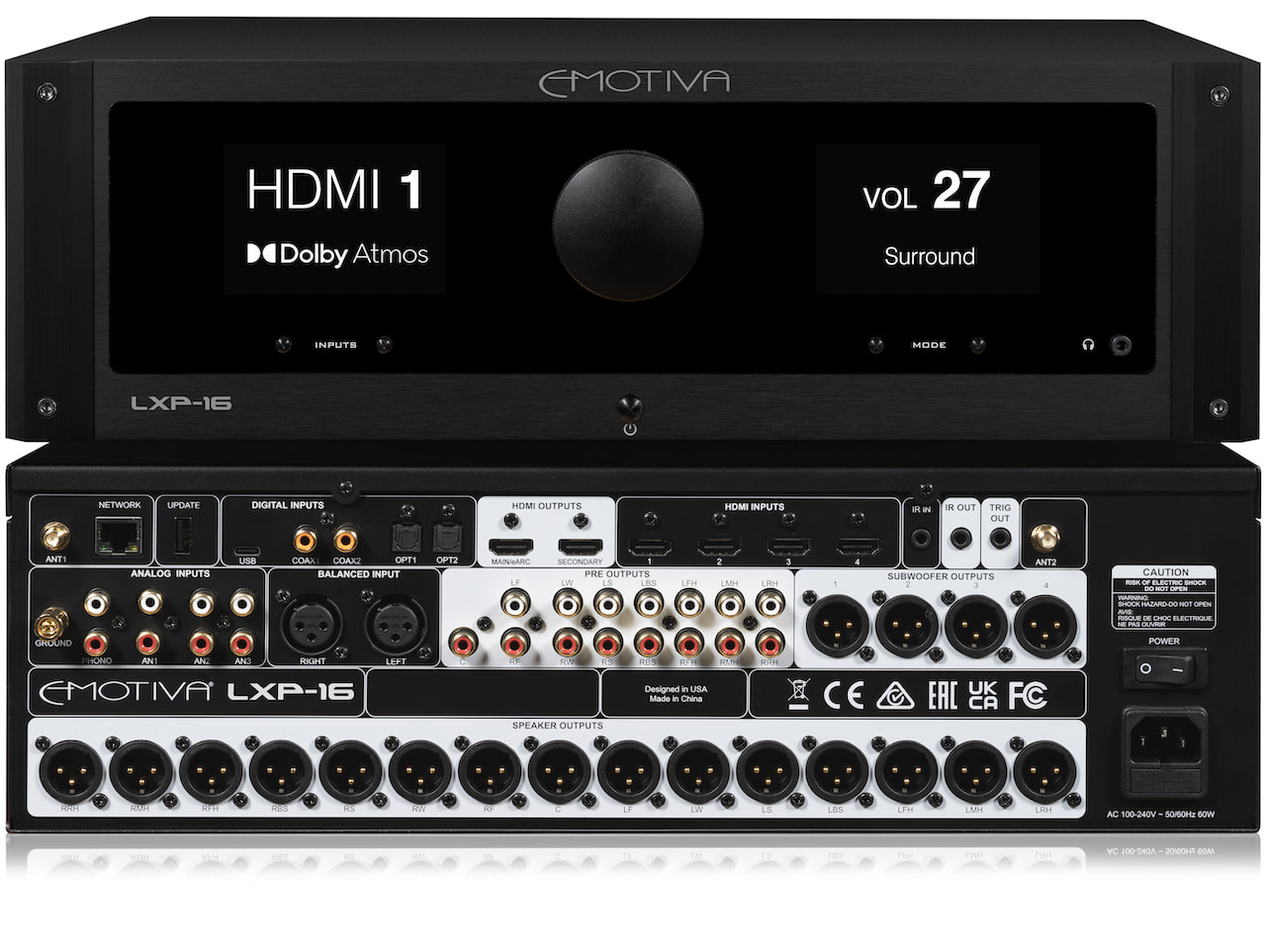
The LXP-16 is the separates option and requires external power amplification.
Internally, Emotiva is using a balanced architecture with Analog Devices SHARC DSP processing and ESS Hyperstream DAC technology. Emotiva has not identified the specific ESS DAC chips, so there is no reason to guess.
The processor provides 15 balanced XLR preamp outputs and 15 unbalanced RCA preamp outputs, with both sets available simultaneously. Four additional balanced XLR outputs are dedicated to the subwoofers. Maximum published output is 8V RMS through the balanced connections and 4V RMS through RCA.
LXP-16 Key Specifications:
- 9.4.6 immersive audio processing
- Dolby Atmos
- DTS:X Pro
- 15 balanced XLR preamp outputs
- 15 RCA preamp outputs
- 4 independent balanced XLR subwoofer outputs
- Analog Devices SHARC DSP
- ESS Hyperstream DAC architecture
- Dirac Live Room Correction included
- Dirac Live Bass Control included
- Dirac Live Active Room Treatment included
- 4 HDMI 2.1 inputs
- 2 HDMI 2.1 outputs
- 8K/60Hz and 4K/120Hz passthrough
- Dolby Vision
- HDR10+
- HLG
- VRR
- ALLM
- Primary HDMI output with ARC/eARC
- Moving magnet phono input
- Balanced XLR stereo analog input
- 3 RCA stereo analog inputs
- 2 coaxial and 2 optical digital inputs
- USB-C PCM input up to 768 kHz
- Ethernet, Wi-Fi and Bluetooth
- Bluetooth transmission to headphones or speakers
- 17 x 13 x 6.25 inches
- 14 pounds
Emotiva also publishes a frequency response of 20 Hz to 22 kHz within ±0.14 dB from analog sources, along with THD+N below 0.0008% at 1 kHz for line-level sources.
For $4,799, that specification puts the LXP-16 into some rather expensive company.
Emotiva LXR-11 Immersive Cinema Receiver

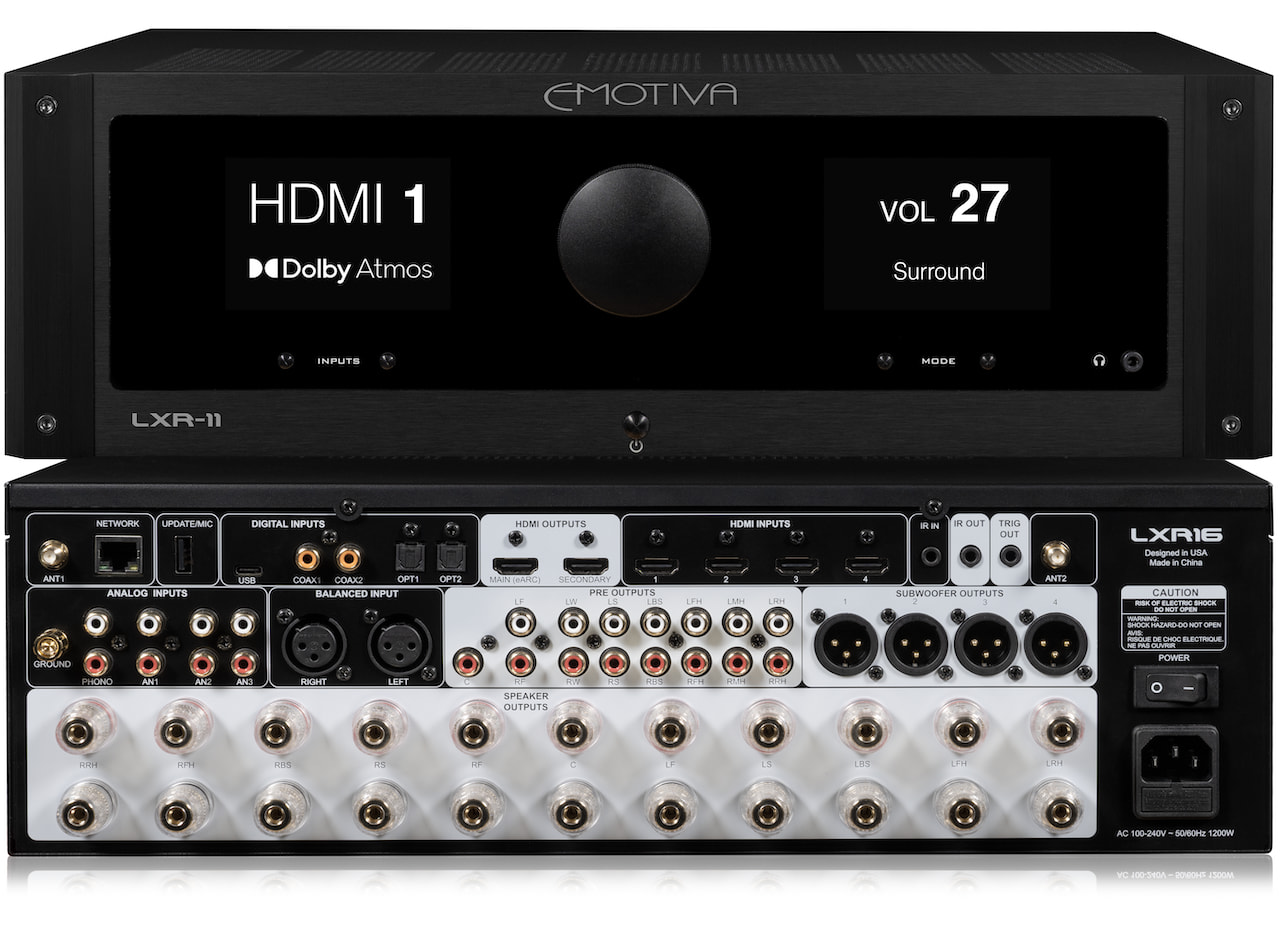
The LXR-11 takes essentially the same processing platform and adds 11 channels of Hypex NCOREx Class D amplification.
That is a notable choice. Hypex amplification has become increasingly common in serious two-channel and multichannel products because it can deliver substantial output from relatively compact, efficient designs.
Emotiva has also made the LXR-11 fanless, which matters in quiet rooms and enclosed equipment installations where mechanical noise is about as welcome as someone opening a bag of potato chips during 2001: A Space Odyssey.
The receiver provides 15-channel RCA preamp outputs, allowing external amplification to be added as the system grows. Emotiva also says the internal amplification can be completely switched off if the LXR-11 is eventually used primarily as a processor.
LXR-11 Amplifier Specifications:
Emotiva’s detailed power specifications are unusually useful because they specify how many channels are being driven:
- 140 watts per channel into 8 ohms, 2 channels driven, 20 Hz to 20 kHz, 0.02% THD
- 240 watts per channel into 4 ohms, 2 channels driven, 20 Hz to 20 kHz, 0.02% THD
- 140 watts per channel into 8 ohms, 5 channels driven, 0.1% THD
- 140 watts per channel into 8 ohms, 7 channels driven, 0.1% THD
- 100 watts per channel into 8 ohms, 9 channels driven, 0.1% THD
Emotiva has not published an 11-channels-driven power specification, so we are not going to invent one.
The rest of the LXR-11 specification closely mirrors the LXP-16, including four HDMI 2.1 inputs, two outputs, four independent balanced subwoofer outputs, MM phono, USB-C audio, network connectivity, and the complete Dirac package.
Emersa Brings Streaming Into the LX Series
Both models also include Emotiva’s Emersa streaming platform and Emersa Control app.
Published streaming support includes TIDAL Connect, Qobuz Connect, Spotify Connect, DLNA, Google Cast, Bluetooth, and USB playback. The app handles volume, source selection, listening modes, streaming access, and commonly used audio adjustments.
One competitive difference is worth noting: Emotiva’s published specifications currently do not list Apple AirPlay or Roon Ready support, both of which are offered by ARCAM’s newest Radia home theater products. Whether that matters will depend entirely on how a system is used.
There is also a more obvious hardware limitation.
The LX Series provides only four HDMI inputs. ARCAM and Marantz offer seven HDMI inputs on several of their closest competitors. Four will be enough for many installations, especially when eARC moves television apps back through the system, but owners with multiple consoles, disc players, streamers, and specialty video sources should count first and purchase second.
The Competition
Two brands stand out as the most relevant competition based on current technology, channel capability, and pricing: ARCAM and Marantz.
ARCAM Radia
ARCAM’s new AVP45 is probably the closest direct rival to the LXP-16.
Priced at $5,999.95, the AVP45 provides 16-channel processing, balanced outputs, seven HDMI inputs, Dolby Atmos, DTS, Auro-3D, extensive streaming, Roon Ready support, AirPlay, Google Cast, Bluetooth with Snapdragon Sound and Auracast, and Dirac Live. Bass Control and Active Room Treatment are supported but require paid upgrades.
The $6,999.95 ARCAM AVA35 is the more logical rival to the LXR-11. It processes up to 16 channels but provides nine channels of Class G amplification rather than eleven. ARCAM counters with more HDMI connectivity, Auro-3D, Roon, AirPlay, and its broader streaming feature set.
The Emotiva advantage is straightforward: more onboard amplifier channels in the receiver, four dedicated balanced subwoofer outputs and the entire Dirac suite already included.
Marantz
Marantz attacks the same market from two different directions.
The $8,000 AV 10 offers 15.4-channel processing, balanced outputs for every channel, seven 8K HDMI inputs, HEOS streaming, Dolby Atmos and a considerably more expensive premium chassis. It also supports Dirac Live, Bass Control and Active Room Treatment, but those features require separate licensing.
At $4,800, the Marantz CINEMA 30 costs less than the Emotiva LXR-11 and includes eleven channels of Class A/B amplification rated at 140 watts per channel with two channels driven. Its processing ceiling is 13.4 channels rather than Emotiva’s 15 speaker channels plus four subwoofers, while HEOS, AirPlay, seven HDMI inputs, Auro-3D and the broader Marantz ecosystem give it a different set of strengths. Dirac remains an optional upgrade.
This is not a case where one specification sheet automatically wins. Marantz has the more mature connected ecosystem and ARCAM offers excellent integration and streaming flexibility. Emotiva is putting more of the expensive acoustic processing into the purchase price.
There Is Another CEDIA Story Here
The hardware is only half of Emotiva’s CEDIA announcement.
The company is also launching a new Authorized Dealer Program and will be meeting with prospective dealers and integrators during the show. Emotiva has historically identified itself as a direct-to-consumer company, and its existing Integrator Program was designed primarily for professionals purchasing equipment for specific installations rather than conventional retail resale.
Emotiva has not yet published enough detail to determine exactly how broadly the new dealer structure will alter that business model.
But appearing at CEDIA with two considerably more ambitious home theater components while simultaneously building a dealer network is not difficult to interpret. Emotiva wants the LX Series specified into professionally designed theaters, not just ordered by enthusiasts already familiar with the brand.
That could ultimately be as important as another HDMI input.
The Bottom Line
Emotiva is not winning this fight simply by being cheaper.
The LXP-16 and LXR-11 combine 15-channel immersive processing, four independent balanced subwoofer outputs, modern HDMI 2.1 video support and the complete Dirac Live suite, while the receiver adds eleven channels of Hypex NCOREx amplification.
ARCAM offers more connectivity and a more comprehensive streaming platform. Marantz brings HEOS, seven HDMI inputs, a mature control ecosystem, and formidable competition at both ends of the price range.
But requiring customers to spend nothing extra for Dirac Live Bass Control or Active Room Treatment changes the value equation considerably.
If the LX Series performs as well as its specifications suggest and Emotiva can make its new dealer strategy work, CEDIA 2026 could mark the point where the company stops being viewed primarily as the direct-to-consumer value alternative and starts becoming a much bigger problem for established high-end home theater brands.
Price & Availability
Both are scheduled for release in October 2026, with further launch information expected before availability. They will make their CEDIA Expo debut at Emotiva Booth 2938 in Denver.
You must be logged in to post a comment Login