Coin batteries don’t make headlines all that often, but today shifts that trend with a smart new development. Energizer has released a new Ultimate Child Shield version of its 20mm coin lithium batteries. As the name implies, the tech is aimed at reducing the number of health risks if a child accidentally swallows the battery. These coin batteries don’t cause burning in the esophagus if ingested, and they also contain a dye that will color a child’s mouth blue if it comes in contact with saliva.
According to Energizer’s press release, more than 3,500 coin lithium battery ingestion incidents are reported in the US each year. Traditional coin batteries can cause esophageal burning within 15 minutes of ingestion, and the addition of the dye can help a caregiver notice quickly if an accident has occurred and get help for the child. Ultimate Child Shield tech is available on the company’s size 2032, 2025 and 2016 batteries, which power a variety of devices including watches and AirTags.
On Wednesday, xAI and Anthropic announced a surprise partnership that has the Claude-maker buying out “all of the compute capacity at [xAI’s] Colossus 1 data center,” roughly 300MW that allowed Anthropic to immediately raise its usage limits. It’s a huge deal for xAI, likely worth billions of dollars. More importantly, it immediately monetized one of the company’s most impressive accomplishments, turning xAI from a consumer to a provider of compute.
It’s tempting to see the arrangement as a shot at OpenAI amid the ongoing lawsuit. But Musk’s explanation on X was that xAI had already moved training to a newer data center, Colossus 2, and xAI simply didn’t need them both.
In the short term, there’s an obvious logic at work. xAI’s existing products are mostly focused on Grok, which has seen plummeting usage since the image generation debacles earlier this year. If xAI’s data center buildout is much more than what Grok needs to operate, partnering with Anthropic adds a lot of green to the balance sheet. This is especially useful as the company, now combined with SpaceX, speeds toward an IPO. More broadly, having Anthropic lined up as a customer makes it easier to believe that SpaceX’s orbital data center play might actually work.
But beyond the short-term benefit, the Anthropic partnership sends an unusual message about where Elon Musk’s priorities really lie. It suggests the company’s real business may be more about building data centers than training AI models.
Advertisement
It’s rare to see a major tech company treat compute resources this way when companies like Google and Meta, which are also training models, are building more data centers. It’s an easy point to miss, because so many of these companies are working as enterprise AI vendors, online services, and cloud providers all at once. But when forced to make a choice between selling more available compute to customers and preserving some to build their own tools, they reliably choose door No. 2.
Just last month, Sundar Pichai admitted on a call that Google Cloud revenue was lower than it could have been because the company was “capacity constrained” — and when given the choice of renting out their GPUs or using them to develop AI products, Google chose the AI products.
Facebook has faced a more extreme version of the same constraint, spinning up an entirely new cloud apparatus just to ensure they would have enough GPU power to chase Mark Zuckerberg’s AI ambition. As he put it when announcing Meta Compute in January, “How we engineer, invest, and partner to build this infrastructure will become a strategic advantage.”
Techcrunch event
Advertisement
San Francisco, CA | October 13-15, 2026
The key word there is “strategic.” Both Zuckerberg and Pichai are looking toward a future where AI is powering the most popular and lucrative systems in the world. Computing power isn’t just a way to satisfy today’s inference demand, but to build tomorrow’s products — and running short on compute means missing out on that chance.
Advertisement
By focusing on data centers (earthbound and otherwise), xAI is positioning itself more like a neocloud business: buying GPUs from Nvidia and renting them out to model developers like Anthropic. It’s a far more difficult business, squeezed by both chip suppliers and the shifting cycles of demand. The valuations for most active neoclouds reflect that reality: xAI was valued at $230 billion in its January funding round; CoreWeave, which oversees a comparable quantity of computing power, is worth less than a third of that.
Musk’s version of a neocloud is more ambitious, as you might expect. Some of the data centers might be in space — at least by 2035, if things go according to plan. xAI will be making its own chips at the Terafab, which will take away some but not all of Nvidia’s pricing power. But none of it changes the basic economics of the neocloud business.
As recently as the February all-hands, xAI had real ambitions in software. That was the presentation that unveiled the orbital data center project, but it also teased significant ambitions in coding (since bolstered by the Cursor partnership) and interesting ideas like leveraging computer use into full-scale digital twins (in the unfortunately named Macrohard project). These are the kind of long-horizon projects that need committed computing resources to succeed. As long as xAI is selling large quantities of compute to its competitors, it’s hard to think such new ambitions have much of a future.
When you purchase through links in our articles, we may earn a small commission. This doesn’t affect our editorial independence.
Google is updating AI Overviews and AI Mode, the AI-generated portions of its search engine, to highlight sources in new ways, and interestingly, more prominently feature first-hand accounts from social media, expert blogs and forums like Reddit.
Via a new section that can appear in AI responses, Google will display “a preview of perspectives from public online discussions, social media and other firsthand sources.” In the sample screenshot the company provided, the section was called “Expert Advice” and included quotes from forums, WordPress blogs and Reddit. These were arranged above links to their respective sources. Google plans to add more context to these links, too, showing “a creator’s name, handle or community name,” so you can judge what you might want to click through and read from a glance.
Google will also start recommending in-depth articles at the end of AI responses for further exploration of a given topic, and link to more sources directly in its generated answers rather than just at the end. If you subscribe to any publications, AI responses will also highlight sources from the subscriptions you link to your Google account.
Given the rapid progress of AI in general, AI Overviews and AI Mode have been pretty consistently iterated on since Google launched them in 2024 and 2025, respectively. Pulling from Reddit and other online social platforms isn’t exactly a new strategy for the company, either — at least one early AI Overview hallucination was caused by information from Reddit. It is perhaps telling Google plans to cite the platform more prominently now, though, because Reddit is considered by some to be a more useful source of information than Google. Even more this update, the search engine has been prominently featuring Reddit links in standard search results.
Advertisement
Whether adding more links and recommending long-form reporting makes a meaningful difference for the dwindling number of publications Google pulls from is another story, however. As of 2025, Google claimed that its AI search tools were leading to more searches and more “high-quality clicks” on the websites it cites. Regardless of how much the company tinkers with its AI responses, though, one outcome of AI Overviews and AI Mode is the creation of scenarios where you don’t have to click away to another website at all, because Google answered your question for you.
Update, May 6, 5:30PM ET: This story was updated after publish to include information from Google that the title of the section is dynamic, rather than called Expert Advice.
Live screen streaming lets attackers monitor activity and capture authentication steps
Security researchers have tracked four Android banking trojan campaigns that rely on deception, stealth, and disappearing app icons to stay hidden out of sight after installation.
Researchers at Zimperium say the campaigns, named RecruitRat, SaferRat, Astrinox, and Massiv, collectively targeted more than 800 banking, cryptocurrency, and social media apps.
The potential reach is vast because many commonly used apps have billions of downloads, although actual infections likely number in the millions rather than billions.
Article continues below
Advertisement
Increasingly complex installation techniques
The researchers note the attackers rely heavily on tricking users, rather than exploiting technical flaws alone. Victims are directed to fake websites disguised as job portals, streaming services, or software downloads that seem legitimate at first glance.
Some campaigns imitate recruitment platforms, pushing victims to download an app as part of a supposed hiring process, while others promise free access to premium streaming content. This leads users to sideload malicious software from unofficial sources.
Advertisement
Installation techniques have grown increasingly complex, with many attacks using multi-stage delivery methods that conceal the true malware payload inside another file.
One tactic involves mimicking official update screens, including layouts resembling the Google Play interface, to lower suspicion during installation.
Sign up to the TechRadar Pro newsletter to get all the top news, opinion, features and guidance your business needs to succeed!
Once active, the malware often requests Accessibility permissions, allowing it to monitor actions, read screen content, and grant itself additional privileges without clear user knowledge.
Advertisement
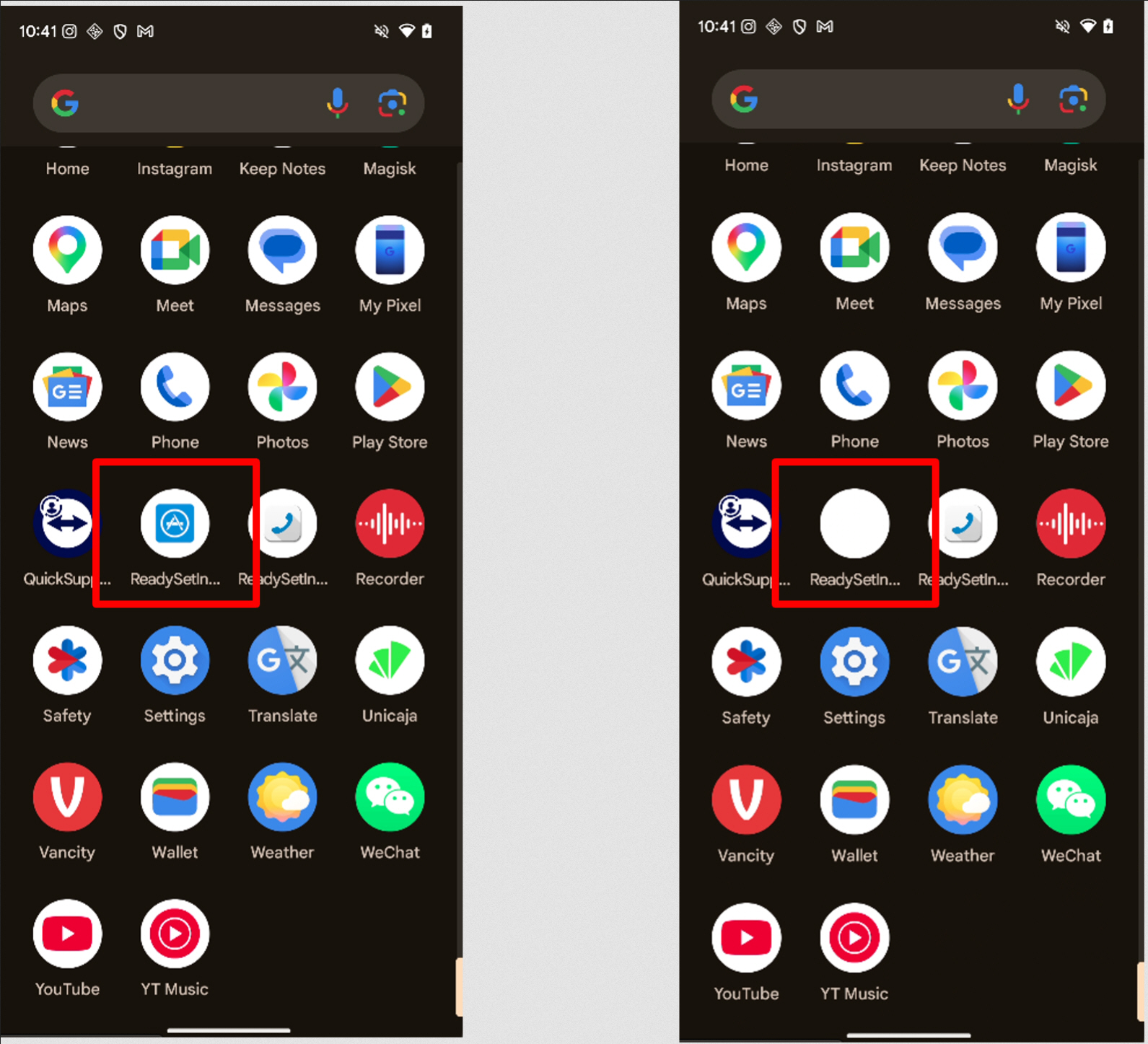
A particularly deceptive feature allows certain variants to replace their app icon with a blank image, effectively making the app “vanish” from the device’s app drawer, creating confusion when users attempt to locate or remove the software.
Other versions interfere directly with attempts to uninstall the malware by redirecting users away from system settings.
Screen overlays play a major role in credential theft across all four campaigns. Fake lock screens can capture PINs and patterns, while simulated banking login pages harvest credentials as users interact with legitimate apps.
Advertisement
Some variants even display full-screen “update” messages that prevent normal interaction while background actions take place.
Beyond stealing credentials, several families transmit live screen content to remote servers, creating a continuous visual feed that allows attackers to observe activity and intercept authentication steps in real time.
Encrypted communication channels connect infected devices to centralized command systems that coordinate attacks and distribute updated instructions.
These systems can manage thousands of compromised devices simultaneously, making widespread financial theft easier to organize.
Advertisement
Zimperium’s researchers say evolving evasion methods, including hidden payloads and structural file tampering, make detection harder for traditional security tools.
RingConn has launched its latest smart ring, and it’s going straight after Samsung with one standout claim: battery life that’s double that of the Galaxy Ring.
The new RingConn Gen 3 lasts up to 14 days on a single charge (with the caveat that haptics are turned off) compared to the seven-day estimate on Samsung’s Galaxy Ring. That alone makes it one of the longer-lasting smart rings currently on the market, and appeals to users who don’t want another device to charge every few days.
Battery aside, RingConn is also leaning further into health tracking. The Gen 3 focuses on vascular health insights, alongside features like sleep tracking and sleep apnea monitoring. There’s also a planned blood pressure tracking feature, but it’s not available at launch and will instead arrive in a future update. As expected, it’s positioned as a trend-tracking tool rather than a medical-grade replacement.
One of the more unusual additions is a built-in vibration module, something you don’t typically see in smart rings. It can deliver haptic alerts for things like health reminders or low-battery warnings, but it notably doesn’t support notifications for messages or apps, which limits its usefulness somewhat.
Advertisement
In terms of design, the Gen 3 remains lightweight, at 2.5-3.5g, depending on size, putting it roughly in line with Samsung’s alternative. It’s available in sizes 6 through 15 and comes in five colour options, with support for both iOS and Android via the companion app. There’s also no subscription fee for accessing health data, which could be a draw for users put off by ongoing costs.
Advertisement
Pricing starts at $349. However, a pre-order discount drops it to $314 (or $332 for premium finishes) until May 28, 2026.
On paper, the RingConn Gen 3 looks like a serious alternative to Samsung’s Galaxy Ring, particularly if battery life is high on your priority list.
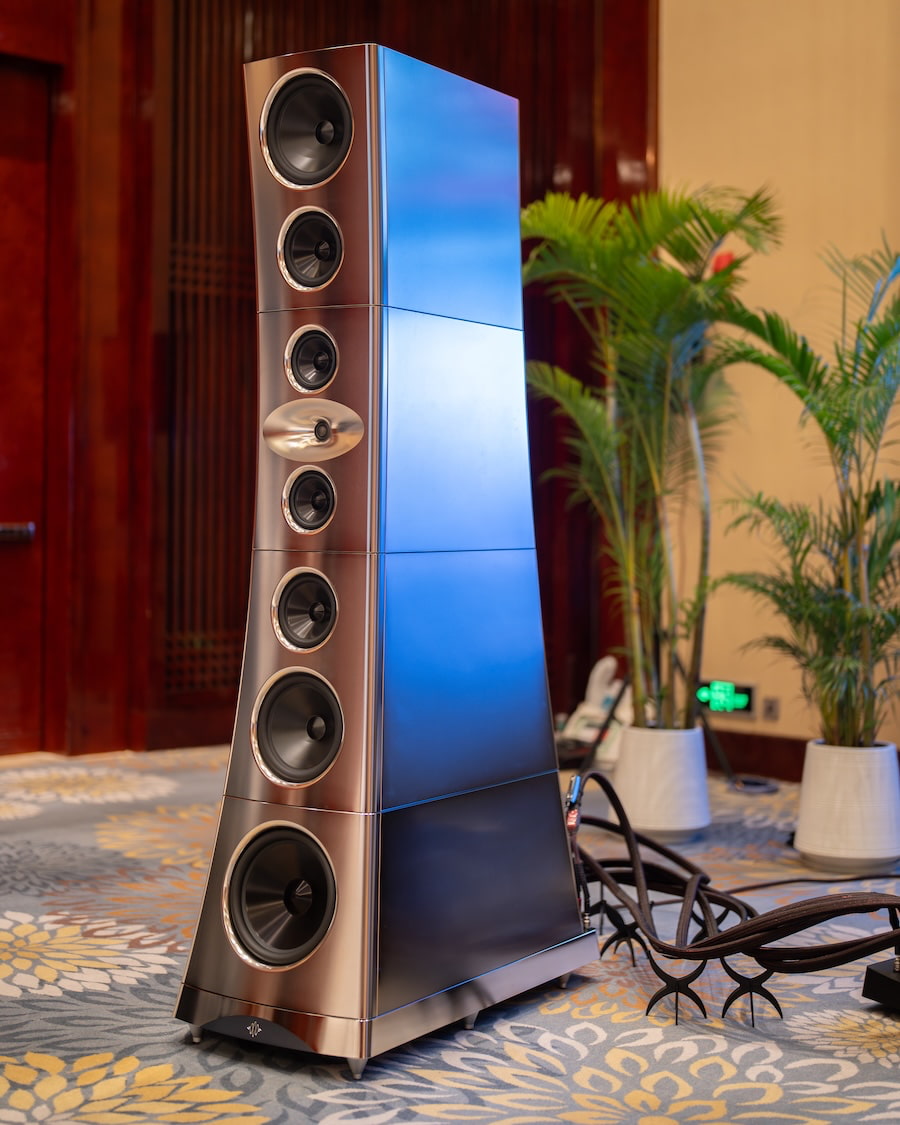
The ultra high-end loudspeaker category has been rather busy in 2026, which is either a sign that the market still has serious money to spend or that nobody in this business knows how to tap the brakes. Wilson Audio has already made a very large statement with the $788,000 per pair Autobiography, while Børresen’s M8 Gold Signature pushes the conversation into seven figure territory. Now YG Acoustics has entered the same rarefied air with Titan, the first model in its new flagship Ultimate Range and arguably the most talked about new loudspeaker at AXPONA 2026.
This is not a speaker aimed at the casually curious. Titan is YG’s attempt to plant a flag at the top of the mountain, where the air is thin, the rooms are large, and your bank account needs to barely flinch when the invoice is opened.
Attack of the Titans?
Five years of research and three years of product development later, YG Acoustics has arrived at Titan, the most ambitious loudspeaker the company has released to date. It is the first model in YG’s new Ultimate Range and is designed to showcase the brand’s latest engineering work while pushing further into the ultra high end loudspeaker category.
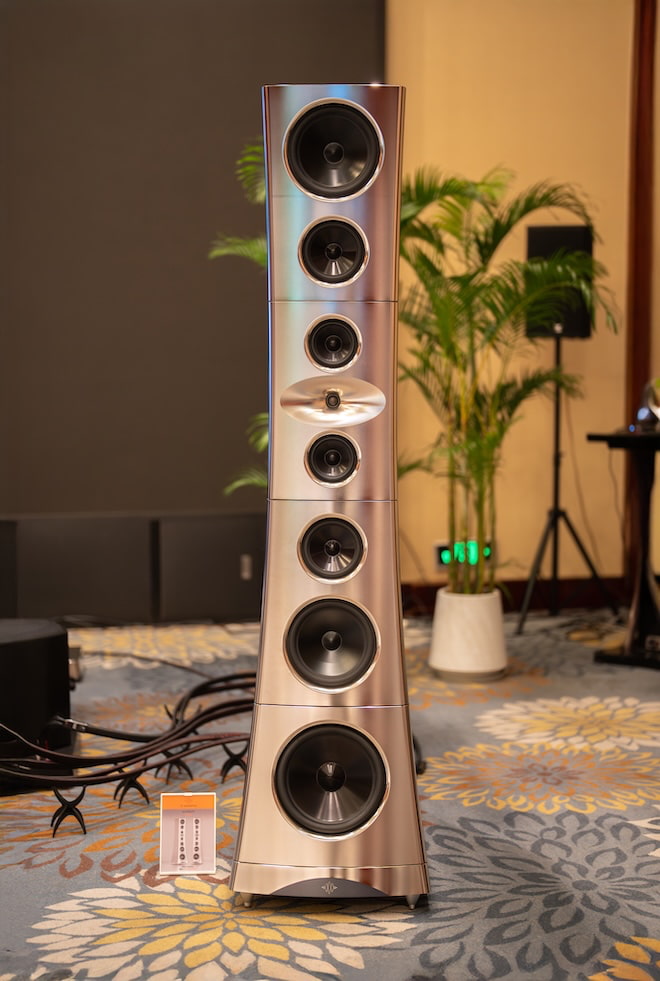
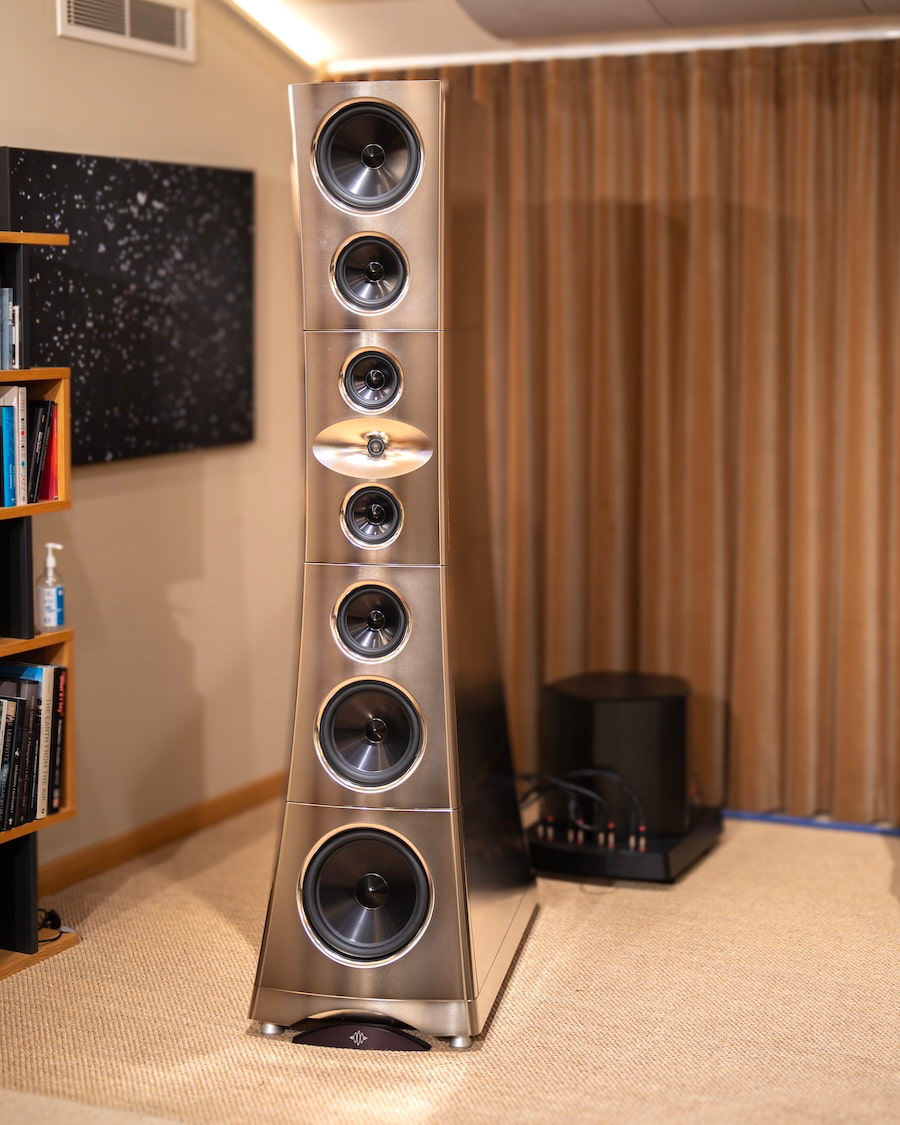
Titan is not trying to disappear visually. It stands approximately 7 feet tall, or 84.5 inches, and weighs about 1,000 pounds. That is half a ton before the crates, the room treatment, and the quiet conversation with your financial advisor. Inside the cabinet, YG uses a seven driver symmetrical array supported by a custom designed sub bass driver.
Advertisement
YG Acoustics Titan Versions & Pricing
YG Acoustics offers the Titan in three configurations, giving ultra high-end buyers some room to choose between passive operation, active sub bass support, and a fully active system. “Some room” being relative when the starting point is $880,000 per pair.
Titan Passive: $880,000 per pair
The Titan Passive is a fully passive five-way loudspeaker that uses an external crossover with YG Acoustics’ Ultracoherent circuits. Crossover points are specified at 35 Hz, 90 Hz, 360 Hz, and 1.85 kHz.
Titan with Active Sub: $910,000 per pair
The Titan with Active Sub uses a passive four-way system with an external crossover and Ultracoherent circuits at 90 Hz, 360 Hz, and 1.85 kHz. Sub-bass duties are handled by a dedicated external 1,000-watt amplifier with DSP tuned crossover control for the 12.5-inch (32 cm) driver, including room correction support. The active sub-bass section is time aligned to integrate with the passive drivers.
Titan Live: $1,000,000 per pair
The Titan Live is the fully integrated active version of YG Acoustics Titan. It includes dedicated amplification and DSP for each channel, covering the high, midrange, low, and sub bass sections. Each tower is partnered with an external amplifier using 8 x 700-watts with an optimized DSP crossover.
The system connects to the Live Controller using glass fiber optic cables, with support for Roon Ready streaming, analog and digital inputs, and a high quality phono stage. In other words, this is the version for buyers who want the full YG ecosystem, not just a pair of loudspeakers and a nervous conversation with their amplifier dealer.
Advertisement
The Drivers
High frequencies are handled by YG’s lattice tweeter set inside a unique oval waveguide flanked by proprietary YG aluminum cone drivers arranged symmetrically above and below it: a pair of 15 cm (6-inch) mid-range drivers, a pair of 18 cm (7.25-inch) mid-bass drivers, and a pair of 26 cm (10.25-inch) bass drivers.
The tweeter, midrange, mid-bass, and bass array is supported by a custom 32 cm (12.5 inch) YG aluminum cone sub bass driver with an ultra high field magnet structure. YG says each driver is phase aligned across a wide frequency range to support a point source presentation.
Advertisement. Scroll to continue reading.
The goal is improved clarity, more precise imaging, and a wider listening area. That matters with a loudspeaker this large, because nobody spending this kind of money wants to sit with their head locked in one exact spot like they are being scanned for replicant behavior.
More details are included in the specifications chart later in the article.
Advertisement
Driver array includes:
One 26 mm (1”) Tweeter: Proprietary YG Lattice hybrid construction
Dual 15 cm (6 inch) midrange drivers: Proprietary YG aluminum cone drivers with neodymium magnets and close pair matching.
Dual 18.5 cm (7.25 inch) midbass drivers: Proprietary YG aluminum cone drivers with neodymium magnets and close pair matching.
Dual 26 cm (10.25 inch) bass drivers: Proprietary YG aluminum cone drivers with ultra high field magnets and close pair matching.
32 cm (12.5 inch) sub bass driver: Proprietary YG aluminum cone driver with an ultra high field magnet and close matching.
Cabinet Construction
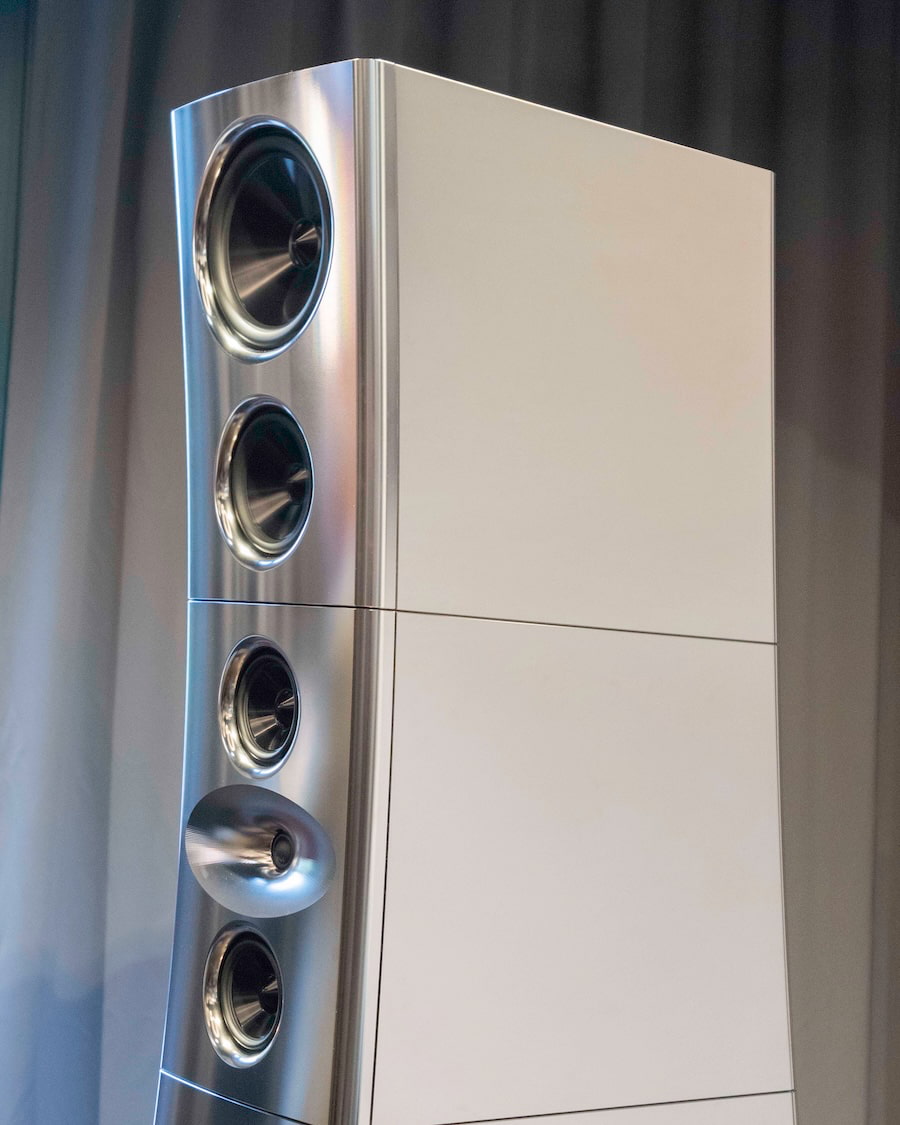
The Titan cabinet uses a five layer construction, another example of YG Acoustics’ focus on structural rigidity, resonance control, and fit and finish.
The side panels use three layers of aerospace grade aluminum alloy, with precision engineered damping materials between them. That creates the five layer structure and gives the cabinet additional stiffness without relying on brute mass alone.
The front faceplates are machined from solid aerospace grade aluminum measuring 75 mm, or 3 inches, thick. YG says the aluminum is heat treated to optimize its crystalline structure before being milled to extremely tight tolerances.
Inside the cabinet, Titan uses advanced bracing, composite resin damping, and computationally optimized diffuser and absorber structures to reduce internal resonances and help the drivers operate with fewer cabinet related distortions.
In addition, the subwoofer section at the bottom maximizes cabinet volume by tapping into a channel that runs up the entire back of the Titan.
The Passive Crossover
The passive crossover is the result of the art and science of speaker engineering. The crossover is built on bespoke multi-layer PCB material with advanced dielectric properties and internal resonance damping.
Advertisement
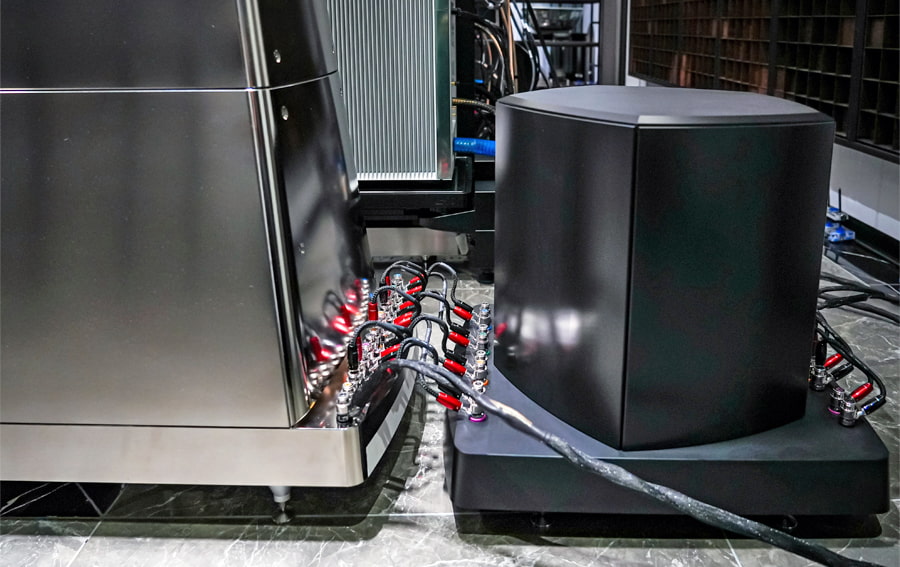
Each crossover circuit is precisely milled in-house from extra-thick, high-purity copper, with traces optimized through simulation to eliminate interference and distortion. The crossover is housed externally in an enclosure crafted entirely from a specially selected polymer material. The external placement eliminates any field interactions with the crossover signal.
YG Acoustics Titan Specifications
YG Acoustics Model
Titan
Speaker Design
5-Way (Available in passive, Active Sub, and Live versions)
Price per pair
$880,000 (passive) $910,000 (passive with active sub) $1,000,000 (fully active)
Cabinet Construction
Side Panels: 3 aerospace aluminum layers with two damping layers in between for a total of five.
Front and Back: 3″ thick monolithic slabs of aerospace aluminum with specially engineered damping chambers
Speaker Type
Floorstanding loudspeaker
Tweeter
One 26 mm (1”) proprietary YG Lattice hybrid tweeter
Midrange
Dual 15 cm (6”) proprietary YG aluminum cone midrange drivers, neodymium magnets, and exceptional matching
Advertisement
Dual 18.5 cm (7.25”) proprietary YG aluminum cone mid bass drivers, neodymium magnets, and exceptional matching
Woofer
Dual 26 cm (10.25”) proprietary YG aluminum cone bass drivers, ultra-high field magnets, and exceptional matching
32 cm (12.5”) proprietary YG aluminum cone sub-bass driver, ultra-high field magnets, exceptional matching
YG Acoustics Titan Loudspeaker with external crossover behind speaker.
The Bottom Line
The YG Acoustics Titan is not just the first model in the company’s new Ultimate Range. It is YG’s statement that it wants a seat at the same very expensive table as the Wilson Audio Autobiography, Børresen M8 Gold Signature, and Sonus faber Suprema. That table does not come with a kids’ menu.
What makes Titan interesting is not one single trick feature, but the complete system approach: a massive seven driver symmetrical array, dedicated 12.5-inch sub bass driver, five layer cabinet construction, phase aligned driver integration, and three available configurations: passive, active sub bass, and fully active Titan Live. That flexibility is unusual for a loudspeaker at this level, especially when buyers can choose between traditional external amplification, active low frequency support, or a complete YG controlled ecosystem with amplification, DSP, streaming, digital inputs, analog inputs, and a phono stage.
Advertisement
Prospective buyers need to think beyond the loudspeaker price. The passive and active sub versions still require serious amplification, sources, cabling, setup expertise, and a room large enough to let a 7 foot tall, 1,000 pound loudspeaker breathe. With output extending below 20 Hz and up to 40 kHz, a 4 ohm average impedance, and a 2.4 ohm minimum load, Titan is not something you casually drop into a living room next to the sectional and hope for the best. It needs space, power, proper setup, and a system built around it.
Advertisement. Scroll to continue reading.
Titan is aimed at listeners who already understand the cost of entry in the ultra high-end category and want YG’s most ambitious expression of scale, control, and engineering. Everyone else can admire it from a safe distance, preferably outside the freight elevator.
YG Acoustics Titan in special gold finish that could double the price.
Price & Availability
YG Acoustics Titan (aluminum version) is available now through Authorized Dealers in three configurations:
Titan Passive – $880,000 per pair
Titan w/Active Sub – $910,000 per pair
Titan Live – $1,000,000 per pair
A gold version is also available for roughly $2 million per pair, depending on market pricing and thickness of gold plating.
Google is updating AI Overviews and AI Mode to more prominently surface “Expert Advice” from public discussions, social platforms, forums, blogs, and Reddit. Engadget reports: Via a new “Expert Advice” section that can appear in AI responses, Google will display “a preview of perspectives from public online discussions, social media and other firsthand sources.” In the sample screenshot the company provided, quotes from forums, WordPress blogs and Reddit were arranged above links to their respective sources. Google plans to add more context to these links, too, showing “a creator’s name, handle or community name,” so you can judge what you might want to click through and read from a glance.
Google will also start recommending in-depth articles at the end of AI responses for further exploration of a given topic, and link to more sources directly in its generated answers rather than just at the end. If you subscribe to any publications, AI responses will also highlight sources from the subscriptions you link to your Google account.
15,500 domains were actively used to deliver cloaked AI investment scams
Cloaking ensures harmful content is shown only to targeted victims
Commercial tracking software allows cybercriminals to scale operations without building infrastructure
Cloaking has shifted from a supporting tactic into a central layer of cybercriminal infrastructure, and commercial tools are now widely embedded in cybercrime operations at scale.
A four-month analysis of malicious activity by Infoblox and Confiant identified roughly 15,500 domains linked to malicious tracker deployments.
These domains routed traffic from compromised websites, spam messages, social media channels, and online advertising ecosystems.
Article continues below
Advertisement
Threat actors exploit commercial tracking software for scale
Rather than building bespoke systems, many threat actors rely on commercial tracking software that already performs filtering, routing, and campaign management functions at scale.
These domains do not simply host scams, but conceal them through cloaking techniques that display harmful content only to intended victims while displaying benign pages to security scanners and others.
Advertisement
Cloaking operates through traffic distribution systems that filter visitors using attributes such as location, device type, and referral source before determining what content is shown.
This allows operators to circumvent advertising restrictions while refining the audience that ultimately sees the scam content.
Sign up to the TechRadar Pro newsletter to get all the top news, opinion, features and guidance your business needs to succeed!
The research describes cloaking as “a foundational block of modern cybercrime,” reflecting how deeply integrated it has become within these operations.
Advertisement
It also allows threat actors to shield infrastructure not only from defenders but also from rival groups seeking to hijack campaigns.
Investment scams accounted for the largest share of activity observed across these domains, with a clear emphasis on AI-themed narratives as the primary lure.
Pages frequently promote automated trading platforms using phrases such as “Smart AI Trading Technology” or “Intelligent Trading Solutions,” often paired with claims of consistent and unusually high returns.
Advertisement
In several cases, deepfake imagery and fabricated media content are used to reinforce credibility and create a sense of urgency.
Also, generative AI tools are being used to produce large volumes of campaign material programmatically.
This includes headlines, promotional copy, and visual assets that can be deployed across multiple domains with minimal variation.
The result is a scalable content pipeline that supports rapid campaign expansion across languages and regions without requiring substantial manual effort.
Advertisement
Despite domain reporting and account suspensions by researchers and the tracker’s operators, the activity shows little sign of slowing.
Operators continue to rotate domains and reuse the same infrastructure with minimal changes, allowing campaigns to return quickly after disruption.
Thousands of active domains within a short window point to persistent and ongoing activity rather than isolated incidents.
Endpoint protection systems often struggle to detect these campaigns because cloaked content is only revealed after specific conditions are met.
Advertisement
Firewallcontrols provide limited coverage when traffic is routed through legitimate advertising and web channels.
Malware removal efforts remain reactive, as harm typically occurs only after victims have already been funneled through these delivery paths.
These limitations mean that standard defenses cannot stop these attacks, and the risk from cloaking and tracker abuse remains high.
Billionaire media mogul Barry Diller doesn’t think OpenAI CEO Sam Altman is untrustworthy, despite recent reporting to the contrary. Onstage at The Wall Street Journal’s “Future of Everything” conference this week, Diller vouched for the AI exec, who has been accused by some former colleagues and board members of being manipulative and deceptive at times.
Diller, who is friendly with Altman, was responding to a question about whether or not people should put their faith in Altman to ensure that artificial intelligence benefits humanity.
In particular, he was asked about the theoretical form of AI known as artificial general intelligence, or AGI, which could one day outperform humans on any task.
The media exec, a co-founder of Fox Broadcasting and chairman of IAC and Expedia Group, said that while he believes Altman is sincere in his pursuits, that’s not really the area of concern people should be focused on. Rather, it’s the unknown consequences that will result from AI.
Advertisement
“One of the big issues with AI is it goes way beyond trust,” Diller said. “It may be that trust is irrelevant because the things that are happening are a surprise to the people who are making those things happen. And I’ve spent a lot of time with various people who’ve been in the creation mode of AI, and they have a sense of wonder themselves. So…it’s the great unknown. We don’t know. They don’t know,” he explained.
“We have embarked on something that is going to change almost everything. It is not under-reported. Now, whether these huge investments are going to come through — I couldn’t care less. I’m not invested in it, but progress is going to be made,” Diller added.
Still, the media mogul said he believes that most of the people leading the charge are good stewards, saying he believes that Altman is sincere and “a decent person with good values.” (Diller wouldn’t say which of the AI leaders he thinks is insincere, we should note.)
Techcrunch event
Advertisement
San Francisco, CA | October 13-15, 2026
“But the issue is not their stewardship. The issue is … it’s dealing truly with the unknown. They don’t know what can happen once you get AGI, and we’re close to it. We’re not there yet, but we’re getting closer and closer, quicker and quicker. And we must think about guardrails,” Diller noted.
Advertisement
Plus, he warned, if humans don’t think about guardrails, then the alternative is that “another force, an AGI force, will do it themselves. And once that happens, once you unleash that, there’s no going back,” Diller said.
When you purchase through links in our articles, we may earn a small commission. This doesn’t affect our editorial independence.
Meta is beefing up its age-verification mechanisms with an AI system that analyzes images and videos on Instagram and Facebook for “visual cues,” such as height and bone structure, to identify and delete accounts of users under the age of 13. The company announced the move amid a wave of cases in which hundreds of children have managed to evade social network access restrictions, even through simple tricks such as drawing on a mustache.
The new approach is part of a series of measures Meta adopted as part of an AI-based security strategy designed to correct the limitations of traditional methods, which rely heavily on self-reported age. With this change, the company seeks to reduce the ease with which minors access platforms that, in theory, are restricted to them.
In a press release, Meta explained that it is implementing several tools to identify contextual indicators that allow estimating a person’s age. This process includes the analysis of posts, comments, bios, and descriptions, with special attention to references related to school years or birthday celebrations—elements that can offer clues about the real age of the person who manages the account.
These tools are in addition to automated analysis techniques aimed at detecting physical traits from imagery shared to Meta’s social platforms. These include characteristics such as height and bone structure. Meta is careful to stipulate that this system is not face recognition, as it does not seek to identify specific individuals in images or videos. Instead, the company notes that, “by combining these visual insights with our analysis of text and interactions, we can significantly increase the number of underage accounts we identify and remove.”
Advertisement
If, based on these elements, Meta suspects that an account is managed by a child under 13, it will be suspended. The user will have to revalidate their age using the procedures established by the company to regain access; otherwise, the profile will be permanently deleted.
Meta also announced that it will expand the scope of its technology to detect users between the ages of 13 and 15 and automatically assign them teen accounts. This type of profile incorporates content restrictions and parental controls enabled by default, with the aim of providing a safer environment for this age group.
Meta began implementing age-verification tech in 2024 for Instagram users in the United States, Australia, Canada, and the United Kingdom. Now, the mechanism will be extended to Instagram accounts in Brazil and 27 European Union countries. In addition, these practices will be applied for the first time to Facebook users in the US, with plans to expand to the EU and UK next month.
Looking All Grown-Up
The new measures have been interpreted as a response to a preliminary ruling recently issued by the European Commission, which concluded that the company led by Mark Zuckerberg is in breach of the Digital Services Act for allegedly failing to effectively prevent children under 13 from using its platforms. The EU body found that the company lacks sufficiently effective mechanisms to block such access and that its current systems for identifying and suspending accounts below the age threshold are insufficient.
Advertisement
These criticisms are supported by the results of a survey conducted by the nonprofit Internet Matters. After surveying nearly 1,300 children and their parents in the UK, the study revealed that approximately one-third of children have successfully evaded government-imposed restrictions on access to social networking sites. In some cases, the methods employed are particularly striking.
The report, titled “The Online Safety Act: Are Children Safe Online?” showed that 46 percent of 9- to 16-year-olds believe that circumventing age controls is very easy. In total, however, only 32 percent admitted to breaking the rules.
Snap’s $400 million deal with Perplexity to put the AI search engine directly in Snapchat is dead. The two companies “amicably ended the relationship” earlier this year, Snap disclosed in its latest earnings report.
The two companies first announced the partnership last November, with plans to make Perplexity’s AI search technology a prominent part of the Snapchat app. Snap said at the time that it expected to start seeing revenue from the partnership in “early 2026.” The feature began testing in Snapchat, but was never fully rolled out, according to a help page. The deal has been on shaky ground for some time, with the Snapchat maker saying earlier this year that the two sides had “yet to mutually agree on a path to a broader roll out.”
In a statement, a spokesperson for Perplexity said that the planned feature was “not the right fit” for either company. “After working together, Snap and Perplexity determined that the original implementation was not the right fit for each company’s product goals and have resolved the matter amicably on confidential terms,” the spokesperson said. “Perplexity continues to value Snapchat as a platform for reaching key audiences, remains active on the Snap platform, and expects to continue using Snap’s advertising products.”
Advertisement
Elsewhere, Snap has explored other ways of bringing revenue-generating AI features to Snapchat’s chat feature.The company recently rolled out “AI Sponsored Snaps,” which allows brands to surface AI agents in users’ conversations. During a call with analysts, CEO Evan Spiegel said that the feature was proof “that chat can be monetized in a way that’s really native to Snapchat.”
Spiegel also spoke about the company’s upcoming plans to show off its new AR glasses, which will be the first consumer-ready version of Specs. “The way that people are using their computers is changing really dramatically, and I think that that’s going to be evident in the adoption of wearables and the adoption of Specs over time,” he said. “Because people are going to spend less time hunched over their computers or their phones typing away on keyboards, and spend more time supervising agents who are doing that work on their behalf.” The company is expected to share more about Specs next month at the Augmented World Expo (AWE) event in Long Beach, California.
























































You must be logged in to post a comment Login