Tech
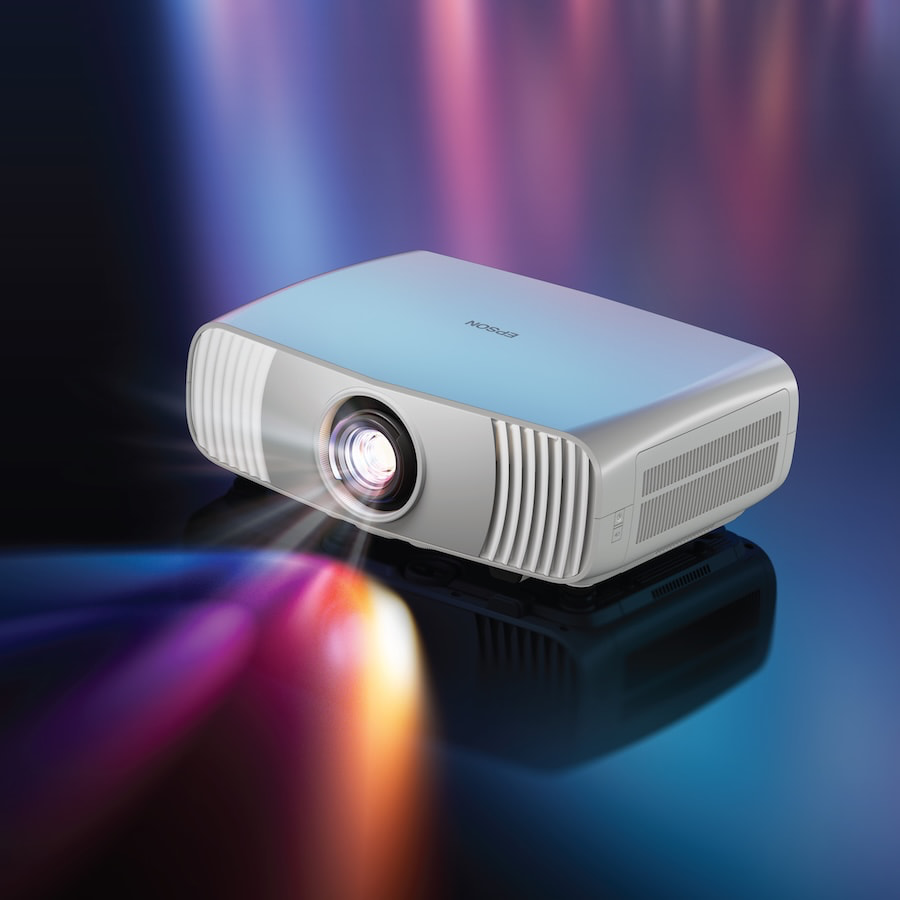
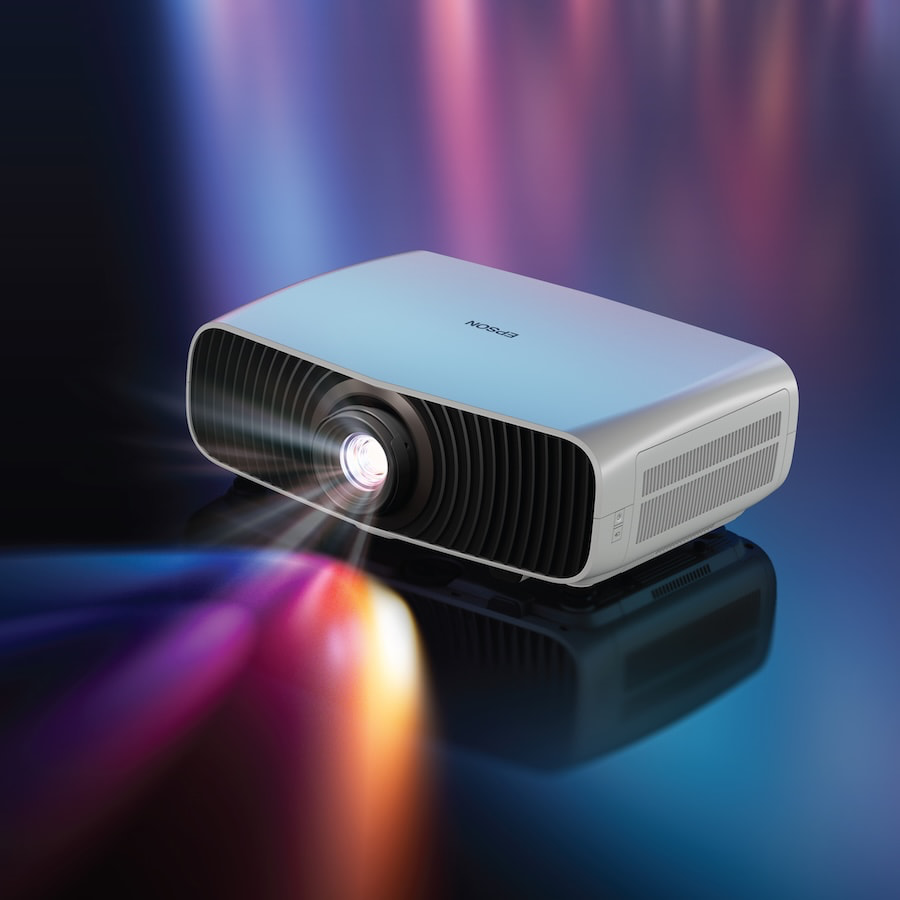
Epson Debuts Affordable 3LCD Home Cinema LS5000, LS6000 and LS7500 4K Laser Projectors

The rapid growth of extra-large TVs measuring 85 inches and larger has put real pressure on the home projector category. Today’s biggest TVs are brighter, smarter, and increasingly affordable, making them a compelling alternative for buyers who once would have automatically considered projection.
Projectors still hold one major advantage, however: sheer image size. In dedicated home theaters and larger multipurpose rooms, projection can deliver a 100-inch, 120-inch, or even larger image without pushing prices into the stratosphere.
Following the launch of its higher-end Pro Cinema Q-Series 4K Laser Projectors in 2024, Epson is now bringing more attention to its step-down Home Cinema lineup with the new LS5000, LS6000, and LS7500 4K HDR laser projectors. The three models sit below the flagship Q-Series but retain a number of the technologies and features that made those projectors noteworthy.
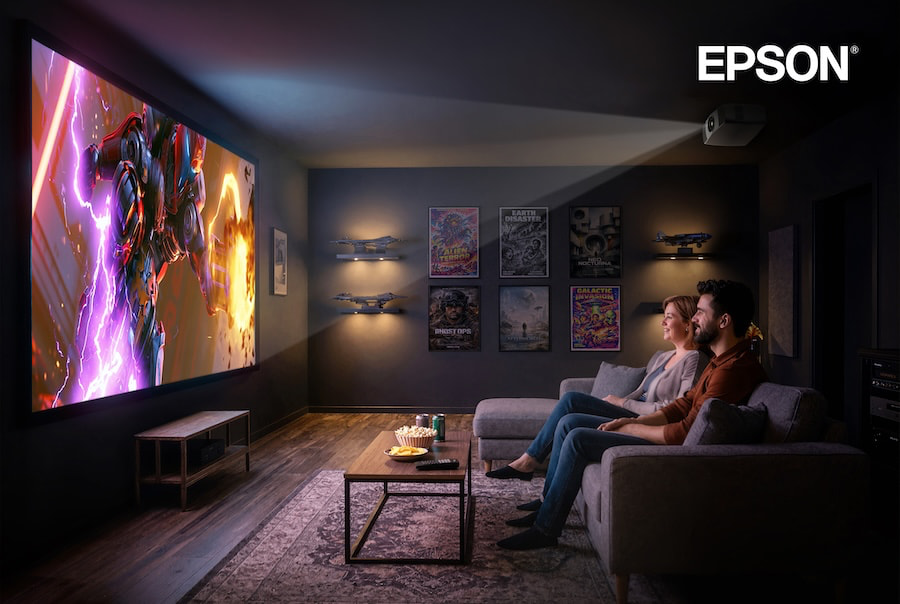

The new LS Series models are built around Epson’s 3-Chip 3LCD technology and use a laser light engine. For owners of older lamp-based projectors, the move to laser brings a longer-lasting light source, more consistent brightness over time, and faster startup and shutdown.
The new models complement Epson’s established Home Cinema projector lineup, which is currently headed by the Home Cinema LS11000, introduced in 2022. Epson says the new Home Cinema projectors are designed to balance image performance with flexible installation and easier integration across a wide range of home entertainment spaces.
“As TVs get bigger, they can also become a design challenge, leaving a large black rectangle that dominates the room when not in use. Projection offers a discreet alternative that virtually disappears when the entertainment ends, while creating immersive experiences not possible with a traditional TV – from everyday 16:9 content to cinematic 21:9 and IMAX-style viewing,” said Fernando Tamashiro, product manager at Epson America, Inc. “By expanding our Home Cinema lineup with these new 4K HDR laser projectors, we’re offering an even broader range of solutions for today’s home entertainment spaces. Combining our unique 3-Chip 3LCD technology with our latest laser light source, Epson projectors are the optimal choice for customers looking to create a big-screen experience tailored to their viewing preferences, space and budget.”
Designed for movies, sports, and immersive gaming, Epson’s new Home Cinema laser projector lineup can display 4K HDR images at screen sizes ranging from 40 to 300 inches.
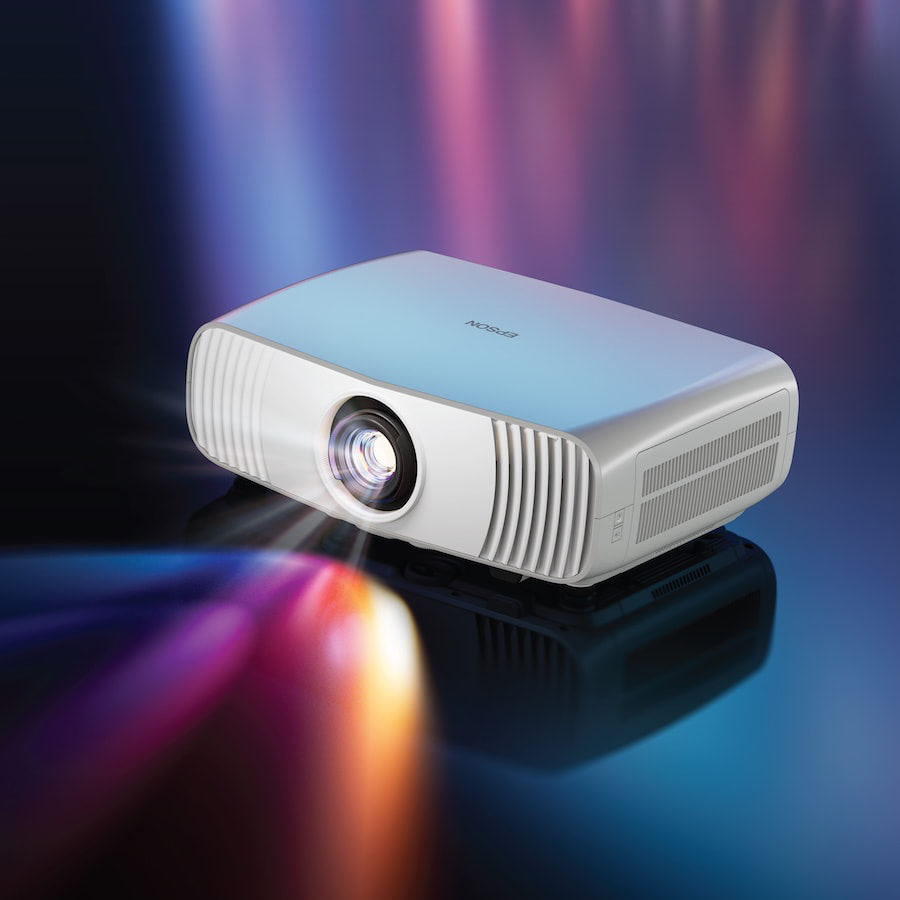

What the Epson LS5000, LS6000, and LS7500 Have in Common
Image Display Technologies: All three projectors use an advanced Epson Picture Processor, proprietary 4K display technology that produces a full 8.29-million-pixel on-screen image via Quad Pixel Shifting, and a 3-Chip 3LCD projection engine powered by a laser-array light source.
Light Output: The three projectors produce between 2,500 and 3,500 lumens of equal Color Brightness (IDMS Rated) and White Brightness (ISO Rated), depending on the model. Epson says the result is a bright, vivid image with strong color performance and deep black levels.
Advanced HDR Capability: Full 10-bit color processing supports HDR10 and HLG content. Additional HDR processing is provided by Epson’s Automatic HDR Scene Correction.
Multiple Aspect Ratios: From 16:9 HDTV content to cinematic 21:9 presentations, the new Home Cinema LS projectors are designed to support a range of screen formats and viewing environments.


Lenses: The Home Cinema LS5000 and LS6000 incorporate Epson Cinema standard-throw lenses, while the Home Cinema LS7500 features a short-throw lens that allows the projector to be positioned closer to the screen than conventional long-throw models. That makes the LS7500 better suited to larger screen sizes in rooms where projector placement is more limited.
High Black Contrast: Producing convincing black levels while maintaining shadow detail has long been a challenge for projectors. Epson specifies dynamic contrast ratios ranging from 800,000:1 to 1,200,000:1 across the three new LS models, depending on the projector. The goal is greater differentiation between bright and dark portions of the image while preserving detail in darker scenes.
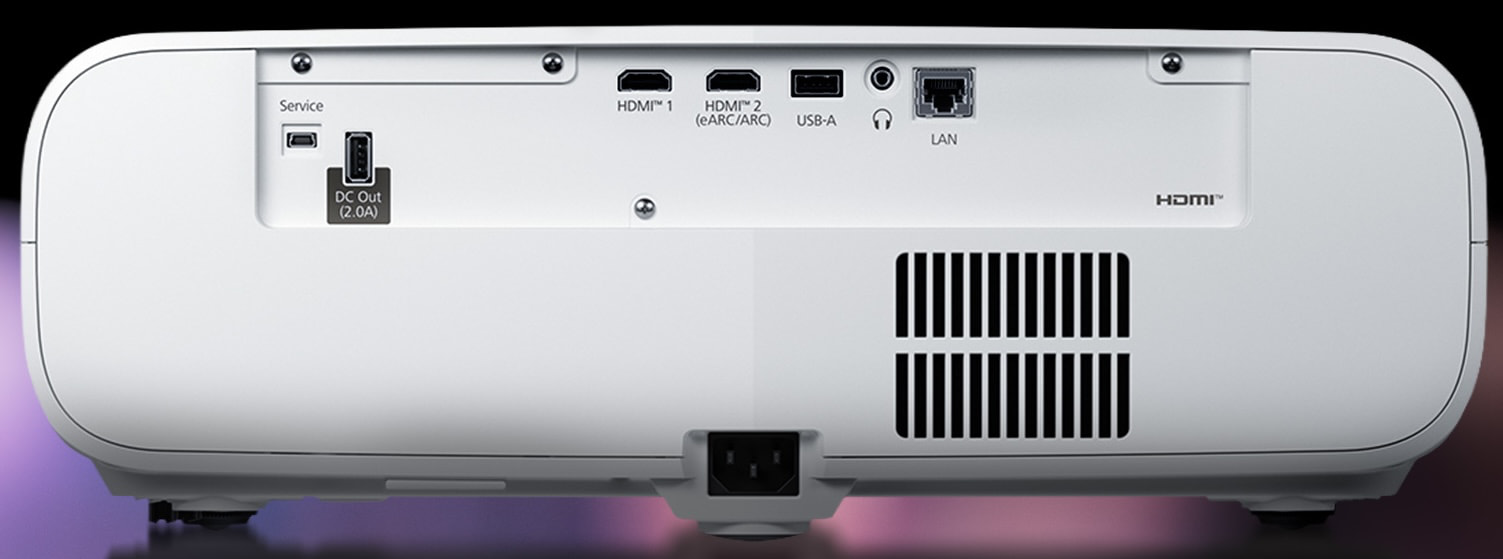
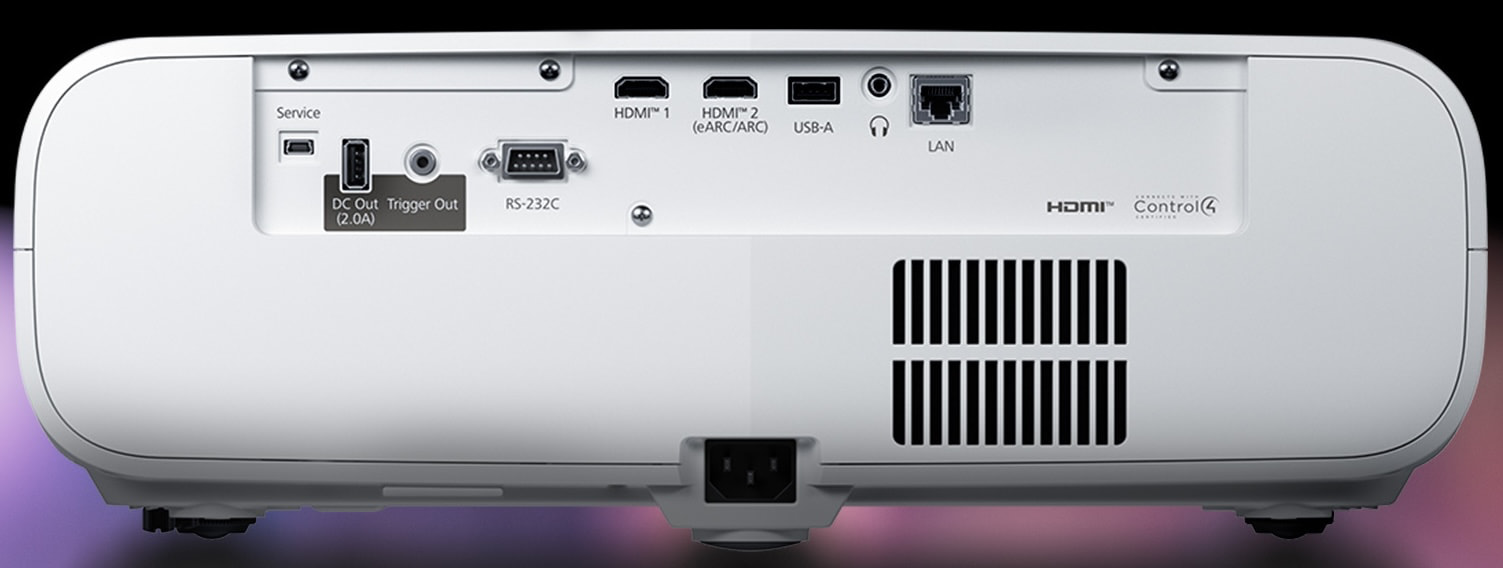


HDMI Connectivity: All three projectors include dual HDMI inputs supporting refresh rates up to 120Hz, with one HDMI port providing eARC for audio passthrough to a compatible AV receiver or soundbar.
Gaming: In addition to supporting refresh rates up to 120Hz, the new LS projectors include Auto Low Latency Mode (ALLM) and input lag rated below 20ms. That combination makes them suitable for gaming with compatible consoles and PCs where faster response times are important.
Flexible Installation: A compact design with quiet, front-exiting airflow provides additional placement flexibility. Manual lens shift of ±21% horizontally and ±59% vertically also makes it easier to position the projector in a variety of home theater and multipurpose spaces.
Bluetooth: Bluetooth connectivity is still not standard across the projector category, but the Home Cinema LS5000, LS6000, and LS7500 include Bluetooth 6.0. This allows audio from HDMI-connected sources to be streamed to compatible wireless headphones or speakers.
Comparison


| Epson Model | LS5000 (2026) |
LS6000 (2026) |
LS7500 (2026) |
LS11000 (2022) |
| Product Type | Video Projector | Video Projector | Video Projector | Video Projector |
| Price | $1,999.99 | $2,199.99 | $2,699.99 | $3,999.99 |
| Projection System | Epson 3LCD | Epson 3LCD | Epson 3LCD | Epson 3LCD |
| Chip Design (Architecture) | 3-chip | 3-chip | 3-chip | 3-chip |
| Light Source | True Laser Diode Array | True Laser Diode Array | True Laser Diode Array | Laser/Phosphor |
| Projection Method | Front, front-ceiling, rear, rear-ceiling | Front, front-ceiling, rear, rear-ceiling | Front, front-ceiling, rear, rear-ceiling | Front, front-ceiling, rear, rear-ceiling |
| Product Color | White | White | White | White |
| Driving Method | Poly-Silicon TFT Active Matrix, 0.62″ wide panel | Poly-Silicon TFT Active Matrix, 0.62″ wide panel | Poly-Silicon TFT Active Matrix, 0.62″ wide panel | Poly-silicon TFT Active Matrix, 0.74″ wide panel |
| Output Resolution | 4K Display Technology1 3840 x 2160 (dual axis: 1920 x 1080) | 4K Display Technology1 3840 x 2160 (dual axis: 1920 x 1080) | 4K Display Technology1 3840 x 2160 (dual axis: 1920 x 1080) | 4K Display 3840 x 2160 (dual-axis: 1920 x 1080) – Upgraded from earlier version that employed PRO UHD |
| Maximum Input Resolution | 4096 x 2160 | 4096 x 2160 | 4096 x 2160 | 4096 x 2160 |
| Supported Resolutions | 3840 x 2160, Full HD 1080p/i, HD 720p, 576p/i, 480p/i | 3840 x 2160, Full HD 1080p/i, HD 720p, 576p/i, 480p/i | 3840 x 2160, Full HD 1080p/i, HD 720p, 576p/i, 480p/i | 3840 x 2160, Full HD 1080p/i, HD 720p, 576p/i, 480p/i |
| Native Aspect Ratio | 16:9 widescreen | 16:9 widescreen | 16:9 widescreen | 16:9 widescreen |
| Color Brightness (IDMS Rated) | 2,500 Lumens | 3,400 Lumens | 3,500 Lumens | 2,500 Lumens |
| White Brightness (ISO Rated) | 2,500 Lumens | 3,400 Lumens | 3,500 Lumens | 2,500 Lumens |
| Contrast Ratio | Up to and over 800,000:1, with dynamic contrast in Normal and Auto Iris On | Up to and over 800,000:1, with dynamic contrast in Normal and Auto Iris On | Up to and over 1,000,000:1, with dynamic contrast in Normal and Auto Iris On | Up to and over 1,200,000:1, with Dynamic Contrast in Normal or High Speed setting |
| White Balance | Not Indicated | Not Indicated | Not Indicated | 14-point temperature adjustment |
| Color Reproduction | Full-color (up to 1.07 billion colors) | Full-color (up to 1.07 billion colors) | Full-color (up to 1.07 billion colors) | Full-color (up to 1.07 billion colors) |
| Size (Projected Distance) | 40″ to 300″ (at 45″ to 28.8′) | 40″ to 300″ (at 45″ to 28.8′) | 40″ to 300″ (at 45″ to 28.8′) – (Zoom: Wide and Zoom: Tele) | 50″ to 300″ (at 58″ to 62’4″) |
| HDR Color Processing | Full 10-bit | Full 10-bit (Partial 12-Bit) | Full 10-bit | Full 10-bit(Partial 12-Bit) |
| Light Source Life | Normal Mode: Up to 20,000 hours | Normal Mode: Up to 20,000 hours | Normal Mode: Up to 20,000 hours | Normal Mode: Up to 20,000 hours Medium Mode: Up to 20,000 hours Eco Mode: Up to 20,000 hours |
| Epson Cinema Lens | Multi-element precision glass structure | Multi-element precision glass structure | Multi-element precision glass structure | 15-element precision glass structure (AGS) |
| Type | Optical Zoom (manual)/Focus (manual) | Optical Zoom (manual)/Focus (manual) | Optical Zoom (manual)/Focus (manual) | Powered focus/optical zoom/lens position |
| F-Number | 1.49 – 1.77 | 1.49 – 1.77 | 1.49 – 1.61 | 2.0 – 3.0 |
| Focal Length | 18.2 mm – 29.2 mm | 18.2 mm – 29.2 mm | 13.9 mm – 18.1 mm | 22.5 – 46.7 mm |
| Zoom Ratio | 1 – 1.62 | 1 – 1.62 | 1 – 1.3 | 1 – 2.1 |
| Throw Ratio Range | 1.32 – 2.15 | 1.32 – 2.15 | 1.0 – 1.3 | 1.35 – 2.84 |
| Keystone Correction | Not Indicated | Not Indicated | Not Indicated | Vertical/Horizontal: ± 30 degrees |
| Lens Shift | Vertical: -59.0% to +59.0% (H center, manual)
Horizontal: -21.0% to +21.0% (V center, manual) |
Vertical: -59.0% to +59.0% (H center, manual)
Horizontal: -21.0% to +21.0% (V center, manual) |
Vertical: -59.0% to +59.0% (H center, manual)
Horizontal: -21.0% to +21.0% (V center, manual) |
Vertical: -96.3% to +96.3% (H center, powered)
Horizontal: -47.1% to +47.1% (V center, powered |
| Lens Cover | Cap | Cap | Cap | Powered, slide lens shutter |
| Connections | 2x HDMI 2.1 (HDCP 2.3), one supporting eARC/ARC
1x USB Type-A 5 V 2.0 A (for power supply) 1x USB Type-A (for Firmware updates) 1x Mini USB (service only) 1x Audio out mini plug (3.5 mm) 1x LAN RJ45 (Projector Control Only |
2x HDMI 2.1 (HDCP 2.3), one supporting eARC/ARC
1x USB Type-A 5 V 2.0 A (for power supply) 1x USB Type-A (for Firmware updates) 1x Mini USB (service only) 1x LAN RJ45 (Projector Control Only |
2x HDMI 2.1 (HDCP 2.3), one supporting eARC/ARC
1x USB Type-A 5 V 2.0 A (for power supply) 1x USB Type-A (for Firmware updates) 1x Mini USB (service only) 1x LAN RJ45 (Projector Control Only |
2x HDMI® 2.1 (HDCP 2.3); one supporting eARC/ARC
1x USB Type-A (for optical HDMI cable; 300 mA maximum power supply only) 1x USB Type-A 5 V, 2.0 A for power and firmware 1x Mini USB (service only) 1x LAN RJ45 (control only) 1x RS-232C (DB-9) 1x Trigger out (On, Off) 12 V DC, 200 mA maximum (3.5mm mono or stereo mini-jack) |
| Dynamic Range Support | HDR10, HLG | HDR10, HLG | HDR10, HLG | HDR10, HDR10+, HLG |
| HDR Adjustment | On/Off | On/Off | On/Off | 16 steps, real-time |
| Color Modes | Dynamic, Vivid, Cinema, Natural | Dynamic, Vivid, Cinema, Natural | Dynamic, Vivid, Cinema, Natural | Dynamic, Vivid, Cinema, Natural |
| Aspect Ratio Adjustment | Yes (Full, Super Zoom) | Yes (Full, Super Zoom) | Yes (Full, Super Zoom, Anamorphic Wide, Horizontal Squeeze) | Yes (Auto/Full/Zoom)
1.9:1 (4096 x 2160) 21:9 (2560 x 1080) 4:3 (1600 x 1200) 9:6 (720 x 480) 5:4 (720 x 576) compatible with Normal, Full or Zoom Mode |
| Input Signal | 480p, 576p, 720p, 1080i, 1080p, 2160p | 480p, 576p, 720p, 1080i, 1080p, 2160p | 480p, 576p, 720p, 1080i, 1080p, 2160p | 480p, 576p, 720p, 1080i, 1080p, 2160p |
| Operating Temperature | 41 °F to 95 °F (5 °C to 35 °C) | 41 °F to 95 °F (5 °C to 35 °C) | 41 °F to 95 °F (5 °C to 35 °C) | 41 °F to 95 °F (5 °C to 35 °C) |
| Power Supply Voltage | 100 V – 240 V AC ± 10%, 50/60 Hz | 100 V – 240 V AC ± 10%, 50/60 Hz | 100 V – 240 V AC ± 10%, 50/60 Hz | 100 V – 240 V AC ± 10%, 50/60 Hz |
| Power Consumption | Normal Mode: 330 W
Quiet Mode: 217 W |
Normal Mode: 330 W
Quiet Mode: 217 W |
Normal Mode: 330 W
Quiet Mode: 217 W |
Normal Mode: 311 W
Medium Mode: 243 W |
| Fan Noise | 22 db – 25 db | 22 db – 25 db | 22 db – 25 db | 22 – 30 dB |
| Wireless LAN | Built-in, Wi-Fi® 6E, for Firmware update only | Built-in, Wi-Fi® 6E, for Firmware update only | Built-in, Wi-Fi® 6E, for Firmware update only | Not supported – Ethernet only |
| Bluetooth | Built-in, supports A2DP, AVRCP, Apt-X | Built-in, supports A2DP, AVRCP, Apt-X, Bluetooth LE | Built-in, supports A2DP, AVRCP, Apt-X | Not Supported |
| Dimensions (WDH – Including Feet) | 17.3″ x 12.4″ x 6.3″ | 17.3″ x 12.4″ x 6.3″ | 17.3″ x 13.1″ x 6.3″ | 20.5″ x 17.6″ x 7.6″ |
| Weight (Approximate) | 17.6 lb (stationary) | 17.6 lb (stationary) | 18.2 lb (stationary) | 28.0 lb |
| What’s Included | 1 x Projector 1 x Power Cable 1x Remote Control 2 x Control Batteries (AA) 1 x Quick Start Guide 1 x Warranty Sheet |
1 x Projector 1 x Power Cable 1x Remote Control 2 x Control Batteries (AA) 1 x Quick Start Guide 1 x Warranty Sheet |
1 x Projector 1 x Power Cable 1x Remote Control 2 x Control Batteries (AA) 1 x Quick Start Guide 1 x Warranty Sheet |
1 x Projector
1 x Power cord 1 x Remote Control Quick Setup Guide |
The Bottom Line
Epson’s position as the world’s top-selling projector brand did not happen by accident. Its lineup stretches from classrooms and conference rooms to dedicated home theaters, and the new Home Cinema LS5000, LS6000, and LS7500 fill an important spot just below the company’s more expensive Pro Cinema Q-Series.
What makes these three interesting is not simply that they use laser light sources or can throw a 300-inch image. Epson combines its 3-Chip 3LCD architecture with equal rated color and white brightness, output ranging from 2,500 to 3,500 lumens, Quad Pixel Shifting for an 8.29-million-pixel 4K image, HDR processing with tone mapping, and gaming features that include 120Hz support and ALLM. The LS7500 also adds a short-throw lens for installations where putting a conventional projector farther back in the room simply isn’t practical.
That combination gives the LS Series a legitimate point of differentiation from many single-chip DLP competitors, where white-light output and color-light output can differ substantially. It also gives buyers much of the functionality they actually need for movies, sports, and gaming without forcing them into Epson’s considerably more ambitious Pro Cinema Q-Series.
Competition from Sony, Hisense, Leica, JMGO, Optoma, and others is substantial, and some alternatives offer more light output, different installation options, or integrated entertainment features. But for someone trying to build a genuinely large-screen home theater without entering flagship-projector territory, the LS5000, LS6000, and LS7500 make a strong case for staying with traditional projection. A 98-inch TV might be getting easier to justify; a 150-inch one remains something of a financial incident.
Pro Tip: None of the three projectors includes a built-in speaker system or projection screen, so those need to be factored into the total system cost. Bluetooth is available for wireless audio, but anyone building a serious home theater will still want to budget for an external audio system and an appropriate screen.
Price & Availability
The new Epson Home Cinema LS Projectors are available through Epson’s Online Store and Select Retailers.
You must be logged in to post a comment Login