Tech
EU official calls for consolidation among Europe’s quantum startups

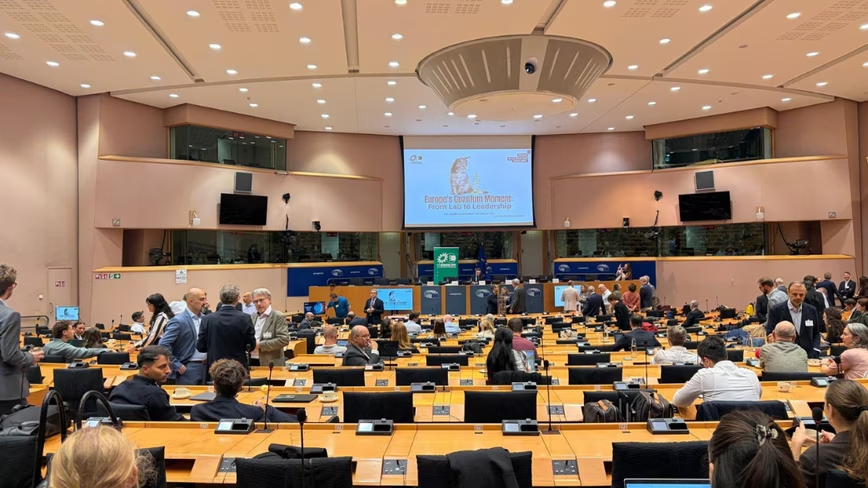

The EU’s forthcoming Quantum Act will not come with a dedicated budget. “The act is not about budget,” said Thomas Skordas, deputy director-general of the European Commission’s DG CNECT, at a European Parliament event last week, on 3rd of September.
“What the act will provide is the stimulus to make sure that we move in the right direction, that we bring people together.”
The session, hosted by the European Quantum Flagship and German Green MEP Sergey Lagodinsky, brought together representatives from the Commission, Council and Parliament, along with researchers and quantum company founders. The Commission hopes to present the legislation by the end of 2026, although that timeline could slip into next year.
The ambition behind it is significant. The EU has declared its aim to become the world’s quantum valley, and the act is intended to help make that happen.
Skordas described the act as an enabling framework rather than a regulation. That distinction matters in Brussels, where recent technology policies such as the AI Act and the Digital Markets Act have largely focused on imposing rules and obligations rather than bringing different parts of an industry together.
The clearest comment of the day concerned Europe’s quantum startups.
“We cannot afford having 78 startups all on their own,” Skordas said. “We don’t have Microsoft, we don’t have Google, we don’t have IBM. We want competition, but at some stage, we expect a little bit of consolidation.”
It is unusual for a Commission official to openly call for consolidation in an industry. But the comment also reflects a problem that has become increasingly difficult for Europe to ignore: its quantum efforts are spread across member states and different technology approaches, producing plenty of prototypes but fewer companies with the scale to build their own manufacturing capacity.
Tommaso Calarco, secretary of the EU’s high-level advisory board on quantum technologies, put it more simply.
“What do we need? We need critical mass,” he said. “And critical mass means three things: it means cash, it means speed, and it means we do things together.”
The act can address two of those three things. Cash is not one of them. Calarco was blunt about what he thinks is at stake: “This quantum act is the last train which is passing for Europe.”
He was also critical of how member states are working with the Commission. They “are not yet pooling their resources strategically to the extent that they should, and we cannot wait”, he said.
Europe does have one advantage that the usual argument about fragmentation can overlook.
“We’re not only buyers, but we are also suppliers,” said Cecile Perrault, executive director of the European Quantum Industry Consortium. “80% of the components that we find in quantum computers in Europe come from Europe. We have a huge advantage compared to other digital technologies there.”
That position in the supply chain is already attracting private investment. The Novo Nordisk Foundation is building an open quantum chip foundry in Copenhagen, creating the kind of manufacturing capacity the act is intended to encourage, and doing so without waiting for the legislation.
Skordas also argued that quantum computing needs to become part of a much broader technology ecosystem.
“We need to break silos,” he said. “Quantum has to be combined with semiconductors, photonics, the cloud industry, the end users and many other technologies that are more mature and can win new markets.”
Talent was another concern raised during the discussion. “The talent goes where the global leaders are, not only where the money is,” said Eleni Diamanti, co-founder of Welinq and a CNRS research director at Sorbonne University. That makes the talent problem closely tied to Europe’s ability to build companies that can become global leaders, rather than a separate issue.
Lagodinsky placed the debate in a broader context.
“It’s not just a competition between business models, it’s a competition between societal models,” the MEP said, “and, in this competition, technology and leadership in the realm of innovation play the role.”
Europe has already been investing significant funds in quantum technology, with public investment reported to be outpacing that of the United States, and France committing €500m of its own.
The bigger question is whether that investment can produce an industry capable of competing at scale, rather than primarily supporting research. That is the problem the Quantum Act will inherit.
For now, it is still unclear what the act will actually contain. There is no draft text, no fixed date for its presentation, and no details yet on how the Commission plans to encourage the kind of consolidation Thomas Skordas described.
You must be logged in to post a comment Login