






Connect with us

Tech

Everything we know so far

Published

on

The Steam Machine is back from the dead. Not as a Valve-supported program for manufacturers to create living room PCs, but instead as a home console sibling to the Steam Deck. Valve introduced its second attempt at ruling the living room in a surprise hardware announcement in November 2025, and paired the new Steam Machine with a new Steam Controller and a wireless VR headset it calls the Steam Frame. Since the announcement, as is often the case with Valve, some details remain elusive, however.

While we wait for the release of the company’s new hardware lineup in 2026, and more information straight from the horse’s mouth, here’s everything we know about the hardware, software and price of the Steam Machine, so far.

What’s the Steam Machine’s hardware like?

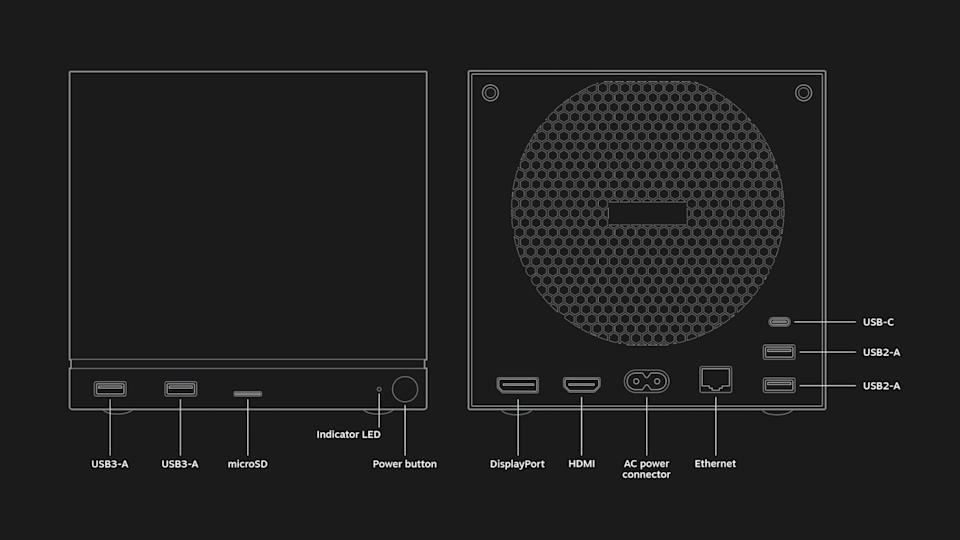
A line-drawing diagram of the Steam Machine and its various ports.

Valve

Like the Steam Deck, the Steam Machine is utilitarian and bespoke. The PC is a black, 5.98 x 6.39 x 6.14 inch (152 x 162.4 x 156mm) box, with ports and a grille for a fan in the back and a removable faceplate and customizable LED light strip in the front. Inside, Valve says the Steam Machine features a “semi-custom” AMD Zen 4 CPU with six cores and up to 4.8GHz clock speeds, and a “semi-custom” RDNA3 AMD GPU, along with 16GB DDR RAM, 8GB GDDR6 VRAM and either 512GB or 2TB of storage.

While these specs make the Steam Machine more powerful than the aging Steam Deck (which shipped in 2022 with its own custom AMD chip) Valve has been careful not to oversell the capabilities of the box. In a blog post, the company said that “the majority of Steam titles play great at 4K 60FPS” using AMD’s FidelityFX Super Resolution (FSR) frame generation and upscaling technology, but some titles require more upscaling than others, and it “may be preferable to play at a lower framerate with [variable refresh rate] to maintain a 1080p internal resolution.”

Advertisement

In a hands-on preview of the Steam Machine, Digital Foundry expressed concern with what Valve’s claims and the device’s stated specs could mean for future performance. “The decision to opt for 8GB of GDDR6 memory has been proven to be a limiting factor on many modern mainstream triple-A games and falls short of the maximum VRAM pools and memory bandwidth available on both Xbox Series X and base PS5,” Digital Foundry writes.

The Steam Machine supports Bluetooth 5.3, Wi-Fi 6E and includes an integrated 2.4GHz adapter for the new Steam Controller. In terms of port selection, there’s DisplayPort 1.4 and HDMI 2.0 inputs for connecting the box to external monitors and TVs, four USB-A ports (divided between two USB 2.0 ports and two USB 3.2 Gen 1 ports) and one USB-C port on the back.

Engadget will have to try out the Steam Machine to really know what it’s capable of, but there’s nothing to suggest it couldn’t be as flexible as the Steam Deck, especially with more power to play with.

What games will be able to run on the Steam Machine?

A Steam Machine connected to a TV playing the game Cuphead.

Valve

Any game that runs on SteamOS, Valve’s Linux-based operating system, will run on the Steam Machine, provided the device’s technical specs will support it. For games running natively on Linux, the Steam Machine will download the Linux version. For Windows games and everything else, it’ll be able to use Steam’s built-in Proton compatibility layer to translate games to Linux, just like the Steam Deck does.

Advertisement

Proton is developed by both Valve and CodeWeavers, the team behind the macOS compatibility app CrossOver. Valve’s compatibility layer translates a game’s API calls and other software features into something Linux understands, essentially tricking the game into thinking it’s running on Windows when it isn’t. Proton has worked remarkably well so far, in some cases helping some PC games run more efficiently on Linux than they do on Windows, but it does have some limitations. Because some anti-cheat software doesn’t support Linux, many competitive multiplayer games aren’t playable on SteamOS. Valve hopes the Steam Machine will help change that.

“While [the] Steam Machine also requires dev participation to enable anti-cheat, we think the incentives for enabling anti-cheat on Machine to be higher than on Deck as we expect more people to play multiplayer games on it,” Valve told Eurogamer. “Ultimately we hope that the launch of Machine will change the equation around anti-cheat support and increase its support.”

To help users find what games work well on the Steam Machine, Valve plans to expand its program for verifying games on the Steam Deck to include the Steam Machine and Steam Frame. Valve looks at things like controller support, the default resolution of the game, whether or not it requires a separate launcher and whether the game and its middleware work with Proton to determine a game’s rating. Then the company sorts games into four categories: Verified (where the game works with Steam hardware at launch), Playable (where a user might have to make modifications to run smoothly), Unplayable (where some or all of the game doesn’t function) and Unknown.

A slide from Valve's GDC 2026 presentation, going over its expectations for Steam Machine games.

Valve

According to an announcement Valve sent to developers in November 2025, games that were Verified for the Steam Deck will automatically be verified for the Steam Machine. In a presentation at GDC 2026, the company also shared that Steam Machine Verified games will be expected to support the same input methods as the Steam Deck and run at 1080p at 30fps at a minimum. Unlike the company’s handheld, Valve won’t require developers to support specific display resolutions or meet legibility requirements to be Steam Machine Verified, though, because the Steam Machine is more likely to be connected to larger displays. That means a game could be marked as Playable on the Steam Deck due to its small text, but Verified on the Steam Machine.

Advertisement

Valve’s system is helpful, but far from definitive — some Unplayable games are in fact playable on the Steam Deck — which is why online, community-run databases like ProtonDB fill in the gaps with more granular information.

How much will the Steam Machine cost and when will it launch?

A Steam Machine with an LED strip displaying the current download progress of a game.

Valve

Valve hasn’t announced a price or a release date for the Steam Machine or any of its new hardware, beyond affirming its new hardware will ship in 2026. In terms of price, however, the company has suggested it might not be a deal in quite the same way the $399 Steam Deck LCD was. Valve designer Pierre-Loup Griffais told The Verge that the “Steam Machine’s pricing is comparable to a PC with similar specs” and that its price would be “positioned closer to the entry level of the PC space” but be “very competitive with what you a PC you could build yourself from parts.”

That means the Steam Machine will likely cost more than the $499 PS5, and that the rising costs of memory could make it even more expensive. Valve has already publicly admitted that memory and storage shortages are affecting its plans. In February, the company said that it was delaying the launch of its hardware (though it still hopes to ship in the first half of 2026) and rethinking pricing, particularly around the Steam Machine and Steam Frame, because of the “limited availability and growing prices” of critical components like RAM.

The changes Framework had to make to the pricing of the Framework Desktop are an illustrative example of the position Valve is in. Framework pitched its compact desktop PC as being great for gaming, with an AMD Ryzen AI Max chip (originally meant for gaming laptops) and a minimum of 32GB of RAM that lets it run games at 1440p. The company originally sold the base configuration of the Framework Desktop for $1,099, but announced in January 2026 that it would now cost $1,139 due to the rising cost of RAM. The price situation got even worse for configurations with more RAM. A Framework Desktop with 128GB of RAM now costs $2,459.

Advertisement

The blame for rising costs lies squarely with the AI industry, whose demand for RAM has led to the collapse of consumer RAM brands and a dearth of true deals on the in-demand component. At this point, PC makers have no solution to the problem other than riding the shortage out and raising prices. Valve clearly isn’t immune to those same issues.

That doesn’t rule out the company offering its Linux PC at multiple different price points, or in some kind of bundle deal with multiple pieces of new Steam hardware. But it does mean that the Steam Machine will likely be priced like a premium device. Same for the Steam Controller and Steam Frame. In the case of the Frame, UploadVR reports that Valve wants to sell the headset for less than the $1,000 Valve Index, but that doesn’t mean it won’t be significantly more expensive than the $300 Meta Quest 3S.

What accessories will work with the Steam Machine?

Someone holding a Steam Controller in a pile of plushies.

Valve

The Steam Machine is designed to work with a variety of different Bluetooth controllers and other wireless accessories, and also whatever you can plug into its multiple USB-A ports and single USB-C port. With a built-in 2.4GHz Steam Controller dongle inside the Steam Machine, Valve’s controller should be an ideal option for controlling games, particularly because of its multiple input options, like touchpads and gyroscopes. Support for Steam Link, Valve’s tech for streaming PC games over local wireless, means you can also send games from a Steam Machine to the Steam Deck, Steam Frame or the Steam Link app and play them there.

Update, March 11, 4:40PM ET: Updated headline and added details on Valve’s Steam Machine Verified program.

Advertisement

Source link

Continue Reading
Click to comment

Leave a Reply

Your email address will not be published. Required fields are marked *

Tech

CISA orders feds to patch n8n RCE flaw exploited in attacks

Published

on

n8n

The U.S. Cybersecurity and Infrastructure Security Agency (CISA) ordered government agencies on Wednesday to patch their systems against an actively exploited n8n vulnerability.

n8n is an open-source workflow automation platform widely used in AI development for automating data ingestion, with over 50,000 weekly downloads on the npm registry and over 100 million pulls on Docker Hub.

As an automation hub, n8n often stores a wide range of highly sensitive data, including API keys, database credentials, OAuth tokens, cloud storage access credentials, and CI/CD secrets, making it an extremely attractive target for threat actors.

Tracked as CVE-2025-68613, this remote code execution vulnerability allows authenticated attackers to execute arbitrary code on vulnerable servers with the privileges of the n8n process.

Advertisement

“n8n contains an improper control of dynamically managed code resources vulnerability in its workflow expression evaluation system that allows for remote code execution,” CISA said.

“Successful exploitation may lead to full compromise of the affected instance, including unauthorized access to sensitive data, modification of workflows, and execution of system-level operations,” the n8n team added.

The n8n team addressed CVE-2025-68613 in December with the release of n8n v1.122.0 and also advised IT administrators to apply the patch immediately. Admins who can’t immediately upgrade can limit workflow creation and editing permissions to fully trusted users only, and restrict operating system privileges and network access as temporary mitigation measures to reduce the impact of potential exploitation.

Internet security watchdog group Shadowserver tracks over 40,000 unpatched instances exposed online, with more than 18,000 IPs found in North America and over 14,000 in Europe.

Advertisement
Vulnerable n8n instances exposed online
Vulnerable n8n instances exposed online (Shadowserver)

​CISA has added the vulnerability to its Known Exploited Vulnerabilities (KEV) catalog on Wednesday and ordered Federal Civilian Executive Branch (FCEB) agencies to patch their n8n instances by March 25, as mandated by a binding operational directive (BOD 22-01) issued in November 2021.

“This type of vulnerability is a frequent attack vector for malicious cyber actors and poses significant risks to the federal enterprise,” CISA warned.

“Apply mitigations per vendor instructions, follow applicable BOD 22-01 guidance for cloud services, or discontinue use of the product if mitigations are unavailable.”

Although BOD 22-01 applies only to federal agencies, CISA has encouraged all network defenders to secure their systems against ongoing CVE-2025-68613 attacks as soon as possible.

Since the start of the year, the n8n security team has addressed several other severe vulnerabilities, including one dubbed Ni8mare that allows remote attackers without privileges to hijack unpatched n8n servers.

Advertisement

Malware is getting smarter. The Red Report 2026 reveals how new threats use math to detect sandboxes and hide in plain sight.

Download our analysis of 1.1 million malicious samples to uncover the top 10 techniques and see if your security stack is blinded.

Source link

Continue Reading

Tech

Social Media and AI Want Your Attention at All Times. This New Documentary Says That’s Bad

Published

on

“Do you remember the world before cellphones?”

The question comes early in Your Attention Please, a documentary premiering this week at South by Southwest in Austin, Texas. And it hit me harder than I expected. As a 27-year-old tech reporter, I realized I don’t have too many clear memories of life before smartphones. My adolescence unfolded alongside the rise of smartphones, social media, push notifications and the routine of endless scrolling. Like many people my age, I’ve spent most of my life inside the attention economy — without ever really stepping outside it.

That’s the uneasy territory the documentary explores. 

Advertisement

CNET was given exclusive early access to the film’s trailer, embedded below.

Exploring how tech shapes our behavior

AI Atlas

Director Sara Robin said she originally set out to make something smaller: a documentary about people trying to reclaim their attention by breaking unhealthy phone habits. In an interview with CNET, Robin described the idea as a personal story about focus and self-control in an age of constant distraction.

As Robin interviewed researchers, technologists and families affected by social media and cyberbullying, the film’s scope widened. What started as a question about individual habits quickly became a larger investigation into how modern technology systems are designed to shape human behavior. The story stretches from the rise of social media to the emerging influence of AI. 

Along the way, Robin and her collaborators kept hearing the same observation from different corners of the digital world: Social media didn’t just change how people communicate; it quietly rewired what we value. Experiences that were once private or emotional — friendship, affection, belonging — began to acquire numerical equivalents. Followers, likes, comments, views and shares began to be how we saw our own self-worth. In the architecture of social platforms, those numbers function as a kind of social currency.

Advertisement

Trisha Prabhu, a digital-safety advocate and inventor of the anti-cyberbullying technology ReThink, argues that social platforms did more than create new online spaces. She says they fundamentally reshaped how social validation works. The metrics that define popularity often reward attention-seeking behavior and amplify conflict, while genuine connection is now harder to quantify and, therefore, easier to overlook.

Prabhu warns that the same dynamics already driving problems like cyberbullying could accelerate as automated systems become more capable. AI tools can generate abusive messages at scale, produce convincing impersonations or create deepfakes that spread rapidly online. In some cases, the technology may even blur the line between human interaction and machine-generated communication, which could deepen loneliness or encourage harmful behavior.

“There’s AI exacerbating existing harms [like automating cyberbullying], but then I also think that there’s AI creating completely new harms,” Prabhu told CNET. “There are reports of AI tools encouraging users, including minor users, to commit self-harm… Even for the everyday user who’s not experiencing the extreme outcome, I think we have to ask ourselves how much of our time and connection we want spent with an AI tool as opposed to a fellow human being.”

Bringing attention to attention

What struck Robin during filming the documentary was how universal these anxieties felt. Across conversations with families, educators and advocates around the world, the themes were remarkably consistent: overstimulated attention, declining focus in classrooms, rising anxiety among young people and a persistent sense of dread that comes from always being plugged in.

Advertisement
screenshot of Your Attention Please documentary poster

Your Attention Please

Those shared concerns have helped spark a coordinated moment around the film’s release.

On March 11, more than 25 organizations focused on digital well-being will simultaneously release the trailer for Your Attention Please as part of an initiative called Stand for Their Attention. What began as a small collaboration among five groups quickly grew as word spread through advocacy networks. The coalition now includes organizations such as Common Sense Media, Protect Young Eyes, Mothers Against Media Addiction, the Center for Humane Technology, Smartphone Free Childhood and Scrolling to Death. 

The idea behind the synchronized launch is simple: Use the attention surrounding the documentary to highlight the growing movement that’s already working to reshape digital culture. 

Many people feel overwhelmed by the scale of the problem, Robin says, but behind the scenes, a widening ecosystem of advocates is experimenting with ways to build healthier digital environments, from redesigning products to changing norms around screen use.

Advertisement

The campaign also arrives at a moment of growing scrutiny around the attention economy. Lawmakers in the US and abroad are increasingly debating how social platforms affect youth mental health and childhood development. Boycotts around AI use are taking off. Researchers are studying how these algorithms and chatbots influence behavior. Individuals are trying to figure out how much technology belongs in everyday life.

What can we do about it? 

Despite the weight of those conversations, Robin says the goal of the film isn’t to leave audiences feeling powerless. In fact, the rapid rise of public awareness around AI has made her more optimistic than she was during the early days of social media. The systems shaping digital life, she argues, are built by people, which means they can also be rebuilt.

“We have more power than we think,” Robin said. “And there are a lot of different ways to get involved in this, from changing individual habits to changing the culture in your own family and in your community, designing technology differently, getting engaged in these conversations, all the way to pushing for legislative change.”

The film intentionally avoids presenting a single solution.

Advertisement

Instead, Your Attention Please asks a broader question: What happens when attention, one of the most human parts of our lives, becomes one of the most valuable commodities in the global economy? And perhaps more importantly, what kind of digital world do we want to build next?

Source link

Advertisement
Continue Reading

Tech

A microscope reveals the ghost of analog video hidden inside a LaserDisc

Published

on


Jueden’s experiment began by accident. While using a low-cost digital microscope to inspect electronics, he turned it toward a LaserDisc out of curiosity. Under magnification, faint but recognizable images began to emerge – proof that LaserDisc’s analog encoding could still be decoded visually without a player, just by analyzing the…
Read Entire Article
Source link

Continue Reading

Tech

The best Samsung Galaxy S26 and S26 Plus plans in Australia for March 2026

Published

on

Samsung officially unveiled the much anticipated Galaxy S26 and S26 Plus on February 26, 2026 with some fresh upgrades over the Galaxy S25 and S25 Plus.

More of the best Samsung phone plans

The larger-screened Galaxy S26 Plus, meanwhile, retains the 6.7-inch display and 4,900mAh battery from its predecessor, and gets Samsung’s new Exynos 2600 chipset, with the Snapdragon 8 Elite Gen 5 chip reserved for the top-tier S26 Ultra. While the battery capacity is the same, the S26 Plus can be charged wirelessly at 20W, compared to the S25 Plus’ slower 15W wireless charging.

Advertisement

These are flagship phones, so the base model Galaxy S26 and S26 Plus won’t fit in our best cheap phones list. It also doesn’t help that both handsets are more expensive than the S25 lineup, with the base model S26 starting from AU$1,549 (up from the S25’s AU$1,399) and the S26 Plus from AU$1,849 (vs the S25 Plus’s starting price of AU$1,699). This would make paying in monthly instalments an attractive option for some.

While the retailers have finished their pre-order specials, Australia’s big three telcos still have some active deals of up to AU$500 off the handset price for the Samsung Galaxy S26 and S26 Plus (as well as the Galaxy S26 Ultra), with some also coinciding with existing promotions.

With so many options available to score a brand new upgrade, fInding the best plan for these new handsets may not be the most straightforward process, so we’ve done the hard work for you. Take a look at our picks for the best phone plans for the Samsung Galaxy S26 and S26 Plus below:

Advertisement

  • Samsung: pay in instalments of up to 24 months through Samsung financing; also save up to AU$865 when you trade in your old device
  • JB Hi-Fi: trade in your old tech for a JB Hi-Fi gift card to be used on a Galaxy S26 series handset
  • The Good Guys: Galaxy S26 and S26 Plus available in 256GB and 512GB
  • Amazon: Same day delivery with the world’s biggest retailer

Privacy Display and the gimbal-like horizontal lock video mode are only exclusive to the Galaxy S26 Ultra, so if you’re specifically looking for those features, you can check out the best Galaxy S26 Ultra plans.

Source link

Advertisement
Continue Reading

Tech

HMD Partners With Flipkart to Launch 2026 Smartphone Lineup in India Soon

Published

on

Thanks to all our beloved AI companions, RAM prices have more than doubled in the last 6 months. As you may have guessed, the smartphone industry has been having some tough times with budget devices. To help solve this problem, HMD (remember the people who resurrected Nokia?) has announced a strategic partnership with Flipkart to bring its upcoming 2026 smartphone lineup to Indian consumers.

HMD Expanding Its Presence in India

Different HMD phones launched at MWC 2026

HMD’s upcoming smartphone lineup will target multiple price segments between ₹10,000 and ₹20,000, catering to users looking for reliable devices with modern features at affordable prices. The first smartphone under the partnership is expected to launch in the coming months, followed by a phased rollout of several additional devices over the next two to four months. Specifics about the phones are not yet known, but we are due to get our hands on them. So, stay tuned.

The partnership will kick off with HMD’s first smartphone launch of 2026 in India, which will debut on Flipkart before reaching other online and retail channels. The goal is to leverage Flipkart’s extensive reach, logistics network, and consumer insights to make its smartphones more accessible nationwide.

Ravi Kunwar, CEO and VP of HMD India and APAC, said, “We are excited to collaborate with Flipkart as one of our key e-commerce partners as we gear up to launch the first HMD smartphone of 2026 in India. Flipkart’s extensive reach and strong consumer connect will play an important role in bringing our latest innovation to customers across the country.”

Commenting on the same, Ajay Veer Yadav, Senior Vice President at Flipkart, said, “Our strategic collaboration with HMD brings their upcoming smartphone portfolio to millions of consumers across the country. With our expansive distribution network and flexible affordability offerings, we are well-positioned to make cutting-edge devices more accessible and inclusive.”

Advertisement

Source link

Continue Reading

Tech

Mentorship, promotions and partnership crucial to ROI, finds report

Published

on

New Research from WiCyS and FourOne Insights explores how skills-based cyber practices can positively impact employees and their organisations.

Women in CyberSecurity (WiCyS), the nonprofit organisation dedicated to the recruitment, retention and advancement of women in cybersecurity and FourOne Insights, a research and advisory firm, have released a new report. 

The ‘ROI of Resilience: How Cybersecurity Talent Management Best Practices Improve the Bottom Line’ study explores the financial impact of skills-based talent strategies in cybersecurity. To gather information WiCyS and FourOne Insights leveraged data from an original survey, job posting data from labour market analytics provider Lightcast, and professional social profile data, also from Lightcast.

What was discovered is that skills-based, talent-friendly practices often generate the highest returns for an organisation and its workforce. Data from the report indicated that mentorship opportunities and skills-based development increased retention by up to 18pc, with skills-based promotions improving the representation of women in cyber leadership by upwards of 10pc and in some cases, as much as 20pc. 

Advertisement

The report said: “These practices benefit the entire workforce and are especially valuable for women. Panels for promotion decisions, internal skills profiles and formal mentorship programmes all correlate with significantly higher representation of women in cybersecurity management roles.

“Organisations using these practices see 10pc to 20pc higher representation of women in cybersecurity leadership than firms that do not. Skills-based promotion criteria and linking incentives to demonstrated skill growth further strengthen both equity and financial performance.”

Addressing challenges

The research indicates that an awareness of skills-based and talent-conscious practices can be mutually beneficial for those operating within an organisation. In fact, they have the potential to deliver more than $125,000 in savings per employee, according to the report. But despite the merits of this system, the data also indicated that the adoption of these practices is uneven. 

The report said: “Despite the mutual benefit to employers and employees, many high-impact practices are among the least utilised. None of the highest-value practices are leveraged by more than 55pc of firms. 

Advertisement

“When companies do implement these practices, they often base them on unreliable, subjective data. This threatens worse talent outcomes for organisations, while limiting career development opportunities for individuals.”

But, third-party partnerships could potentially expand capacity and ease the adoption of talent and skills-focused practices. Almost 80pc of contributing respondents explained that they find access to supportive, career-based organisations such as WiCyS to be valuable, with many of the opinion that they create stronger professional networks than those created by an employer. 

According to the report, the firms that offer this kind of access tend to fill roles 16pc faster, retain workers longer and avoid significant productivity losses, when compared to those who don’t. “These partnerships provide capabilities such as peer learning, industry context, and trusted communities that are difficult for employers to build internally.”

Future ready

WiCyS’ and FourOne Insight’s research suggests that the companies attracting the strongest talent and meeting business objectives have a common approach, in that they ground their strategies in skills data, leadership actions and clear employee development opportunities.

Advertisement

“High-ROI practices, such as transparent promotion processes, executive sponsorship, access to upskilling and mentorship and engagement with trusted third-party partners, can consistently reduce hiring friction and support retention,” said the report. “Over time, they open advancement pathways that have historically been narrow, especially for women.”

The framework to ensure effective practices should include the assessment of workforce pain points, the planning of targeted interventions, execution with stakeholder buy-in and continuously evaluating outcomes. This, the report states, will create a “durable, self-correcting system that strengthens workforce resilience and ensures that opportunities are genuinely accessible to all talent, not simply expanded in name only”.

As for further research, the report suggests that those collecting data should explore how these practices influence broader indicators of organisational performance, including profitability and long-term resilience. 

“What remains clear is that in a tightening labour market, workforce resilience is a strategic imperative. Skills-based, talent-friendly practices, reinforced by strong third-party partnerships, offer a path to building that resilience at scale.”

Advertisement

Don’t miss out on the knowledge you need to succeed. Sign up for the Daily Brief, Silicon Republic’s digest of need-to-know sci-tech news.

Source link

Advertisement
Continue Reading

Tech

SQLi flaw in Elementor Ally plugin impacts 250k+ WordPress sites

Published

on

SQLi flaw in Elementor Ally plugin impacts 250k+ WordPress sites

An SQL injection vulnerability in Ally, a WordPress plugin from Elementor for web accessibility and usability with more than 400,000 installations, could be exploited to steal sensitive data without authentication.

The security issue, tracked as CVE-2026-2313, received a high severity score. It was discovered by Drew Webber (mcdruid), an offensive security engineer at Acquia, a software-as-a-service company that provides an enterprise-level Digital Experience Platform (DXP).

SQL injection flaws have been around for more than 25 years and continue to be a threat today, despite being well understood and technically easy to fix and avoid. This type of security issue occurs when user input is directly inserted into an SQL database query without proper sanitization or parameterization.

This allows an attacker to inject SQL commands that alter the query’s behavior to read, modify, or delete information in the database.

Advertisement

CVE-2026-2313 affects all Ally versions up to 4.0.3 and lets an unauthenticated attacker to inject SQL queries via the URL path due to improper handling of a user-supplied URL parameter in a critical function.

“This is due to insufficient escaping on the user-supplied URL parameter in the `get_global_remediations()` method, where it is directly concatenated into an SQL JOIN clause without proper sanitization for SQL context,” reads a technical analysis from WordFence.

“While `esc_url_raw()` is applied for URL safety, it does not prevent SQL metacharacters (single quotes, parentheses) from being injected.

“This makes it possible for unauthenticated attackers to append additional SQL queries into already existing queries that can be used to extract sensitive information from the database via time-based blind SQL injection techniques,” the researchers explain.

Advertisement

Wordfence notes that exploiting the vulnerability is possible only if the plugin is connected to an Elementor account and its Remediation module is active.

The security firm validated the flaw and disclosed it to the vendor on February 13. Elementor fixed the flaw in version 4.1.0 (latest), released on February 23, and an $800 bug bounty was awarded to the researcher.

Data from WordPress.org shows that only about 36% of websites using the Ally plugin have upgraded to version 4.1.0, leaving more than 250,000 sites vulnerable to CVE-2026-2313.

In addition to upgrading Ally to version 4.1.0, site owners/administrators are also recommended to install the latest security update for WordPress, released yesterday.

Advertisement

WordPress 6.9.2, addresses 10 vulnerabilities, including cross-site request (XSS), authorization bypass, and server-side request forgery (SSRF) flaws. The new version of the platform is recommended to be installed “immediately.”

Malware is getting smarter. The Red Report 2026 reveals how new threats use math to detect sandboxes and hide in plain sight.

Download our analysis of 1.1 million malicious samples to uncover the top 10 techniques and see if your security stack is blinded.

Source link

Advertisement
Continue Reading

Tech

14,000 routers are infected by malware that’s highly resistant to takedowns

Published

on

Researchers say they have uncovered a takedown-resistant botnet of 14,000 routers and other network devices—primarily made by Asus—that have been conscripted into a proxy network that anonymously carries traffic used for cybercrime.

The malware—dubbed KadNap—takes hold by exploiting vulnerabilities that have gone unpatched by their owners, Chris Formosa, a researcher at security firm Lumen’s Black Lotus Labs, told Ars. The high concentration of Asus routers is likely due to botnet operators acquiring a reliable exploit for vulnerabilities affecting those models. He said it’s unlikely that the attackers are using any zero-days in the operation.

A botnet that stands out among others

The number of infected routers averages about 14,000 per day, up from 10,000 last August, when Black Lotus discovered the botnet. Compromised devices are overwhelmingly located in the US, with smaller populations in Taiwan, Hong Kong, and Russia. One of the most salient features of KadNap is a sophisticated peer-to-peer design based on Kademlia, a network structure that uses distributed hash tables to conceal the IP addresses of command-and-control servers. The design makes the botnet resistant to detection and takedowns through traditional methods.

“The KadNap botnet stands out among others that support anonymous proxies in its use of a peer-to-peer network for decentralized control,” Formosa and fellow Black Lotus researcher Steve Rudd wrote Wednesday. “Their intention is clear: avoid detection and make it difficult for defenders to protect against.”

Advertisement

Distributed hash tables have long been used to create hardened peer-to-peer networks, most notably BitTorrent and the Inter-Planetary File System. Rather than having one or more centralized servers that directly control nodes and provide them with the IP addresses of other nodes, DHTs allow any node to poll other nodes for the device or server it’s looking for. The decentralized structure and the substitution of IP addresses with hashes give the network resilience against takedowns or denial of service attacks.

Source link

Advertisement
Continue Reading

Tech

TikTok to Let Apple Music Users Stream Full Songs Without Ever Leaving the App

Published

on

If you’ve ever scrolled TikTok, caught a snippet of a tune, and thought, “I wish I could play this song all the way through,” this is for you. TikTok and Apple Music announced on Wednesday that they have partnered on two new features, Play Full Song and Listening Party. The goal is to offer listeners a seamless music listening experience without ever leaving the social media app.

Apple Music subscribers who discover a song on their TikTok For You Page or on the Sound Detail Page will be able to click Play Full Song to open the Apple Music player and listen to the track in its entirety. From there, subscribers to the music streaming service will be able to save the song as a favorite, add it to a playlist on Apple Music and listen to a customized stream of recommended songs.

When a full-length song is played, the stream will pay artists through Apple Music. 

Advertisement
Images of a mobile phone showing how Apple Music will work seamlessly in TikTok.

TikTok and Apple Music’s Play Full Song and Listening Party features will launch this month.

TikTok

“Tapping into the music you love should feel effortless,” Ole Obermann, co-head of Apple Music, said in a statement. “With Play Full Song, Apple Music subscribers can move easily from discovering a track on TikTok to listening to it in full instantly, without breaking the flow. This integration not only makes it easier for fans to discover, listen to, and engage with the artists they love, but also creates a powerful new pathway for artists — turning moments of discovery into deeper connection and sustained engagement in one simple, seamless experience.”

Listening Party sounds somewhat like Spotify‘s feature of the same name. Fans join a shared, real-time session where they listen to the same tracks together and interact live, with the songs streamed through Apple Music inside TikTok. Musicians can also join and chat with their fans.

Advertisement

“TikTok is where music discovery and culture move at the speed of the community,” Tracy Gardner, global head of music business development at TikTok, said in a statement. “Thanks to Apple Music, Play Full Song gives fans a seamless way to go from discovery to full-length listening, and Listening Party provides a shared place to experience music together in real time. It’s all about bringing artists and fans closer, and turning shared moments into lasting connections.”

Play Full Song and Listening Party will launch globally on TikTok over the next few weeks.

Source link

Advertisement
Continue Reading

Tech

Meta buying social network for AI bots Moltbook should worry anyone who still hopes social media is for people

Published

on

Meta buying Moltbook, the developer of a social media platform designed for AI agents to talk to each other, sounds a little like a joke someone might make about how there are too many bots on Facebook and other Meta platforms. But it looks like Meta hopes to use Moltbook to fill the internet with even more digital voices.

Meta has spent two decades building platforms that connect billions of people. Facebook, Instagram, and Threads all promise some version of the same basic idea: a digital place where humans share thoughts, photos, jokes, and complaints about social media.

Advertisement

Source link

Continue Reading

Trending

Copyright © 2025