Connect with us

Tech

Fake faces generated by AI are now "too good to be true," researchers warn

Published

on


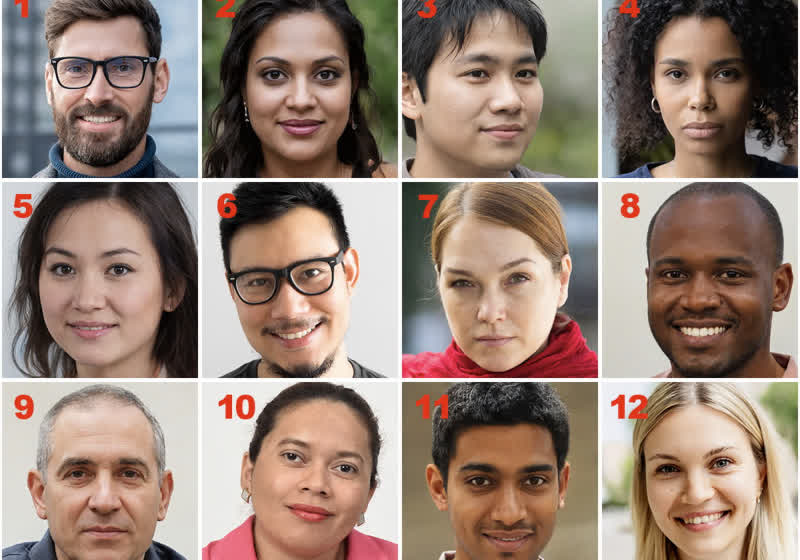
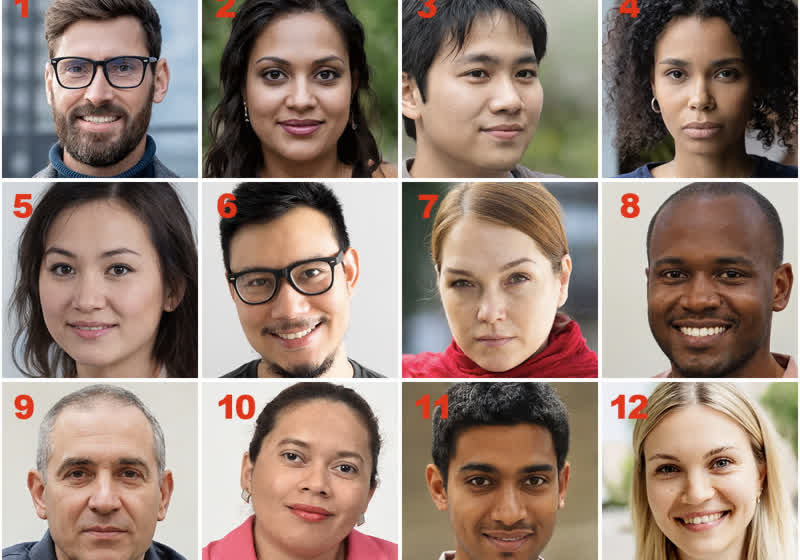
Think you can quickly identify fake faces generated by AI models? Think again. According to a recently published study by Australian researchers, AI-generated faces are now essentially too difficult to spot – except for a small minority of people who are exceptionally skilled at analyzing facial features. As a result,…
Read Entire Article
Source link

Continue Reading
Click to comment

Leave a Reply

Your email address will not be published. Required fields are marked *

Tech

Canadian start-up chipmaker Taalas raises $169m

Published

on

The company’s customised AI chips aim to achieve cheaper and faster results than traditional AI hardware.

Toronto-based start-up Taalas has raised $169m for its specialised AI hardware models.

Total investment in the company stands at $219m, with funding from Quiet Capital and Fidelity, among others, according to Reuters.

In a blogpost from CEO Ljubisa Bajic announcing the release of its first models, the company said it wants to mitigate the “high latency and astronomical cost” of AI, and that its specialised method is faster and cheaper than traditional AI chip approaches.

Advertisement

The company said it took a team of 24 and a spend of $30m since its founding less than three years ago to bring to market its first product, a hard-wired Llama 3.1 8B, which is available as both a chatbot demo and an inference API service.

The company’s aim is to mitigate the need for vast and expensive data centres through the principles of specialisation, merging storage with computation, and simplification.

Taalas said its “platform for transforming any AI model into custom silicon” means that “from the moment a previously unseen model is received, it can be realised in hardware in only two months”.

It claimed its hardware output is “an order of magnitude faster, cheaper and lower power than software-based implementations”, achieved through physically customising chips depending on the bespoke needs of the AI model in question.

Advertisement

Taalas claimed its silicon Llama chip, for example, is nearly 10 times faster than the current state of the art, costs 20 times less to build and consumes 10 times less power.

Taalas aims to release two further models in 2026.

AI chipmaking giant Nvidia this week announced a huge deal with Meta to provide millions of chips for Meta’s AI infrastructure in exchange for billions of dollars.

Don’t miss out on the knowledge you need to succeed. Sign up for the Daily Brief, Silicon Republic’s digest of need-to-know sci-tech news.

Advertisement

Source link

Continue Reading

Tech

Latest leak confirms price hike for the Nothing Phone 4a series

Published

on

The Nothing Phone (4a) series is shaping up to be more expensive than its predecessor according to fresh leaks detailing pricing, specs and release dates ahead of the company’s March 5 launch event.

A new report from Dealabs suggests the Nothing Phone (4a) will start at around €400. This marks roughly a €50 increase over the Phone (3a), with pricing said to vary slightly by region. For instance, Germany and Spain will reportedly see a €389 starting price. Meanwhile, France, Belgium and Italy could see it land at €409. A 12GB RAM variant is expected to cost between €429 and €449.

The Nothing Phone (4a) Pro could see an even steeper jump. Dealabs claims pricing will begin at €479 in Germany and Spain. This rises to €499 in France, Belgium and Italy — around €90 more than the previous Pro model. A higher-tier 12GB version could reach as much as €569 depending on the market.

As for availability, the base Phone (4a) is tipped to release on March 12. The Pro model could potentially follow on March 26.

Advertisement

Advertisement

Specs are where things get slightly less clear.

Android Headlines, in a separate leak, claims the base model will instead include an 8MP ultrawide alongside a 50MP main sensor and a 3.5x telephoto lens. It also added that the Phone (4a) will run on Snapdragon 7s Gen 4, paired with a 5,400mAh battery and 50W charging. It will also include IP65 dust and water resistance.

Meanwhile, the Pro model is tipped to include a 50MP Sony main sensor, improved optical zoom, an aluminium chassis, a larger 6.83-inch 144Hz display, and a new “Glyph Matrix” lighting system on the rear. The standard model is expected to retain the familiar Glyph Bar and a 6.78-inch display.

Advertisement

Colour options are said to include black, white, pink and blue for the base model. The Pro may arrive in black, silver and pink.

Nothing founder Carl Pei previously hinted that price increases were on the way. These latest leaks appear to confirm that shift. We’ll have full details once Nothing makes it official next month.

Source link

Advertisement
Continue Reading

Tech

The Supreme Court’s Tariff Ruling Won’t Bring Car Prices Back to Earth

Published

on

It has never been more expensive to buy a new car. The average transaction price last month for buyers in the United States was $48,576, up nearly a third from 2019, according to Edmunds. The “affordable” car—$20,000 or less—is dead.

The high prices have been pinned on plenty of economic dynamics: lingering pandemic-era supply-chain issues, the introduction of expensive technology into everyday cars, higher labor and raw materials costs, and new tariffs by the Trump administration affecting imported steel, aluminum, and cars themselves.

Now, despite a US Supreme Court ruling that will nix some of those Trump tariffs, car buyers will likely get no respite.

“The core cost structure facing the auto industry hasn’t fundamentally changed overnight,” writes Jessica Caldwell, Edmunds’ head of insights, in an emailed statement. Put more simply: Cheaper cars aren’t coming, at least not because of this ruling.

Advertisement

The Supreme Court’s decision gets in the way of the president’s power to use the International Emergency Economic Power Act to levy tariffs in response to emergencies. Trump used this power to apply tariffs to countries around the globe, the emergency being “large and persistent” trade deficits. The administration applied other new duties on Canada, China, and Mexico because of what it called emergencies related to the flow of migrants and drugs into the United States.

But most of the tariffs that affect the auto industry come from another law, section 232 of the Trade Expansion Act. That provision can apply to imports that “threaten to impair” the country’s national security. Tariffs on steel, aluminum, copper—key raw materials for cars—and imported auto parts and vehicles themselves came under this provision and are still in effect. This includes 15 percent tariffs on cars built in Europe, Japan, and South Korea.

Automakers have actually done an OK job shielding consumers from the effects of tariffs, Caldwell says. Even as retailers have blamed tariffs for steadily rising prices of consumer goods like electronics and appliances, car prices are up just 1 percent since this time last year, the firm’s data shows. But as the tariff regime drags on, that could change in ways that make new-car buyers even less happy.

“If cost pressures continue to build, automakers may have less room to shield shoppers from higher prices,” Caldwell says, “but for now, the broader market impact is still playing out.”

Advertisement

Source link

Continue Reading

Tech

China’s ByteDance to expand US-based AI teams

Published

on

Reportedly, the organisation intends to hire up to 100 additional employees within its Seed artificial intelligence division.

According to Bloomberg, Chinese technology giant ByteDance has announced plans to employ up to 100 new people in its artificial intelligence (AI) division as a means of competing with some of the world’s leading US-based AI companies. 

The positions open to US-based professionals will be in Seed, which is ByteDance’s AI division with laboratories in the US, Singapore and China. 

Vacancies will be across various responsibilities and will include work in producing international data for ByteDance’s large language models, advancing its popular text, image and video generation tools, completing research to develop ‘human-like’ AI, and building science models that enable the organisation to pursue drug discovery and design. 

Advertisement

ByteDance’s announcement comes despite significant concerns from US lawmakers and regulators around national security. Those in the regulatory space in the US have long argued that there is potential for ByteDance to use TikTok in the collection of its citizens’ private, valuable data or in the spreading of a narrative in favour of Beijing’s leadership via the app’s algorithm. 

Last month, after a long period of deliberation, stalling and false starts, ByteDance and representatives in the US reached a deal wherein the organisation would create an entity for US TikTok operations – with non-Chinese majority owners – as a means of addressing some of the pressing security concerns. 

As noted by Bloomberg, many know ByteDance solely in the context of popular social media platform TikTok; however, it also operates as a well-known AI company in China, offering chatbot app Doubao, AI video generation model Seedance 2.0, and image generation mode, Seedream 5.0.

Earlier this week (16 February), ByteDance promised to “strengthen current safeguards” against intellectual property theft after Disney threatened legal action regarding videos generated by Seedance 2.0.

Advertisement

Via a cease and desist letter, Disney claimed that Seedance 2.0 operates a “pirated library” of Disney assets, taken from its biggest franchises. The company accused ByteDance of using its proprietary content assets as if they were in the public domain.

Don’t miss out on the knowledge you need to succeed. Sign up for the Daily Brief, Silicon Republic’s digest of need-to-know sci-tech news.

Source link

Advertisement
Continue Reading

Tech

EDB says AI sovereignty is a people strategy and only 13% of enterprises are ready

Published

on

In a year defined by sovereign AI and data, one truth has become unavoidable: humans will matter more than ever. Even the most ambitious AI strategies will stall if organizations fail to invest in their people.

More than 95% of enterprises worldwide now say they want to operate as their own AI and data platforms within the next 850 working days. It’s a stunning recognition from C-suite leaders across 13 countries representing a combined GDP of $48 trillion – and a signal of how rapidly the world is shifting. IDC estimates this transition could generate $17 trillion in GDP growth, effectively creating the world’s third-largest economy if counted as a country.

Yet despite this massive ambition, only 13% of more than 134,000 major enterprises are getting it right.

These early leaders have made AI and data sovereignty a mission-critical priority. Their infrastructure allows intelligence to be accessed securely – anywhere, anytime, and in any form. The results speak for themselves: they see 5x higher ROI than the rest, with 2x more GenAI and agentic systems deployed in mainstream production. They are also 250% more confident in their ability to thrive long term.

Advertisement

Enterprises such as Abbott, AIA Singapore, Aviva India, Boston Scientific, Danske Bank, ENOC, JP Morgan Chase, Mastercard, Singtel, Wells Fargo, Toyota, and others are already proving what scaled success looks like.

But this transformation is not a push-button upgrade. Digital transformation took nearly a decade. The AI and data revolution may peak in just three to four years, and its impact could far surpass anything seen before.

That is why the defining question of the next era is not purely technological. Sovereign AI will rise or fall on human readiness. Organizations that fail to reskill, align, and carry their workforce into this transformation will find their ambitions constrained before they ever scale.

There are three key reasons why.

Advertisement

The Intelligent Systems Economy Will Require Hundreds of Millions of Skilled People

This new AI-driven economy brings greater complexity than the cloud migration wave. According to the World Economic Forum’s 2025 Future of Jobs report, AI is expected to displace 92 million jobs, but also create 170 million new ones—a net gain of 78 million. In some countries, up to 70% of these new roles risk going unfilled due to skill shortages.

“We cannot realize the potential of this new intelligent systems economy unless we invest significant time and energy reskilling and enabling employees in new ways,” says Einav Lavi, CHRO at EDB. “Demand for qualified people will far exceed supply, emphasizing how central humans are to this revolution.”

Enterprise-Wide Agentic Success Requires Everyone – Not Just Specialists

The top 13% of enterprises treat AI and data sovereignty as a company-wide standard. Their 2x density of AI initiatives and 5x ROI stem from building a sovereign foundation that reaches everyone—from HR and frontline staff to product design, engineering, and finance.

They rolled out GenAI and agentic systems in a coordinated, enterprise-wide sequence that embedded AI into organizational DNA. Skill levels varied, but reskilling at scale produced transformation at scale.

As enterprises evolve into AI “factories,” every employee becomes part of the production line, sharing common standards, practices, and a unified vision.

The Future Workforce Will Demand Continuous Reinvention

For most of the past century, people held 1.5 careers across 5–10 employers. That era is ending. By 2050, 60–80% of today’s jobs will be automated, and individuals may have 20–30 roles across a dozen organizations.

“In this environment, continuous reskilling becomes one of the most valuable currencies of success,” Lavi notes. “The enterprises that thrive will invest as much in their people as they do in their AI.”

Advertisement

AI itself will accelerate this reinvention – surfacing internal opportunities faster, matching people to roles or stretch assignments, and building personalized development pathways. Growth will be driven increasingly by skills and contribution, not proximity or bias.

For HR and managers, AI-powered “people copilots” will reshape workforce planning by identifying early signals of burnout, workload imbalance, sentiment shifts, and retention risks – augmenting, not replacing, human judgment.

The goal is not the automation of humanity, but the elevation of what makes us human – freeing people to focus on creativity, judgment, empathy, and innovation, the very things machines cannot replicate.

Digital Trends partners with external contributors. All contributor content is reviewed by the Digital Trends editorial staff.

Advertisement

Source link

Continue Reading

Tech

NASA Eyes March 6 To Launch 4 Astronauts To the Moon On Artemis II Mission

Published

on

An anonymous reader quotes a report from NPR: NASA could launch four astronauts on a mission to fly around the moon as soon as March 6th. That’s the launch date (PDF) that the space agency is now working towards following a successful test fueling of its big, 322-foot-tall moon rocket, which is standing on a launch pad at the Kennedy Space Center in Florida.

“This is really getting real,” says Lori Glaze, acting associate administrator of NASA’s exploration systems development mission directorate. “It’s time to get serious and start getting excited.” But she cautioned that there’s still some pending work that remains to be done out at the launch pad, and officials will have to conduct a multi-day flight readiness review late next week to make sure that every aspect of the mission is truly ready to go. “We need to successfully navigate all of those, but assuming that happens, it puts us in a very good position to target March 6th,” she says, noting that the flight readiness review will be “extensive and detailed.” […]

When NASA workers first tested out fueling the rocket earlier this month, they encountered problems like a liquid hydrogen leak. Swapping out some seals and other work seems to have fixed these issues, according to officials who say that the latest countdown dress rehearsal went smoothly, despite glitches such as a loss of ground communications in the Launch Control Center that forced workers to temporarily use backups.

Source link

Advertisement
Continue Reading

Tech

Amazon pushes back on Financial Times report blaming AI coding tools for AWS outages

Published

on

Amazon Web Services issued an unusual public rebuttal to a Financial Times report about outages. (GeekWire File Photo / Todd Bishop)

Seven hours at the top of Techmeme was apparently too much for Amazon to take.

The tech giant’s cloud division, Amazon Web Services, issued an unusually pointed public rebuttal Friday afternoon to a widely cited Financial Times report asserting that Amazon’s own AI coding tools have caused at least two AWS outages in recent months. 

The story was picked up by numerous media outlets, and the widely followed tech news aggregator, as an example of the risks of deploying agentic AI tools, and the underlying question of who — or what —  is responsible when something goes wrong.

In a blog post titled “Correcting the Financial Times report about AWS, Kiro, and AI,” Amazon acknowledged a limited disruption to a single service in one region last December but attributed it to a user error in configuring access controls, not a flaw in the AI tool itself.

“The issue stemmed from a misconfigured role—the same issue that could occur with any developer tool (AI powered or not) or manual action,” Amazon said, noting that it received no customer inquiries about the disruption.

Advertisement

In addition, the company wrote, “The Financial Times’ claim that a second event impacted AWS is entirely false.”

This is where it gets into semantics, the key phrase being “impacted AWS.” In fact, the FT reported that Amazon itself acknowledged a second incident but said it did not affect a “customer-facing AWS service.”

In other words, if an incident doesn’t impact a service used by customers, does it count as an outage? The FT called it one. Amazon clearly thinks not. And this is ultimately the crux of the dispute.

As for the undisputed outage impacting AWS, the FT’s report cited four people familiar with the matter in describing a 13-hour interruption to an AWS system in mid-December. 

Advertisement

The sources said engineers had allowed Amazon’s Kiro AI coding tool — an agentic assistant capable of taking autonomous actions — to make changes, and that the tool determined the best course of action was to “delete and recreate the environment.”

Multiple Amazon employees told the publication that it was the second time in recent months that AI tools had been involved in a service disruption. According to the FT report, a senior AWS employee said the outages were “small but entirely foreseeable,” adding that engineers had let the AI agent resolve issues without human intervention.

AWS is Amazon’s most profitable division. It generated $35.6 billion in revenue last quarter, up 24%, and $12.5 billion in operating income. The cloud unit is a significant focus of the company’s planned $200-billion capital spending spree this year, much of it directed toward AI infrastructure.

In addition to using agentic tools in its own operations, Amazon is selling them to AWS customers, making any narrative about AI-caused outages particularly unwelcome.

Advertisement

Amazon’s core defense — that the December incident was “user error, not AI error” — was already included in the FT’s original story. The blog post largely restates that position in a more prominent and pointed way.

“We did not receive any customer inquiries regarding the interruption,” Amazon wrote in its response. “We implemented numerous safeguards to prevent this from happening again—not because the event had a big impact (it didn’t), but because we insist on learning from our operational experience to improve our security and resilience.”

Amazon said the disruption was limited to AWS Cost Explorer, a tool that lets customers track their cloud spending, in one of its 39 geographic regions. Reuters and The Verge reported that the affected region was in mainland China, citing an Amazon spokesperson. It did not affect core services such as compute, storage, or databases, the company said.

The company added that it has since implemented new safeguards, including mandatory peer review for production access.

Advertisement

Posting on X, New York Times reporter Mike Isaac called the Amazon response “the most prickly” he’d seen from Amazon in years, comparing it to the past era when former White House press secretary Jay Carney, who led public policy for the company, spoke out strongly in its defense.

Source link

Continue Reading

Tech

Real-world data shows plug-in hybrids use far more fuel than advertised

Published

on


Using data transmitted wirelessly from roughly one million PHEVs produced between 2021 and 2023, the researchers measured actual fuel consumption across diverse driving conditions and found an average of six liters per 100 kilometers – roughly three times the officially certified figures.
Read Entire Article
Source link

Continue Reading

Tech

1 in 3 S’poreans have spent 10+ years in the same company

Published

on

Disclaimer: Unless otherwise stated, any opinions expressed below belong solely to the author. All data sourced from the Labour Force in Singapore 2025 report, released by Singapore’s Ministry of Manpower last month.

We’re often told that the age of stable jobs where people would spend many years is long behind us and that the future will require flexibility and adaptability—including frequent changes of employment. Frankly speaking, I’ve been hearing this for the past 20 years myself.

And yet, the statistics released by the Ministry of Manpower show that this is hardly the case in Singapore. The city-state is often presented as one of the most modern, dynamic and advanced economies, so you’d be forgiven for thinking that local workers are leading the trends in job hopping.

As it turns out, the opposite is true.

Advertisement

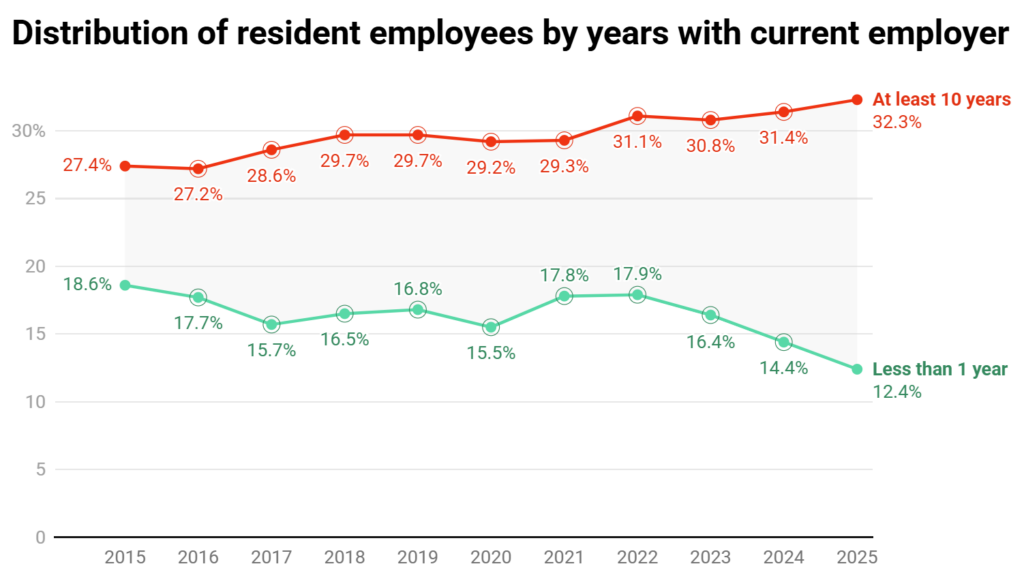
Over the past decade, the share of local, resident workers who have stayed with the same company for 10 years or more has gone up from a little over a quarter to a full one-third.

Source: Labour Force in Singapore 2025/ Singapore Ministry of Manpower

At the same time, the share of those who have either just entered the job market or changed their job in the past 12 months has shrunk from nearly 20% to just 12%, with the biggest drop recorded in the post-pandemic years.

Looking at the entire workforce, back in 2015, more than half of Singapore’s workers had stayed under five years in the same place. Today, the proportions have flipped, with the majority reporting 5 years or more with their employers.

Source: Labour Force in Singapore 2025/ Singapore Ministry of Manpower

Stability or stagnation?

The crucial question is whether these trends are a sign of unusual stability, whereby local workers enjoy secure jobs for many years, or if they simply lack better options and choose to stay put where they are.

While they aren’t mutually exclusive—after all, much depends on the company you work for—data suggests that the job market in Singapore is good for its workers. And getting better.

Since 2015, the median income from work has increased from S$3,949 to S$5,775 in 2025. That is 46.2% in nominal terms and 23.2% when accounting for inflation. This means local salaries can buy 1/4 more compared to a decade ago.

Advertisement

Meanwhile, the average number of weekly working hours for full-time employees has dropped from 47 to 43.8. That’s a cumulative decrease of over 166 hours per year, equivalent to 20 eight-hour workdays.

Singaporeans work less and earn more than ever, despite the fact that a growing number choose to stay with the same employer—or, perhaps, because of that.

Let’s not forget that, like much of the world, Singapore continues to face a persistent talent shortage, with 83% of local businesses reporting a deficit of capable employees.

Image Credit: ManpowerGroup Singapore

Retaining good workers is a far better option than hiring new ones. Recruitment is expensive and unpredictable because it takes time to train a new hire, and there’s no guarantee they will turn out to be good team members.

Similarly, while job hoppers may hope to get a 10 to 20% raise each time they switch workplaces, the disruption it causes and the uncertainty about working conditions (expectations, flexibility, getting along with coworkers) add risks of their own.

Advertisement

Mutual understanding, that the company needs the people it already has and can rely on, and that those people are willing to stay if they are appreciated, could explain why Singapore seems to defy the predictions about an ever more dynamic job market of the future.

As it turns out, stability is highly valuable even to modern companies—and modern workers.

  • Read other articles we’ve written on Singapore’s current affairs here.

Featured Image Credit: Stas_K/ depositphotos

Advertisement

Source link

Continue Reading

Tech

Trump Imposes New Tariffs to Sidestep Supreme Court Ruling

Published

on

President Trump is adding a new 10 percent tariff on nearly all imports to the United States, following a Supreme Court ruling that overturned most of the levies imposed by the US government last year.

In an executive order signed Friday evening, Trump outlined a few exceptions, including imports of critical minerals, beef and fruits, cars, pharmaceuticals, and products from Canada or Mexico. The new tariffs will take effect on February 24, 2026.

In a press conference Friday afternoon, Trump was fired up about the Supreme Court decision and resorted to personal attacks, calling the six justices who ruled against his trade policies “a disgrace to our nation.” Answering a reporter’s question about how two of the justices he nominated, Neil Gorsuch and Amy Coney Barrett, voted for the overturn, Trump called them “an embarrassment to their families.”

The new trade policy is based on Section 122 of the Trade Act of 1974, which allows the president to single-handedly and immediately charge tariffs of up to 15 percent if there are “large and serious” trade deficits. These tariffs only last 150 days unless Congress authorizes an extension. Like the International Emergency Economic Powers Act (IEEPA), the statute has never before been used by a US president in this way.

Advertisement

Once the 150-day deadline arrives, it’s possible for Trump to keep re-issuing Section 122 tariffs. But the administration could also use this time to prepare other forms of tariffs, essentially switching legal justifications to get the same regulatory effects, says Gregory Husisian, a partner and litigation attorney at Foley & Lardner LLP, which has helped over one hundred companies file requests for tariff refunds. “[Section 122 tariff] is for a limited time period, so it’s going to be a bridge authority,” Husisian says.

In the meantime, the Trump administration could rush through the process of conducting trade investigations based on concerns of national security or unfair trade practices abroad, which are a requirement for launching Section 301 and Section 232 tariffs. “We are also initiating several Section 301 and other investigations to protect our country from unfair trade practices of other countries and companies,” Trump said at the press conference, referring to these other tariff options that take longer to launch.

In a separate executive order, the administration confirmed that despite IEEPA tariffs being overturned, the de minimis exemption—which is used to exempt e-commerce packages under $800 in value from being taxed—remains suspended. The end of de minimis last year caused massive package processing backlogs at the US border as well as price increases on budget shopping platforms.

At the press conference, Trump didn’t specify what exactly would happen to companies seeking refunds on their tariff payments. The Supreme Court decision did not specify whether and how the tariffs should be refunded. Answering a reporter’s question on the topic, Trump said he expected the issue to be litigated in court.

Advertisement

Experts tell WIRED that they expect the refund process to be messy and long, since it might require companies to file complaints and calculate the amount of money they believe they are entitled to receive. The government could also then push back on the calculated amount. The process could last anywhere from a few months to more than two years.

The Supreme Court decision specified that the IEEPA gives the president significant power during emergencies, but noted this power doesn’t extend to taxation. Trump, at the press conference, repeatedly distorted the ruling: “But now the court has given me the unquestioned right to ban all sorts of things from coming into our country, to destroy foreign countries … but not the right to charge a fee,” he said. “How crazy is that?”

At times, the press conference turned into a rant about issues unrelated to tariffs, like how the president thinks Europe is too woke or how much he hates the Federal Reserve chair Jerome Powell. Speaking about how the court interprets the literal meaning of the IEEPA, Trump suddenly started bragging about his reading comprehension skills. “I read the paragraphs. I read very well. Great comprehension,” he said.

Source link

Advertisement
Continue Reading

Trending

Copyright © 2025