

Tech
Fanttik’s Spring 2026 Toolkit: – Digital Trends


A Compact Arsenal for Your Garage, Yard, and Desktop & Furniture DIY Dreams
If your home project plans have ever been stalled by bulky, single-purpose tools, or the sheer hassle of setup and cleanup, Fanttik’s latest drop is about to become your new best friend. This March, the brand known for packing serious performance into portable designs is unleashing a Spring New Arrivals collection, over 20 tools that targets four major arenas of domestic life: the Garage, the Yard, the Desktop, and the Furniture. Forget the days of dedicating a whole shelf or closet to your gear; this lineup is all about efficiency, power, and saving precious space.
Garage: Your Roadside Rescue and Detailing Squad, Miniaturized

Fanttik’s garage solutions read like a wishlist for any car or bike owner who values preparedness and a clean ride without the bulk. The star here might be the Potent T10 Jump Starter, a pocket-sized powerhouse that can revive a dead car battery and still have juice to top up your phone. It embodies the collection’s ethos: be ready for anything.
Cleaning gets a major upgrade with the ultra-portable NB10 Fold pressure washer. The Fold, as the name implies, collapses for easy stowage in a trunk or corner, yet delivers the punch to blast grime off your bike, patio furniture, or weekend adventure gear.
For interior detailing, the Flip G10 Nano – AutoCare electric brush tackles grime in crevices and on surfaces, while the V8 Mate Car Vacuum quickly cleans seats, floor mats, and hard-to-reach spots. Follow up with the P10 Pro Polisher for a showroom finish.
Tire care spans from casual to professional needs. The compact X11 Ace Bike Pump is a cyclist’s best friend for quick top-ups on the trail or at home. For vehicles, the X10 Pro Tire Inflator handles daily maintenance and emergency top-ups with reliable precision, while the X10 Pro Max goes further with its precision fill-and-release valve—allowing off-roaders to accurately adjust pressure up or down to match sand, rock, or pavement conditions.
Yard: Tame Your Outdoor Oasis with Less Effort

Transform yard maintenance from a chore marathon into a series of quick wins. Fanttik’s outdoor tools are designed for speed and simplicity. The NB10 Flip Water Gun makes washing the deck, patio furniture, or even the family dog a task measured in minutes, not hours—with adjustable spray patterns for every need.
For greenery care, Fanttik brings specialized efficiency to garden maintenance. The Z10 Pro Hedge Trimmer is designed for precise shaping of hedges and trimming of small shrubs (handling branches up to 8mm thick), making light work of keeping your greenery neatly manicured. For more targeted pruning tasks, the Y10 Pro Electric Pruning Shears provide the power and sharp blades needed to effortlessly cut through garden branches, significantly reducing the hand strain typically associated with manual shears during extended gardening sessions.
The Cruise V11 APEX is a versatile 4-in-1 tool that goes beyond the yard—it’s a portable cordless vacuum, blower, extractor, and inflator all in one. With suction for quick cleanups, blowing power for debris, and inflation for pool floats or camping gear, it handles tasks from car interiors to home messes with ease. An 180-degree rotating handle makes switching between modes effortless, and the included 8 accessories ensure you’re ready for cleaning, storage, and inflation needs anywhere. The Flip G10 Nano – HomeCare electric brush easily cleans outdoor furniture, grills, and siding. For quick repairs like tightening a loose fence panel or securing deck boards, the compact REX K2 Apex Impact Driver delivers just the right amount of torque in a user-friendly format.
Desktop DIY: Precision Tools for Makers and Tinkerers

For the creators, model builders, and 3D printing enthusiasts, a clean, precise workspace is key. Fanttik’s desktop lineup supports the entire process. The F2 Series Rotary Tool (F2 Master Kit, F2 Pro Kit, and F2 Master Eng) offer the control needed for detailed engraving, smoothing 3D prints, or intricate crafting. And there’s a F2 Master Pet which is specifically designed for safe, efficient pet nail grinding.
The compact V8 Mate Handheld Vacuum is perfect for instantly sucking up dust, shavings, and debris from sanding, carving, or cleaning up after any desk project—keeping your creative space tidy without missing a beat. For electronics cleaning, the new B11 Pro Max electric air duster delivers professional-grade power with its 150,000RPM motor, blasting 160g of force at 80m/s to effortlessly clear dust from PC cases and keyboards. Its MegaBoost One-Tap Booster provides instant deep cleaning at the push of a button, making quick work of both everyday maintenance and professional-grade tasks. Meanwhile, the versatile B11 Mix Blower serves as a focused air duster for lighter cleaning or, with its fan attachment, a personal desk fan during long crafting sessions.
Furniture DIY: Build and Repair with Pro-Level Ease

Finally, Fanttik brings confidence to home repairs and furniture projects. The NEX S2 Pro Max Electric Screwdriver takes the strain out of assembling flat-pack furniture or fixing wobbly chairs with its adjustable torque and ergonomic design.
The A11 Ultra Distance Measurer uses a unique rolling wheel to accurately capture curved dimensions—perfect for planning upholstery replacement, custom shelving, or any project requiring precise measurements of irregular surfaces.
For light cutting tasks on PVC, wood, or metal during small repairs or creations, the R11 Pro Reciprocating Saw provides manageable power in a user-friendly format, making small upgrades and repairs genuinely approachable.
The Bottom Line
Fanttik’s Spring 2026 collection, available starting March 10th, feels like a direct response to the modern DIYer’s needs: power without the footprint, versatility without the compromise. Learn more and explore the full Spring New Arrivals collection at fanttik.com.



Microsoft says Teams will soon automatically tag third-party bots in lobbies, allowing organizers to control whether they can join meetings.
As detailed in a new Microsoft 365 roadmap entry, the feature is currently in development and scheduled to roll out in May 2026. When it reaches general availability, it will be available across Windows, macOS, Android, and iOS platforms for worldwide standard multi-tenant and GCC cloud environments.
After the rollout, external third-party bots attempting to join a Teams meeting will be distinctly labeled in the lobby rather than blending in with human participants.
Organizers will then have to explicitly allow the bot to join the meeting, ensuring it cannot be accidentally accepted alongside a group of human attendees.
“During Teams meetings, if there is an external 3P bot trying to join the meeting, organizers will be able to see a clear representation of the bots while they wait in the lobby. Organizers will be required to explicitly and separately admit these bots into the meeting, if really required,” Microsoft said.
“This approach will ensure that no one inadvertently accepts the external bots into the meeting ensuring that the organizers have full control over the presence of these bots.”
The change ensures that malicious apps controlled by threat actors or third-party bots (used for note-taking, transcription, or other automated tasks) cannot join Teams meetings without attendees realizing that a non-human participant has been added.
In January, Microsoft announced that Teams will get a call reporting feature by mid-March, allowing users to flag suspicious or unwanted calls as potential scams or phishing attempts.
Teams has also added new fraud-protection features for calls, warning users about external callers impersonating trusted organizations in social-engineering attacks.
Starting in December, admins can block external Teams users via the Defender portal to thwart cybercrime gangs(including ransomware groups) that attempt to abuse the video conferencing and collaboration platform in social engineering attacks targeting victims’ employees.

Malware is getting smarter. The Red Report 2026 reveals how new threats use math to detect sandboxes and hide in plain sight.
Download our analysis of 1.1 million malicious samples to uncover the top 10 techniques and see if your security stack is blinded.

When the Trump administration last year sought to freeze construction of offshore wind farms by citing concerns about interference with military radar and sonar, the implication was that these were new issues. But for more than a decade, the United States, Taiwan, and many European countries have successfully mitigated wind turbines’ security impacts. Some European countries are even integrating wind farms with national defense schemes.
“It’s not a choice of whether we go for wind farms or security. We need both,” says Ben Bekkering, a retired vice admiral in the Netherlands and current partner of the International Military Council on Climate and Security.
It’s a fact that offshore wind farms can degrade radar surveillance systems and subsea sensors designed to detect military incursions. But it’s a problem with real-world solutions, say Bekkering and other defense experts contacted by IEEE Spectrum. Those solutions include next-generation radar technology, radar-absorbing coatings for wind turbine blades and multi-mode sensor suites that turn offshore wind farm security equipment into forward eyes and ears for defense agencies.
How Do Wind Farms Interfere With Radar?
Wind turbines interfere with radar because they’re large objects that reflect radar signals. Their spinning blades can introduce false positives on radar screens by inducing a wavelength-shifting Doppler effect that gets flagged as a flying object. Turbines can also obscure aircraft, missiles and drones by scattering radar signals or by blinding older line-of-sight radars to objects behind them, according to a 2024 U.S. Department of Energy (DOE) report.
“Real-world examples from NATO and EU Member States show measurable degradation in radar performance, communication clarity, and situational awareness,” states a 2025 presentation from the €2-million (US$2.3-million) offshore wind Symbiosis Project, led by the Brussels-based European Defence Agency.
However, “measurable” doesn’t always mean major. U.S. agencies that monitor radar have continued to operate “without significant impacts” from wind turbines thanks to field tests, technology development, and mitigation measures taken by U.S. agencies since 2012, according to the DOE. “It is true that they have an impact, but it’s not that big,” says Tue Lippert, a former Danish special forces commander and CEO of Copenhagen-based security consultancy Heimdal Critical Infrastructure.
To date, impacts have been managed through upgrades to radar systems, such as software algorithms that identify a turbine’s radar signature and thus reduce false positives. Careful wind farm siting helps too. During the most recent designation of Atlantic wind zones in the U.S., for example, the Biden administration reduced the geographic area for a proposed zone off the Maryland coast by 79 percent to minimize defense impacts.
Radar impacts can be managed even better by upgrading hardware, say experts. Newer solid-state, phased-array radars are better at distinguishing turbines from other objects than conventional mechanical radars. Phased arrays shift the timing of hundreds or thousands of individual radio waves, creating interference patterns to steer the radar beams. The result is a higher-resolution signal that offers better tracking of multiple objects and better visibility behind objects in its path. “Most modern radars can actually see through wind farms,” says Lippert.
One of the Trump administration’s first moves in its overhaul of civilian air traffic was a $438-million order for phased-array radar systems and other equipment from Collins Aerospace, which touts wind farm mitigation as one of its products’ key features.
 Saab’s compact Giraffe 1X combined surface-and-air-defense radar was installed in 2021 on an offshore wind farm near England.Saab
Can Wind Farms Aid Military Surveillance?
Another radar mitigation option is “infill” radar, which fills in coverage gaps. This involves installing additional radar hardware on land to provide new angles of view through a wind farm or putting radar systems on the offshore turbines to extend the radar field of view.
In fact, wind farms are increasingly being tapped to extend military surveillance capabilities. “You’re changing the battlefield, but it’s a change to your advantage if you use it as a tactical lever,” says Lippert.
In 2021 Linköping, Sweden-based defense contractor Saab and Danish wind developer Ørsted demonstrated that air defense radar can be placed on a wind farm. Saab conducted a two-month test of its compact Giraffe 1X combined surface-and-air-defense radar on Ørsted’s Hornsea 1 wind farm, located 120 kilometers east of England’s Yorkshire coast. The installation extended situational awareness “beyond the radar horizon of the ground-based long-range radars,” claims Saab. The U.K. Ministry of Defence ordered 11 of Saab’s systems.
Putting surface radar on turbines is something many offshore wind operators do already to track their crew vessels and to detect unauthorized ships within their arrays. Sharing those signals, or even sharing the equipment, can give national defense forces an expanded view of ships moving within and around the turbines. It can also improve detection of low altitude cruises missiles, says Bekkering, which can evade air defense radars.
Sharing signals and equipment is part of a growing trend in Europe towards “dual use” of offshore infrastructure. Expanded dual-use sensing is already being implemented in Belgium, the Netherlands and Poland, and was among the recommendations from Europe’s Symbiosis Project.
In fact, Poland mandates inclusion of defense-relevant equipment on all offshore wind farms. Their first project carries radar and other sensors specified by Poland’s Ministry of Defense. The wind farm will start operating in the Baltic later this year, roughly 200 kilometers south of Kaliningrad, a Russian exclave.
The U.K. is experimenting too. Last year West Sussex-based LiveLink Aerospace demonstrated purpose-built, dual-use sensors atop wind turbines offshore from Aberdeen. The compact equipment combines a suite of sensors including electro-optical sensors, thermal and visible light cameras, and detectors for radio frequency and acoustic signals.
In the past, wind farm operators tended to resist cooperating with defense projects, fearing that would turn their installations into military targets. And militaries were also reluctant to share, because they are used to having full control over equipment.
But Russia’s increasingly aggressive posture has shifted thinking, say security experts. Russia’s attacks on Ukraine’s power grid show that “everything is a target,” says Tobhias Wikström, CEO for Luleå, Sweden-based Parachute Consulting and a former lieutenant colonel in Sweden’s air force. Recent sabotage of offshore gas pipelines and power cables is also reinforcing the sense that offshore wind operators and defense agencies need to collaborate.
Why Is Sweden Restricting Offshore Wind?
Contrary to Poland and the U.K., Sweden is the one European country that, like the U.S. under Trump’s second administration, has used national security to justify a broad restriction on offshore wind development. In 2024 Sweden rejected 13 projects along its Baltic coast, which faces Kaliningrad, citing anticipated degradation in its ability to detect incoming missiles.
Saab’s CEO rejected the government’s argument, telling a Swedish newspaper that the firm’s radar “can handle” wind farms. Wikström at Parachute Consulting also questions the government’s claim, noting that Sweden’s entry into NATO in 2024 gives its military access to Finnish, German and Polish air defense radars, among others, that together provide an unobstructed view of the Baltic. “You will always have radars in other locations that will cross-monitor and see what’s behind those wind turbines,” says Wikström.
Politics are likely at play, says Wikström, noting that some of the coalition government’s parties are staunchly pro-nuclear. But he says a deeper problem is that the military experts who evaluate proposed wind projects, as he did before retiring in 2021, lack time and guidance.
By banning offshore wind projects instead of embracing them, Sweden and the U.S. may be missing out on opportunities for training in that environment, says Lippert, who regularly serves with U.S. forces as a reserves liaison officer with Denmark’s Greenland-based Joint Arctic Command. As he puts it: “The Chinese and Taiwanese coasts are plastered with offshore wind. If the U.S. Navy and Air Force are not used to fighting in littoral environments filled with wind farms, then they’re at a huge disadvantage when war comes.”
From Your Site Articles
Related Articles Around the Web

Founded in 2013, the Providore has scaled back its presence in recent years
Homegrown café, deli and grocer, The Providore Singapore, announced on Instagram that it will cease operations in Singapore with immediate effect on Monday (Mar 9).
In its post, the F&B brand expressed gratitude to patrons for their “long-term support and kindness,” though it did not disclose reasons for the closure.
“Partings come, but flavour and memories last forever,” the message read. It added: “We look forward to meeting you again in another form in the future.”
The F&B chain scaled back in recent years
The Providore Singapore was founded in 2013. It operated six outlets in locations including Mandarin Gallery, VivoCity and Raffles Place.
According to The Business Times, the brand quickly gained popularity with office-goers, thanks to its brunch mains and premium retail selection of cheeses, gourmet foods, baked goods, and groceries.
In recent years, however, the chain scaled back. In Apr 2025, The Providore was sold to new investors, and founder Robert Collick exited the business. That same month, its Raffles City outlet closed after four years of operation.
The Providore also ran a warehouse in Ayer Rajah, which included a retail section selling gourmet foods, wines, beers, spirits, and bespoke gifts, alongside its head office. Both the Ayer Rajah warehouse and head office are now marked as permanently closed on Google Maps. According to the company’s website, the warehouse’s retail section had already shut down in Sept 2020.
Staff were reportedly told on the day itself
According to a report by Mothership, The Providore’s staff were only informed of the closures on the morning of Mar 9, when they arrived at work.
A staff member who spoke to the publication said many of the outlets’ products appeared to have been cleared overnight.
“It is really so sad that the company never take into consideration the impact this will have on the employees who have their own various commitments. No empathy, no practical solutions were offered to the affected staff too,” they added.
Vulcan Post has reached out to The Providore for comments.
- Read more stories we’ve written on Singaporean businesses here.

Barely a week after the introduction of the iPhone 17e, rumors are already spreading about the iPhone 18e. The cycle begins again.

iPhone 17e
The Apple rumor mill is always looking toward the future, and often speculates on the next update just as everyone recovers from Apple’s latest launches. As expected, this has already happened for the iPhone 18e.
In a post to Weibo on Saturday by leaker Fixed Focus Digital, Apple is already working on the iPhone 18e. This is apparently “confirmed” by the leaker, and according to an automated translation of the post, the iPhone 18e is “finalized,” whatever that means.
Rumor Score: 🤔 Possible
Continue Reading on AppleInsider | Discuss on our Forums

OpenAI announced Monday it has acquired Promptfoo, an AI security startup founded in 2024 to protect LLMs from online adversaries.
The frontier lab said in a blog post that once the deal closes, Promptfoo’s technology will be integrated into OpenAI Frontier, its enterprise platform for AI agents.
The development of independent AI agents that perform digital tasks has generated excitement about productivity gains. But it’s also given bad actors fresh opportunities to access sensitive data or manipulate automated systems. This deal underscores how frontier labs are scrambling to prove their technology can be used safely in critical business operations.
Promptfoo was founded by Ian Webster and Michael D’Angelo to develop tools that companies can use to test security vulnerabilities in LLMs, including an open-source interface and library. The company reports that its products are used by more than 25% of Fortune 500 companies.
Promptfoo has raised just $23 million since its founding, and was valued at $86 million after its most recent round in July 2025, according to Pitchbook. OpenAI did not disclose the value of the transaction.
OpenAI’s post said Promptfoo’s technology will allow its agent platform to perform automated red-teaming, evaluate agentic workflows for security concerns, and monitor activities for risks and compliance needs. The company also said it expects to continue building out Promptfoo’s open-source offering.
Techcrunch event
San Francisco, CA
|
October 13-15, 2026
Tech
Audio-Technica ATH-ADX7000 at CanJam NYC 2026: The Dynamic Featherweight Flagship That Thinks It’s an Electrostat?

When Audio-Technica announced the ATH-ADX7000, its new $3,500 flagship open back headphone, curiosity spread quickly across the audiophile world. The company brought the model to CanJam NYC 2026, giving enthusiasts and industry insiders a chance to hear what the Japanese manufacturer believes is its most advanced dynamic headphone to date.
My first exposure actually came months earlier. Back in November 2025, our UK Headphone Columnist James Fiorucci asked if he could review Audio-Technica’s new flagship. I’ll admit it. I was a little jealous. After editing his superb review and digging into the design details, the Audio-Technica ATH-ADX7000 became one of the headphones I most wanted to hear in person.

My relationship with Audio-Technica headphones goes back much further than that review. Years ago, when I worked in news radio, their headphones were everywhere in the studio. The slightly top end tilted tonal balance was never exactly my can of Vernors, but I understood why stations relied on them. They were reliable, mostly neutral, durable, lightweight, and reasonably priced in an environment where 40 different people might use the same pair in a single day.
And yes… the Jack Nicholson side of me from As Good as It Gets always wiped them down before and after. If you’ve ever worked in radio, you know why. If you haven’t… trust me. You never really know where the last person’s been.
So after reading Fiorucci’s take and seeing the buzz build around Audio-Technica’s new flagship, CanJam NYC 2026 was my first real opportunity to sit down with the ATH-ADX7000. I didn’t waste it.
Featherweight Design, Heavyweight Sound?
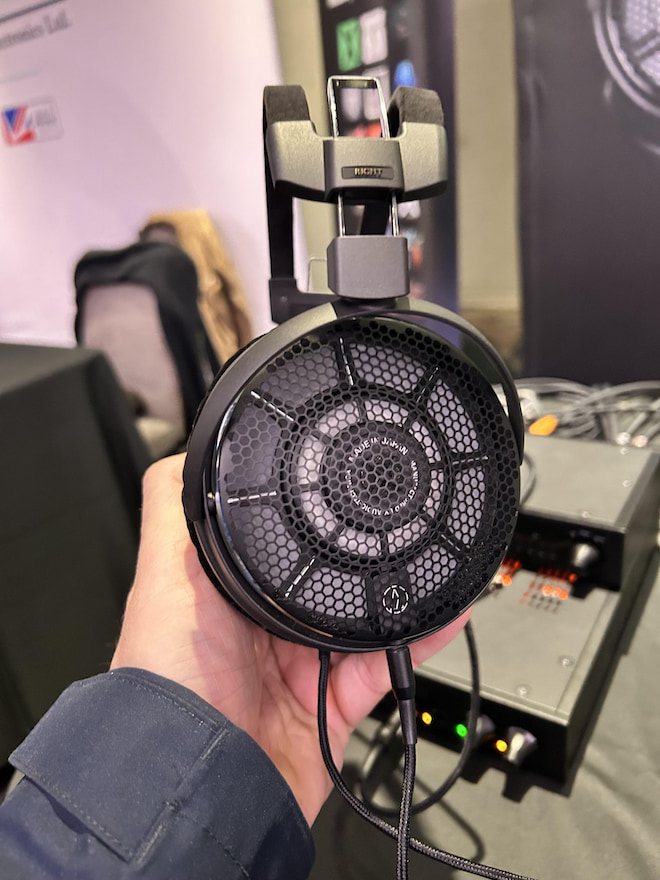
The Audio-Technica ATH-ADX7000 is remarkably light for a flagship open-back headphone. Slip them on and the first thing you notice is how little they seem to weigh on your head. Audio-Technica has long prioritized comfort and low mass in its reference designs, and the ADX7000 continues that tradition with a frame and suspension system that practically disappears during long listening sessions.
At just 275 grams, these things practically disappear the moment they land on your head. I’ve worn heavier baseball caps.
Putting them on the first time at CanJam NYC 2026, I actually paused for a second because it felt like something was missing. The clamping force is moderate, maybe a touch lighter than some listeners might prefer, but when you spend 60+ hours a week sitting in front of a computer listening, writing, and editing, comfort stops being a luxury and becomes survival strategy. In that context, Audio-Technica’s approach makes a lot of sense. They stay put without squeezing your skull like they’re trying to extract a confession. I deny everything. We’ve never met. Not even behind the 7-Eleven on Ocean Avenue in Long Branch at 2:17 a.m.
I had two listening sessions with them at the show, each around twenty minutes, and never experienced the dreaded headband hotspot that some listeners have mentioned. That said, twenty minutes at a show and three hours at home are two very different universes. Anyone who claims to know how a headphone feels long term after a quick demo is either lying or selling something. A few hours of real listening would be needed to make that call with confidence.
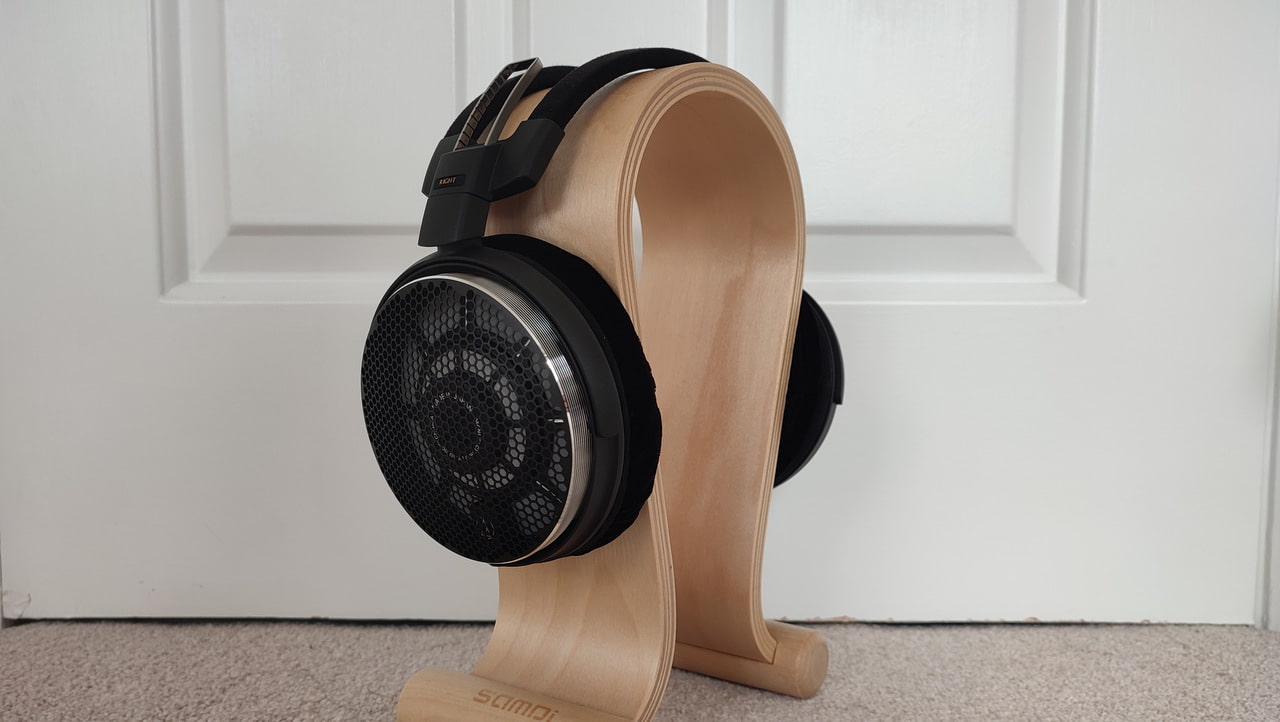
Because they’re so light, it would be easy to assume the ADX7000 is built from plastic. That assumption would be wrong. The frame uses magnesium, which is a far less common material in headphone construction but a clever one. It keeps the structure rigid while shaving off weight — a trick more manufacturers should probably steal.
And yes, each pair is made and hand assembled in Japan, which is exactly what you expect when a headphone costs $3,500. At that price, you want craftsmanship, not something that feels like it rolled off the same assembly line as a pair of airline earbuds.
Put it this way: the ATH-ADX7000 is lighter than a Cleveland pierogi before it hits the fryer — and a hell of a lot easier to live with after a long night.
The headline feature of the Audio-Technica ATH-ADX7000 is its new HXDT driver technology. Each earcup houses a 58 mm diaphragm formed through a precision moulding process designed to maintain a highly uniform circular shape. That level of consistency helps the diaphragm move more accurately, improving detail retrieval and overall clarity. Audio-Technica also aligns the circular components of the driver assembly with micrometre level precision, minimizing unwanted resonances and helping the driver behave exactly as intended.
Impedance is rated at 490 ohms with 100 dB/mW sensitivity, which is very much an Audio-Technica engineering choice. You can run the ATH-ADX7000 from a dongle DAC, but it probably shouldn’t be a bargain-bin one. These headphones clearly reward power and control. If it were my system, I’d lean toward a neutral to slightly warm source with strong bass control to keep the presentation balanced. A good desktop headphone amplifier or a high-powered DAP will get the most out of them.
The Audio-Technica AT-BHA100, now discontinued, was Audio Technica’s reference desktop headphone amplifier designed to drive headphones from 16 to 600 ohms. Its fully balanced design delivered up to 1.5 watts per channel into 16 ohms and 120 milliwatts per channel into 600 ohms, providing the headroom and control needed for high impedance flagship models. Unless my eyes were getting worse under the show lighting, this appears to be the amplifier Audio-Technica brought to power the ATH ADX7000 during its demonstrations.
Electrostatic Lite Without the Electrostatic Hassle?
On the train into Manhattan on Saturday morning, thanks to NJ Transit and its ongoing Portal Bridge construction circus, the ride stretched closer to two hours with the usual power hiccups and delays. Plenty of time to kill, so I reread James Fiorucci’s review and asked myself the obvious question. Was he right?
Turns out…yeah. He was.
The more I listened to the Audio-Technica ATH-ADX7000, the more it became clear that these drift very close to electrostatic lite territory without requiring an energizer or dedicated electrostatic amplifier. Running through tracks from Massive Attack, The Orb, deadmau5, along with a few jazz selections, several things jumped out immediately. Transparency. Excellent detail retrieval that never feels forced. Speed. Dynamic snap. And a very satisfying punch from the mid bass into the lower mids.

And then there is the space. These things are undeniably spacious sounding. Not just wide. New York wide. Like standing on the East River looking across Manhattan, past the Hudson, and all the way into Hiram’s Roadstand parking lot in Bergen County before the soundstage finally taps out. If a headphone can pull that off in a noisy show environment, something serious is happening under those magnesium grills.
The Bottom Line
The Audio-Technica ATH-ADX7000 is not a casual purchase. At $3,500, it firmly sits in the flagship tier. The good news is that it’s still less expensive than the top offerings from Audeze, Abyss, and ZMF Headphones, while delivering a presentation that edges close to electrostatic territory without requiring an energizer.
The extremely high 490 ohm impedance means these headphones reward serious amplification. A good desktop amplifier or powerful DAP will unlock their speed, transparency, and expansive soundstage. But the real question lingering in my mind after CanJam NYC 2026 is this: what would they sound like paired with a dedicated OTL tube amplifier? My suspicion is that the answer could be very, very interesting.
Where to buy:
Related Reading:

The first leak surrounding the Pixel 11 Pro Fold has surfaced, offering an early look at Google’s next foldable phone. According to CAD renders shared by Android Headlines in partnership with OnLeaks, the device will look very similar to the Pixel 10 Pro Fold, though with a slightly slimmer profile and a redesigned camera bump.
Visually, the phone sticks to Google’s now-familiar book-style foldable design with an inner folding display and a cover screen on the outside. The materials also appear unchanged, with an aluminum frame paired with a glass back, while the physical button placement remains the same as before, with the power button sitting above the volume keys.

The most noticeable change appears to be the thinner chassis. The Pixel 11 Pro Fold is expected to measure 10.1mm when folded and 4.8mm when unfolded, making it slightly slimmer than its predecessor. The overall height and width, however, are expected to remain largely the same.
Another notable tweak is the redesigned camera island, which reportedly looks cleaner and more modern, with the LED flash and microphone placed within the upper pill-shaped cutout alongside the sensors. While the exact camera hardware hasn’t been confirmed yet, the report suggests Google could introduce upgrades, possibly borrowing components from the Pixel 10 Pro lineup.

Under the hood, the Pixel 11 Pro Fold is expected to run on the new Google Tensor G6 chip, reportedly built by TSMC on a potential 3nm process, with rumors pointing to a 7-core CPU configuration. Beyond that, much of the feature set is expected to remain familiar, including IP68 water resistance, Qi wireless charging, and support for PixelSnap accessories, while the display sizes and battery capacity are likely to stay largely unchanged from the current generation.
A slimmer Pixel Fold, but not a radical overhaul
It seems Google is following in the footsteps of Samsung, which trimmed the waistline of the Galaxy Z Fold 7. Across the ocean, Chinese labels are already engaged in an even more furious race to make the thinnest foldable phone out there, with the Honor Magic V6 and the Oppo Find N6 being the top contenders. It would be interesting to see whether Google has managed to slim down its next foldable, while also bolstering its ingress protection against dust and water exposure.

While the design leak is a big pre-launch expose, there are murmurs of a few other changes under the hood for the broader Pixel 11 portfolio. Google is reportedly eying a modem supplied by MediaTek, switching away from Samsung. Pixel phones have often struggled with connectivity woes, so let’s hope the MediaTek partnership brings some respite.
As for launch timing, the report suggests Google will likely unveil the Pixel 11 series in August, following the company’s recent launch schedule. Pricing remains unclear for now, though earlier roadmap leaks hinted the foldable could target around $1,500, though that figure may change due to market conditions and tariffs.

Apple’s fourth round of developer betas has arrived, with builds of iOS 26.4, iPadOS 26.4, watchOS 26.4, tvOS 26.4, visionOS 26.4, and macOS Tahoe 26.4 now available for testing.

Apple’s hardware that works with the 26-generation operating systems – Image Credit: Apple
The fourth developer betas for iOS 26.4, iPadOS 26.4, watchOS 26.4, tvOS 26.4, macOS 26.4, and visionOS 26.4 arrive after the third, which landed on March 2 for most, March 3 for macOS. The second round appeared on February 23, and the first round arrived on February 16.
- iOS 26.4 build 4 is 23E5234a, replacing 23E5223f


The Federal Bureau of Investigation (FBI) warns that criminals are impersonating U.S. officials in phishing attacks targeting businesses and individuals who request city and county planning and zoning permits.
In a public service announcement published on Monday, the bureau said that the criminals behind this campaign are identifying potential victims using publicly available information, which also makes their malicious messages seem legitimate and helps them trick suspicious targets.
“Individuals and businesses with active applications for land-use permits are being targeted by criminals impersonating city and county planning and zoning board officials, fraudulently requesting fees associated with these permits,” the FBI warned.
“Victims receive unsolicited emails citing their permit information, zoning application numbers, and/or property addresses. Victims are instructed to pay invoices for fees related to their permits and directed to make payments via wire transfer, peer-to-peer payment, or cryptocurrency.”
The FBI says there are several common indicators that can help detect such schemes, including messages sent from non-governmental domains (such as @usa.com), attachments that ask recipients to request more details via email, and various tactics to push for quicker payments to avoid permit delays.
Scammers may also time their phishing messages to match the timing of official communications with details about zoning permits.
The law enforcement agency advised businesses and individuals to carefully check whether messages they receive from U.S. officials are legitimate by verifying the domain and email address and calling the city or county government to confirm outstanding fees.
Those who were targeted or fell victim to this scam should file a complaint with the FBI’s Internet Crime Complaint Center (IC3) and share the email address, date of email, and/or phone number used by the scammers, the date of the project’s scheduled hearing, the amount listed in the fraudulent invoice, as well as any other financial information provided by the criminals.
Four years ago, the FBI also warned of widespread attacks in which scammers impersonated government or law enforcement officials by spoofing authentic phone numbers to extort money from potential victims or steal their personally identifiable information.
In April 2025, the bureau said that criminals were also impersonating FBI IC3 employees, while offering to “help” fraud victims recover money lost to other scammers.
One month later, the FBI also warned of cybercriminals using AI-generated audio deepfakes to target U.S. officials in voice phishing attacks.
Malware is getting smarter. The Red Report 2026 reveals how new threats use math to detect sandboxes and hide in plain sight.
Download our analysis of 1.1 million malicious samples to uncover the top 10 techniques and see if your security stack is blinded.


Living in the digital age often feels like a double-edged sword. We can connect with virtually anyone, anywhere, at any time. You can chat with a peer in a different time zone, order flowers from the shop across town, and post those cute new pictures of your kids, all in a matter of minutes and from the handy little device you carry around in your pocket. Modern technology allows us to share our lives in ways many of us never imagined even 20 years ago, but there’s also a dark side to digital life. The modern age has made it much easier for scammers to target anyone with even a hint of a digital footprint.
Scams are a timeless crime, far predating the age of FBI alerts. Insurance scams have been around for centuries, but today we’re more worried about phishing scams and deceptive websites. In February 2026, the FBI issued a warning to the public about an emerging, malicious plot that can potentially target anyone who posts photos online. Criminals are finding those photos of your loved ones, be it your children, parents, significant other, or friends, and using them to create fake proof-of-life photos. They’ll then send you these photos to try to fool you into believing that this person has been kidnapped and demand a ransom payment. When presented with a frightening photo of someone we love, many of us may immediately pay up — here’s what to do instead.
A vicious scam

It’s easy to hang up the phone on a would-be scammer that’s talking about your car’s extended warranty and set up your phone to block potential scam calls, but this scam plays deep into fears of our loved one’s safety. After obtaining one of your photos, a scammer may contact you via text message claiming that they’ve kidnapped them and demanding a ransom payment. The text may be violent and will often be timed so that you don’t have long to examine the image before it disappears.
If you receive a text or email similar to this, don’t panic. Take a screenshot of the message if possible and immediately get in touch with the loved one that is pictured to ensure they are safe. You should also closely examine the photo for accuracy — these photos have been manipulated and may have altered or missing physical features or proportions that just look off. If a friend or family member is actually missing, know that posting information online will likely lead scammers to your doorstep.
If you’re concerned about falling victim to this scam, the FBI recommends that you set up a code word with your loved ones that only you know to ensure reliable communication. Also, be sure to report any scam to the FBI’s Internet Crime Complaint Center, even if you don’t fall for it. Include any information that you have, such as phone numbers, photos, and payment information.

Scottish support for Windfall Tax as energy costs surge

Rival barbers brawled in street with weapons in front of stunned onlookers, court hears
Live Nation settles DOJ antitrust lawsuit, to divest venues


-

 Politics6 days ago
Alan Cumming Brands Baftas Ceremony A ‘Triggering S**tshow’
-
Business3 days ago
Form 8K Entergy Mississippi LLC For: 6 March
-

 Fashion3 days ago
Weekend Open Thread: Ann Taylor
-

 News Videos7 hours ago
10th Algebra | Financial Planning | Question Bank Solution | Board Exam 2026
-

 Tech5 days ago
Bitwarden adds support for passkey login on Windows 11
-

 Tech7 days ago
Cynus Chess Robot: A Chess Board With A Robotic Arm
-
 Sports4 days ago
499 runs and 34 sixes later, India beat England to enter T20 World Cup final | Cricket News
-

 Sports2 days ago
Three share 2-shot lead entering final round in Hong Kong
-

 Sports2 days ago
Braveheart Lakshya downs Lai in epic battle to enter All England Open final | Other Sports News
-

 Business6 days ago
Guthrie Disappearance Enters Fifth Week as Family Visits Memorial
-

 Crypto World3 hours ago
Paradigm, a16z, Winklevoss Capital, Balaji Srinivasan among investors in ZODL
-

 NewsBeat4 days ago
Piccadilly Circus just unveiled ‘London’s newest tourist attraction’ and it only costs 80p to enter
-

 Business1 day ago
Search for Nancy Guthrie Enters 37th Day as FBI Probes Wi-Fi Jammer Theory
-

 Politics3 days ago
Top Mamdani aide takes progressive project to the UK
-

 Entertainment3 days ago
Hailey Bieber Poses For Sexy Selfies In New Luscious Lip Thirst Traps
-
 Sports6 days ago
Jack Grealish posts new injury update as Man City star enters crucial period
-

 Tech5 hours ago
Despite challenges, Ireland sixth in EU for board gender diversity
-

 Crypto World5 days ago
New Crypto Mutuum Finance (MUTM) Reports V1 Protocol Progress as Roadmap Enters Phase 3
-

 Tech4 days ago
ACIP To Discuss COVID ‘Vaccine Injuries’ Next Month, Despite That Not Being In Its Purview
-
Entertainment5 days ago
Harry Styles Has ‘Struggled’ to Discuss Liam Payne’s Death