Tech
FiiO Teases K17 R2R Pro DAC and Headphone Amplifier With Wi-Fi

FiiO is pushing performance with the launch of the K17 R2R Pro, a DAC, and headphone amplifier built around a proprietary resistor ladder design and a long list of connectivity options. It follows directly on the heels of the recently reviewed K17 ($989) covered by James Fiorucci, making this the next step in a product line that’s clearly gaining traction.
That timing isn’t accidental. The one box desktop system has become one of the fastest growing segments in personal audio, driven by listeners who want a full featured DAC, and headphone amp in a single chassis without the cost, complexity, or footprint of separates. FiiO is betting that demand isn’t slowing down.
The real question, before digging into the K17 R2R Pro itself, is what you give up when everything is consolidated into one box and what you actually gain in return. Can something like this compete with well-matched separates, or is the appeal more about convenience and system flexibility?
FiiO K17 as the Reference Point
Before getting into the new K17 R2R Pro, the standard K17 matters because it already sets a serious baseline. The $989 model, which uses AKM’s AK4191 digital modulator with dual AK4499EX DACs, a fully discrete amplifier stage with ON Semiconductor MJE243 and MJE253 transistors, and up to 4 watts of balanced output power.
Specifications look impressive. Crosstalk over 119 dB, THD+N below 0.00049% at 32 ohms, and SNR above 123 dB. FiiO also uses a 35W linear power supply with five 4700µF capacitors, which is not something you see in every sub $1,000 desktop DAC and headphone amplifier.
The K17 also brings a 3.93-inch touchscreen, ESP32 S3 SoC, X2000 multi core processor, and a front panel with 1/4-inch, 4 pin XLR, 4.4mm balanced, and USB-C connectivity. At nearly 3 kg, it also feels like a proper desktop component rather than another lightweight box pretending to be one.
That matters because the K17 R2R Pro is not arriving in a vacuum. The regular K17 already made the argument for a serious desktop audio system. The new model now has to show what FiiO can improve with a resistor ladder DAC architecture, and whether that change makes the Pro feel like a real step forward instead of just another badge on the same chassis.
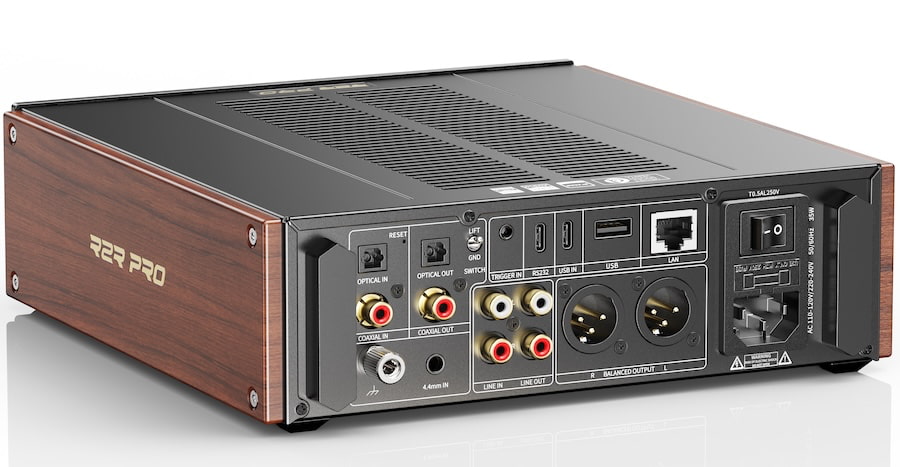

FiiO K17 R2R Pro: What’s Actually New?
The FiiO K17 R2R Pro moves beyond the AKM-based K17 with a proprietary 5 + 24-bit R2R PRO resistor array, giving the new model a very different DAC architecture and a more analog-leaning design brief.
Users can switch between NOS and OS modes, allowing the K17 R2R Pro to run without oversampling or with oversampling engaged, depending on the source material and listening preference.
The headphone section uses a discrete Class AB transistor current-boosting amplifier circuit rated at 4000mW + 4000mW. That gives it enough output for a wide range of headphones, from sensitive IEMs to more demanding planar designs.
FiiO is also positioning this as a complete desktop audio solution or hi-fi system hub. The K17 R2R Pro supports local playback, wi-fi connectivity, and QPlay, with dual-band 2.4GHz/5GHz Wi-Fi and Gigabit Ethernet for more stable network use.
What’s missing from FiiO at this point is information about native support for any of the major streaming platforms. Outside of support for QPlay which is confirmed, we still don’t know if Spotify Connect, TIDAL Connect, and Qobuz Connect are part of the package.
For system tuning, it includes a 31-band high-precision parametric EQ with Auto EQ support. Users can adjust PEQ settings through the FiiO Control app or a web browser and save those settings directly to the unit.
Other key features include a USB ground-loop isolator, a 35W low-noise linear power supply, a 3.93-inch touchscreen with VU meter and clock display options, and an aluminum-alloy infrared remote control.
FiiO K17 R2R Pro Connectivity
A look at the rear panel of the FiiO K17 R2R Pro makes it clear that this is designed to function as the hub of a desktop or even small two channel system.
On the digital side, you get optical in and out, coaxial in and out, USB-C, and a standard USB-A port for storage or external devices. There is also an Ethernet LAN connection for network streaming, alongside trigger in and RS232 for system integration.
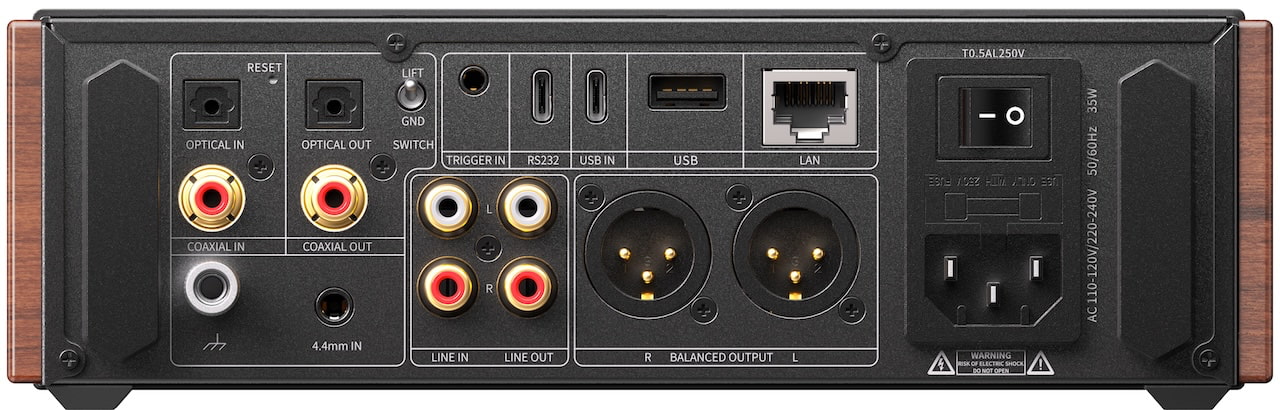

Analog connectivity is just as complete. There are RCA line inputs and outputs, along with balanced XLR outputs for connecting to a power amplifier or active speakers. A 4.4mm balanced line input is also included, which is less common at this level and gives additional flexibility for portable or balanced source devices.
FiiO has also included a ground lift switch to help deal with system noise issues, which is a practical addition for desktop setups connected to multiple components.
The Bottom Line
The FiiO K17 R2R Pro stands out by replacing the standard DAC approach with a proprietary R2R ladder while keeping the all in one concept intact with streaming, DAC, and a 4W per channel Class A/B headphone amplifier. That combination of R2R architecture and full system control in a single chassis is still relatively uncommon.
The R2R design will offer a different tonality than the AKM based K17, but that does not automatically make it better. It is simply a different presentation that some listeners may prefer.
What is missing is any clear indication that it can outperform well matched separates, and pricing has not been confirmed, though it is unlikely to come in below the $989 K17.
As noted, details around the streaming platform are still limited, which is unusual for a product being positioned as a streamer. FiiO has not outlined supported services or ecosystem integration, so for now it is reasonable to assume the Wi-Fi implementation is intended for network streaming, even without Bluetooth support. We will update when we learn more.
Price & Availability
Global pricing will be announced in June 2026. However, visitors will be able to hear the K17 R2R Pro at Vienna High End starting June 4th at World of Headphones, H X4, N01.
You must be logged in to post a comment Login