



Connect with us

Tech

First multi-coronavirus vaccine enters human testing, built on UW Medicine technology

Published

on

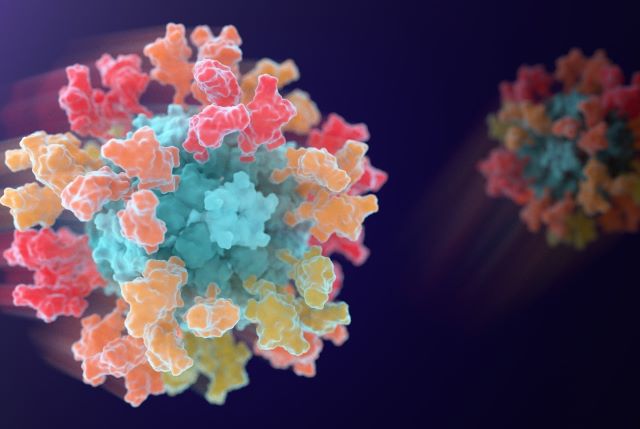
A model of a new vaccine targeting a family of coronaviruses that includes the virus that causes COVID-19. The image highlights pieces of several different viruses attached to a computer-designed nanoparticle to trigger an immune response. (Ian C. Haydon Image)

A candidate vaccine that fights a suite of coronaviruses including COVID-19 and related, deadly respiratory diseases is starting human clinical testing in Australia. The vaccine was developed using technology from the University of Washington’s Institute for Protein Design.

South Korean pharmaceutical company SK bioscience is leading the trial for the new coronavirus vaccine, called GBP511. SK bioscience previously partnered with UW researchers on a COVID-19 vaccine that received regulatory approval.

The Coalition for Epidemic Preparedness Innovations has provided the GBP511 program with approximately $65 million in funding. 

Unlike most vaccines that target a single virus or strain, GBP511 aims to protect against multiple coronaviruses at once.

Neil King (left) and David Veesler are University of Washington biochemistry professors developing computer-designed protein vaccines. (UW Photo / Ian C. Haydon)

“GBP511 is the first vaccine to reach human testing that is intended to protect against multiple strains of the virus that causes COVID-19 as well as related coronaviruses with the potential to spark dangerous outbreaks,” Neil King, associate professor of biochemistry at UW Medicine, said in a statement.

King, who is deputy director of the Institute for Protein Design, co-invented the self-assembling nanoparticle technology that was used to generate the vaccine. The institute is on the cutting edge of AI-assisted protein innovation and perhaps best known as the home of David Baker, a 2024 Nobel Prize winner in chemistry.

Advertisement

The new vaccine recognizes sarbecoviruses, a subgroup of coronaviruses that include the virus that causes COVID-19, as well as those responsible for other major disease outbreaks: the original SARS-CoV-1 virus that caused widespread illness in the early 2000s and MERS-CoV, which caused outbreaks primarily in the Middle East. The family also includes viruses found in animals such as camels and bats, some of which have already infected humans and others that potentially could.

The vaccine features pieces of four different coronaviruses attached to a computer-designed nanoparticle, triggering an immune response to a variety of invaders.

“The beauty of this approach is that by presenting the immune system with multiple related antigens at once, we can train it to recognize features that are conserved across the entire sarbecovirus family,” said David Veesler, a professor of biochemistry at UW Medicine who led the preclinical studies.

The international Phase 1/2 trial launched its enrollments last month and aims to include approximately 368 healthy adults in Perth, Western Australia. Results from the study examining the vaccine’s safety and effectiveness are expected by 2028. 

Advertisement

Source link

Continue Reading
Click to comment

Leave a Reply

Your email address will not be published. Required fields are marked *

Tech

Motorola Solutions officially opens Cork R&D centre

Published

on

The new hub focuses on software design for its public safety land mobile radio portfolio.

US telecoms company Motorola Solutions has officially opened its new global R&D centre in Cork city. The centre was initially announced in 2024 and will house nearly 200 employees across software engineering, design, development, testing, quality assurance and management.

The R&D centre in Cork’s Navigation Square focuses on software design for its public safety land mobile radio (LMR) portfolio.

LMR consists of a push-to-talk two-way communication system between radio transceivers, such as walkie-talkies. This system is used by public safety organisations like the police or ambulance services.

Advertisement

“Today’s LMR extends highly resilient voice capabilities to AI and advanced data applications,” said Mahesh Saptharishi, the executive vice-president and chief technology officer at Motorola Solutions.

“The work at Navigation Square underscores our relentless commitment to mission-critical communications that public safety agencies trust in their most demanding moments.”

The company’s new centre – supported with investment from IDA Ireland – expands Motorola Solutions’ existing footprint in the country following its acquisition of Tetra Ireland, the provider of Ireland’s National Digital Radio Service, in 2022.

IDA CEO Michael Lohan said that the new centre “highlights the continued attractiveness of Ireland’s stable business environment and our proven track record in supporting the world’s leading technology companies”.

Advertisement

“This investment reinforces our country’s reputation as a global hub for the technology sector, where world-class engineers can solve some of the most complex challenges of the modern era,” said Taoiseach Micheál Martin, TD.

Motorola Solutions has early‑career and education partnerships with University College Cork and Munster Technological University for internships that offer students hands-on, practical industry experience and mentorship.

The company also supports the Tech For Good programme to help provide schools in Cork with 3D printers and resources to promote STEM curriculums.

Don’t miss out on the knowledge you need to succeed. Sign up for the Daily Brief, Silicon Republic’s digest of need-to-know sci-tech news.

Advertisement

Source link

Continue Reading

Tech

Engineering isn’t ‘just a job’ for this senior process project engineer

Published

on

Abbott’s Jasmine Swift discusses how a career in engineering is far more than just another nine to five.

“Growing up in an engineering household shaped my curiosity from an early age,” explains Jasmine Swift, a senior process project engineer at healthcare company Abbott. 

“My father was an engineer and I was constantly surrounded by conversations about problem-solving, design and innovation.

“That exposure gave me a general understanding of engineering principles long before college, and it sparked a fascination with how things work.”

Advertisement

She “didn’t just see engineering as a job”, but instead regards it as a vehicle through which professionals can “create solutions that make life better”.

“That foundation, strengthened through my education and career experiences, made choosing this path feel natural. It’s a career where curiosity meets impact and that’s what drew me in.”

What’s the best thing about working in this field?

The best part is the sense of purpose and impact. Every project I work on contributes to improving health and nutrition for people around the world. That’s a powerful motivator. It’s not just engineering for the sake of engineering; it’s engineering that changes lives.

I also love the variety and challenge. STEM is never static. There’s always a new technology, a new problem to solve, or a new way to make processes more efficient and sustainable. It keeps me learning and growing every single day, and that’s something I value.

Advertisement
What’s the most exciting development you’ve witnessed in your sector since you started working in it? 

The evolution of automation and data analytics has been incredible to witness. When I first started, many processes were still heavily manual, relying on operator experience and traditional controls. Today, we’re leveraging smart sensors, predictive modelling and real-time data to optimise performance and reduce variability.

What excites me most is how these technologies don’t just make processes faster, they make them smarter and more sustainable. For example, predictive maintenance can prevent downtime before it happens, and advanced analytics help us minimise waste and energy use.

It’s a shift from reactive to proactive, and it’s transforming how we think about manufacturing. Seeing this digital transformation unfold reminds me why I chose engineering – it’s about continuous improvement and shaping the future. 

What aspect of your job did you struggle to get to grips with? 

Early in my career, I struggled with stakeholder alignment. Engineering solutions aren’t just technical, they involve people, priorities, and timelines. I had to learn that success depends as much on communication and collaboration as it does on technical expertise.

Advertisement

It was a shift in mindset: moving from ‘I need to solve this problem’ to ‘I need to bring everyone along on the journey’. Over time, I developed skills in active listening, empathy and clear communication, which have made me a stronger leader and a better engineer.

How were challenges overcome?

One of the toughest challenges has been working on a project that started as a small initiative and then transformed into a significant and strategic project for our site – a project I’m still leading today.

The scale-up was enormous, and with it came increased visibility, tight timelines and high expectations. Managing this transition required me to shift from a technical mindset to a strategic leadership role. Suddenly, it wasn’t just about engineering solutions but about aligning stakeholders, managing risk, and keeping a diverse team motivated under pressure.

To navigate this, I focused on breaking the work into clear phases, building strong team dynamics and maintaining transparent communication. I also leaned heavily on mentorship and coaching to strengthen my leadership skills. This experience continues to teach me resilience, adaptability and the importance of collaboration. It’s a defining chapter in my career that proves growth often comes from stepping into discomfort.

Advertisement
If you had the power to change anything within the STEM sector, what would that be? 

I would focus on making STEM careers more accessible and inclusive. When different perspectives come together, we create better solutions and stronger teams. But change needs to start early.

Too often, children grow up with a narrow view of what engineering looks like, typically imagining someone in a hard hat on a construction site. I’d love to see schools actively educate students about the wide range of engineering roles, from process design to data analytics to sustainability.

Showing young people the breadth of opportunities could inspire the next generation of innovators and break down stereotypes that limit potential. 

Which of your personality traits makes you best suited to your job and this sector? 

Curiosity and adaptability are at the heart of everything I do. Curiosity drives me to ask ‘why’ and ‘how’ every single day, whether it’s understanding a process, troubleshooting a problem or exploring new technologies. It keeps me learning and growing, even when the answers aren’t obvious.

Advertisement

Adaptability is equally important because STEM is constantly evolving. Projects change, priorities shift, and unexpected challenges arise. Being able to pivot quickly, stay calm under pressure and find creative solutions have been critical to my success.

I’d also add resilience and empathy. Resilience helps me push through setbacks without losing sight of the bigger picture, and empathy allows me to connect with people. Engineering isn’t just about machines and data; it’s about collaboration and understanding the human side of every decision. 

Is there something in your personal life that helps you or has helped you in your job? 

Definitely. Growing up with my father as an engineer gave me an early appreciation for problem-solving and innovation. That exposure gave me a foundation that I’ve built on through college and my career. Having that understanding early in life made technical concepts feel less intimidating and gave me confidence to tackle challenges head-on.

Over time, I’ve strengthened that base with formal education and hands-on experience, but the curiosity and logical thinking I learned at home still guide me every day. It’s a reminder that our roots often shape the way we lead and create.

Advertisement
How do you make connections with others in the STEM community?  

For me, building connections is about being intentional and authentic. I actively seek out opportunities to engage through professional networks, industry conferences or internal groups like Women Leaders of Abbott. These spaces allow me to share ideas and learn from others. The STEM community thrives on collaboration, and every connection is a chance to learn something new or spark innovation.  

What advice would you give to someone thinking about a career in your field? 

Be curious and fearless. Engineering is about solving problems, and the best solutions often come from bold ideas and diverse perspectives. Don’t be afraid to ask questions, even the ‘simple’ ones, and seek opportunities that stretch you beyond your comfort zone.

One of my favourite insights from Brené Brown’s book Dare to Lead is that ‘clear is kind’. In STEM, clarity matters – whether you’re explaining a design, managing a project or leading a team. Communicate openly, set clear expectations and don’t shy away from tough conversations. It builds trust and makes collaboration stronger.

Also, remember that STEM isn’t just about technical skills; it’s about courage, creativity and connection. Build your network, find mentors and never stop learning. Every challenge is an opportunity to grow and every failure is a stepping stone towards success. 

Advertisement

Don’t miss out on the knowledge you need to succeed. Sign up for the Daily Brief, Silicon Republic’s digest of need-to-know sci-tech news.

Source link

Advertisement
Continue Reading

Tech

CarPlay could soon support third-party AI voice assistants like ChatGPT

Published

on

CarPlay could soon support more than just Siri, as Apple explores wider access for third-party voice tools.

Car dashboard with a large touchscreen running Apple CarPlay, showing colorful app icons like Music, Maps, Phone, Messages, Podcasts, Calendar, and News, with surrounding air vents and controls
Apple may open CarPlay to third-party AI assistants

It looks as though Apple is gearing up to allow third-party chatbots on CarPlay. This would allow users to query voice-enabled chatbots directly through the CarPlay interface.
Until now, Apple has kept voice assistants off CarPlay, save for its first-party assistant, Siri. However, with the slow rollout of the new, more personal Siri, Apple may feel the pressure to give its users options.
Continue Reading on AppleInsider | Discuss on our Forums

Source link

Continue Reading

Tech

Intel confirms GPU development is heating up with internal builds and top hires aiming to aggressively challenge Nvidia’s dominance

Published

on


  • Intel is returning to GPUs to challenge Nvidia’s market leadership directly
  • The company plans to produce GPUs internally for tighter manufacturing control
  • Eric Demers joins Intel from Qualcomm as a key technical figure in GPU development

Intel chief executive Lip-Bu Tan has publicly confirmed internal work on graphics hardware remains active, directly addressing questions about whether the company intends to stay involved in that segment.

Speaking during the recent Cisco AI Summit, Tan said upcoming products will be built internally and that Intel’s manufacturing arm will also support production at scale.

Source link

Advertisement
Continue Reading

Tech

Google and Microsoft-backed Terradot acquires carbon removal competitor

Published

on

Carbon removal startup Terradot is acquiring competitor Eion, the two companies announced today. The sale was driven largely by big investors like sovereign wealth funds, which want to work with companies that can handle large contracts. Eion was simply too small, Eion CEO Anastasia Pavlovic Hans told The Wall Street Journal.

Both companies spread pulverized rocks on farm fields to absorb carbon dioxide from the atmosphere. Known as enhanced rock weathering (EWR), it speeds up a natural process and has the potential to be a low-cost way to remove carbon, but it requires large and distributed operations. The spread between what EWR companies would like to charge and what buyers would like to pay remains wide, according to a survey by CDR.fyi. 

California-based Terradot’s operations are centered on Brazil, where the company works with basalt as its mineral of choice, while Eion works in the U.S. and uses olivine. Terradot’s investor list includes Gigascale Capital, Google, Kleiner Perkins, and Microsoft, while Eion’s investors include AgFunder, Mercator Partners, and Overture.

Source link

Advertisement
Continue Reading

Tech

‘Wicked: For Good’ Is Coming to Streaming. Here’s What You Can Watch

Published

on

Wicked: For Good is the second half of Universal Pictures’s epic tale about the witches of Oz and how their relationship has soured since the events of the first movie. The sequel, which debuted at the top of the global box office, is the biggest opening ever for a Broadway musical adaptation. 

Get ready to relive the magic as Wicked: For Good is coming to streaming.

The movie picks up with Glinda (Ariana Grande) as the leader of Emerald City. Elphaba (Cynthia Erivo), now known as The Wicked Witch of the West, has been ostracized and forced into exile. Thanks to the arrival of a mysterious girl from Kansas, the two must face their past in order to save their present.

Advertisement

The movie was directed by Jon M. Chu and also stars Jonathan Bailey, Ethan Slater, Bowen Yang, Marissa Bode, Michelle Yeoh and Jeff Goldblum. Wicked: For Good bonus features include director commentary, behind-the-scenes featurettes and a full-length sing-along version of the movie.

Read on to find out when Wicked: For Good will hit streaming, along with more information on how a VPN can improve your viewing experience.

Read more: Here Are the Ways You Can Get Peacock Premium for Free

When to watch Wicked: For Good on Peacock

Advertisement

Viewers in the US can start watching the celebrated musical on Peacock starting Friday, March 20.

There are two Peacock plans to choose from. The cheaper Peacock Premium costs $11 a month or $110 a year and includes ads. Peacock Premium Plus and costs $17 a month or $170 a year. This tier includes downloads, your live local NBC station and is mostly ad-free.

James Martin/CNET

How to watch Wicked: For Good with a VPN

If you’re traveling abroad and want to keep up with your favorite shows, a VPN can enhance your privacy and security when streaming. It encrypts your traffic and prevents your internet service provider from throttling your speeds. It can be helpful when connecting to public Wi-Fi networks while traveling, adding an extra layer of protection for your devices and logins.

VPNs are legal in many countries, including the US and Canada, and can be used for legitimate purposes such as improving online privacy and security. However, some streaming services may have policies restricting VPN use to access region-specific content. If you’re considering a VPN for streaming, check the platform’s terms of service to ensure compliance.

Advertisement

James Martin/CNET

ExpressVPN is our best VPN pick for people who want a reliable and safe VPN. The service is compatible with a variety of devices. It typically costs $13 a month but if you sign up for an annual subscription for $100, you will get four months free and save 70%. Note that ExpressVPN offers a 30-day money-back guarantee.

If you choose to use a VPN, follow the provider’s installation instructions to ensure you’re connected securely and in compliance with applicable laws and service agreements. Some streaming platforms may block access when a VPN is detected, so verifying if your streaming subscription allows VPN usage is crucial.

Advertisement

Source link

Continue Reading

Tech

How Elon Musk is rewriting the rules on founder power

Published

on

Elon Musk has merged SpaceX and xAI, creating what might be the blueprint for a new Silicon Valley power structure. With his $800 billion net worth already rivaling historic conglomerate GE’s peak market cap, and Musk being vocal about his view that “tech victory is decided by velocity of innovation,” the question isn’t whether a personal conglomerate can be built, but rather how far Musk himself is going to take it. 

Watch as Equity dives into this new era of the “everything” business, whether we’ll see others like Sam Altman follow suit, and more of the week’s headlines. 

Subscribe to Equity on YouTube, Apple Podcasts, Overcast, Spotify and all the casts. You also can follow Equity on X and Threads, at @EquityPod. 

Advertisement

Source link

Continue Reading

Tech

Harbor Freight Just Dropped A New Purple Color For Several US General Tool Cabinets

Published

on


Harbor Freight has hit the ground running in 2026, debuting a selection of products that aren’t power tools, including smartphone-compatible OBD II code readers and foldable welding tables. It’s not just introducing new offerings for 2026, though; it’s also expanding color options for several of its U.S. General tool boxes and cabinets, with purple the latest addition to the lineup.

U.S. General is one of Harbor Freight’s in-house brands and focuses primarily on tool storage solutions. In late 2025, Harbor Freight announced it was adding three colors to the list of exterior color options for U.S. General products: purple, slate gray, and green. Green and gray arrived first, with purple now the newest shade customers can choose from at the time of writing. Many of U.S. General’s third-generation of tool chests, such as its triple-bank roll cab, work center hutch, and 22-inch end locker, are all now available in purple.

Advertisement

Certain attachments and accessories, such as folding side trays for U.S. General carts, also come in purple. This helps those opting for the new color to keep their tool setup looking uniform. However, many U.S. General accessories, like its Magnetic Power Strip and Magnetic Glove/Tissue Dispenser, are not currently sold in purple as of early February 2026.

Advertisement

Harbor Freight likely has another new color on the horizon

Another U.S. General product that is now available in purple is the Snap-On-esque Mini Steel Toolbox. Originally perceived by many as a gimmick, the store’s compact, 10-pound toolbox eventually became a very popular item, due in part to its simple functionality and sub-$20 price tag. 

Like other U.S. General products, the Mini Steel Toolbox comes in black, red, and blue, as well as the newer green, slate gray, and purple colors. However, Harbor Freight is capitalizing on the Mini Toolbox’s virality by asking followers to vote on the next color option for the product. In August 2025, the retailer announced a seventh color would be added in 2026, with voters able to choose from light pink, hot pink, yellow, or orange.

Harbor Freight provided mock-ups for the vote, but it wouldn’t be hard to imagine what the Mini Toolbox would look like in either orange or yellow anyway. That’s because a lot of other equipment from the brand, like the U.S. General Series 3 72 x 22-inch Triple-Bank Roll Cab, already comes in yellow and orange, as well as white, and that’s in addition to the six colors currently available for the Mini Toolbox. Thankfully, cost needn’t be a factor when deciding which color is right for you, as the price remains the same for these U.S. General products regardless of color.

Advertisement


Source link

Advertisement
Continue Reading

Tech

Disney+ loses access to Dolby Vision and HDR10+ in some European countries

Published

on

Disney+ subscribers in some European countries have lost access to advanced HDR features like Dolby Vision and HDR10+, TechRadar and FlatpanelsHD report. The issue was first spotted by German Disney+ subscribers on Reddit, but currently also impacts subscribers in Portugal, Poland, France and the Netherlands, according to FlatpanelsHD.

“Dolby Vision support for content on Disney+ is currently unavailable in several European countries due to technical challenges,” Disney said in a statement. “We are actively working to restore access to Dolby Vision and will provide an update as soon as possible. 4K UHD and HDR support remain available on supported devices.”

If the issue is in fact a technical one, it seems like it could be around for the long-term. Disney has removed any reference to Dolby Vision from its Disney+ video quality support page in Germany. As of now, the company lists HDR10 as its default HDR format, despite Dolby Vision support being a feature of Disney+ for several years now.

FlatpanelsHD writes that the real issue might be legal, rather than technological. A company called InterDigital won an injunction in a German court against Disney in November 2025 because it violated at least one of the company’s patents on streaming video technology. The injunction specifically requires Disney to stop violating InterDigital’s patent on “a method for dynamically overlaying a first video stream with a second video stream comprising, for example, subtitles.” It’s not entirely clear how that plays into the company offering Dolby Vision and HDR10+ in Europe, but it would explain why subscribers in Germany were some of the first people to notice Dolby Vision’s absence.

Advertisement

Engadget has contacted Disney for more information about Disney+’s missing HDR support and whether InterDigital’s injunction played a role. We’ll update this article if we hear back.

Mentions of Dolby Vision and HDR10+ were also stripped out of the US version of Disney+’s video quality support page. InterDigital hasn’t won an injunction in the US, but the company is pursuing a patent case against Disney in the United States District Court for the Central District of California. That doesn’t necessarily mean Dolby Vision support will be taken from US subscribers next, but it does suggest there’s more happening here than just technical challenges.

Source link

Advertisement
Continue Reading

Tech

The US Marine Corps Unveils First Modular 3D-Printed Drone

Published

on


Drone technology has prompted military forces around the world to innovate defensive techniques as remote-controlled war machines get more capable, and affordable. Ukraine says its new mini-drone can go as fast as some hypercars and is using WWII-era prop planes to take out Russian attack drones. A joint U.S. military task force published new guidelines to defend the country from drones in January, and the nation’s Marine Corps has a new 3D-printed drone that was designed by and built entirely by Marines. It’s the Marines’ first 3D-printed drone to be greenlit under the National Defense Authorizing Act, or NDAA. It’s also cleared anti-spyware checks to get flight clearance from NAVAIR, the US Navy command responsible for managing naval equipment. The Marines are a separate branch from the Navy with its own wing in the Pentagon, but the two forces were joined as sister services in 1834 by Congress and President Andrew Jackson.

The Hanx is intended to be a “one-way attack” drone that deploys its weapons payload in a way that destroys the craft. This precludes the need for a return flight  that an enemy could track, which has U.S. military commanders more than curious. In December 2025 the The Marines tested their first ship-launched one-way drone. The HANX is also modular, and when not tasked with delivering explosive payloads it could be outfitted for surveillance or logistics support. The Marines will also be able to produce spare parts for and repair damaged or malfunctioning HANX drones quickly. Instead of waiting for purchase orders to go through and a contractor to make and deliver parts, all the Marines need to fix a Hanx are digital blueprints and a 3D printer. It’s the very same reason aircraft carriers are now using 3D-printed parts.

Advertisement

Who designed the Hanx drone?

The Marine Corps has a Lego club and the COVID-19 pandemic partially to thank for its new drone. Sgt. Henry David Volpe joined a Lego robotics club in middle school, and in an interview on the Marine Corps website he credited his family with inspiring his love for technology. “Both my parents are engineers, so I feel like I’ve always had that encouragement to tinker and experiment with things,” he said. Volpe started working as an auto mechanic while studying to be one in college, but the COVID pandemic made it hard for him do both simultaneously. He joined the Marines with the 2nd Maintenance Battalion, where he learned about the Expeditionary Force Innovation Campus at Camp Lejeune that worked with 3D printing and robotics. As he recalls, “I immediately went over to the innovation campus, shook hands with the master sergeant, and said, ‘I want to work over here, I’ve got experience with this.’”

Advertisement

Volpe’s problem solving skills (he was quickly able to repair a broken 3D printer at the facility) impressed Matthew Pine, the officer in charge of the campus. Pine and Volpe observed an Army drone project at Fort Campbell during a visit there. Volpe recalls being impressed, “but what I saw was a big price tag. I knew I could make something far cheaper without sacrificing too many features.” Pine assembled a team of Marines to bring Volpe’s vision to the workshop, and they were able to produce a prototype in just 90 days. The name “Hanx” comes from Volpe’s nickname Hank, but he deflects credit for creating it. “This was only possible because of the collaboration with the team around me,”he explained. “I designed it, but I didn’t work on it alone.”


Advertisement

Source link

Continue Reading

Trending

Copyright © 2025