


Connect with us
DAPA Banner

Tech

Focal/Naim buyout shows how big the custom install market is becoming

Published

on

In slightly unexpected news this week, Barco, a Belgian company that specialises in AV projection has just snapped up the Focal / Naim brands for €135 million.

While Focal / Naim is a premium, even luxury brand, I think this deal is different from the spate of acquisitions seen over the last few years, where Bose bought the McIntosh Group, and Harman ate up Sound United.

Those were MA deals where brands were looking to move into more luxury areas of the market, as well as grab a foothold in the growing in-car audio market, too. I suspect that this deal from Barco is more about the custom install space.

Similar to the in-car audio market, this is an area that seems to be growing and growing, though not getting much attention in the mainstream market. But give Naim’s expertise with two-channel amplification, while Focal has pushed towards more immersive sound systems; Barco’s own knowledge in the projection market would make an obvious lining up of all these skills.

Advertisement

Your own private cinema

I can’t really speak to what’s driven interest in the custom install market but there’s increasingly more attention being paid to that area by brands.

Advertisement

Sonos has been a player in that space for years, releasing its Amp Multi as a solution to driving multiple speakers in a custom home audio set-up. Q Acoustics has been making forays into that area with its in-wall systems and speakers, as has Linn Audio and L Acoustics, which if you ever go to a music festival in 2026, you’re likely to hear sound through one of their speakers.

And let’s not forget the likes of Loewe, Sharp, JBL, DALI, all of whom were present at ISE 2026 with their professional AV solutions. I went to an event by a prominent British audio brand (which I’m not allowed to talk about yet) that had a prominent emphasis on custom-install and private cinema-based solutions. There’s even a whole awards show (CEDIA) that’s dedicated to this area of the market.

Advertisement
L-Acoustics HYRISS hidden speakerL-Acoustics HYRISS hidden speaker

So it is growing, and given these systems can start in the range of a few hundred Pounds for a speaker, to tens of thousands for kitting out a private cinema, this is an area where there’s a lot of money to be made.

The pandemic has likely contributed to this growth, with people hunkering down in their homes rather than venturing out to the cinema, with video delivery systems such as Kaleidescape that can funnel films to your home network that are arguably even better in terms of quality than 4K Blu-ray.

So Barco’s purchase of Focal / Naim would seem, from what I can see, to be firmly entering an area where they can now offer the visual solution (with its projectors) and the audio solution (with in-wall/ceiling speakers), it seems like a match made on the silver screen. It’s a surprise that no one else made a bid for these brands.

Advertisement

What does it mean for Focal / Naim?

There’s no smoke without fire, and while we’ve seen this deal from Barco’s POV, it’s possible that Focal / Naim were inviting bidders on their part.

Advertisement

But I don’t think Focal / Naim will stop being Focal / Naim. They’re a luxury brand(s) that have done impressive work in the last few years with their streaming products, wireless speakers and large-sized active speakers – so I don’t see much changing on that front.

Focal already covers indoor and outdoor audio solutions – it even has audio solutions for boats, another area I could see Barco pushing into – and Focal has been developing in-car solutions for the likes BWM, Toyota, Tesla, Mercedes, Volkswagen, Ford and others.

Focal Hadenys on carry caseFocal Hadenys on carry case
Image Credit (Trusted Reviews)

I see the Barco deal enhancing what Focal / Naim already does and not mucking about with its DNA. And I imagine they’ll be a renewed focus on the professional side but considering it exists, and has existed, along with the commercial side for decades, I don’t imagine any disruption to headphones, wireless speakers etc

Advertisement

I could be wrong, but Barco seems to have bought Focal / Naim for what they represent now, rather than purchasing them as a means to turn them into something other than what they are. I sense a “if it ain’t broke, don’t fix it” attitude to this acquisition, which could be a good thing for the future of Focal / Naim.

Advertisement

Source link

Continue Reading
Click to comment

You must be logged in to post a comment Login

Leave a Reply

Tech

Rethinking AEO when software agents navigate the web on behalf of users

Published

on

For more than two decades, digital businesses have relied on a simple assumption: When someone interacts with a website, that activity reflects a human making a conscious choice. Clicks are treated as signals of interest. Time on page is assumed to indicate engagement. Movement through a funnel is interpreted as intent. Entire growth strategies, marketing budgets, and product decisions have been built on this premise.

Today, that assumption is quietly beginning to erode.

As AI-powered tools increasingly interact with the web on behalf of users, many of the signals organizations depend on are becoming harder to interpret. The data itself is still accurate — pages are viewed, buttons are clicked, actions are recorded — but the meaning behind those actions is changing. This shift isn’t theoretical or limited to edge cases. It’s already influencing how leaders read dashboards, forecast demand, and evaluate performance.

The challenge ahead isn’t stopping AI-driven interactions. It’s learning how to interpret digital behavior in a world where human and automated activity increasingly overlap.

Advertisement

A changing assumption about web traffic

For decades, the foundation of the internet rested on a quiet, human-centric model. Behind every scroll, form submission, or purchase flow was a person acting out of curiosity, need, or intent. Analytics platforms evolved to capture these behaviors. Security systems focused on separating “legitimate users” from clearly scripted automation. Even digital advertising economics assumed that engagement equaled human attention.

Over the last few years, that model has begun to shift. Advances in large language models (LLMs), browser automation, and AI-driven agents have made it possible for software systems to navigate the web in ways that feel fluid and context-aware. Pages are explored, options are compared, workflows are completed — often without obvious signs of automation.

This doesn’t mean the web is becoming less human. Instead, it’s becoming more hybrid. AI systems are increasingly embedded in everyday workflows, acting as research assistants, comparison tools, or task completers on behalf of people. As a result, the line between a human interacting directly with a site and software acting for them is becoming less distinct.

The challenge isn’t automation itself. It’s the ambiguity this overlap introduces into the signals businesses rely on.

Advertisement

What do we mean by AI-generated traffic?

When people hear “automated traffic,” they often think of the bots of the past — rigid scripts that followed predefined paths and broke the moment an interface changed. Those systems were repetitive, predictable, and relatively easy to identify.

AI-generated traffic is different.

Modern AI agents combine machine learning (ML) with automated browsing capabilities. They can interpret page layouts, adapt to interface changes, and complete multi-step tasks. In many cases, language models guide decision-making, allowing these systems to adjust behavior based on context rather than fixed rules. The result is interaction that appears far more natural than earlier automation.

Importantly, this kind of traffic is not inherently problematic. Automation has long played a productive role on the web, from search indexing and accessibility tools to testing frameworks and integrations. Newer AI agents simply extend this evolution — helping users summarize content, compare products, or gather information across multiple sites.

Advertisement

The issue is not intent, but interpretation. When AI agents interact with a site successfully on behalf of users, traditional engagement metrics may no longer reflect the same meaning they once did.

Why AI-generated traffic is becoming harder to distinguish

Historically, detecting automated activity relied on spotting technical irregularities. Systems flagged behavior that moved too fast, followed perfectly consistent paths, or lacked standard browser features. Automation exposed “tells” that made classification straightforward.

AI-driven systems change this dynamic. They operate through standard browsers. They pause, scroll, and navigate non-linearly. They vary timing and interaction sequences. Because these agents are designed to interact with the web as it was built — for humans — their behavior increasingly blends into normal usage patterns.

As a result, the challenge shifts from identifying errors to interpreting behavior. The question becomes less about whether an interaction is automated and more about how it unfolds over time. Many of the signals that once separated humans from software are converging, making binary classification less effective.

Advertisement

When engagement stops meaning what we think

Consider a common e-commerce scenario.

A retail team notices a sustained increase in product views and “add to cart” actions. Historically, this would be a clear signal of growing demand, prompting increased ad spend or inventory expansion.

Now imagine that a portion of this activity is generated by AI agents performing price monitoring or product comparison on behalf of users. The interactions occurred. The metrics are accurate. But the underlying intent is different. The funnel no longer represents a straightforward path toward purchase.

Nothing is “wrong” with the data — but the meaning has shifted.

Advertisement

Similar patterns are appearing across industries:

  • Digital publishers see spikes in article engagement without corresponding ad revenue.

  • SaaS companies observe heavy feature exploration with limited conversion.

  • Travel platforms record increased search activity that doesn’t translate into bookings.

In each case, organizations risk optimizing for activity rather than value.

Why this is a data and analytics problem

At its core, AI-generated traffic introduces ambiguity into the assumptions underlying analytics and modeling. Many systems assume that observed behavior maps cleanly to human intent. When automated interactions are mixed into datasets, that assumption weakens.

Behavioral data may now include:

Advertisement
  • Exploration without purchase intent

  • Research-driven navigation

  • Task completion without conversion

  • Repeated patterns driven by automation goals

For analytics teams, this introduces noise into labels, weakens proxy metrics, and increases the risk of feedback loops. Models trained on mixed signals may learn to optimize for volume rather than outcomes that matter to the business.

This doesn’t invalidate analytics. It raises the bar for interpretation.

Data integrity in a machine-to-machine world

As behavioral data increasingly feeds ML systems that shape user experience, the composition of that data matters. If a growing share of interactions comes from automated agents, platforms may begin to optimize for machine navigation rather than human experience.

Over time, this can subtly reshape the web. Interfaces may become efficient for extraction and summarization while losing the irregularities that make them intuitive or engaging for people. Preserving a meaningful human signal requires moving beyond raw volume and focusing on interaction context.

Advertisement

From exclusion to interpretation

For years, the default response to automation was exclusion. CAPTCHAs, rate limits, and static thresholds worked well when automated behavior was clearly distinct.

That approach is becoming less effective. AI-driven agents often provide real value to users, and blanket blocking can degrade user experience without improving outcomes. As a result, many organizations are shifting from exclusion toward interpretation.

Rather than asking how to keep automation out, teams are asking how to understand different types of traffic and respond appropriately — serving purpose-aligned experiences without assuming a single definition of legitimacy.

Behavioral context as a complementary signal

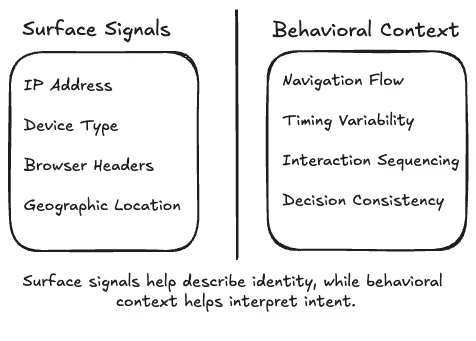
One promising approach is focusing on behavioral context. Instead of centering analysis on identity, systems examine how interactions unfold over time.

Advertisement

Human behavior is inconsistent and inefficient. People hesitate, backtrack, and explore unpredictably. Automated agents, even when adaptive, tend to exhibit a more structured internal logic. By observing navigation flow, timing variability, and interaction sequencing, teams can infer intent probabilistically rather than categorically.

This allows organizations to remain open while gaining a more nuanced understanding of activity.

Image 1

Ethics, privacy, and responsible interpretation

As analysis becomes more sophisticated, ethical boundaries become more important. Understanding interaction patterns is not the same as tracking individuals.

The most resilient approaches rely on aggregated, anonymized signals and transparent practices. The goal is to protect platform integrity while respecting user expectations. Trust remains a foundational requirement, not an afterthought.

The future: A spectrum of agency

Looking ahead, web interactions increasingly fall along a spectrum. On one end humans are browsing directly, in the middle users are assisted by AI tools, on the other end agents are acting independently on a user’s behalf.

Advertisement

This evolution reflects a maturing digital ecosystem. It also demands a shift in how success is measured. Simple counts of clicks or visits are no longer sufficient. Value must be assessed in context.

Image 2

What business leaders should focus on now

AI-generated traffic is not a problem to eliminate — it’s a reality to understand.

Leaders who adapt successfully will:

  • Reevaluate how engagement metrics are interpreted

  • Separate activity from intent in analytics reviews

  • Invest in contextual and probabilistic measurement approaches

  • Preserve data quality as AI participation grows

  • Treat trust and privacy as design principles

The web has evolved before, and it will evolve again. The question is whether organizations are prepared to evolve how they read the signals it produces.

Shashwat Jain is a senior software engineer at Amazon.

Advertisement

Welcome to the VentureBeat community!

Our guest posting program is where technical experts share insights and provide neutral, non-vested deep dives on AI, data infrastructure, cybersecurity and other cutting-edge technologies shaping the future of enterprise.

Read more from our guest post program — and check out our guidelines if you’re interested in contributing an article of your own!

Source link

Advertisement
Continue Reading

Tech

Why AI must shrink to reach its enterprise potential

Published

on

From copilots and chatbots to advanced analytics and automation, AI systems are now embedded in how organizations operate and compete. Yet as adoption accelerates, a less visible issue is coming sharply into focus: energy.

Enrique Lizaso

Co-founder and CEO at Multiverse Computing.

Advertisement

Source link

Continue Reading

Tech

LEGO Machine Plays Tic-Tac-Toe Without Electronics

Published

on

Tic-Tac-Toe is a relatively simple game, and one of the few which has effectively been solved for perfect play. The nature of the game made it possible for [Joost van Velzen] to create a LEGO machine that can play the game properly in an entirely mechanical fashion.

The build features no electronics to speak of. Instead, it uses 52 mechanical logic gates and 204 bits of mechanical memory to understand and process the game state and respond with appropriate moves in turn. There are some limitations to the build, however—the game state always begins with the machine taking the center square. Furthermore, the initial move must always be played on one of two squares—given the nature of the game though, this doesn’t really make a difference.

It’s also worth heading over to the Flickr page for the project just to appreciate the aesthetics of the build. It’s styled in the fashion of an 18th-century automaton or similar. It’s also been shared on LEGO Ideas where it’s raised quite a profile.

Advertisement

If you’ve ever wanted to think about computing in a mechanical sense, this build is a great example of how it can be done. We often see some fun LEGO machines around these parts, from massive parts sorters to somewhat-functional typewriters.

Advertisement

Source link

Continue Reading

Tech

Liquid Glass is divisive now, but Apple knows where it's going

Published

on

Six months after public release, Liquid Glass remains as controversial as ever. Apple may be considering some mitigations in iOS 27 and so forth, but this is the future — especially if we get touchscreen Macs.

Close-up of a glossy smartphone screen displaying rounded, glass-like app icons for search, messages, music, and other apps on a blue gradient background with reflections.
Maybe Liquid Glass is controversial on Macs and iPhones, but you’d still buy one of these Apple Park models if you could — image credit: Apple

It’s not at all true that everyone hates Apple’s Liquid Glass redesign. What is true is that right now, it’s in flux and being changed.
There was never any question that it would stay. It was always going to evolve, just as Apple’s iOS 7 so famously and controversially did over many years.
Continue Reading on AppleInsider | Discuss on our Forums

Source link

Continue Reading

Tech

Digg relaunch fails in two months as AI agents and spambots overrun the site

Published

on


The new Digg experiment is ending in a resounding fiasco. The beta version of the rebuilt social sharing portal has already been shut down – a “difficult” decision that forced the company to significantly downsize its development team. Building new internet projects in 2026 is a completely different experience, Digg…
Read Entire Article
Source link

Continue Reading

Tech

The 2026 Audi Q3 Is Better Than It Needs To Be

Published

on


Exclusivity is a part of luxury, but luxury automakers have found that a more egalitarian approach is good for the bottom line. The Audi Q3 is one of numerous pint-sized crossover SUVs (as well as a few sedans and coupes) from luxury brands that appeal to budget-conscious new car shoppers and thus represent a major opportunity for cynicism. A customer who won’t look past the brand name can end up with an underwhelming car built down to a price. What’s a reputation when image-conscious shoppers don’t know (or care about) the difference?

The redesigned 2026 Audi Q3 naturally incorporates elements from other new or recently-updated Audi models like the Q5 and Q6 e-tron crossovers. But Audi is also dispensing with the bovine excrement and offering a single well-equipped version (with a few options) that’s more expensive than before, but also offers more of everything and ensures customers will get more than just a prestige badge.

Advertisement

It looks more like an SUV than before

This third-generation Q3 retains the Volkswagen Group MQB architecture used by the outgoing model, as well as the Audi A3 sedan and most of VW’s U.S. lineup, but clothes it in something different. Audi put it on a whey and protein diet, creating more visual bulk in order to make the Q3 look less like a lifted hatchback and more like a traditional SUV. It also looks like a mini version of the Audi Q5, which fits perfectly with its aspirational mission.

That doesn’t mean the new Q3 is nice to look at. The tall front end and body sides left a lot of space that needed to be filled with fussy styling details. The headlights and LED daytime running lights (with three programmable styles) are stacked atop pillar-like air intakes that are mostly blanked off (there’s a small secondary radiator intake below the passenger-side headlight, and slats for to direct air around the outside of the wheel wells to reduce drag).

Things are better in profile view, where sheetmetal character lines nicely break up the body-side surfaces and a longer hood makes the front end look less stubby than before. A strip of textured plastic clutters the back end, but is necessary to camouflage the girth of the rear bumper. Optional OLED taillights have programmable styles like the DRLs, but that required a split arrangement similar to that of the 2026 Audi A6 to meet federal regulations.

Advertisement

Form meets function

The interior is perfectly calibrated for the price point. Standard wood dashboard trim provides a nice bit of contrast, while the dash itself has a distinctive concave shape. The overall aesthetic is clean but a bit sterile, like a new apartment in a freshly gentrified neighborhood, the kind of place many Q3 owners will likely call home. Even the plastics are presentable, although there’s an unfortunate moat of piano black around the cupholders, where it’s likely to get stained by coffee drips.

Designers also made sure aesthetics didn’t get in the way of functionality. The door handles are placed high and are easy to grab, a simple detail many other automakers nonetheless miss. The doors also have seemingly endless space for water bottles, and the wireless phone charger on the center console is now standard equipment. To free up more space, Audi also replaced the shifter and the wiper/turn signal stalks with small tabs on either side of the steering wheel. They don’t take much getting used to, although it is easy to accidentally brush the touchpads on the wheel spokes when using them.

Advertisement

The new Q3 isn’t much bigger than the old version: Audi increased cargo space by 5.3 cubic feet with rear seats up and 2.0 cubic feet with the rear seats folded, to 29.0 and 50.0 cubic feet, respectively. That gives the Audi more cargo space than rivals with the rear seats in place. Headroom and legroom aren’t as remarkable, but are respectable.

Advertisement

Important tech updates

As the least-expensive Audi SUV, one might expect the Q3 to have a watered-down version of the tech seen in its pricier siblings. But in some respects, the Q3 is a step ahead.

The standard touchscreen grows from 10.25 inches to 12.8 inches, while the digital instrument cluster grows from 8.8 inches to 11.9 inches. They’re arranged in the same Digital Stage style as other recent Audi models, meaning in an oversized housing that curves around the driver’s seat. The instrument cluster in particular is much smaller than the bezel around it. That looks chintzy, a word that also describes the sound of the optional 12-speaker Sonos audio system.

However, the Q3 launches with an updated interface that isn’t available on other Audi models yet. This returns the map view to the gauge cluster, and populates both the cluster and touchscreen with large gray icons that are easier to read than the previous version. The underlying Android-based software still provides snappy responses, while incorporating wireless Apple CarPlay and Android Auto.

The voice recognition system is augmented with ChatGPT, allowing the car to answer trivia questions, although when we asked it to tell us a joke it demurred (perhaps because this is a German car). It was also able to make recommendations, although we were unable to confirm the quality of the Mexican food at the place the system suggested due to time constraints. More mundane tasks, such as adjusting temperature and adjusting seat heaters, were easily handled.

Advertisement

It’s quicker and more powerful than before

Like the vehicle architecture, the engine carries over and will be familiar to fans of Audi and its parent Volkswagen brand. It’s the EA888 (here in Evo 4 spec) 2.0-liter turbocharged inline-four. Versions of this engine are used in everything from the VW GTI hot hatchback to the Atlas midsize SUV. In the 2026 Q3, it gets a substantial power bump of 27 horsepower and 22 pound-feet of torque, bringing the totals up to 255 hp and 273 lb-ft.

That extra power means, according to Audi, the Q3 will now do zero to 60 mph in 5.5 seconds instead of 7.1 seconds. That’s quicker than a BMW X1 xDrive28i or Mercedes-Benz GLA 250 4Matic—the base all-wheel drive versions of the Audi’s German rivals—where the opposite was the case previously. And it leaves other subcompact crossovers behind as well. BMW and Mercedes offer quicker versions, though, whereas the Q3 is only available in a single spec for now. Audi engineered RS Q3 performance versions of the previous two generations, but not for the U.S.

Naturally for Audi, all-wheel drive is standard. That’s far for a given in the segment, despite the premium brands playing in it. However, this redesign swaps the eight-speed automatic transmission for a seven-speed dual-clutch unit, like that used in the Q5 and A5. And as in those models, it’s not very well calibrated. There’s significant hesitation at throttle tip-in, and a bit of clunkiness after that.

Advertisement

But more power doesn’t equal more fun

The transmission wasn’t the only thing that needed a bit more fine-tuning. Audi fitted the latest Q3 with its “progressive” steering rack, which is supposed to quicken up responses as the wheel is turned more. But that effect wasn’t apparent when maneuvering on urban streets. Combined with the slow-reacting transmission, it made this subcompact crossover feel clumsy in an area where it should excel. Outward visibility is at least better than in bigger traditional SUVs, at least.

Unshackled from stop-and-go traffic, the Q3 felt more composed, and indeed refined enough to justify its prestige badge. It may share components with humble Volkswagen models, but the comfortable ride (even on optional 20-inch wheels) shows just how well-engineered those components are. Audi also added acoustic laminated glass to the front-door windows for 2026, lowering the amount of wind noise significantly. The crashing of the 20-inch wheels against surface imperfections was still apparent, but that could be cured with smaller wheels.

Advertisement

What’s missing is excitement. Audi dialed up the power, but it didn’t do the same with anything else. The Q3 goes around corners without embarrassing itself, and it has autobahn-worthy solidity at highway speeds. But this isn’t a car that encourages you to take the long way home. Most shoppers probably aren’t looking for that from their entry-level crossover, even if Audi laid the foundation for something sportier with the Q3’s added power.

Advertisement

2026 Audi Q3 verdict

Audi’s decision to offer the 2026 Q3 in one well-equipped spec means it’s more expensive than before, but it’s still a good value. The base price of $44,995 is $3,900 higher than the outgoing model, but Audi claims that $3,699 worth of previously-optional equipment is now standard. Factor in the added power, cargo space, and screen size, and the price increase is (for once) justified.

Several option packages are available, which can boost the price to $51,790 for a fully-loaded model. That’s not an enormous step up from the starting price, showing that Audi really did cover the bases with standard equipment. Many of the added features are design-related or, like the lackluster Sonos audio system, don’t dramatically change the experience. The Q3 is also still priced close to all-wheel drive versions of its BMW X1 and Mercedes GLA-Class rivals, as well as the Volvo XC40. The Acura ADX and Lexus UX are cheaper, but also less appealing.

The Q3 won’t make these rivals obsolete, but it will deliver what customers attracted to its four-ring badge should expect. Its refined driving experience and long list of features provide solid reasons to choose a Q3 over something more mainstream, even if its handling and styling aren’t as stirring as they should be. It could be better but, by delivering a true budget-friendly dose of luxury, it’s probably already better than it needed to be.

Advertisement


Source link

Continue Reading

Tech

Microsoft pulls Samsung app blocking Windows C: drive from Store

Published

on

Windows 11

​Microsoft has removed the Samsung Galaxy Connect app from the Microsoft Store because it was causing issues on specific Samsung Galaxy Book 4 and desktop models running Windows 11.

This comes after the company said on Friday that it was investigating reports of app failures and users losing access to their C:\ drive on some Windows 11 systems.

“Users might encounter the error, ‘C:\ is not accessible – Access denied,’ which prevents access to files and blocks the launch of some applications including Outlook, Office apps, web browsers, system utilities and Quick Assist,” Microsoft explained.

The known issue impacts a wide range of Samsung Galaxy Book 4 and Samsung Desktop models running Windows 11, including NP750XGJ, NP750XGL, NP754XGJ, NP754XFG, NP754XGK, DM500SGA, DM500TDA, DM500TGA, and DM501SGA.

Advertisement

On affected devices, users have been experiencing problems launching apps, accessing files, or performing administrative tasks, and, in some cases, issues elevating privileges, uninstalling updates, or collecting logs due to permission failures.

​Following a joint investigation with Samsung, Microsoft has attributed these issues to the Samsung Galaxy Connect app (used for screen mirroring, file sharing, and data transfer between Galaxy devices and Windows PCs) and temporarily removed it from the Microsoft Store.

“The affected Samsung Galaxy Connect application was temporarily removed from the Microsoft Store to prevent further installations,” Microsoft said.

“Samsung has republished a stable previous version of the application to stop recurrence on additional devices. Recovery options for devices already impacted remain limited, and Samsung continues to evaluate remediation approaches with Microsoft’s support.”

Advertisement

Microsoft and Samsung have not yet provided a workaround and are still working on a fix for affected Windows 11 devices. Impacted users are advised to contact Samsung for device-specific assistance.

On Friday, Microsoft also released an out-of-band (OOB) update to fix a security issue in the Routing and Remote Access Service (RRAS) management tool affecting Windows 11 Enterprise devices that receive hotpatch updates instead of regular Patch Tuesday cumulative updates.

Malware is getting smarter. The Red Report 2026 reveals how new threats use math to detect sandboxes and hide in plain sight.

Download our analysis of 1.1 million malicious samples to uncover the top 10 techniques and see if your security stack is blinded.

Source link

Advertisement
Continue Reading

Tech

The accessibility gap: Why good intentions aren’t enough for digital compliance

Published

on

Presented by AudioEye


While most organizations recognize the importance of accessibility from a theoretical angle, a stark gap exists between that awareness and actual execution. Companies can’t just give a nod to accessibility — and it can’t just be a nice-to-have. The chasm between knowing and doing is not only exposing businesses to significant legal risk, it’s also costing them actual business and growth opportunities.

According to AudioEye’s newly released 2026 Accessibility Advantage Report, 59% of business leaders say their organization would face legal risk due to accessibility failure if audited today, and more than half have already encountered accessibility-related lawsuits or threats. That’s unsurprising, because today the average web page still contains 297 accessibility issues, based on an analysis of over 15,000 websites in AudioEye’s 2025 Digital Accessibility Index.

The report, which surveyed more than 400 business leaders across the C-suite, VPs, and directors, reveals that organizations understand accessibility matters, but most lack the systems, expertise, and operational infrastructure to deliver it consistently, says Chad Sollis, CMO at AudioEye.

Advertisement

“What the data makes clear is that accessibility hasn’t stalled because people don’t care,” Sollis says. “It’s stalled because fragmented ownership and reactive workflows make it hard to sustain as digital experiences evolve. Leaders know accessibility matters, but their organizations aren’t set up to deliver it consistently.”

Why digital accessibility delivers a measurable business advantage

With regulations like the European Accessibility Act now in effect and enforcement intensifying globally, the benefits extend far beyond avoiding lawsuits. Over half of leaders now cite accessibility as a business growth opportunity, recognizing that accessible digital experiences drive better user outcomes across the board.

“Organizations that treat accessibility purely as a compliance exercise miss the opportunity to improve performance, reach new audiences, and build stronger digital experiences for everyone,” Sollis says. “Accessibility is a growth lever hiding in plain sight.”

In fact, accessible design doesn’t just serve users with disabilities; it creates faster, more intuitive experiences for everyone. Organizations leading in accessibility are seeing it as a performance multiplier that:

Advertisement

• improves site discoverability through better structure and cleaner code

• reduces friction in the customer journey

• strengthens brand loyalty by demonstrating inclusion in action

“The leaders making the smartest decisions aren’t asking, ‘What’s the fastest fix?’” Sollis adds. “They’re asking, ‘What gives us durable protection while improving experience?’”

Advertisement

Where digital accessibility breaks down in execution

Despite widespread recognition of accessibility’s importance, implementation remains inconsistent. The report identifies what AudioEye calls “The Yet Problem,” or the gap between good intentions and actual execution.

While many business leaders say they actively champion accessibility, the same percentage cite low budgets and limited expertise as barriers. Developers, designers, and content creators want to build accessible experiences. But when accessibility isn’t integrated into their everyday tools and processes, it creates additional complexity — with extra steps, extra time, and extra cost added to already heavy workloads and tight deadlines.

The result is what the report calls “patchwork accessibility,” or programs that appear compliant on paper but fail users in practice. Many organizations treat accessibility as a project to complete rather than a practice to maintain, pursuing compliance milestones or quick fixes without building sustainable systems.

“Accessibility doesn’t fail because companies aren’t trying; it fails because it’s treated as a single-layer problem,” Sollis says. “Real accessibility spans code, content, design, and ongoing change.”

Advertisement

This pattern reveals a fundamental truth: accessibility is failing because the systems supporting it weren’t built for the people doing the work. Until accessibility is easier to design, build, and track alongside other priorities, it will continue to be deprioritized.

The limits of fully in-house digital accessibility programs

Even when leaders secure better tools and a larger budget, progress often stalls because of the misconception that accessibility must be tackled entirely in-house. AudioEye calls this “the in-house illusion,” or the assumption that internal responsibility automatically translates to organizational ability.

“There’s a growing gap between ownership and capability,” Sollis explains. “Managing accessibility within the company can create the illusion of control, but without the right expertise and support, progress often stalls.”

In fact, while nearly half of organizations manage accessibility with their own teams, 50% admit those teams lack internal accessibility expertise, and 43% cite competing priorities as major barriers. Only 47% describe their programs as proactive, while the rest operate reactively or meet only bare minimums.

Advertisement

The illusion persists because many organizations equate ownership with control, and control with efficiency. In reality, accessibility is a specialized, evolving discipline.

Without cross-functional expertise and external guidance, well-intentioned teams end up doing more work for less impact and more cost. True ownership doesn’t mean doing everything yourself, but knowing where to partner, automate, and delegate.

The organizations advancing fastest are rethinking ownership altogether, treating accessibility as a system to orchestrate rather than a silo to control.

Building a sustainable digital accessibility program

The report’s findings point toward a clear path forward: organizations must move accessibility from aspiration to operational habit. This requires giving teams what they need to implement, maintain, and measure accessibility efficiently.

Advertisement

Leading companies are building scalable systems that make accessibility part of everyday work. Plus, they’re elevating it from a compliance cost to a growth opportunity, in order to secure adequate budget and internal resources. And they’re quantifying the impact of the work, to demonstrate that accessibility improvements drive traffic, reduce abandonment, and expand total addressable market.

Most importantly, they’re recognizing that sustainability often requires partnership.

“The organizations making the most progress are the ones treating accessibility as an always-on system rather than a one-time project,” Sollis says. “That means using automation to handle scale, pairing it with expert review for complex, high-risk issues, and backing it all with protection that actually holds up when legal claims arise.”


Sponsored articles are content produced by a company that is either paying for the post or has a business relationship with VentureBeat, and they’re always clearly marked. For more information, contact sales@venturebeat.com.

Advertisement

Source link

Continue Reading

Tech

Shadow AI is everywhere. Here’s how to find and secure it.

Published

on

Popular AI products

AI tools are everywhere now and used by virtually everyone in your org. For IT and security teams, that means the job has shifted from “should we allow AI?” to “how do we secure and govern it?” And that’s no small task.

New AI tools and integrations are added constantly, usually without any knowledge or oversight from IT.

To manage this new hidden source of risk, you need a system that gives you continuous discovery, real-time monitoring, and proactive governance without requiring a full-time team dedicated to tracking down every new AI tool. That’s exactly what Nudge Security delivers.

Here’s how it works:

Advertisement

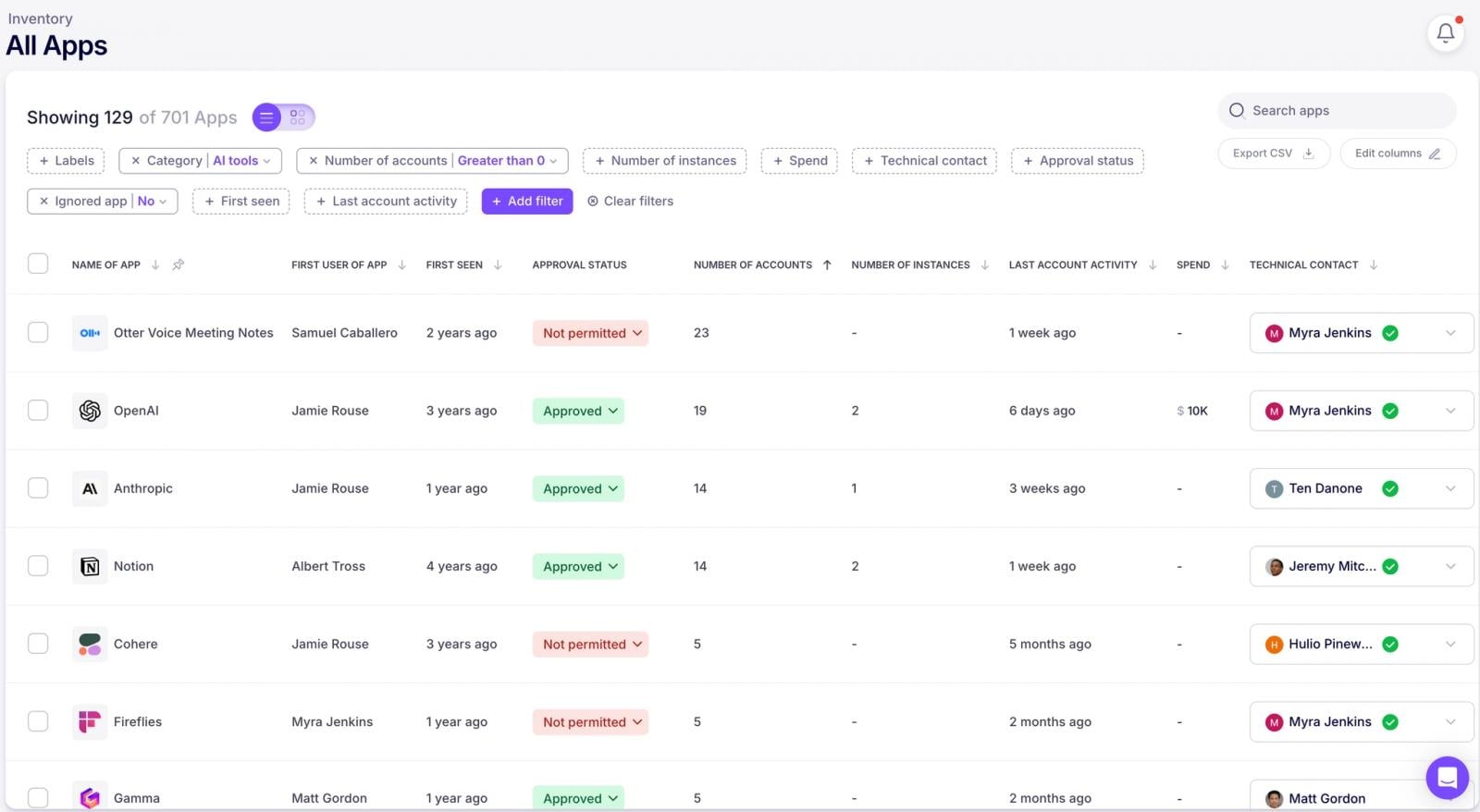
Day One: Get a full inventory of AI apps and users

First things first—you can’t secure what you can’t see. Nudge Security gives you Day One discovery of every AI app and account ever introduced to your org, even those added before you started using Nudge. No surveys, no guesswork, no relying on people to self-report (because let’s be honest, that never works).

You’ll get a complete picture of your AI landscape from the moment you start.

All apps

How it Works

Nudge Security’s shadow AI discovery works through a lightweight integration with your IdP (Microsoft 365 or Google Workspace). It takes less than 5 minutes to enable this integration ,and once that’s in place,

Nudge Security analyzes the machine-generated emails sent by SaaS and AI app providers (think noreply@dropbox.com) to document activities like creation of new accounts, password changes, changes to security settings, and more.

Advertisement

Nudge taps into this signal (without ever storing email content) to automatically detect new accounts and tool adoption across your workforce. This means you get comprehensive visibility into AI tool sprawl as it happens, and a Day One inventory of everything that has been introduced up to that point.

You can get expanded visibility by deploying the browser extension which delivers real-time insights and alerts when risky behaviors are detected.

Additionally, you can “nudge” users via the browser extension (and via Slack, Teams, and email) to warn users of risky behaviors, remind them of secure practices, redirect them to approved tools, ask for additional context on new or unfamiliar tools, and more.

Let’s dive into how this works in practice.

Advertisement

Shadow AI is quietly accessing sensitive data across your SaaS environment. AI use now spans MCP servers, agentic AI, and SaaS apps with AI features—it’s more than just chat prompts.

Learn how to close AI blind spots and get ahead of data exposure risks with this new guide.

Get Your Free AI Discovery Guide →

Monitor AI Conversations for Sensitive Data Sharing

AI tools are incredibly useful, but they’re also incredibly chatty. Employees paste all sorts of things into ChatGPT, Gemini, and the dozens of other AI assistants out there.

The Nudge Security browser extension monitors AI conversations and detects when sensitive data like PII, secrets, or financial info is shared.

Advertisement

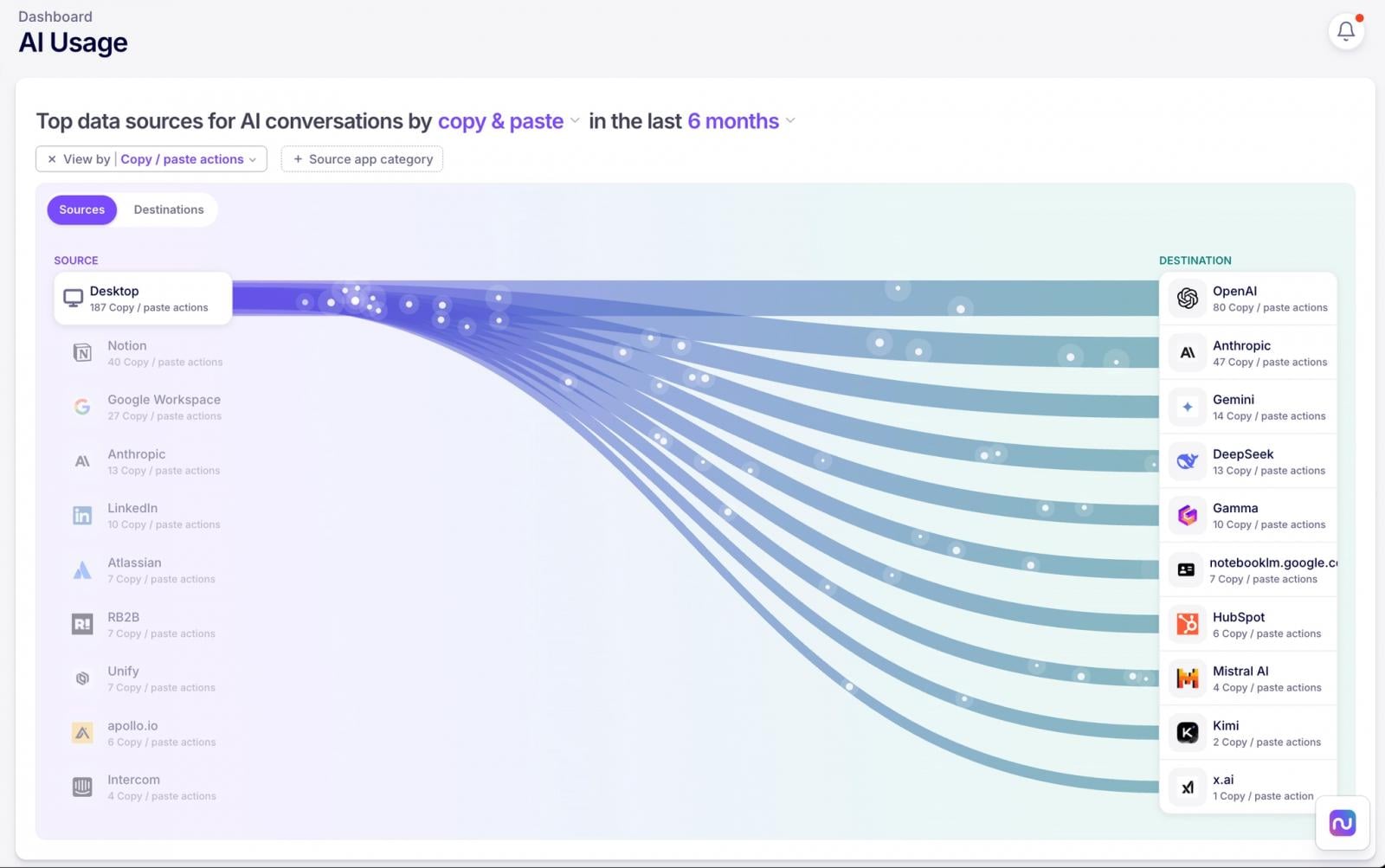
And it’s not just text. Nudge also detects file uploads to AI tools, including context on who, what, when, and how. You’ll also see a visual summary of data flows between your systems and AI tools to quickly understand where the biggest data risks are likely to be.

AI Usage

Track Usage of AI Tools

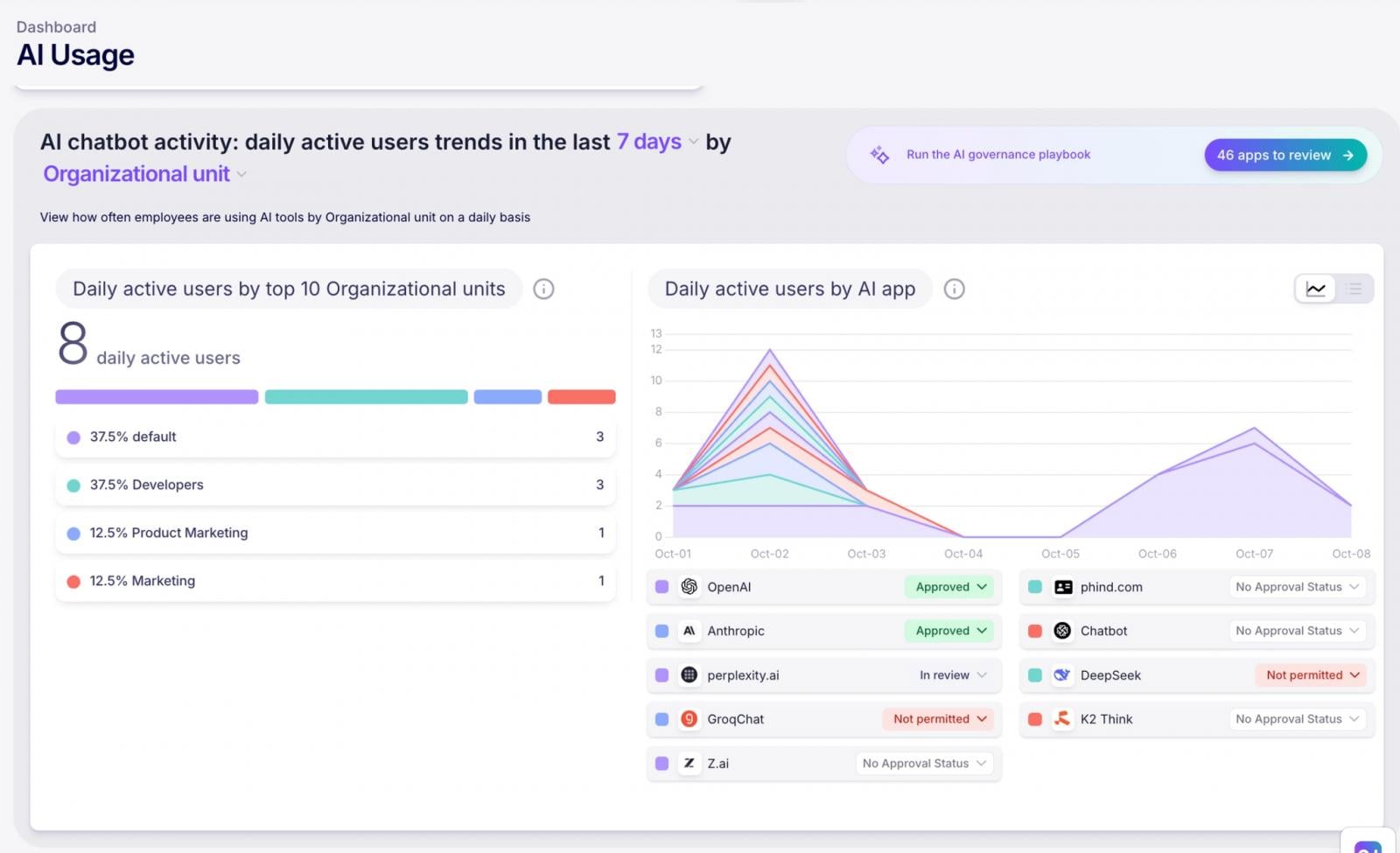
Want to know which departments are AI power users? Curious whether that unapproved tool is popping up again? Nudge tracks AI use by approved/unapproved app status, specific apps, and department.

You’ll finally have data showing what AI use actually looks like in practice so you can focus your security efforts on the most-used tools and guide users towards the approved toolset.

AI Chatbot activity

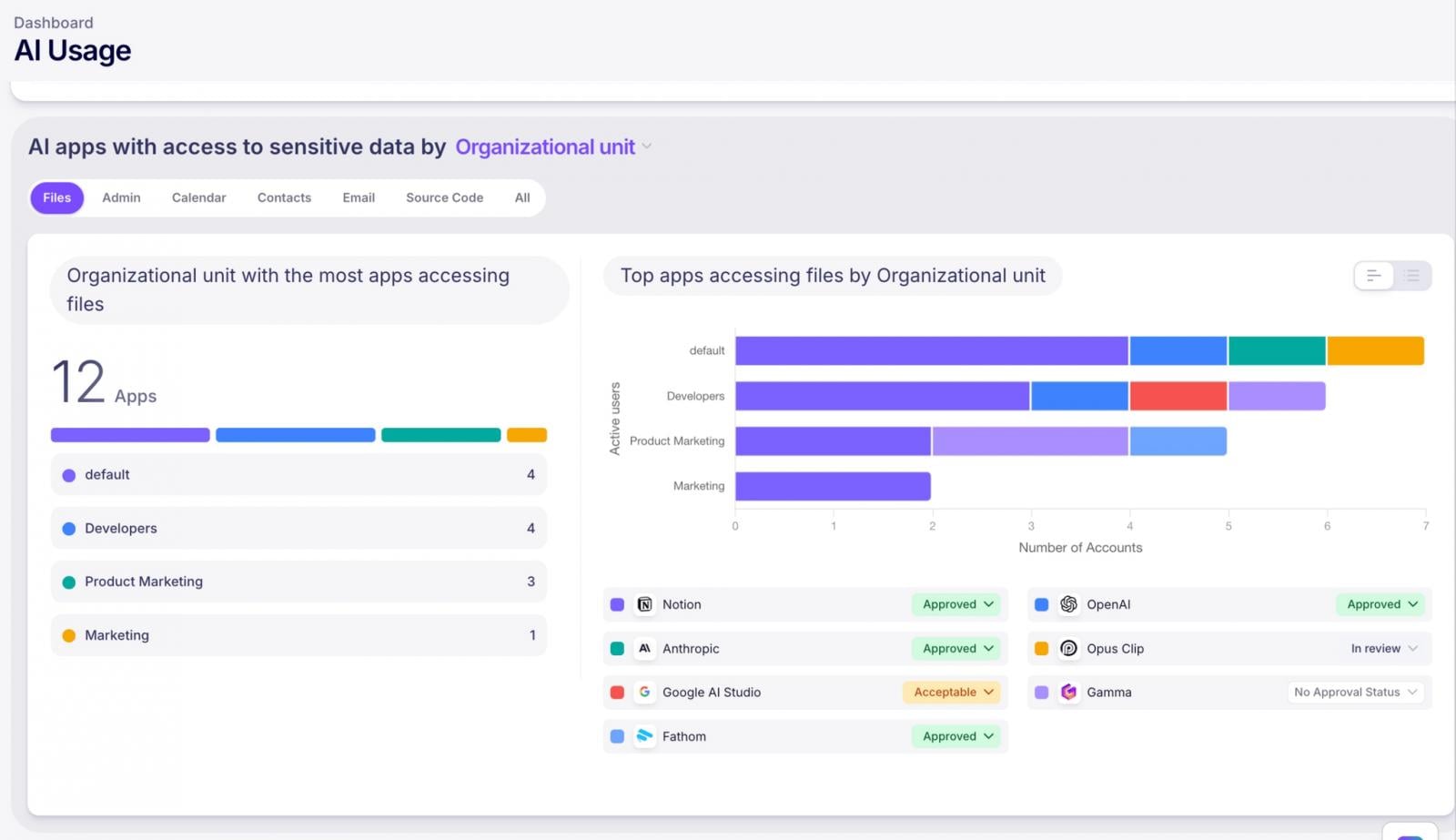
See Which AI Apps Have Access to Sensitive Data

AI tools love to integrate with your SaaS apps. MCP server connections, AI agents, Google Workspace add-ons, Microsoft Copilot plugins—they’re all requesting access to data.

Advertisement

Nudge maintains an inventory of SaaS-to-AI integrations and scopes, including MCP server connections, so you can see exactly where AI tools have been granted access to data and evaluate the risk.

AI apps with sensitive data

Get Alerted of Risky Activities

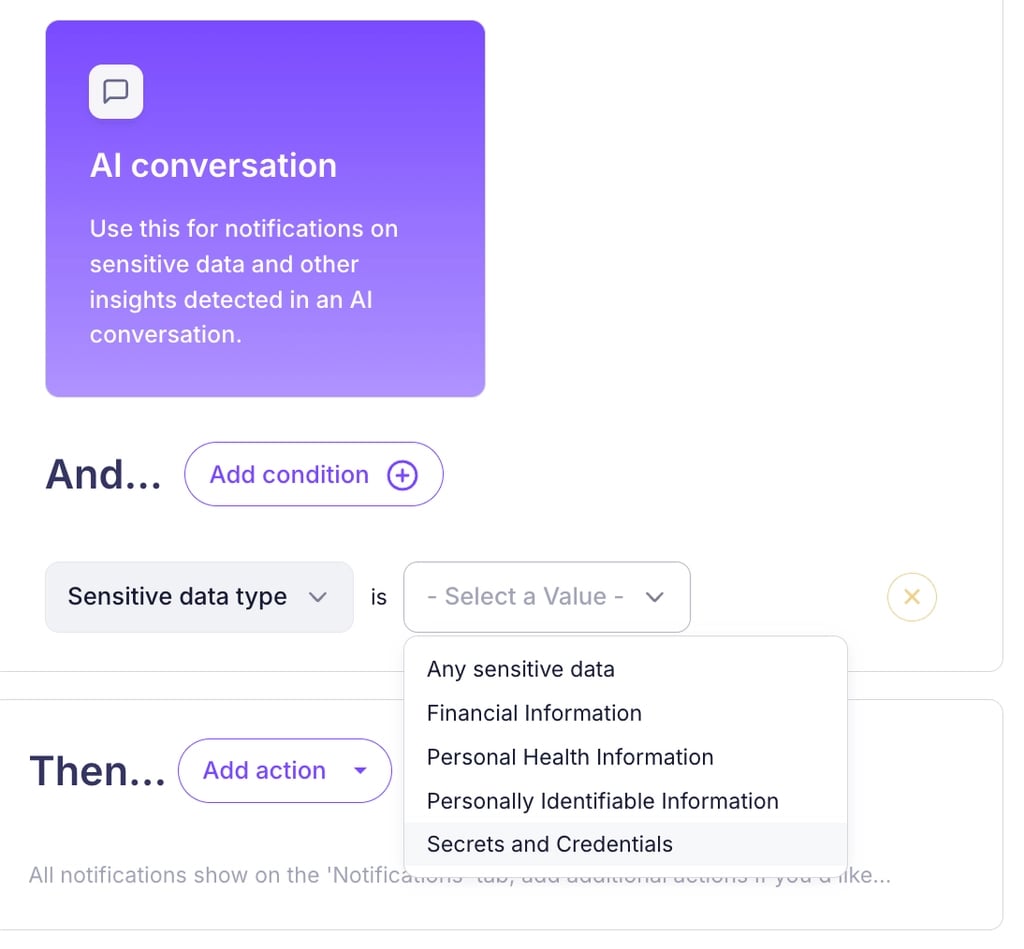
You can’t watch everything all the time. That’s why Nudge offers configurable alerts that notify you when new AI tools show up or when policy violations occur—like sensitive data sharing or use of unapproved tools. Think of it as your early warning system.

AI Conversation

Enforce Your AI Policy

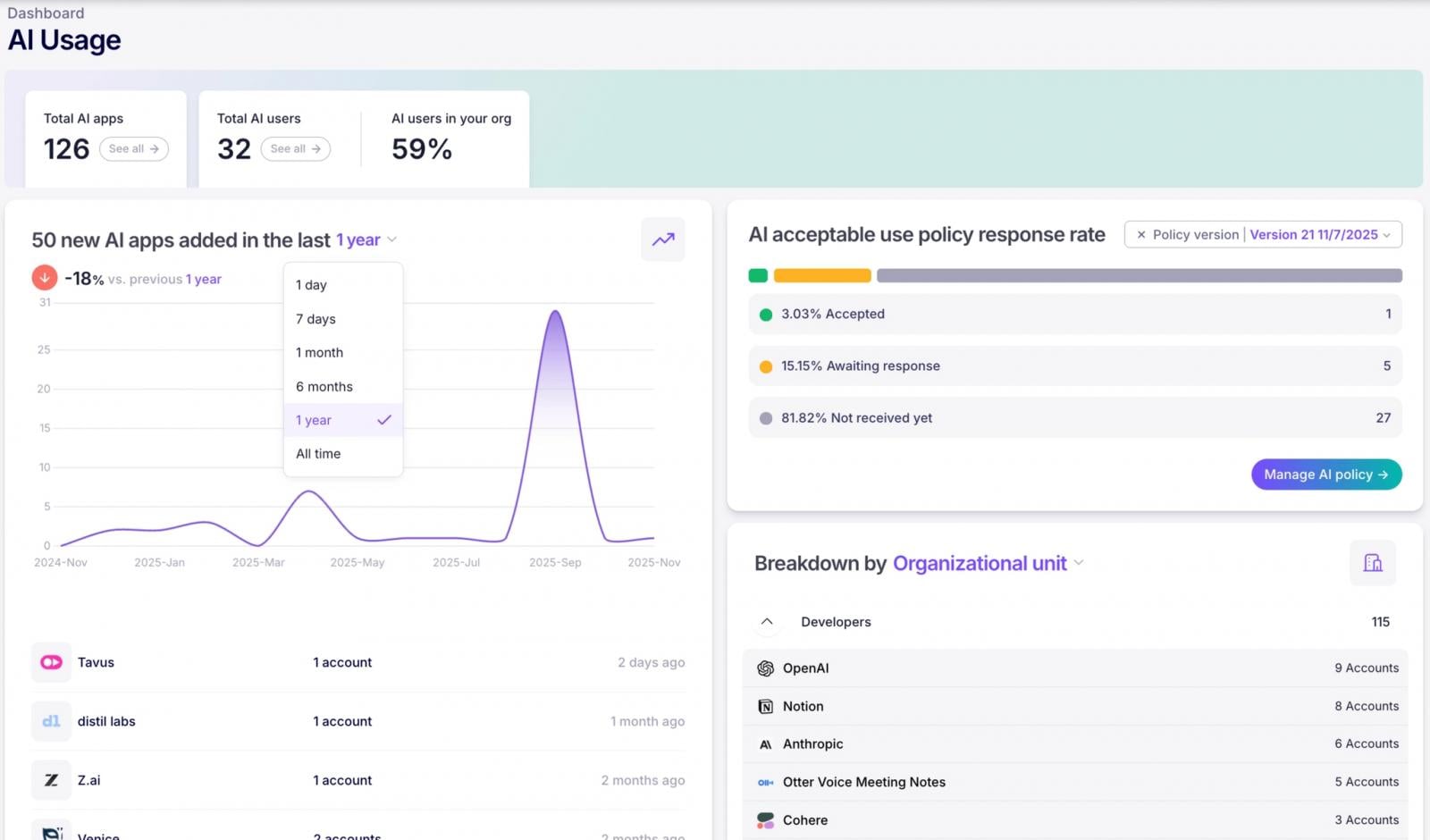
You have an AI acceptable use policy, right? (If not, let’s talk.) Nudge automates the process of sharing your policy with employees as well as collecting and tracking acknowledgements.

AI Dashboard

But acknowledgment is just the beginning. Nudge delivers guardrails when and where employees are working in the form of friendly nudges (hence the name) that reinforce your policy and guide them toward safer AI use in real time.

Advertisement

It’s proactive governance that doesn’t require you to be the bad guy.

The Bottom Line

Your job isn’t to stop progress—it’s to make sure progress doesn’t come with a side of data breach. Nudge Security gives you the visibility, control, and automation you need to govern AI use effectively, so you can sleep a little better at night.

Interested in seeing it for yourself? Start a free 14-day trial of Nudge Security today.

Sponsored and written by Nudge Security.

Advertisement

Source link

Continue Reading

Tech

Nanophotonics and AI for Molecular Sequencing and Single-Cell Phenotyping

Published

on

11 am PDT / 2 pm EDT / 7 pm CET

The biosphere transmits data 9 orders of magnitude faster than the technosphere. A new class of nanophotonic tools is beginning to close that gap.

In this webinar, Prof. Dionne will present VINPix: Si-photonic resonators with high-Q factors (thousands to millions), subwavelength mode volumes, and densities exceeding 10M/cm². Combined with acoustic bioprinting and AI, they may enable detection of multiomic signatures — genes, proteins, and metabolites on a single chip — at previously unattainable rates, opening new possibilities for molecular communication systems and biochemical sensing for health and sustainability.


Advertisement

Key Takeaway: 

  • Single-chip multiomics — VINPix arrays plus AI for simultaneous gene, protein, and metabolite detection
  • Field-deployed biosensing — integrated with Monterey Bay Aquarium Research Institute (MBARI) autonomous underwater robots for ocean biochemical monitoring
  • Peptide & glyco-conjugate sequencing — major histocompatibility complex (MHC)-tethered peptides, dynamic Raman spectroscopy, and computational metadynamics to identify previously unseen molecular species
  • Tumor microenvironment profiling — subcellular prediction of drug resistance, macrophage polarization, and T-cell activation states

Who Should Attend:

  • R&D engineers, data scientists, and researchers in biotech & pharma, medical diagnostics, environmental & marine science, and the semiconductor and photonics industries.

    Can’t attend live? Register for the recording.

Note that COMSOL will follow up with all registrants about this event and any related questions.

*Please see www.comsol.com/privacy for COMSOL’s Privacy Policy. Contact COMSOL at www.comsol.com/contact for more information.

Source link

Advertisement
Continue Reading

Trending

Copyright © 2025