Tech
Four Tons of SpaceX Falcon 9 Rocket Debris Carve a Fresh Crater Near Einstein on the Moon

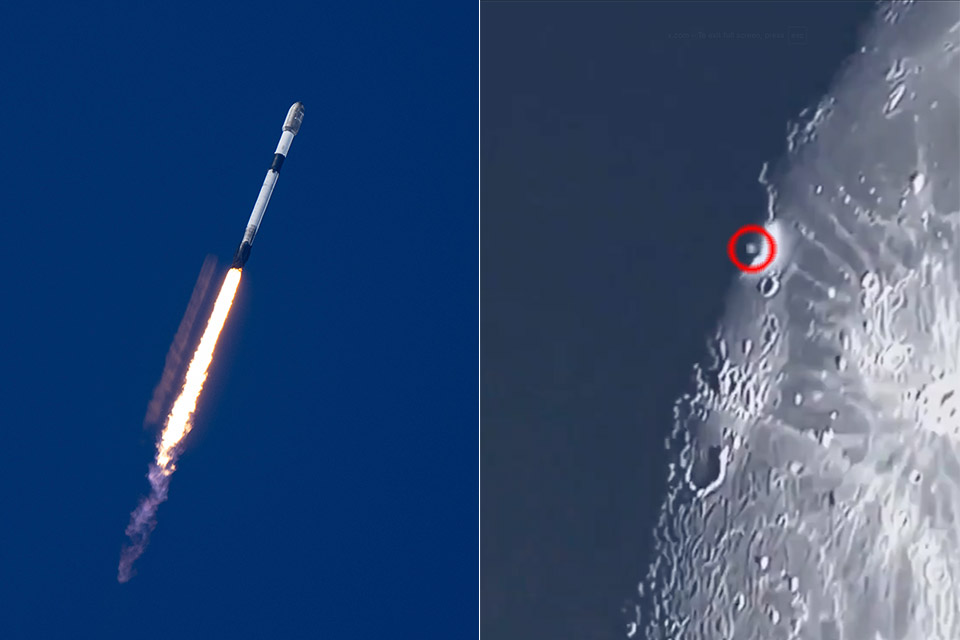
After drifting aimlessly for more than a year and a half, a discarded SpaceX Falcon 9 upper stage finally ran out of empty space on Wednesday. The four-ton cylinder, roughly the size of a school bus and more than 40 feet long, slammed into the Moon at 5,400 miles per hour near Einstein Crater on the sunlit western limb.

SpaceX launched a rocket from pad 39A at the Kennedy Space Center on January 15, 2025. The aim was to launch two private lunar landers, Firefly Aerospace’s Blue Ghost and ispace’s Resilience, on a path to the Moon. Blue Ghost landed safely on the Moon’s surface, and then there was Resilience. Unfortunately, Resilience didn’t fare so well. Once the top stage had completed its burn and jettisoned the landers, it had no further instructions and insufficient fuel for any course correction. It was just lying there, floating, until the combined force of the sun’s gravity, the Earth’s gravity, and solar activity gradually began to alter its route, and the Moon became the inevitable destination.


LEGO Icons NASA Artemis Space Launch System – DIY Rocket Model Building Set for Adults, Ages 18+ – Gifts…
- NASA rocket model kit – Launch into a creative project with the LEGO Icons NASA Artemis Space Launch System model building project for adult space…
- What’s in the box? – This creative building set includes everything you need to craft a multistage rocket with 2 solid-fuel boosters, an Orion…
- Features and Functions – This NASA-themed rocket model features retractable launch tower umbilicals, rocket support and crew bridge, detachable…
Bill Gray, a skilled amateur astronomer who first raised the alarm a few months ago with available orbital data, calculated the impact window. When the time arrived for astronomers all across the world to focus their telescopes at the anticipated impact zone, they were unable to see anything. That was due to the fact that the impact zone was on the edge of the moon’s near side during daylight hours, which was not optimal for terrestrial observers. Marco Langbroek, a Dutch astronomer, trained in the area but discovered nothing, believing it was a long shot even before. Still, he believes the stage made it.

Confirmation came from a Boston University team led by Carl Schmidt, who discovered traces of a large plume of sodium and lithium streaming from the crash site.You could see this plume stretching for miles. Unfortunately for ground-based telescopes, it was shortly after daylight, so you wouldn’t get a good look. The European Southern Observatory’s Very Large Telescope in Chile was able to capture some images of the debris cloud, which lingered for at least 5 to 10 minutes, after which it was still unclear whether the impact had occurred, but Schmidt is certain that what his team saw was the impact. Both NASA’s Lunar Reconnaissance Orbiter and the South Korean Danuri spacecraft will hopefully be able to take before and after photos of the new crater when they pass over, as it is predicted to be 60 feet broad and 12 feet deep.
The blast produced when the rocket stage collided with the Moon was very small in comparison to the larger lunar impacts that occur on occasion, weighing approximately three tons of TNT, but nonetheless noteworthy. It hurled lunar dust and debris in all directions. Though astronomers point out that impacts of nearly the same energy occur on the Moon on a regular basis, the fact that these objects are man-made raises questions. Not to mention how frequently they occur these days. A similar incident occurred in March 2022, when a Chinese rocket stage formed a double crater on the moon’s far side under similar conditions.
[Source]
You must be logged in to post a comment Login