





TL;DR
Nadella promoted Jacob Andreou to EVP of Copilot after one year. He oversees 11,000 people and is building a super app while only 4.5% of 365 users pay.
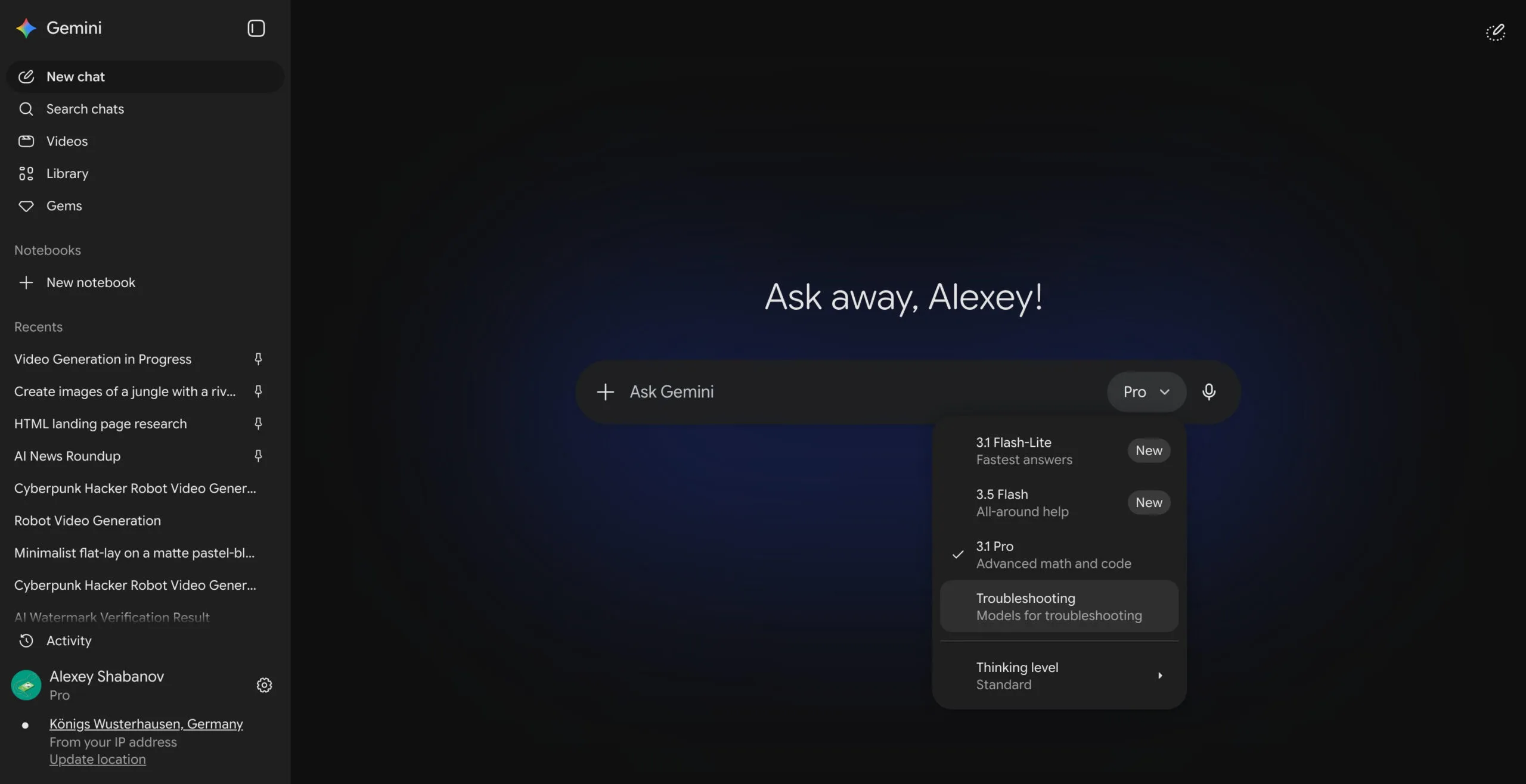
Google may have just accidentally shown everyone where Gemini is headed next. According to TestingCatalog, a new Troubleshooting mode has quietly appeared inside the Gemini model picker menu for some users.
It sits alongside existing options like Gemini 3.5 Flash and 3.1 Pro, which are the standard AI models you already switch between in the app.
Rather than giving you a wall of text to read, the Troubleshooting mode guides you through a problem step by step using a mix of text responses and interactive widgets.

For example, if you tell Gemini your car will not start, it might identify common causes like a dead battery and then present you with symptom options to tap, such as “clicks or silent,” to help narrow down the issue faster. It is a more structured, guided experience than asking Gemini a question in regular chat mode.
That is a fair question, and the answer comes down to how the mode is tuned under the hood. Redditors who got early access suggest it runs on a lower temperature setting, which means it sticks closely to the problem at hand and skips the conversational filler.

Its responses are reportedly focused on diagnosis and practical fixes rather than general information. Google has not officially announced the feature, and it remains unclear whether this is a planned rollout or an internal test.
For now, the Troubleshoot feature appears to be an unintended release, meaning Google likely flipped it on by mistake, and could pull it back at any time. More details are expected in the coming weeks.
If you find Gemini’s new Troubleshooting mode exciting, there is a lot more happening with the assistant right now. Google just unveiled Gemini Spark, a 24/7 AI agent that handles your tasks in the background. On the flip side, free users may soon face stricter weekly usage caps.
Tesla has settled a lawsuit connected to a fatal 2023 crash involving a vehicle using the company’s advanced driver assistance system known as Full Self-Driving.
Bloomberg was first to report on the settlement. Terms were not disclosed.
The lawsuit was filed against Tesla and the driver by the daughter of Johna Story, a 71-year-old woman who was struck by a Tesla Model Y. Story was hit after she stepped out of her own vehicle to direct traffic around a crash that had occurred earlier due to sun glare.
The National Highway Traffic Safety Administration (NHTSA) opened an investigation into Tesla’s FSD (Supervised) automated driving software in 2024 after four reported crashes in low visibility conditions — including the one involving Story. The NHTSA said, at the time, it was investigating the driver assistance system to find out whether it could “detect and respond appropriately to reduced roadway visibility conditions,” such as “sun glare, fog, or airborne dust.”
That investigation was upgraded in March 2026 to an engineering analysis. In that report, the agency wrote “Available incident data raise concerns that Tesla’s degradation detection system, both as originally deployed and later updated, fails to detect and/or warn the driver appropriately under degraded visibility conditions such as glare and airborne obscurants.”
While the settlement ends the family’s lawsuit, this upgraded NHTSA investigation has not yet been closed. At stake for Tesla for the federal investigation is a host of possible outcomes, including a recall.
The federal agency also opened an investigation into FSD in October 2025 after receiving reports the software caused the vehicles to run red lights or cross into the wrong lane.
Flip over the box of any product, and you’ll usually see that it’s adorned with a number of official-looking logos at the bottom. Most of us don’t give these markings a second thought, but they all signify an important step –- or steps -– required in order to bring that product to specific markets or to meet certain standards related to safety or testing. You’ve almost certainly come across an ETL Listed marking from Intertek, or maybe a UL Listed or UL Certified marking on a package.
Depending on where you live, you may also have seen an EAC marking on a product’s packaging. The Eurasian Conformity (EAC) mark shows that a product has met compliance requirements as established by the Customs Union of the Eurasian Economic Union (EAEU). A product with an EAC certificate means that it can be bought and sold across all member states of the EAEU, which includes Armenia, Belarus, Kazakhstan, Kyrgyzstan, and Russia. It’s not uncommon to find un-branded, cheap electronics on marketplaces like Amazon that try to skirt these certifications, and those are products you should avoid buying.
Similar to how the CE marking on electronics and other products works, any product bearing the EAC mark means that it complies with the various technical regulations governed by the Eurasian Customs Union. Many of the technical regulations set forth by the EAEU are based on previous existing standards from its member states, such as Russia’s GOST-R or Kazakh’s GOST-K. The basis of these regulations are to establish safety standards and requirements for the consumer and the environment, and the EAEU has 52 technical regulations it has adopted spanning multiple product categories.
Three methods exist for obtaining an EAC mark, and it usually depends on the products and where they are coming from -– for example, whether they’re originating from a EAEU member state or being imported by a foreign manufacturer. These methods include EAC Certificate of Conformity, EAC Declaration of Conformity, or a Certificate of State Registration. The biggest difference between an EAC Certificate and an EAC Declaration is required testing. The EAC Declaration of Conformity allows a manufacturer to provide its own testing and documentation to verify compliance, where an EAC Certificate always requires independent testing through an approved laboratory, and the certificate has to be issued by a certification body.
A Certificate of State Registration provides proof that certain products in the EAEU meet sanitary guidelines. These include food and beverages, hygiene products, or equipment that comes in contact with food and water. In cases where a product doesn’t fall under established EAEU guidelines for EAC certification, it is still required to meet conformity standards according to its governing member state, and frameworks such as Russia’s GOST-R are still important for addressing those products.
Another marking stamped on products is the CE marking, and it is used to largely achieve the same thing as the EAC mark –- to ensure products being sold meet minimum safety and health requirements serving both the customer and the environment. The primary difference is in which markets the marks are intended to serve: The EAC mark serves countries within the EAEU, and the CE mark serves those within the European Union (EU) and the European Economic Area (EEA). While there are similarities in some of the regulations for each mark, there is no mutual recognition between them and they are separate systems. However, certain products may require both marks if they are being sold across different markets.
Another key difference is foreign manufacturers can self-apply for CE conformity, rather than having to go through an independent representative in the case of EAC certification. It’s also important to recognize that there is no entity or body that validates product compliance or that issues a certification. It is up to the manufacturer to ensure product compliance with any and all applicable CE rules, maintain proper documentation, and use the CE mark legally. In some cases, a company may need to address a notified body (an EU-authorized independent organization) for third-party conformity assessment.
Because the onus of conformity is mostly on the companies that sell the products, CE marks are also commonly abused or forged. The best way to spot a fake CE mark is to be aware of the design requirements in using one legally. The regulations and directives that form the underpinning of the CE and EAC marks often have a ripple effect on other markets, such as the case of Europe forcing Apple’s iPhone to switch to USB-C.
![]()
What is often framed as a race to develop smarter AI models is, in practice, a massive industrial expansion. Data centers require dense clusters of advanced chips, extensive cooling systems, fiber networks, and backup power. Columbia University economist Stijn Van Nieuwerburgh put it plainly, describing the effort to the Wall…
Read Entire Article
Source link
Dana, 46, and Calista, 43, are two women in Florida who turned to the subreddit as they reckoned with the possibility of being evicted due to prolonged unemployment.
Calista tells WIRED that she has applied to more than a thousand full-time positions since losing her remote job in February 2024 but can’t seem to land an interview. She says she’s three months behind on rent. “I’ve never been close to homelessness like this before. It’s a new experience,” she says. “It’s very helpful to see the stories from other people, see the things they’ve tried, just that solidarity.”
Dana, who has extensive work experience in software development, says she has been laid off four times since the start of the Covid-19 pandemic, most recently in November, in part due to the AI boom. A single mother, she has discussed the possibility of living in a tent with her son, who recently graduated from high school. “So many people are in similar situations,” Dana says of the stories she’s read online. “It’s honestly been the most helpful from a mental perspective. I don’t feel so alone.” This is contrary, she says, to the stigmatization of poverty that she feels in her own city.
Politicians and commentators who demonize the homeless population as mentally ill drug addicts—such as former reality TV star Spencer Pratt, who ran a failed mayoral campaign in Los Angeles that characterized them as “zombies” on “super meth”—are distorting the issues at play, says Margot Kushel, director of the Benioff Homelessness and Housing Initiative at UC San Francisco.
“What we’re seeing in the numbers of people experiencing homelessness isn’t that we suddenly have this increase in people with mental health or substance use problems,” she says. “What we have is that the rent is too damn high.”
The cruel ways unhoused people are depicted in the media add “to the already very heavy burden of homelessness,” Kushel continues, with groups like r/almosthomeless countering those narratives and making people feel seen.
Keith, 35, in South Carolina, says he attempted suicide in 2023 after a long battle with alcoholism. He recounts how he survived jumping off a bridge but broke his back. After he received a spinal fusion, he found it difficult to work or do much of anything physical because of his injury, and finally he wound up homeless. He took to sleeping in the woods outside a hospital where he says he regularly sought assistance. “I was just staying there, like trying to get into the mental health department or something like that,” Keith says. “They would just turn you away.”
Later, Keith says, he secured a spot at a local Salvation Army shelter, found a job at a gas station, and in January made the transition into a studio apartment, staying sober and “building something that resembled a normal life,” he says. Yet lately he has started to worry that he’s “watching years of progress disappear in slow motion.” A succession of restaurant jobs, including dishwashing and prep work, have proven impossible with his back problem, and he has avoided further medical treatment for fear of the cost. Now he expects to be evicted, and he’s dreading a return to an unhoused existence.
Nadella promoted Jacob Andreou to EVP of Copilot after one year. He oversees 11,000 people and is building a super app while only 4.5% of 365 users pay.
Jacob Andreou, the 33-year-old executive Satya Nadella promoted to run Copilot in March after just one year at Microsoft, now oversees more than 11,000 people. He has merged the consumer and enterprise Copilot teams, eliminated redundant product versions, and is building a super app that combines chat, coding, and a new agentic workflow called Autopilot, according to a Fortune profile published Friday.
“This is one of the most intensely competitive environments tech has seen in the last 20 years,” Andreou told Fortune. “Because the technology is moving so quickly, the reality is a six to twelve month roadmap doesn’t really exist in the way it used to.”
The profile paints Andreou as a technically hands-on leader who personally codes alongside developers. He built Copilot Tasks, an AI agent that can autonomously perform multi-step actions like ordering food, in roughly two months. That speed impressed Nadella, who dismantled Microsoft’s entire senior leadership structure this year in favour of startup-style engineering groups.
Andreou’s appointment freed Mustafa Suleyman, the DeepMind co-founder, to focus on proprietary AI models rather than day-to-day product management. The two work closely but run separate organisations. Suleyman told a group of roughly 80 developers in March that the future of software development means fewer people working harder by leveraging AI agents, according to Fortune.
The challenge is substantial. Only about 4.5% of 450 million Microsoft 365 customers pay for Copilot, and its free consumer version trails far behind ChatGPT. Microsoft’s stock is down double digits over the past year as investors question AI spending and the company’s reliance on OpenAI. Jefferies analyst Brent Thill said the general perception of Copilot is that “it stinks.”
Before Microsoft, Andreou spent eight years at Snap scaling the platform from 80 million to 360 million daily active users. He then joined Greylock as a venture partner backing consumer AI startups. At Microsoft, he has introduced consumption-based pricing alongside seat licences, scaled back the Copilot icons that irritated Windows users, and launched Copilot Cowork to compete with Anthropic’s Claude.
Not everyone is on board with the new culture. Current and former employees told Fortune that some teams now work 12-hour days, feel daily panic to keep up with Anthropic and other labs, and worry that shipping speed risks compliance problems. Critics say Andreou can be overconfident and still has to prove himself in enterprise software, where the burden is building durable revenue at scale.
Andreou’s three stated priorities are delivering a superior AI chat product, achieving leading model quality without being late to market, and providing a trusted way to integrate various models. The super app, expected by end of summer, will let users toggle between personal and enterprise accounts in one interface. Microsoft is also exploring hosting DeepSeek and other open-source models inside Copilot Cowork, while Nadella has warned against industry reliance on only a few AI providers.
A loudspeaker is a vital component of every device that plays sound, but while its operation is simple, it’s a surprisingly difficult device to build. [Rvanderouderaa] has made an Instructables post showing a speaker design that it’s claimed, had an impedance that varies by volume (Dutch language, Google Translate link).
In all moving-coil speakers, a coil of wire is held in a radial magnetic field. To this is attached a cone, and when a current is passed through the coil the whole thing moves to create the sound. The tricky part of making one comes in making the cone itself, and in particular the suspension system that holds it in place while allowing it to move backwards and forwards. It’s normal for these components to be moulded from thick paper.
This design uses a 3D printed frame and cone, with the 3D printing providing excellent rigidity. The suspension system is a circular corrugated sheet, and it’s made in this case using papier-maché made from wet toilet paper, and a 3D printed mould. We particularly like this technique.
This is an impressive build, simply for having made a recognizable and working speaker in the first place. There’s no demo video so we have no idea how it sounds, but for us the point is more in the construction than the reproduction.
If speakers interest you, we’ve taken an in-depth look at them in the past.
New EU proposals would give Europol a sovereign cloud and a shared data space to fight cross-border crime.
The European Commission has proposed extensive new measures to strengthen Europol and Eurojust, aiming to give the EU’s law enforcement and judicial agencies sharper tools against crime that it said is increasingly sophisticated, international and digital.
The package includes two regulations reinforcing the mandates of Europol and Eurojust, a revision of the European Investigation Order, and changes to the Data Protection Regulation for EU institutions and bodies. The reforms are designed to target criminal networks and hostile actors operating across borders, online and, increasingly, through AI.
Technology is at the heart of the proposed Europol overhaul. The agency will build a secure, scalable and sovereign cloud infrastructure alongside a new Police Shared Data Space, allowing investigators in different member states to work jointly on the same cases in real time. Automated information sharing is intended to replace slower manual exchange between national authorities.
Europol will also set up a technology and innovation hub, giving the EU its first bloc-wide view of law enforcement capability gaps, and helping member states pool investment in joint research and development. Any tools that come out of the hub will be distributed to national authorities through the same shared data space.
On the ground, Europol Support Offices staffed by former Europol officers will be rolled out in member states, widening access to the agency’s forensics and data-analysis capabilities.
Eurojust gets its own tech upgrade: a new information system will let Eurojust and Europol flag cases and information relevant to both agencies, tightening the link between judicial and law enforcement cooperation. Eurojust’s mandate is also being widened into emerging crime areas, including cybercrime, breaches of EU restrictive measures, and gender-based violence, alongside greater power to open coordination on its own initiative.
Separately, the Commission wants to update the European Investigation Order, the standard mechanism for gathering evidence across borders in criminal cases, by clarifying procedures and removing operational snags. A new European Remote Participation Order would let suspects, accused persons and victims take part in criminal hearings remotely from another member state.
“Criminals are highly adept at exploiting the opportunities of the digital realm, operating effectively across borders without limitations,” said Henna Virkkunen, Executive Vice-President for Tech Sovereignty, Security and Democracy yesterday at the announcement.
“With today’s proposals, we are strengthening both Europol and Eurojust so that Europe can respond faster, including in the fight against online criminal activities, share information more effectively, and bring criminals to justice more efficiently.”
“Serious organised crime is becoming increasingly sophisticated, digital and transnational,” said Michael McGrath, Commissioner for Democracy, Justice, the Rule of Law and Consumer Protection. “Eurojust must be equipped to keep pace with these evolving threats. This reform strengthens the agency’s capacity to support national judicial authorities, coordinate complex cross-border investigations and enhance cooperation with partners across Europe and beyond.
“By modernising Eurojust’s mandate, we are reinforcing the rule of law and ensuring that justice can respond with the same speed and agility as the criminal networks it seeks to disrupt,”
The proposals now move to the European Parliament and member states for negotiation.
Don’t miss out on the knowledge you need to succeed. Sign up for the Daily Brief, Silicon Republic’s digest of need-to-know sci-tech news.
We may receive a commission on purchases made from links.
Smart bulbs have really caught on in recent years, and it’s easy to see why. They are a breeze to use, work exactly as advertised and offer a simplified introduction into the world of smart home automation. Also, there’s just something fun about barking “turn the lights off” like a spoiled monarch and getting the bulb to do your bidding.
Smart bulbs tend to be filled with some nifty, albeit relatively simple, tech, leaving many to wonder if they use more energy than traditional LED bulbs. After all, they do contain more components to enable communication with your smartphone or Wi-Fi. So are these gadgets truly energy efficient or does the convenience come with a price?
The answer is yes. Smart bulbs do use a tad bit more energy than regular LED bulbs. This is due to the nature of the technology. The two types of bulbs use the same amount of energy when illuminating a space, but standard LEDs draw no power when turned off. Smart bulbs do draw a bit of power when not in use, so they can remain connected to Wi-Fi or a hub.
According to a 2019 study published in ScienceDirect, “when a user turns off a smart LED bulb from a mobile device, the bulb stops emitting light; however it is constantly consuming power.” The study found that of the 30 smart LED bulbs tested, 21 had standby power consumption levels of less than 0.5 watts, which met the requirement set out by the Energy Star program.
Smart bulbs use very little electricity in standby mode. This varies depending on the manufacturer and model, but we’ve found devices like the TP-Link Tapo that are advertised as consuming about 0.2 watts in standby, while Philips Hue stated in a whitepaper that most of its “more modern products” consume less than 0.5 watts while in standby mode.
A single bulb’s standby power consumption will increase your energy bill by $0.35 to $1.30 per year, though this will vary depending on local utility costs. For many, this difference in consumption will be negligible and won’t impede smart bulb adoption.
The US Department of Energy notes that devices left in standby mode make up around 5 to 10 percent of a home’s total electricity use. The biggest standby power thieves are things like microwaves, televisions, routers and computers, though.
Absolutely. The additional power draw of a smart bulb is so small that the various benefits offered could offset the cost and even reverse it. One of the primary functions of a smart bulb is the ability to turn it on or off at will via an app or smart assistant. Another primary function is the ability to create schedules. Taken together, this can drastically reduce the amount of time the bulb is being used. Many models even allow for dimming, which further lowers the energy load.
There is one other fairly significant cost factor, but it’s not hidden at all. That’s the price of the actual bulbs. Smart bulbs tend to be more expensive to purchase when compared to regular bulbs. Traditional LEDs cost anywhere from $1.50 to $4 per bulb, and combo packs can lower the price even further. Smart bulbs start at around $6, in the case of IKEA’s latest offering, and shoot all the way up to around $90. However, the average price sits at around $8 to $15 per bulb. Combo packs can help keep costs down.
No, but it’s a bit more complicated than that. Smart bulbs are typically rated slightly under traditional LED bulbs when it comes to lifespan. This is primarily because of the additional components involved with a smart bulb, which can wear down as the years go on. On paper, regular LEDs last for 20 to 40 years and smart bulb LEDs last anywhere from 15 to 25 years.
Once again, this can be offset by the nature of the technology. Smart bulbs won’t stay powered on as long as old-school light bulbs, but the added control options will likely translate to a more economical usage schedule.
Octopus Energy has outlined plans for large-scale battery projects aimed at accelerating the shift towards electric freight transport across Europe.
The company is working with battery giant CATL on battery technologies for freight transport, energy storage, and grid services.
While the immediate focus falls on commercial transport infrastructure, the partnership could eventually help bring battery swapping into the mainstream European trucking market.
Octopus and CATL have formed a joint venture called Swaptopus to expand battery swapping infrastructure throughout European freight networks.
Instead of waiting for charging sessions to finish, electric lorries will exchange depleted battery packs within a matter of minutes.
CATL’s largest commercial vehicle batteries can reach 1000 kWh, roughly 20 times the capacity found in an average electric passenger car.
“Electric trucks already beat diesel on running costs, the challenge is keeping them moving. Battery swapping changes that. Instead of waiting for hours, trucks can be back on the road in minutes,” said Greg Jackson, CEO and Founder of Octopus Energy Group.
“By combining Octopus’s software and energy expertise with CATL’s world-class battery technology, we’re making clean freight practical at scale across Europe.”
The first large battery swapping hubs are expected to begin operating during 2027, beginning with sites located within the UK.
Octopus and CATL intend to increase that network to more than 30 large hubs operating throughout Europe by 2035.
According to figures released alongside the announcement, the infrastructure could eventually support more than 300,000 electric trucks.
The companies also estimate the project could unlock more than £30 billion in private investment over the coming years.
Beyond freight transport, both companies are also examining energy storage technologies and wider electricity management opportunities across Europe.
One proposal involves expanding Vehicle to Grid technology across CATL’s global network of automotive manufacturing partners and customers.
The companies believe millions of future electric vehicles could eventually return electricity back into national energy networks during demand peaks.
“Battery swapping will be a significant part of the future of commercial transport. We have field-proven this technology in China, and we are delighted to bring it to the UK and Europe…” said Dr. Robin Zeng, Chairman and CEO of CATL.
“Together, our expertise in battery swapping, B2G (Battery-to-Grid) and energy storage, paired with Octopus’s AI-powered energy trading and management technologies, will speed up the electrification of road transport across the region.”
Swaptopus believes battery swapping hubs could eventually serve purposes extending well beyond keeping electric trucks on the road.
“We believe the future of land based transport is electric and autonomous, and battery swapping is a massive part of the enabling infrastructure,” said William Rowe, CEO and Founder of Swaptopus.
“Not only does it significantly reduce down time but since the batteries at the swapping stations can be charged and discharged when the grid needs it, they act as a virtual power plant and in turn lower costs for consumers.”
Follow TechRadar on Google News and add us as a preferred source to get our expert news, reviews, and opinion in your feeds.
Ice cream for breakfast? Well, sure, why not, especially when it’s a wholesome and nutritious high-protein ice cream you make in your Ninja Creami. It might even be healthier than the breakfast you had this morning.
There are several different models of the Ninja Creami, including the Swirl, which I used. You can read my Ninja Creami Swirl review here. Any model will do for making delicious and healthy breakfast ‘ice cream’, the Swirl can just make it into soft serve if you like. You must freeze your ingredients in the provided container for 24 hours, so be sure to plan a day ahead.
I’ve made a number of different protein-forward Creami recipes, but it might take some experimentation to find the ones you like the best. The simplest option is just to freeze a protein shake (or your milk of choice plus protein powder.) If those taste too plain or icy, you can doctor them with extras like vanilla extract, cacao powder, xanthan gum, pudding mix, collagen powder, cottage cheese, or fruit. You can process them on the CreamiFit setting if your Creami has that; if not, the Light Ice Cream setting will work. Personally, I’m not a big fan of protein powders and shakes. But if you do like them, you’ll like them even better as ice cream.
Another very simple high protein option is to simply freeze a tub or two of your favorite flavored yogurt. That won’t need any doctoring to produce a perfectly textured frozen yogurt treat. I used the Frozen Yogurt setting and sometimes also put it through the Swirl mechanism for a true frozen yogurt shop experience. Of course you can skip that step if you have a regular or Deluxe Ninja Creami and not the Swirl model. Either way, you’ll probably want to experiment with mix-ins and toppings. Granola, fruit, and/or a drizzle of nut butter make nice breakfast frozen yogurt toppings. I’ve frozen a number of yogurts; my favorites have been apple pie, tiramisu, and creme brulee.
Honestly, I have not yet found the perfect ‘healthy vanilla Creami base’, but I tried this concoction of vanilla greek yogurt, skim milk, and cottage cheese. Sure, it was healthy, and the texture was great, but it didn’t taste like much. The mangoes on top helped! There are so many recipes online, I’ll have to keep searching.
I often eat chia pudding for breakfast, a simple concoction of chia seeds, almond milk, and Greek yogurt. I recently made my usual chia pudding, but instead of topping it with fruit, I topped it with seeds, granola, and a few scoops of simple Ninja Creami sorbet. The one-ingredient sorbet was simply a can of peaches in juice, dumped into a Ninja Creami container. I processed it on the Sorbet cycle. This is delicious and works with any kind of fruit. Pears, mangoes, and pineapple are particular favorites. Of course, you can just make simple fruit sorbet for a light, refreshing breakfast.
I made my own açai bowl with store-bought frozen açai cubes. I blended them with some fruit, milk, and sweetener and used the Lite Ice Cream setting. I topped mine with fruit, granola, hemp seeds, and almond butter, but you could also add coconut flakes, honey, yogurt, other seeds, nuts, or anything you like. This was tasty.
A simple cherry vanilla Creami, basically just equal parts milk of choice, vanilla yogurt, and cherries came out quite nicely. You could do this with any kind of fruit you like.
I keep thinking of more recipe ideas I want to try, there are so many breakfast-appropriate Ninja Creami recipes out there. And if you want to make a real full-on whole-milk-cream-egg-sugar ice cream and eat that for breakfast? No judgement here. Life is short — eat dessert first!
Follow TechRadar on Google News and add us as a preferred source to get our expert news, reviews, and opinion in your feeds.

Two goals and an assist by sheer aura: Cristiano Ronaldo just entered the World Cup chat
Microsoft accidentally kills epic Outlook email threads
Weekend Open Thread: Staud – Corporette.com
The House | Manchesterism won’t survive the painful trade-offs unless it gets citizens on board
Potential 2028er World Cup attendee leaderboard
Asia stock markets slide as tech shares slump
A Look At A Gaggle Of Transputer Boards
Bitcoin (BTC) Dips Below $62K, Ethereum (ETH) Plunges 6% Daily: Market Watch
Dell (DELL) Shares Tumble Over 5% Following Analyst Downgrade to Hold
Securitize Wraps Roubini's SEC-Registered ETF as Dubai VARA Digital Security
Entergy settles forward sale agreements, raises $672 million in cash proceeds
Kraken's xStocks Opens Bending Spoons IPO Registration to EEA Retail
FIH Pro League: India defeat Pakistan 7-1, register biggest win of campaign | Other Sports News
RTX holders must register wallets before token distribution begins
Hyperliquid Named on Singapore MAS Investor Alert Register
India vs Bangladesh LIVE Score, Women’s T20 World Cup: Bangladesh Opt To Bat; India Enter ‘Do-Or-Die’ Stage As Semi-Final Race Heats Up
Signal’s Meredith Whittaker says AI chatbots ‘are not your friends’ and calls Copilot agents a backdoor
The DATA Foundation Launches to Tackle AI’s Multi-Billion Dollar Training Data Bottleneck
Strategy (MSTR) has a 10-month cash runway for dividends, but retail investors are losing faith
AAVE price tests 9-month trendline after 17% rebound as breakout hopes build
You must be logged in to post a comment Login