Tech
Geshelli’s Torc DAC at AXPONA 2026 Lets You Have It Your Way Because Different Strokes for Different Folks

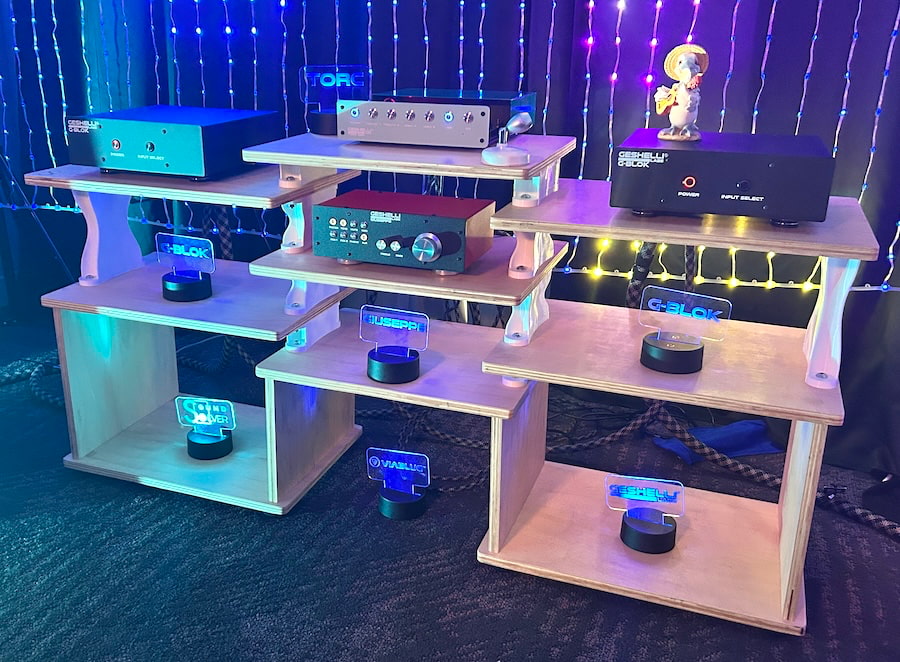
Geshelli doesn’t do “launch hype.” Maybe a little. They build something, tear it apart, rebuild it again, and only then let it out into the world. The $699.99 TORC DAC that showed up at AXPONA 2026 isn’t some carryover from last fall; it’s the version that survived that process. And it shows. After spending time with their gear at CanJam NYC 2026, we were already paying attention. The TORC gave us a reason to stop and then stay while it took control of the room with some Metallica and a rather large pair of SVS floorstanders. Add one of the most colorful setups at the show and it felt less like a demo and more like a full-blown music party under the sea.
Which is impressive, considering we’re in Schaumburg. Closest thing to an ocean here is Lake Wazzapamani and even that’s a rather heavy ask.
Because this isn’t just another DAC with a new chip and a slightly shinier faceplate. The TORC is Geshelli doubling down on what they do best: practical engineering, modular thinking, and pricing that doesn’t assume you just sold a kidney to be here.
And here’s the part that makes some of the room a little uncomfortable; it’s a family operation, it’s built in the U.S., you can actually afford it, and it’s not cutting corners to get there. That combination isn’t supposed to exist. But here we are.
Finally a DAC That Doesn’t Expire the Second a New Chip Drops
The TORC is built around a genuinely modular architecture and not the usual marketing version where “upgradeable” really means “buy the next model.” At its core is a swappable DAC module (the GDAC card), which lets you choose between different conversion paths; AKM, ESS, Burr-Brown, even R2R, and change them later without replacing the entire unit. Each module has its own onboard power regulation, so you’re not just swapping chips, you’re changing how the DAC behaves at a fundamental level.
Geshelli didn’t stop there. The TORC uses four socketed mono op-amps instead of the typical dual configuration, which improves channel separation and gives you direct control over the output stage. If you want to tweak the sound, you physically swap op-amps. No menus. No DSP tricks. Just hardware doing the work.
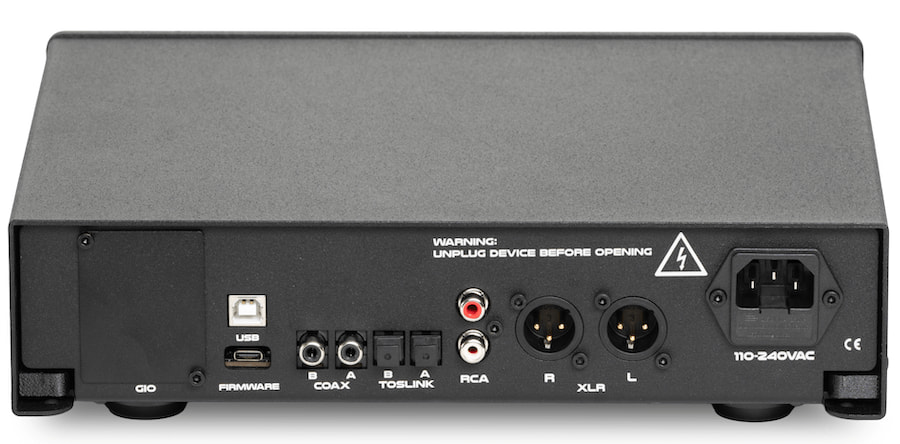

On the digital side, inputs are relay-switched—an old-school approach that physically disconnects unused inputs to reduce noise. It’s more complex to implement, but it works better than the shortcuts most DACs take. You get a solid baseline of connectivity with dual coaxial and dual Toslink inputs supporting up to 24-bit/192kHz PCM, and there’s an optional Amanero USB interface that pushes things much further; up to 32-bit/768kHz PCM and DSD512, depending on the DAC module installed.
Power is handled internally with a 20W AC/DC supply using a standard IEC connection, and it’s not just a single rail feeding everything. The TORC separates digital (7V, 5V, 3.3V) and analog (±11V) power rails, each with its own filtering, plus an isolated supply for the optional expansion card. That kind of separation keeps noise where it belongs—away from the signal path.
Output options are equally flexible, with both RCA (unbalanced) and XLR (balanced) connections standard. And if that’s not enough, the optional GIO (Geshelli Input/Output) expansion adds AES input, additional SPDIF connections, extra RCA output, and even a 4.4mm balanced output.
Which brings us to the part most companies conveniently ignore longevity. The TORC is designed to evolve. You can swap DAC modules, change op-amps, upgrade inputs and outputs, and update firmware as needed. At $699.99, it’s not trying to be disposable and it doesn’t behave like it either.
Most DACs are a dead end. New chip drops, new box shows up, and your “investment” becomes a paperweight.
What Is This Going to Cost Me?
The Geshelli Labs TORC starts at $699.99, and that gets you a fully functional DAC with your choice of standard DAC modules; AKM4493, Burr-Brown PCM1794, or ESS ES9039Q2M along with OPA1655 or OPA1641 op-amps. At that price, you’re not getting a stripped-down entry point; you’re getting the core experience with balanced (XLR) and unbalanced (RCA) outputs, multiple SPDIF inputs, and the modular platform already in place.
Where things get interesting—and more expensive—is when you start customizing. Upgraded DAC modules range from about $128.99 to $259.99 if installed at purchase, including options like the ESS ES9026PRO, ES9039PRO, AKM4499 (single or dual mono), and even the AD1862R R2R module at $249.99. If you want to own multiple DAC boards to swap later, those run separately between $178.99 and $309, depending on the configuration. That’s the whole point of the TORC—you’re not replacing the DAC, you’re swapping its personality.
Op-amp rolling is another rabbit hole. Since the TORC uses four mono op-amps and all four must match, your upgrade cost lands between roughly $159.60 and $240 depending on whether you go with Sparkos, Sonic Imagery, Staccato, or Burson options. It’s not mandatory, but if you’re chasing a specific sound signature, it’s part of the appeal.
Add-ons are relatively painless by comparison. The optional Amanero USB input is $50, and the GIO expansion board, adding AES, additional SPDIF, RCA, and even 4.4mm balanced output—is another $50. Cosmetic choices like case color, LED ring, and feet don’t appear to impact pricing, but they do let you personalize the unit far more than most gear in this category.
So where do you land? Stick with the base unit and you’re in at $699.99. Add a better DAC module and USB, and you’re realistically in the $850 to $1,000 range. Go all-in with multiple DAC boards, premium op-amps, and expansion options, and you can push past $1,200 without trying too hard. The difference here is that you’re building one DAC that evolves with you and not replacing it every time something new drops.

For Whom the DAC Tolls and It Hits Hard
Nothing like some older Metallica requested by a couple of listeners in their 20s to get things moving. The TORC was feeding a pair of G-BLOK monoblocks, each a fully balanced Class A/B differential design rated at 200 watts into 8 ohms, and they didn’t exactly ease into For Whom the Bell Tolls. The presentation was robust, clean, and tight right out of the gate, with real grip in the low end and no sense of strain as the volume climbed. If there was a slight dryness to the overall balance, it was hard to pin on one culprit; the amps were clearly in control, but the TORC wasn’t adding any extra warmth to soften the edges either.
What makes the TORC unique is simple; it doesn’t expire. Modular DAC boards, swappable op-amps, and expandable I/O mean it evolves instead of getting replaced.This is a platform, not a dead end. And after hearing it here, we’re absolutely down to get one into the home system and see what it can really do.
For more information: geshelli.com
You must be logged in to post a comment Login