Tech
Global Paid Music Subscriptions Hit 865 Million as Streaming Takes 86% of Spending

Global consumer spending on recorded music increased 8.6% to $47.1 billion in 2025, with streaming accounting for 86% of the total, according to Futuresource Consulting’s latest industry outlook.
The number of paid music subscriptions worldwide reached 865 million, an increase of 71.5 million from the previous year. Those figures make the direction of the business difficult to misunderstand: streaming is no longer merely the largest part of the recorded music market. It has become the market’s central economic engine, with physical sales and downloads operating around it.
Futuresource expects global music spending to surpass $50 billion in 2026 and reach $60.2 billion by 2030, when subscription streaming could account for almost nine out of every ten dollars spent on recorded music.
That does not mean physical music is disappearing. Consumer spending on physical formats increased 7% during 2025, while global vinyl retail value rose 10% to $3.77 billion. Streaming may have taken over the largest bedroom and changed the Wi-Fi password, but records and CDs have not moved into the garage quite yet.
Subscriber Growth Is Moving Beyond Mature Markets


The addition of 71.5 million paid subscriptions during 2025 reflects continued growth in regions where streaming adoption still has considerable room to expand.
Latin American recorded music revenue increased 15%, while the Asia-Pacific region surpassed 400 million paid music subscriptions. China, India, Brazil and Mexico are expected to play increasingly important roles as subscription growth slows across North America and Western Europe.
That slowdown is one reason streaming services are focusing more heavily on higher-priced plans, bundled content, premium features and regular price increases. Most consumers in mature markets who are willing to pay for music streaming already subscribe to at least one service, which means future growth depends increasingly on charging existing users more rather than simply finding new ones.
Spotify, Apple Music, TIDAL, Qobuz, Amazon Music and other platforms have responded with higher monthly prices, additional subscription tiers, audiobooks, music videos, artificial-intelligence features and other additions designed to make the increases appear less like increases.
Some of those changes have created real value. Others have mostly improved the number printed on the credit-card statement.
Vinyl Remains the Physical Market’s Economic Engine


Vinyl continues to generate the largest share of physical music revenue, with global retail spending reaching $3.77 billion in 2025.
That figure is consistent with the broader trend eCoustics has followed throughout 2026. The RIAA reported that U.S. vinyl generated $1.043 billion in wholesale revenue during 2025, with 46.8 million records sold. Revenue increased 9.3%, while unit sales grew 7.9%.
It was the format’s 19th consecutive year of growth in the United States, which makes it increasingly difficult to dismiss vinyl as a short-lived revival driven entirely by aging collectors and Record Store Day releases. Fads generally do not survive four presidential administrations, multiple economic downturns, a pandemic and the arrival of $50 single-LP reissues bought by people who already own five other copies.
Vinyl now supports a substantial network of independent retailers, pressing plants, equipment manufacturers, distributors, labels and reissue companies. It has also evolved into something broader than an audio format, combining music ownership with collectibility, artwork, limited editions and physical merchandise.
That explains why buyers continue to spend money on colored vinyl, numbered editions, alternate covers and deluxe box sets, even when the same music is available instantly through a streaming subscription.
CDs Are Showing More Life Than Expected


Compact discs remain considerably smaller than vinyl in both revenue and cultural visibility, but the format has shown unexpected momentum during 2026.
Luminate reported that U.S. CD sales increased 16% to 16.3 million units during the first half of the year, while vinyl unit sales grew by only 2.4%. That gave CDs a growth rate almost seven times higher during the period.
K-pop releases contributed significantly through elaborate packaging, photo cards, alternate editions and fans purchasing multiple versions of the same album. However, Luminate found that CD sales would still have increased 6.7% after K-pop titles were removed from the data, suggesting that the improvement was not dependent on one unusually committed group of collectors.
Target, Walmart and other mass-market retailers now account for almost 30% of U.S. physical music sales, another indication that records and CDs are no longer confined to independent stores and specialist websites.
The figures do require some context. Futuresource measures global consumer spending, while the RIAA reports U.S. wholesale revenue net of returns and Luminate tracks retail consumption and unit activity. The numbers describe related trends, but they are not directly interchangeable.
The RIAA still reported that U.S. CD sales declined to 29.5 million units in 2025, with wholesale revenue falling to $312.4 million. Luminate’s stronger first-half results therefore suggest a possible change in direction rather than proof that compact discs have suddenly returned to their late-1990s commercial peak.
Nobody should start rebuilding Tower Records just yet.
Physical formats will remain much smaller than streaming, but the evidence does not support the idea that they are disappearing. Vinyl is a multibillion-dollar global business with nearly two decades of sustained U.S. growth, CD sales are showing renewed momentum in 2026, and manufacturers at both ends of the market continue introducing new players and transports.
Esoteric and Luxman still serve buyers who want disc playback treated as a precision instrument, while Denon, Yamaha, NAD, Audiolab, Mission, Quad, Topping and FiiO continue to develop products at more accessible prices. This is not an industry maintaining a format on life support; it is one still investing in it.
The turntable market is even more remarkable. There have not been this many new models available in at least 30 years, with hundreds of options from Rega, Pro-Ject, Thorens, Kuzma, VPI, Vertere, Linn, Luxman and far too many others to list without turning this article into a dealer catalog. Entry-level decks, premium belt-drive designs, direct-drive models, automatic turntables and statement products all continue to arrive because demand remains real.
Interest in physical music has not been this strong in a very long time. Listeners understand that well-mastered records and CDs can sound better than compressed or compromised streams, but sound quality is only part of the appeal. Physical media provides ownership, permanence and a sense of community among listeners, collectors, retailers and artists that no monthly subscription can reproduce.
There will never be a Streaming Store Day. Nobody is lining up outside at 6 a.m. to celebrate a licensing agreement that can disappear before lunch.
The music business often treats streaming and physical media as opposing formats, but consumers increasingly use them for different reasons.
Streaming provides access, convenience and discovery. It allows listeners to explore enormous catalogs, move between devices and hear new releases immediately without committing to a purchase.
Physical media provides ownership and permanence. A record or CD cannot disappear because a licensing agreement expired, an artist changed distributors or a streaming platform removed a specific version from a regional catalog.
CDs also provide an inexpensive route to creating lossless local files, while vinyl offers artwork, presentation and a physical connection to an album that streaming cannot reproduce. For many listeners, the most practical approach is to stream broadly and purchase selectively.
That is not a contradiction. It may be the most rational way to consume music in 2026: use streaming to discover, buy the albums that matter, rip the CDs and retain a library that does not depend on a monthly subscription or somebody else’s licensing agreement.
The cloud is convenient. It is not ownership.
AI Will Influence Where the Next Billions Go

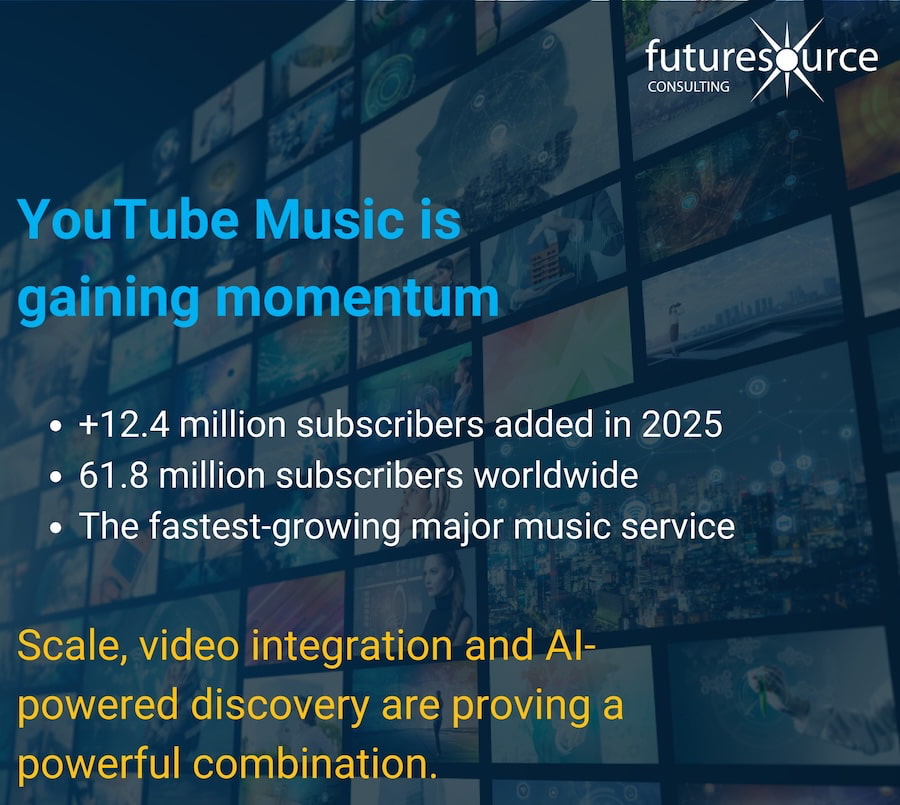
Futuresource also identifies artificial intelligence as one of the major forces shaping the music business.
Streaming platforms are using AI for recommendations, playlists, search and engagement, while labels and rights holders explore licensing and content-management agreements. Services are also being forced to address the rapid growth of fully synthetic music and determine whether AI-generated recordings should compete directly with human artists for recommendations and royalty payments.
Deezer has taken one of the clearest positions by identifying fully AI-generated tracks and removing them from algorithmic recommendations. Other services are still developing their policies, even as synthetic content continues to increase.
The issue will become more significant as streaming controls a larger share of global music spending. Platforms do not merely deliver music; they influence what listeners discover, which artists receive exposure and how revenue is distributed.
There is a great deal of money attached to those decisions, which usually means the ethical discussion will continue immediately after the commercial agreements have been signed.
The Bottom Line
Global paid music subscriptions reached 865 million in 2025, while streaming captured 86% of recorded music spending and pushed the market to $47.1 billion. By 2030, that share could approach 90%, driven by higher prices, premium tiers, expansion in developing markets and the increasingly unavoidable arrival of AI inside every service.
Those numbers confirm that streaming has won the battle for access. It is fast, convenient and almost impossible to avoid. What it does not provide is ownership, permanence or any guarantee that the version of an album you love will still be available next year, in the same country, under the same licensing agreement.
Physical media remains much smaller, but it offers something streaming cannot: control. A record or CD belongs to the buyer, can be played without permission from a platform and often sounds better when the mastering is superior.
That combination of sound quality, ownership and community is why records and CDs continue to matter, even as streaming absorbs most of the money. The industry may prefer recurring monthly payments, but listeners still understand the difference between having access to music and actually owning it.
The industry appears perfectly willing to charge people for both, and a growing number of listeners appear willing to pay.
[Reference: futuresource-consulting.com (login required)]
You must be logged in to post a comment Login