Connect with us
DAPA Banner
DAPA Coin
DAPA
COIN PAYMENT ASSET
PRIVACY · BLOCKDAG · HOMOMORPHIC ENCRYPTION · RUST
ElGamal Encrypted MINE DAPA
🚫 GENESIS SOLD OUT
DAPAPAY COMING

Tech

Glue-in Hinge Design Tries Something Different

Published

on

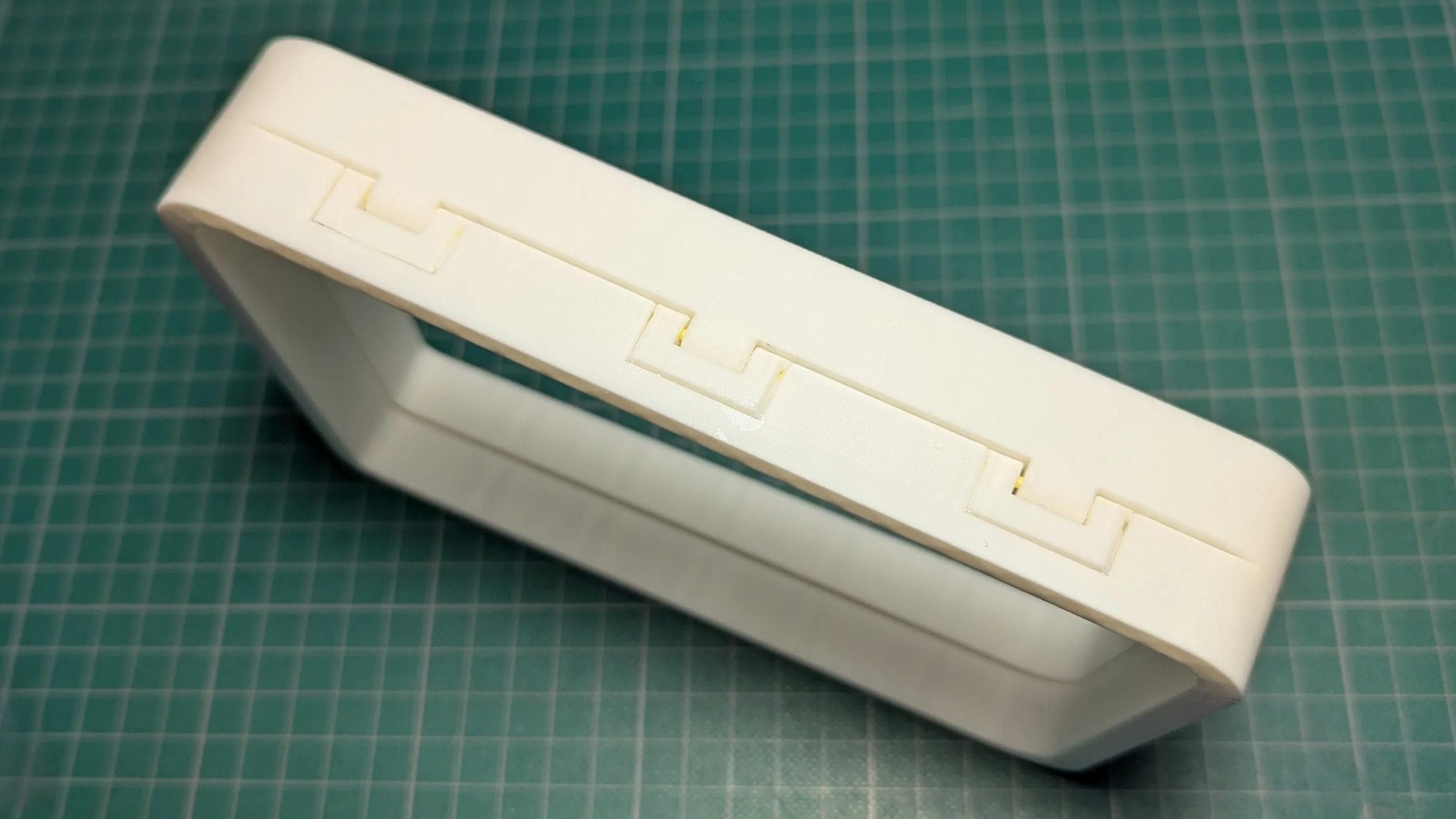
Need a hinge in your 3D printed design and would prefer not to re-invent the wheel? You may find [Alex Krush]’s glue-in filament hinge useful.

This design (shown in this simple box as an example) makes a very close-fitting hinge point.

This design prints half the hinge as a separate piece — the u-shaped one in the picture to the side — that must be glued into the target object after printing. It’s a bit of extra work, but doing it this way has a couple advantages.

One is that printing some of the hinge elements separately means one no longer needs to choose between a print orientation that best suits the object, and a print orientation that works best for the hinge. Also, the length of 1.75 mm filament used as a hinge pin is held captive after assembly so there’s no need to glue the hinge pin itself.

[Alex] helpfully provides the parts in STEP format, which makes CAD tweaks and adjustments easy. While incorporating the design should be doable even if one is just using .stl or .3mf files because boolean subtraction and merging is all that’s needed, having the model in STEP format is so much better.

Advertisement

Should you need some pointers on incorporating either into FreeCAD, we have you covered.

Source link

Advertisement
Continue Reading
Click to comment

You must be logged in to post a comment Login

Leave a Reply

Tech

Craft Recordings Marks It’s the Great Pumpkin, Charlie Brown 60th Anniversary With Zoetrope Vinyl

Published

on

Craft Recordings is heading back to the pumpkin patch, and this one should hit hard for anyone old enough to remember watching It’s the Great Pumpkin, Charlie Brown on television before Halloween became a month-long retail hostage situation. To mark the 60th anniversary of It’s the Great Pumpkin, Charlie Brown, Vince Guaraldi’s 1966 Halloween soundtrack returns on August 7th in collectible zoetrope vinyl and limited-edition pressings, featuring “The Great Pumpkin Waltz,” “Graveyard Theme,” “Linus and Lucy,” and rare outtakes from one of the most beloved Peanuts TV specials ever produced.

The timing is not accidental. Peanuts and Charlie Brown have become one of the hottest nostalgia licenses in music and hi-fi, with Craft Recordings continuing its run of Guaraldi reissues after releases tied to A Charlie Brown ChristmasIt’s the Easter Beagle, Charlie Brown!A Boy Named Charlie BrownBe My Valentine, Charlie Brown, and It’s Arbor Day, Charlie Brown.

eCoustics has covered that vinyl revival closely, including Craft’s Record Store Day releases and the 60th anniversary A Charlie Brown Christmas zoetrope pressing. 

And it is not just records. The Peanuts revival has spilled directly into audio hardware, including Pro-Ject’s limited-edition Peanuts 75th Anniversary Turntable, a themed T1 BT-based deck with built-in phono stage, Bluetooth transmission, and enough Charlie Brown energy to make even Schroeder consider upgrading his rig. That is where this latest Craft release fits: part soundtrack restoration, part collectible vinyl, part proof that Guaraldi’s jazz scores have become a very real corner of the modern hi-fi and vinyl economy.

Advertisement

Craft Recordings Gives the Great Pumpkin the Collectible Vinyl Treatment

its-the-great-pumpkin-charlie-brown-lp

Arriving August 7th and available to pre-order now, Craft Recordings’ 60th anniversary reissue of It’s the Great Pumpkin, Charlie Brown brings Vince Guaraldi’s 1966 Halloween soundtrack back to vinyl in multiple collectible formats. The main release is a 45 RPM zoetrope LP featuring memorable animated scenes from the special on each side, along with a new essay by Sean Mendelson.

Because apparently one pumpkin was not enough, Craft is also rolling out several limited-edition variants through exclusive retail partners. Target will offer an Orange 4-inch Tiny Vinyl beginning July 17th, with “The Great Pumpkin Waltz” on Side A and “Graveyard Theme” on Side B. Pumpkin-shaped pressings arrive August 21st in several colorways, including Electric Pumpkin Patch at Barnes & Noble, Pumpkin Spice at Walmart, Ghost White at Target, and Candy Corn through Craft Recordings. The Orange Pumpkin pressing also returns by popular demand at all major retailers.

That may sound like a lot of plastic gourds, but the demand makes sense. Peanuts remains one of the strongest nostalgia licenses in music and hi-fi, and Guaraldi’s scores have become a legitimate gateway drug into jazz for listeners who first encountered them while waiting to see whether Linus was finally going to be vindicated.

Vince Guaraldi’s Halloween Score Finally Gets Its Due

By 1966, Vince Guaraldi was still in the early stages of what became a long and fruitful creative partnership with producer Lee Mendelson. Mendelson originally approached the Bay Area jazz pianist to score a documentary about Charles M. Schulz and the Peanuts comic strip. That film, A Boy Named Charlie Brown, never aired, but the collaboration survived and led directly to A Charlie Brown Christmas in 1965.

its-the-great-pumpkin-charlie-brown-back-cover

That special, written by Schulz, animated by Bill Melendez, and produced by Mendelson, became an immediate success, and Guaraldi’s soundtrack became one of the most enduring holiday albums ever recorded. The following year, Mendelson brought Guaraldi back for two more Peanuts specials: Charlie Brown’s All-Stars!, which aired in June, and It’s the Great Pumpkin, Charlie Brown, which debuted on October 27, 1966.

Advertisement

Recorded only weeks before its broadcast at Desilu’s Gower Street Studio in Hollywood, It’s the Great Pumpkin, Charlie Brown marked an important shift in the sound of the Peanuts specials. Guaraldi had handled the music for the first two specials largely on his own, but this time he was joined by seasoned composer, arranger, and conductor John Scott Trotter, best known for his long run as Bing Crosby’s music director. Trotter helped bring more structure to the sessions, shaping Guaraldi’s jazz writing into shorter, television-ready cues without draining the personality out of the music. A small miracle, considering what network television can do to anything interesting.

Guaraldi’s core trio included bassist Monty Budwig and drummer Colin Bailey, with additional color from Emmanuel “Mannie” Klein on trumpet, John Gray on guitar, and Ronald Lang on woodwinds. Together, they gave the special its autumnal texture: warm, slightly mysterious, and just melancholy enough to remind you that Charlie Brown was never getting a normal Halloween.

Advertisement. Scroll to continue reading.

The centerpiece remains “The Great Pumpkin Waltz,” a sophisticated and beautifully restrained theme tied to Linus’ unwavering belief in the mythical figure he insists will rise from the pumpkin patch. Other highlights include the eerie “Breathless,” the playful “The Red Baron,” the familiar “Charlie Brown Theme,” and the immortal “Linus and Lucy,” which remains one of the most recognizable pieces of music ever attached to an animated television special.

Advertisement

When It’s the Great Pumpkin, Charlie Brown premiered, it captured a 49 percent audience share and earned an Emmy nomination. Unlike A Charlie Brown Christmas, however, it did not receive a proper companion soundtrack at the time. Select tracks appeared on compilations over the years, but the first comprehensive soundtrack release did not arrive until 2018. Craft reissued it again in 2022 after the discovery of the original session tapes, adding more material from the recordings.

Guaraldi would go on to score 15 Peanuts specials before his death in 1976. His music remains a major part of the franchise’s identity, not because it was cute or merely nostalgic, but because it treated children and adults like they could handle real melody, real swing, and a little emotional ambiguity. Imagine that. A children’s special with better musical taste than half the people in charge of streaming playlists.

Where to buy: $36.98 at Amazon | Craft Recordings (ships August 7, 2026)

Source link

Advertisement
Continue Reading

Tech

Tech Moves: Microsoft exec departs Azure; Xealth gets first CRO; Slalom names Pacific NW leader

Published

on

Marcus Fontoura, Microsoft technical fellow and CTO for Azure Core, with his new book, A Platform Mindset, during a recent conversation at the company’s Redmond campus. (GeekWire Photo / Todd Bishop)

Microsoft technical fellow Marcus Fontoura is leaving the company after serving as Azure Core’s chief technology officer for more than a year. During that time he also published A Platform Mindset, a book exploring how to build scalable systems and effective teams.

@media (max-width: 600px) {
aside.callout { float:none !important; max-width:100% !important; margin-left:0 !important; margin-right:0 !important; }
aside.callout .callout-img { display:none !important; }
}

Fontoura had an earlier eight-year run at Microsoft, where he worked as a technical fellow in Azure and as a partner architect for Bing before departing in 2022 to join fintech company Stone as CTO and head of engineering. Prior to Microsoft, he held positions at Google, Yahoo and IBM.

“I leave with deep gratitude and immense respect for the people and culture that make Microsoft such a special place,” he said on LinkedIn. Fontoura, who is based in Boca Raton, Fla., did not share his next move.

Travis Moore is now the first chief revenue officer for Xealth, a Seattle-based digital health startup acquired last year by Samsung Electronics.

Travis Moore. (LinkedIn Photo)

“The challenge is no longer simply finding more technology. It is connecting that technology to the clinical workflows and turning fragmented tools into coordinated, meaningful care,” Moore said on LinkedIn.

Moore began his career in healthcare 25 years ago as a pediatric nurse before moving into health technology, where he worked in product management, sales and marketing and then transitioned to commercial leadership. He joins Xealth from Eleos Health, a North Carolina behavioral health company, where he served as head of sales.

Advertisement

Judson Althoff, CEO of Microsoft’s Commercial Business, was appointed to GE Aerospace’s board of directors. Althoff has been with the tech company for 13 years.

Eric Foster has taken a role at Slalom, a Seattle-based business and technology consulting firm, as leader of its Pacific Northwest market. Foster comes from Accenture, where he spent 14 years across three stints, most recently as managing director.

Digimarc, a Beaverton, Ore., company providing digital watermark technology, named Paul Carreiro as CEO, effective July 6. Carreiro joins from Atlanta’s Elemica, where he has been chief executive and president for two years. He succeeds Riley McCormack, who will remain on the board of directors.

The AI boom is driving business, said a Digimarc release, as “both humans and intelligent systems require scalable ways to verify what’s real, protect what matters, and move forward with confidence.”

Advertisement

Jose Calzada has joined the VP ranks at Microsoft with a promotion to VP software engineer. Calzada works on the company’s AI platform and has been with Microsoft for 17 years. He joined as a design engineer intern and was later hired permanently to the Outlook team.

Soracom, a Japanese IoT connectivity company, has named Richard Halliday as CEO of its operations in North and South America. The publicly traded company’s U.S. headquarters are in Bellevue, Wash. Halliday has been with Soracom for more than four years.

Seattle Mayor Katie Wilson has reshuffled her leadership team, moving Nicole Vallestero Soper from her current role as director of policy and innovation to director of affordability, housing, and economic development, Publicola reported. Before joining city leadership, Soper was a principal consultant at Transformative Shifts.

Scott Whalen of Pacific Northwest National Laboratory has been honored as the Department of Energy’s National Innovator of the Year. Whalen serves as chief scientist in PNNL’s Applied Materials and Manufacturing group and leads its Thermomechanical Processing team. He holds 23 U.S. patents with 13 more pending.

Advertisement

Source link

Continue Reading

Tech

Screen Time Concerns Lead to Backlash Against Edtech Vetting Proc

Published

on

Among the increasing concern about screen time in school comes a new culprit: the vetting process for school software.

A growing group of parents and teachers has spent the last few years fighting against cellphones in the classroom, with some extending that to all digital devices. But the school-issued laptops, and the software accompanying them, have been left largely unscathed.

“A lot of the issues with personal devices can move to the district-issued devices,” said Kim Whitman, co-lead for Smartphone Free Childhood US, in a previous interview with EdSurge. Whitman explained that when students do not have cellphones, they can still message with friends on their Chromebooks, or through tools like Google Docs. “There are definitely issues with school-issued devices as well.”

Proposals in three states – Rhode Island, Utah and Vermont – are now tackling these concerns.

Advertisement

Better Vetting Processes

At the start of this year’s legislative session, all three states concurrently proposed reviewing the vetting process of education software.

In most districts, school boards, IT personnel and administrators choose vendors, often relying on the vendors’ own data to prove the products’ safety and efficacy.

“There is nobody right now that is confirming these products are safe, effective and legal,” Whitman said in a previous interview. “It should not fall on the district’s IT director; it would be impossible for them to do it. And the companies should not be tasked with doing it — that would be like nicotine companies vetting their own cigarettes.”

The proposed legislation is looking to change that.

Advertisement

Vermont

Bill: An act relating to educational technology products

NEWSLETTERS

STAY AHEAD IN EDUCATION.

Sign up for EdSurge newsletters for timely news, insights and analysis.

Status: Passed by the House March 27; currently before the Senate Committee on Education

Advertisement

This bill proposes to require that providers of educational technology products register annually with the state. It also requires the secretary of state to create a certification standard and review process for these products before schools can use them.

Any provider of an educational technology product — specifically student-facing tools that are used for teaching and learning in schools — must register with the secretary of state, pay a registration fee of $100 and provide its most up-to-date terms and conditions and privacy policy.

The secretary of state would work with the Vermont Agency of Education to review registrations.

Criteria for certification include:

Advertisement
  • The product’s compliance with state curriculum standards

  • Advantages of using it versus non-digital methods

  • Whether it was explicitly designed for educational purposes

  • Design features, including artificial intelligence, geotracking and targeted advertising

While the initial bill proposed that any edtech provider not certified by the state, but continues to operate, could be liable for fines of $50 a day up to $10,000, that language was struck by the final bill passed from the House.

If passed by the Senate, the bill would go into effect July 1, 2026. By November 2027, the Agency of Education would submit a written report on which state entities should be involved in the edtech certification and any other recommendations for certification.

Utah

Bill: Software in Education

Status: Signed into law on March 18

Advertisement

The bill requires the Utah Board of Education to study the use of software and digital practices in public schools, review best practices and provide guidance for responsible use.

The state also passed a Classroom Technology Amendments bill tackling screen time at every grade level, banning it entirely from kindergarten through third grade, except for computer science and assessments. Middle school students must have their parents “opt-in” to taking devices home and high school students will be allowed to bring home devices unless parents “opt-out.”

“We’re not anti-technology,” Rep. Ariel Defay (R-UT) said in a statement. She is a sponsor of the Classroom Technology Amendments bill. “We just want to ensure that education technology is used intentionally and actually helps students to learn.”

Rhode Island

Bill: The Safe School Technology Act of 2026

Advertisement

Status: Passed by the House April 14; currently in the Senate Education Committee

This bill, proposed by three Rhode Island representatives who are also mothers, is part of a six-bill package focused on protecting children from social media, artificial intelligence and digital platforms.

The Safe School Technology Act bill would be enacted this August if approved, banning software providers from activating or accessing any audio or video functions on a device outside of school-related activities. It also bans the use of location data.

The initial bill lists a litany of concerns that the “lack of regulation” caused, including increased screen time, and “marketing commercial products as educational with no accountability; children being given devices without proof of developmental appropriateness and parents being excluded from decisions about their child’s digital exposure.”

Advertisement

But the main concern, argued by state Representative June Speakman (D-RI), who sponsored the bill, is that a majority of school districts’ technology policies do not have limits on tracking student devices. She added roughly two-thirds of districts also do not limit school-issued device’s ability to activate audio and video.

“Passing this bill will provide clear, consistent protection across all schools in the state that assures students and their families that their devices cannot be used to invade their privacy or track their activities,” Speakman said in a statement.

“They deserve to feel confident that their privacy is protected when they use technology that is required for school,” she added.

Tech Pushback

Several technology proponents have pushed back.

Advertisement

The Software and Information Industry Association spoke out against the Rhode Island bill in March, saying if the bill passed it would make the state be one of the most restrictive in the nation.

In an open letter to Joseph McNamara, chair of the Rhode Island House Education Committee, Abigail Wilson, director of state policy at the Software and Information Industry Association, said the bill “proposes an overly restrictive regulatory framework that will severely disrupt classroom instruction, impose massive unfunded administrative burdens on local schools, and deprive Rhode Island students of critical, evidence-based learning tools.”

Keith Krueger, CEO of the nonprofit Consortium for School Networking, told NBC News that the proposed legislation “does keep me up at night.”

“I think some well-intentioned policymakers … are rushing so quickly that they haven’t thought through the implications,” he said.

Advertisement

Source link

Continue Reading

Tech

Adding Weight To A 3D Print With Plaster Of Paris, Cleanly

Published

on

Sometimes it’s useful to add extra mass to a 3D print, and [Joe Fedewa] shared a simple and effective technique that uses plaster of Paris. Rather than pause the print and insert hardware or weighted bits inside, he designed the base as hollow. Not in the sense of zero infill, but in the sense of modeling a cavity into the open bottom of the object.

An open cavity in the base is perfect for filling with plaster of Paris.

After the print is complete, he mixes the dry plaster with water until it creates a thick but pourable mixture. Then the object gets turned upside-down and the cavity filled. In about an hour, it will have set up enough to be handled and worked.

Plaster of Paris has a good heft to it, but more importantly it can be made perfectly presentable thanks to being very friendly to post-processing. Any rough spots can be easily sanded and the whole bottom smoothed, so one doesn’t even need to cap it off. Completely cured plaster can be sealed with a clear coat for a more durable finish, if desired.

This basic concept has been used in other ways, such as reinforcing prints with concrete to yield parts solid enough to make tools out of. But using plaster of Paris not just to add mass, but specifically to create a presentable surface that doesn’t need covering up is a neat and highly economical adaptation of the idea.

Advertisement

Other methods of adding mass to a 3D print include inserting metal balls or chunky nuts, bolts, or other hardware, but this method doesn’t require pausing prints to insert things. Nor does it require sealing off or capping the print, messing with goopy epoxies or resins, or spending a lot of money — making it a good one to keep in mind in case it comes in handy someday.

Source link

Advertisement
Continue Reading

Tech

Novo Nordisk says hackers stole clinical trial data

Published

on

Security

Clinical trial participant data stolen, but pharma giant says exposed records were pseudonymized

Pharmaceutical giant Novo Nordisk says data related to clinical trial participants was stolen as part of a cyberattack.

The affected patient data was pseudonymized and not directly linked to names or other direct identifiers, the company said.

Advertisement

The maker of the Wegovy weight-loss drug said the affected data types include patient ID, information on trial participation, gender, year of birth, biomarkers, health/immunogenicity data, and lifestyle factors including smoking status, alcohol use, and BMI.

“This information is not directly linked to any patients by name or other direct identifiers,” the Novo Nordisk said on its dedicated page for the attack.

“Information about identity would therefore require access to underlying information, identifying patients by name etc. This information was not exposed. We therefore do not consider the incident to enable any third party to identify participants in our clinical trials.”

The same statement confirmed that the attack affected a “limited number of internal IT systems,” and the company said some systems have been taken offline as a precaution. 

Advertisement

Although it does not believe there is an immediate risk stemming from the breach, it nonetheless warned patients to remain vigilant for anything that could be connected to the data stolen during the attack.

A separate letter sent to the company’s healthcare partners (HCPs) states that additional personal information may have been stolen and could lead to targeted phishing attempts.

Affected HCP data includes names and registration numbers, email addresses, phone numbers, WhatsApp details, and office locations.

“Based on the nature of the exposed data, the potential consequences of the incident include targeted phishing attempts through emails, phone, and WhatsApp, or fraudulent communications impersonating colleagues,” Novo Nordisk said in the letter.

Advertisement

“We recommend that you remain vigilant against unexpected messages or calls and report any suspicious activity to us.”

The pharma biz warned that it may take time to bring these systems back online, but it is working to do so “in a controlled and safe manner.”

Elsewhere, it all sounds like standard practice. Outside experts were called in to help investigate, and Novo Nordisk has not yet confirmed the scale of the breach, nor will it until the experts have more time to assess the damage.

Novo Nordisk added that the attack has had no impact on its core business operations, which remain running as normal.

Advertisement

The attack was announced on what should have been a day of celebration for the company, whose flagship semaglutide weight-loss and diabetes pill received the green light to become the UK’s first daily GLP-1 tablet hours earlier.

The Wegovy pill joins the list of approved weight-management treatments that act as agonists for the GLP-1 receptor. All the other approved treatments are injectables, including Wegovy and Ozempic, both of which are also developed by Novo Nordisk.

The Danish company employs roughly 67,900 people across 80 countries, and markets products in nearly every country globally. ®

Source link

Advertisement
Continue Reading

Tech

A major KPMG report on AI was found to be chock-full of…AI hallucinations

Published

on


  • Only five of the 45 citations accurately reflected real sources
  • Some were totally fake, others included “garbled” attributions and titles
  • GPTZero argues vibe citations have consequences, with reports disseminated globally

GPTZero investigators have revealed how major government reports, academic papers and other research are becoming plagued with AI hallucinations, so much so that the company is on its second report exploring the trend.

In the latest embarassing incident, a KPMG report on agentic AI was in fact found to be filled with AI-generated errors, false citations and misleading case studies.

Source link

Continue Reading

Tech

Firefox’s AI kill switch exists. Only 1% of users have flipped it.

Published

on

TL;DR

Only 1% of Firefox users used the AI kill switch. Mozilla launched Smart Window (BYO AI models), a built-in VPN with 1.5M signups, and a fall redesign.

Mozilla built an AI kill switch into Firefox after its users demanded one. Only 1% have used it. Another 3% turned off some AI features selectively. The rest left everything on. CEO Anthony Enzor-DeMeo says the point is not the percentage but the choice.

Our community was pretty vocal, especially during the CEO announcement, that not everyone wanted AI,” Enzor-DeMeo told CNET.At its core, we want to listen to our users. It was honestly on the roadmap, but I expedited it, given the community feedback.

The low usage rate suggests that most people who said they wanted an AI kill switch either did not follow through or found specific features, like AI-powered translation, useful enough to keep. Enzor-DeMeo pointed to this as validation that Firefox’s approach works. The differentiator is not removing AI but offering control, something he contrasted with Microsoft defaulting to Copilot on Windows desktops and Google silently downloading a 4 GB AI model onto users’ machines.

Advertisement

Firefox’s newest feature is Smart Window, now available in beta. It lets users choose which AI model to run inside the browser, including ChatGPT, Gemini, Claude, or privately hosted open-source models. “They all excel at different things. Why do I need to be forced into one of them?” Enzor-DeMeo said. Mozilla says it does not use chat data to train models and automatically filters out sensitive information.

Advertisement

The browser also launched a free built-in VPN last month. It has 1.5 million signups and roughly 800,000 active users. Enzor-DeMeo said building VPN directly into the browser was a top priority because clicking a button is easier than opening a separate app. The VPN only encrypts browser traffic, not activity in other apps.

A full redesign, codenamed Project Nova, is coming in September or October. It includes faster page loads (up to 9% improvement), compact mode, rounded UI elements, AI-powered tab grouping, and accessibility features. Firefox has around 200 million monthly users and just over 2% of the browser market, compared to Chrome’s 70% and Safari’s 16%.

Enzor-DeMeo framed the stakes in global terms. He cited data showing 83% of the world’s population has not used AI, and only about 3% of Americans pay for it. He called AI “largely non-profitable” and predicted more ads in AI services soon. “If we actually go the route that AI becomes more centred in the browser, and that’s how people access the internet, you run the risk of the internet becoming more closed off.

Mozilla’s position is that the browser should be the user’s agent, not the AI company’s distribution channel. Whether 200 million users and 2% market share are enough to make that argument matter is the open question for Firefox. But the 1% kill switch stat tells a more nuanced story than the backlash suggested. People wanted the option. They did not want to use it. That is a distinction the broader AI debate has struggled to make.

Advertisement

Source link

Continue Reading

Tech

SpaceX goes public in the largest IPO ever, and Musk crosses the trillion-dollar line

Published

on

Why it matters: The largest IPO in history did two things at once: it made Elon Musk the world’s first trillionaire, and it quietly converted a privately held rocket company into a stock that millions of investors may soon own whether they chose to or not. SpaceX isn’t asking Wall Street to price its launches or its satellites. It’s asking the market to bet that a rocket company is on its way to becoming one of the most valuable AI companies on Earth, and to start paying for that future today.

SpaceX began trading on the Nasdaq on Friday under the ticker SPCX, and the numbers attached to the debut are the kind that usually require a footnote to believe. The company priced 555.6 million Class A shares at $135 on Thursday evening, raising roughly $75 billion and valuing the firm at about $1.77 trillion before a single share changed hands. That makes it the biggest initial public offering in history, nearly triple Saudi Aramco’s $29 billion listing in 2019, the record it displaced.

The stock did what hotly anticipated debuts tend to do. It opened around $150, about 11% above the offer price, then swung as high as the $168 to $175 range in the first minutes of live trading before settling near $158 to $165 by midday. At those levels SpaceX briefly carried a market capitalization north of $2 trillion, placing it among the most valuable public companies in the world on day one.

Advertisement

But not to be surprised, the headline most news outlets led with was personal rather than corporate. Elon Musk, who holds an estimated 42% of SpaceX and acts as chairman, chief executive, and controlling shareholder, became the world’s first trillionaire, at least on paper. That wealth is tied up in stock and options across SpaceX and Tesla.

Musk rang the opening bell from SpaceX’s headquarters in Starbase, Texas alongside hundreds of employees, while president Gwynne Shotwell and CFO Bret Johnsen handled the ceremony in New York. “Take the fiction out of science fiction,” Musk said before the session opened, restating the Mars ambitions that have always been part of the pitch.

The AI story is doing a lot of the work

Strip away the spectacle and the SpaceX’s trillion-dollar valuation rests on a forecast, not a balance sheet. SpaceX reported a net loss of $4.9 billion in 2025 on revenue of about $18.6 billion, so investors are not paying $1.77 trillion for current profits. They are paying for what the company says comes next.

Credit: App Economy Insights

Advertisement

The filing makes that explicit. SpaceX estimates a total addressable market of $28.5 trillion, with roughly $26.5 trillion of it attributed to AI, a category the company entered in earnest after absorbing Musk’s xAI earlier this year. Beyond Starship and Starlink, the SEC documents describe plans for terrestrial data centers, custom AI microchips, and what SpaceX calls orbital AI compute infrastructure.

In other words, the rocket company is asking the market to value it largely as an AI company, which is why the offering is being read as the first in an expected wave that includes OpenAI and Anthropic.

For retail investors, that framing is the appeal. SpaceX targeted about 30% retail participation, well above the 10% typical of a large IPO, and the listing offers one of the few direct routes into a major AI player outside Meta, Microsoft, and Alphabet. Fidelity reported more than 500,000 buy orders within the first hour.

But not everyone is buying the story

The skeptics are loud, and they are not all anonymous. Morningstar this week pegged SpaceX’s fair value at roughly $63 a share, less than half the IPO price, calling the offering overvalued. That is a striking gap for a name generating this much demand.

Advertisement

The sharper critique concerns who ends up holding the stock. Several index providers, including Nasdaq and FTSE Russell, recently adopted fast-entry rules that could add SpaceX to major indexes well inside the year that benchmarks have historically required after an IPO. Because index funds must mirror their benchmarks, inclusion forces automatic buying, which means millions of savers could gain exposure to an unprofitable company without ever choosing the stock. S&P Dow Jones declined to bend its rules, so the S&P 500 will wait, but the broader point stands.

Economist Paul Krugman put it most bluntly, describing Musk as a “human Ponzi scheme” and arguing that the rule changes effectively conscript ordinary investors into propping up a valuation built on belief rather than fundamentals. He notes that index and index-based funds now hold roughly 52% of mutual fund assets, which is how a debut like this reaches people who never opted in.

That is the tension worth watching. SpaceX has a real and rare asset in Starlink, a launch business with no genuine competitor, and an engineering record that few firms can match.

Whether any of that justifies a two-trillion-dollar valuation, or whether the AI pivot is doing more lifting than the engineering, is a question the next few quarters will start to answer. For now, the most-watched stock chart in the market belongs to a company that is selling tomorrow harder than it is selling today.

Advertisement

Source link

Continue Reading

Tech

Why Galway is ideal for organisations with a growing tech identity

Published

on

The west of Ireland is fast becoming a globally recognised hub of technological activity and achievement.

“Galway punches well above its weight as a tech hub,” explained Siobhán Dervan, a director of engineering at Rent the Runway, Galway. “A vibrant, diverse ecosystem, anchored by big tech names like HPE, Cisco and Genesys, creates the kind of collaborative energy that attracts further investment and talent.”

Home to numerous indigenous and multinational organisations, the west of Ireland – particularly Galway – has built a sturdy reputation as an attractive region for scaling and growing companies with a focus on science, technology, engineering and maths (STEM).

Dervan said: “The PorterShed and Platform94 nurture so many start-ups and scale-ups in Galway, including ourselves at Rent The Runway back in 2019 and the University of Galway and ATU [Atlantic Technological University] deliver a continuous stream of talent into the local market.

Advertisement

“The business case is compelling too. IDA support and Ireland’s favourable tax environment apply nationally, but operational costs in the west are meaningfully lower and Galway’s culture, community and craic make it somewhere people genuinely want to be.”

This opinion was shared by the head of Viatris’ Galway site, David Read, who agreed Galway is a significant hub for talent, noting its large population of indigenous talent, its size, strong transportation links and a great coastal location that attracts a talented migrant community. 

He said 30pc of the platform’s workforce were attracted to Galway and the west because of its reputation as an ideal location to raise a family, as well as to grow and develop careers. 

Supported by third-level institutions, such as ATU and the University of Galway, Read noted that the region benefits from a homegrown talent pipeline, which is key for organisations looking to recruit and bolster their teams. 

Advertisement

“Viatris supports this talent pipeline with our graduate development programme where we support the rotation of successful graduates through different functions, for example quality, manufacturing, science and technology on the site and also support rotations in the other Viatris sites in Ireland,” he said. 

“The concept here is that we contribute to talent development and hopefully this talent anchors in the area and continues to grow and develop to more senior roles in the organisation.”

Wander west

For both Dervan and Read, in addition to the importance of developing a sturdy talent pipeline and meeting future skill needs, it is also vital that technology organisations commit to scale and growth outside of Ireland’s capital. 

Dervan said this is “critically important and the data backs it up”.

Advertisement

“Almost 70pc of new jobs created by Enterprise Ireland-backed companies in 2025 were outside Dublin and 88pc of new IDA jobs added in H1 2025 were in regional locations. The case for regions isn’t just about economic balance, it’s talent strategy,” she said. 

“Dublin salaries and cost of living create real friction for scaling companies; regions like Galway offer access to the same world-class talent at a more sustainable cost base. And the quality-of-life argument is underrated. My commute to the office is five minutes on a bike and my view is the iconic Long Walk, that’s not a small thing when you’re trying to attract and retain great people.”

“It is important to grow organisations outside of Dublin, so that new emerging talent can live and grow with their families and communities and have great career opportunities,” agreed Read, who further explained that this needs to be supported by sustainable transport to ensure organisations can get staff to and from their place of employment.

He said: “This also means that organisations can harness what’s great about their region and the local talent pool. This vision is why organisations like the IDA and Údarás na Gaeltachta exist.”

Advertisement

Local engagement

But in a diverse landscape, such as the one in Galway, how might organisations ensure that they are contributing to the business and technology ecosystems in the region?

Dervan advised companies to actively engage with local drivers such as ITAG and the PorterShed to create opportunities year-round.

“Invest in local talent development,” she said. “Our local universities provide a strong pipeline of local talent. Rent The Runway offers student internships and actively recruits graduates, hiring a graduate that was previously our intern is a genuine win-win. We also support Teen Turn in guiding girls toward STEM careers. 

“Foster internal innovation. Ireland’s 35pc R&D tax credit makes this as commercially smart as it is culturally valuable, good for your people and good for the bottom line.”

Advertisement

For Viatris’ Isobel Foyle, a HR director, Galway benefits strongly from a rich ecosystem made up of both multinational and Irish companies, each playing a critical role in sustaining regional economic stability. In order to remain competitive in this space, organisations need to actively invest in pipeline building via strategic partnerships and third-level institutions. 

“This includes shaping future skills through aligned educational pathways and providing meaningful development opportunities via structured co-operative placements and graduate programmes,” she said. “Furthermore, we play a vital role in partnering with innovation hubs such as IDA Ireland and Údarás na Gaeltachta to share best practice and drive innovation and investment. 

“In parallel, sustained investment in STEM initiatives at primary and secondary levels is essential to cultivating future talent. This collective commitment is increasingly critical in a highly competitive, rapidly evolving socio-economic and technological landscape, ensuring Galway’s long-term economic resilience.”

Don’t miss out on the knowledge you need to succeed. Sign up for the Daily Brief, Silicon Republic’s digest of need-to-know sci-tech news.

Advertisement

Source link

Continue Reading

Tech

Tech Leaders Say AI-Created Bioweapons Are Getting Too Easy To Make

Published

on


Teachers worry about students using AI to do their homework, publishers worry about novelists using AI to finish their books, but now biosecurity experts have something even bigger to worry about: AI’s ability to design dangerous biological agents. It’s enough to have major tech companies, top scientists, and national security advocates alike all worried about the same thing.

The fear is that AI systems have become capable enough to design biological molecules and assist with other complex laboratory tasks that were once reserved for highly trained specialists alone. Now executives from Microsoft to OpenAI to Anthropic have joined in the calls for Congress to do something. Specifically, the hope is that the government can require mandatory screenings of synthetic DNA and RNA orders to prevent bad actors from pursuing dangerous (potentially deadly) biological weapons.

As it stands, screening programs operated by some synthetic biology companies are largely voluntary. But supporters of drafting new legislation say these screenings need to become a requirement nationwide before AI capabilities advance even further. Lawmakers have already made some headway on similar proposals, such as the Biosecurity Modernization and Innovation Act of 2026. If passed, it would require companies selling synthetic genetic materials to screen both customers and orders while maintaining records to assist with any future investigations that emerge.

Advertisement

Scientists disagree on the best solution to the problem

Still, opinions differ on how quickly the danger is growing, and what should be done about it. Broadly speaking, biological AI systems can already design proteins, predict viral evolution, and generate new molecular structures. That’s where a lot of the worry is coming from. Scientists are concerned that future versions could be used to engineer toxins, enhance existing pathogens, even develop novel biological threats. It’s not baseless, either. Researchers can point to studies showing that advanced language models can already help users perform specialized biological tasks at levels approaching experienced scientists.

However, designing a harmful organism on a computer is only step one. It’s important to remember that manufacturing, testing, and deploying biological agents still requires specialized equipment, technical knowledge, and various other resources that remain out of reach for most people. That’s why experts argue the most effective defense would be to strengthen oversight at the point where digital designs become physical. (That is, DNA synthesis companies.) No matter if the guardrails ultimately go up on the software or the hardware, the main point remains: industry and researchers need to move fast if they truly want to stop amateurs from mixing AI and weaponry.


Advertisement


Source link

Advertisement
Continue Reading

Trending

Copyright © 2025