Tech
Google Home Speakers Turn the Google TV Streamer Into a $300 Spatial Audio System, But Is It Really Dolby Atmos?

Google’s new Home Speaker was already more interesting than the average $99 smart speaker because it was the company’s first audio product designed specifically around Gemini for Home. It can now do something far more useful than answer questions, control the lights, or quietly confirm that Orwell lacked imagination about consumer electronics.
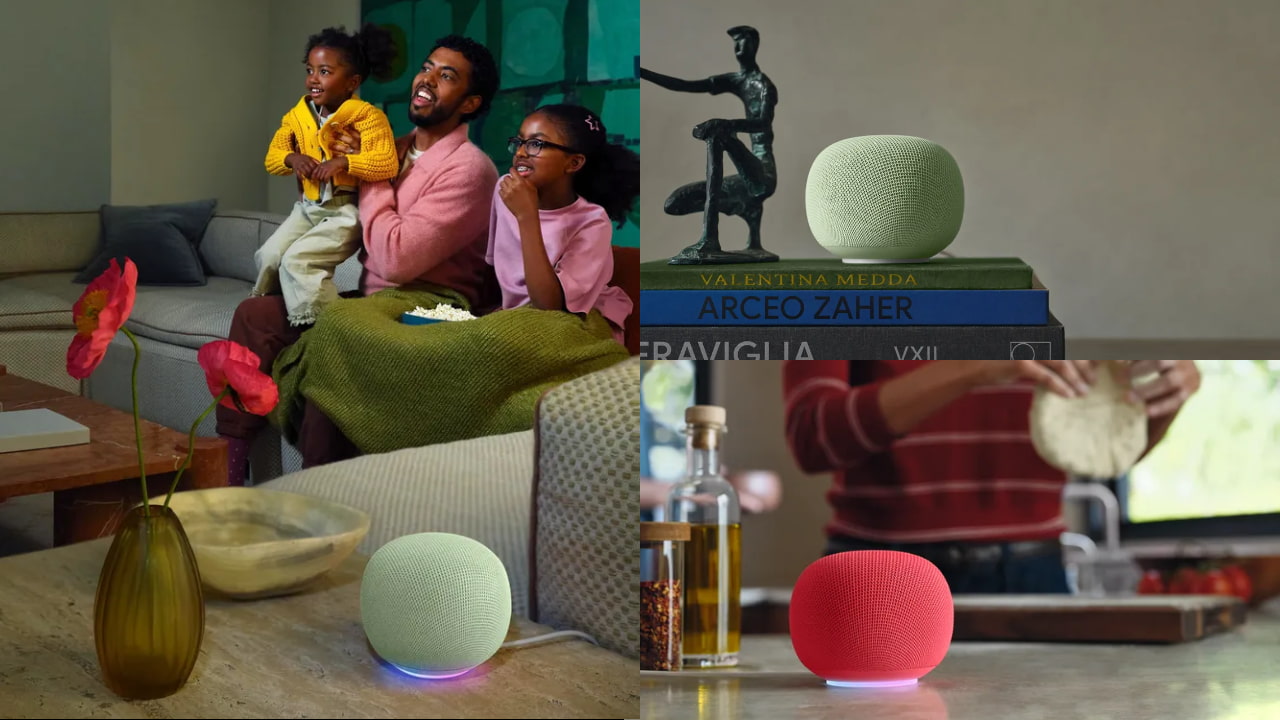
One or two Google Home Speakers can connect wirelessly to the Google TV Streamer and become its primary audio system. A single speaker replaces the television’s built-in sound, while two speakers can operate as a stereo pair and enable Google’s new Spatial Audio processing.
The complete two-speaker setup costs $299.97 before tax: $99.99 for the Google TV Streamer and $99.99 for each Home Speaker. Existing Google TV Streamer owners can add the stereo pair for $199.98. That puts the system below most premium soundbars and makes it potentially useful for bedrooms, apartments, offices, and smaller living rooms where an AVR, subwoofer, and several loudspeakers would be excessive.
Related Reviews:
Google Finally Connects Its Speakers to the Television
Google has had smart speakers, streaming hardware, multiroom audio, and voice control for years, but it never combined them into a particularly convincing television sound system.


The 2026 Google Home Speaker begins to close that gap. Each compact speaker uses a single 58mm full-range driver designed for omnidirectional playback. It also supports Wi-Fi 6, Bluetooth 5.4, Thread 1.3, Matter, and Google Cast speaker groups, while Gemini for Home handles voice commands and smart-home control.
Setup is handled through either the Google TV interface or Google Home app. Users can select up to two speakers, place them beside the television, assign the left channel, and activate Spatial Audio. The setup process asks for the approximate viewing distance and the distance between the speakers so Google can adjust its processing to the room.
Google says the two-speaker system simulates surround sound and creates the sensation that audio is arriving from multiple directions rather than only from the conventional left and right channels. It requires spatial-audio-encoded content from a supported streaming service.
That should provide wider imaging and greater immersion than most television speakers, which are forced into increasingly thin cabinets and often struggle with basic dialogue intelligibility. Two physically separated speakers also have an inherent advantage over a compact soundbar trying to create stereo width from beneath the screen.
Does It Support Dolby Atmos?
This is where the reporting has become muddled.
The Google TV Streamer unquestionably supports Dolby Atmos. Google lists Dolby Atmos among its supported audio formats and promotes the device as capable of delivering immersive 3D sound when connected to compatible audio equipment.
Google also says two Home Speakers can create immersive Spatial Audio.
What Google does not currently say is that the Home Speaker pair constitutes an officially supported Dolby Atmos playback system.
Google’s setup documentation repeatedly uses the terms “Spatial Audio,” “spatial surround sound,” and “simulates surround sound.” It does not state that the speakers decode Dolby Atmos, identify them as a Dolby Atmos system, or describe how an Atmos soundtrack is rendered through the pair.
Some reports have combined the Google TV Streamer’s confirmed Atmos support with the speakers’ confirmed Spatial Audio feature and concluded that the complete pairing supports Dolby Atmos. That conclusion may eventually prove correct. The streamer could decode an Atmos soundtrack and render it through Google’s virtual spatial processing.
But Google has not documented that signal path clearly enough to present it as being true.
The accurate description is that the Google TV Streamer supports Dolby Atmos, while two paired Google Home Speakers reproduce compatible spatial content through Google’s Spatial Audio processing. Until Google explicitly confirms Dolby Atmos rendering through the speakers, calling the combination a Dolby Atmos system goes beyond the available documentation.
A logo on one box and spatial processing in two others do not automatically produce a certified Atmos system, regardless of how enthusiastically the dots are connected.
How Apple Handles the Same Question


Apple is considerably more explicit.
Apple states that one full-size HomePod or a stereo pair connected to an Apple TV 4K can automatically reproduce Dolby Atmos, Dolby Digital 7.1, and Dolby Digital 5.1 soundtracks. The full-size HomePod’s specifications also list Spatial Audio with Dolby Atmos for music and video.
HomePod mini can still be used alone or as a stereo pair for Apple TV audio, but it does not reproduce Dolby Atmos or Dolby surround formats. Those soundtracks are rendered through the smaller speakers in mono or stereo.
Apple also supports HDMI ARC and eARC through Apple TV 4K models from the second generation onward. That allows compatible televisions to send audio from game consoles, disc players, cable boxes, and internal TV apps through the Apple TV and onward to the HomePod system.
Google has not documented an equivalent television-audio return feature for its Home Speaker pairing. The confirmed Google configuration handles audio from the Google TV Streamer. There is currently no official indication that a PlayStation, Blu-ray player, or television tuner can route its sound through the speakers.
That is an important practical difference.
Did tvOS 26 Expand Apple’s Atmos Support?
Not significantly.
tvOS 26 allows any AirPlay-enabled speaker to be selected as the Apple TV’s default audio output. However, that does not turn every AirPlay speaker into a Dolby Atmos home-theater system. When third-party AirPlay speakers are selected, Apple notes that system alerts and game sounds continue to play through the television rather than the wireless speakers.
Apple’s full Dolby Atmos home-theater implementation remains limited to one or two full-size HomePods.
tvOS 18.5 previously added Wireless Audio Sync calibration for Dolby Atmos playback over AirPlay or Bluetooth. That feature corrects timing between picture and wireless audio; it does not add Atmos reproduction to speakers that lack it.
As of July 15, 2026, tvOS 26.5 is the latest public release. Apple describes it as a performance and stability update, while tvOS 26.4 corrected an audio issue when moving between Atmos and stereo programming. Neither update added rear HomePods, four-speaker configurations, Atmos support for HomePod mini, or Dolby Atmos playback through generic AirPlay speakers.
Better Than a Soundbar?
Google’s system has several appealing qualities. It is inexpensive, wireless, compact, and provides genuine stereo separation. The speakers also remain useful as Gemini assistants, Matter hubs, Thread devices, and components in a Google Cast multiroom system.
The limitations are equally obvious.
There is no dedicated center channel, subwoofer, rear channel, or height driver. Google has not published amplifier output, frequency response, or maximum volume specifications. Each speaker relies on one small full-range driver, and the surround presentation is created through processing rather than discrete speakers around the room.
A system such as the Klipsch The Sevens II costs considerably more but offers larger drivers, deeper bass, HDMI eARC, multiple physical inputs, a subwoofer output, and more convincing performance with both music and movies. A Dolby Atmos soundbar can also provide dedicated height processing and broader television connectivity.
Google’s system is not designed to replace either of those options. It is an affordable alternative to weak television speakers for people already invested in Google TV and Google Home.
That is still a worthwhile improvement when you consider the price.

The Bottom Line
Pairing two Google Home Speakers with Google TV Streamer gives Google something it should have delivered years ago: a simple and relatively inexpensive wireless television-audio system that connects its streaming, smart-home, and voice-assistant platforms.
The system should create a wider and more immersive presentation than most built-in television speakers, and $300 for the streamer and stereo pair is not unreasonable.
It should not yet be described as a confirmed Dolby Atmos speaker system.
Apple clearly states that the full-size HomePod and Apple TV 4K combination reproduces Dolby Atmos. Google currently says its two-speaker pairing provides Spatial Audio that simulates surround sound. Those statements are not interchangeable.
Google has finally found its way into the living room. It still needs to explain exactly what kind of soundtrack followed it through the door.
You must be logged in to post a comment Login