Connect with us
DAPA Banner

Tech

Google Maps uses Gemini to write captions for your photos

Published

on

In short: Google Maps now uses Gemini to suggest captions when users share photos of places, launching on iOS in the U.S. and expanding globally to Android in the coming months, the latest step in a six-month campaign to weave AI into every layer of Maps.

Sharing a photo on Google Maps has always required a small act of will: you take the shot, upload it, and then stare at a blank text field deciding whether the restaurant you just visited warrants a full sentence or nothing at all. Most people choose nothing. As of 7 April 2026, Google is trying to fix that with Gemini. The company announced that Google Maps will now analyse uploaded photos and videos and automatically suggest a caption, giving contributors what it describes as a head start on writing. Users can accept, edit, or delete the suggestion. The feature is live now in English on iOS in the United States, with a global rollout to Android in the coming months.

The change is minor in scope and meaningful in intent. Google Maps is powered by user-generated content at a scale few platforms match: more than 120 million Local Guides contribute to the platform, collectively uploading an estimated 300 million photos per year and generating more than 20 million contributions every day, across reviews, ratings, edits, and imagery. That content forms the factual substrate of the map. The quality of a restaurant’s listing, the accuracy of a hotel’s photos, the legibility of a new business’s page, all of it depends on people choosing to write something rather than nothing when they open the share screen. Removing the friction of the blank text box, even slightly, is a data quality decision as much as a user experience one.

How Gemini captions work

The mechanics are straightforward. When a user selects a photo or video to share on Maps, Gemini analyses the image, identifies the subject and context, and generates a suggested caption. The user sees that suggestion before posting and can modify it freely or remove it entirely. Google has framed the tool as assistive rather than automated: the caption is a starting point, not a published output. That framing matters both for user trust and for the platform’s content standards, since a caption Google helped write would carry a different kind of liability if it were factually wrong.

Advertisement

The 💜 of EU tech

The latest rumblings from the EU tech scene, a story from our wise ol’ founder Boris, and some questionable AI art. It’s free, every week, in your inbox. Sign up now!

The feature builds on capabilities Google has been deploying in Maps for several months. In November 2025, the company introduced its first Gemini-powered navigation features, including landmark-based directions that tell drivers to turn “after the Thai Siam Restaurant” rather than “in 200 metres.” In January 2026, Gemini-assisted guidance expanded to cycling and walking. On 12 March 2026, Google announced Ask Maps, a conversational search mode drawing on more than 300 million places and 500 million community reviews to answer complex, natural-language queries, alongside Immersive Navigation, which it described as the biggest overhaul to driving directions in a decade. The AI photo caption feature is the next increment in that sequence, extending Gemini from navigation and search into the content creation workflow that keeps the map fresh. Last year’s aggressive AI deployment across Google’s product suite set the pace for this rollout, and Maps is now clearly a priority target.

The data flywheel behind the feature

The strategic logic is not hard to decode. Google Maps’ value proposition rests on having more accurate, more comprehensive, and more up-to-date information about more places than any competitor. That information advantage is maintained primarily through user contributions, not through Google’s own editorial staff. Anything that increases contribution volume — particularly captioned, contextualised photos rather than captionless image dumps — strengthens the map’s relevance for search and discovery. A photo with a descriptive caption (“wide outdoor seating, dog-friendly, gets busy after 6pm”) is more useful to someone planning a visit than an unlabelled image of a table.

Advertisement

The timing also reflects competitive pressure. ChatGPT’s expanding role in local search and recommendations has become a live concern for Google’s Maps and Search businesses, and as AI models begin to monetise local intent directly, the quality of the underlying place data they can draw on becomes a competitive moat. Google’s Local Guides network is one of its most significant proprietary assets in this context. Lowering the bar for high-quality contributions helps keep that dataset ahead of what rivals can source or replicate.

The quality paradox

There is a tension the caption feature will need to navigate carefully. Making it easier to share content on Maps does not automatically make the content better. Google removed more than 160 million photos and 3.5 million videos from Maps in its most recent content moderation period, citing policy violations or low quality. The platform also took down more than 960,000 reviews in 2024 that were flagged as fake or policy-breaching, and has since deployed Gemini specifically to detect AI-generated reviews and suspicious profile edits. Lowering the friction of photo sharing means lowering the friction for poor-quality or manipulated content as well as good-quality contributions.

Google’s apparent answer is to use the same AI that generates captions to assist moderation — using Gemini both to write content and to screen it. That dual role is becoming a structural feature of large platforms managing AI-assisted user-generated content, and it raises questions about governance that extend well beyond maps or photos. The governance of AI in content pipelines remains one of the unresolved infrastructure challenges of this moment, and the Maps caption feature is a small but instructive case study: beneficial automation and content risk reduction require the same underlying model to play two opposing roles simultaneously.

iOS first, then the world

The iOS-first, U.S.-first rollout is consistent with Google’s standard pattern for Gemini feature launches. Ask Maps launched in the U.S. and India before expanding; Immersive Navigation started with U.S. drivers before moving to other markets. The English-only restriction on captions reflects the additional complexity of generating contextually appropriate, grammatically natural text in languages where AI performance varies more significantly. An expansion to Android and to non-English markets “in the coming months” is the expected trajectory, though Google has not specified which languages will follow first.

Advertisement

The competitive landscape for AI-assisted mapping is also shifting at the model infrastructure level. Microsoft’s push for model independence from OpenAI includes vision and multimodal capabilities that could eventually power competing location-based features, and the image understanding underpinning Google’s caption suggestions is precisely the kind of capability where the gap between frontier models and mid-tier alternatives is narrowing quickly. For now, Google’s advantage is integration depth rather than raw model performance: Gemini works inside Maps because Maps is Google’s, and no competitor has equivalent leverage over the contribution workflow of 120 million users.

The blank caption box has existed in Google Maps for years. It turns out the simplest way to get people to fill it in is to fill it in for them and let them decide whether to keep it.

Source link

Advertisement
Continue Reading
Click to comment

You must be logged in to post a comment Login

Leave a Reply

Tech

Motorola’s Souped-Up Folding Phone Is Almost Half Off

Published

on

For a limited time, you can grab the Motorola Razr Ultra with 16 GB of memory and 512 GB of storage for just $700, a $600 discount from its usual price. It’s our favorite folding smartphone, with excellent performance, full-day battery life, and all the trappings you’d expect from a phone that doesn’t also fold in half.

  • Photograph: Julian Chokkattu

  • Photograph: Julian Chokkattu

  • Photograph: Julian Chokkattu

Motorola

Razr Ultra (2025)

While they may look similar to previous generations of Motorola Razr, there are quite a few under-the-hood improvements for the 2025 model. The Ultra model has the Qualcomm Snapdragon 8 Elite chip, paired with 16 GB of memory, for super snappy performance in everyday use and while gaming. It has an upgrade 4,700-mAh battery, which our reviewer Julian Chokkattu found was easily able to make it through a full day of use with around a quarter of its charge left. If you’re a heavy user and find yourself running low often, there’s 68-watt wired charging and 30-watt Qi wireless charging support to bring you back to life.

Advertisement

There’s no need to worry about the hinge in the middle breaking over time, as all the 2025 Razr models feature a titanium-reinforced hinge plate that should hold up well to daily use. While beauty is subjective, these phones really stand out, with beautiful Pantone color options and unique materials for the case. The screens are more durable too, with ceramic glass coating, and the Ultra features a proper AMOLED internal display with a refresh rate up to 165 Hz, perfect for gaming or smooth scrolling. The exterior screen is a 4-inch pOLED, which also has a 165-Hz refresh rate, so you can check notifications, respond to messages, and even catch a quick selfie without opening your phone.

If you’re ready to flip for this awesome Android smartphone, head on over to Amazon to grab the Motorola Razr Ultra in Pantone Scarab for just $700. If you don’t like the green, for $100 more you can upgrade to one of the other Pantone colors, Cabaret, Rio Red, or Mountain Trail. If you’re curious what the competition looks like, make sure to check out our guide to the best folding phones.

Source link

Advertisement
Continue Reading

Tech

Snap’s AR glasses inch closer to reality with Qualcomm Snapdragon chips

Published

on

Snap’s AR glasses ambitions might be starting to look a lot more real. In an official announcement, Snap has said it has expanded its partnership with Qualcomm through a multi-year strategic agreement that will bring Qualcomm’s Snapdragon silicon to future generations of Specs.

The company describes this as the first flagship engagement for Specs Inc, which will be launching Specs wearable later this year.

What was revealed in the announcement

According to Snap, future Specs devices will run on Qualcomm’s Snapdragon XR platforms, while the company says it will provide the foundation for edge AI, on-device processing, advanced graphics, and lower-power performance. Snap is framing this mix as essential for building AR glasses.

Snap is clearly trying to position Specs like an always-on computer instead of the tethered demos.

Why this actually matters for Snap

Sony has been working on AR eyewear for years through Spectacles, but this latset announcement seems more serious because it is tied to a long-term hardware roadmap. The company says its collaboration with Qualcomm already stretches back more than five years, with Snapdragon platforms having powered multiple earlier generation of Spectacles.

Advertisement

So the new agreement is meant to provide a more predictable foundations for developers and partners building apps for the platform. Snap also added that the collaboration will focus on things like on-device AI, improved graphics, and advanced multiuser digital experiences. In simplers terms, Snap is saying it wants its glasses to handle AR interactions without feeling slow, power-hungry, or dependent on a phone.

There is still a lot that Snap isn’t saying yet. The company hasn’t shared detailed consumer hardware specs, pricing, or launch timing beyond later in 2026. Though, Snap clearly wants developers and buyers to see Specs as a long-term computing platform, and Qualcomm is now being positioned as the chip partner that could help make it possible.

Source link

Advertisement
Continue Reading

Tech

Google News Now Prominently Featuring Polymarket Bets

Published

on

Futurism found that Google News is surfacing Polymarket betting pages alongside traditional news sources. “The bets often appear in the ‘For you’ section of Google News, which is tailored to a user’s personal interests,” the publication reports. “In one instance, it was even the very top result, as with this bet on the price of Bitcoin.” From the report: In our testing, Polymarket bets are also showing up on the Google News home page. But links from the prediction market can pop up all over Google News, including in searches. In further tests, looking up “will ships transit the strait,” referring to the Strait of Hormuz, returned numerous credible sources like Financial Times, The Guardian, and Reuters. Just below them, however, was a Polymarket bet on the number of ships that would be allowed to pass through the critical oil passageway.

This doesn’t appear to be an accident. When searching “Polymarket” in its search bar, Google News now allows users to choose it as a “source,” directing them to a page that aggregates other Polymarket hits. It’s not the only non-news site that’s selectable as a source — looking up “Reddit” and “X” offers the option, too — but searching for “Kalshi,” another prediction market and Polymarket’s main competitor, doesn’t give the option to use it as a source. […] In light of all this, Polymarket appearing in Google News is a major victory for the prediction platform — rubber-stamping its image as an authority on developing real-world events right alongside genuine real publishers of journalism.

Source link

Continue Reading

Tech

Microsoft Is Scrubbing the Copilot Name From Some Windows 11 Apps

Published

on

AI Atlas

Tired of seeing the Copilot AI logo appear everywhere in Windows 11? It may be getting at least a little less ubiquitous. Reports this week found the latest Insider version of Windows 11, version 11.2512.28.0, has removed Copilot language from key places such as the computer’s Notepad app. 

Previously, Notepad used Copilot to offer generative writing help, with a button featuring the AI tool’s swirly logo on the top right of the toolbar. Options included writing from scratch with prompts, rewriting, changing tone and more. In the latest update, the Copilot language has disappeared from Notepad, and the feature has been renamed “Writing tools.”

“Writing tools” appears to offer all the same AI features Copilot did, just without the name. The Copilot branding has also vanished from Notepad settings, with AI tools now relegated to the Advanced Features section. This change follows reports from March that Microsoft is quietly backing away from pushing Copilot into so many parts of Windows 11. 

Advertisement

That’s not entirely surprising. AI is one of the least popular things in the US in 2026. Copilot has drawn particular ire on Reddit and other social media sites.

Right now, it looks like Microsoft is pausing its Copilot expansion and removing the branding while leaving the AI features themselves intact, at least on Notepad. Other reports suggest that AI features have disappeared entirely from the Windows 11 Snipping Tool. 

Again, it’s only the Insider version of Windows 11 that shows these Copilot changes for now. When I booted up my standard version of Notepad, Copilot was still there. So unless you’re signed up for early versions of Windows updates, you’ll have to wait for these changes to take effect. 

Microsoft did not immediately respond to a request for comment.

Advertisement

Source link

Continue Reading

Tech

‘I’m Alarmed’: Senator Opens Inquiry Into the Ways Tech Companies Report Suspected Child Abuse

Published

on

Amazon’s AI services division filed 1.1 million reports of suspected online child exploitation in 2025 to an advocacy group. But because those reports lacked essential information, there were zero cases where law enforcement was able to take action. A new inquiry opened in the Senate aims to ensure that never happens again.

Sen. Chuck Grassley, an Iowa Republican who chairs the Senate Judiciary Committee, this week opened an inquiry into eight big tech companies over their handling of mandatory reporting of online child exploitation. It’s the latest step in a growing movement questioning whether tech companies can be trusted to keep their youngest users safe while online.

Electronic service providers are required by law to report incidents of child sex exploitation to the CyberTipline run by the National Center for Missing and Exploited Children. In 2025, over 17 million reports of suspected online child sex exploitation were filed. But these reports may not have the necessary information to prompt action in the real world.

Advertisement

“I’m alarmed by what I’ve read,” Grassley said. “Based on information provided to my office, I am concerned that some companies have not provided NCMEC and law enforcement with sufficient data needed to protect kids and prosecute suspected predators.”

AI Atlas

Grassley sent requests for more information to several major tech companies: Meta, TikTok, Roblox, Snap, Amazon AI Services, xAI, Grindr and Discord. These eight companies make up 81% of all child exploitation reports submitted to NCMEC. Notably absent from the inquiry was Google, owner of YouTube. 

A Meta spokesperson told CNET the company “works tirelessly” to protect kids from this “horrific crime,” stating: “We’re committed to constant improvement and appreciate feedback, which has already led us to make some improvements, as NCMEC has acknowledged. We will continue making refinements to improve our reporting process.” 

Grindr, Discord and Roblox made similar comments, saying they plan to work with the Senate and NCMEC on these issues. Grindr added that its dating site is only for adults, aged 18 and up. The other tech companies did not immediately respond to requests for comment. 

Advertisement

The Iowa Republican’s inquiry follows reports from NCMEC in 2025 that tech companies were failing to provide essential location data in their reports and failing to disclose their use of child sex abuse material in AI data training. This is especially concerning given previous incidents of AI being used to create nonconsensual intimate imagery, including child sex abuse material.

Child exploitation online is a growing issue. In 2025, Meta alone filed nearly 11 million reports, 1.2 million of which dealt with suspected child trafficking. Meta owns the popular platforms Facebook, Instagram and WhatsApp. NCMEC said in 2025 that Meta and xAI had improved their reporting, but it was still lacking.

“Many ESPs regularly tout the number of reports they submit to the CyberTipline, but fail to disclose that millions of reports lack basic information,” NCMEC wrote to Grassley in 2025. “This leaves children unprotected online, subjects survivors to revictimization, enables sexual offenders to remain freely online and wastes valuable and limited law enforcement resources.”

There has been movement in other branches of government to hold tech companies accountable for child safety. Meta was recently found liable by a New Mexico jury for misleading users about the safety of its platforms and failing to prevent child exploitation. The company was ordered to pay $375 million in damages. One day later, Meta and Google were found liable by a California jury for creating social media platforms that are addictive to children.

Advertisement

The first person was convicted on Tuesday under the new US anti-AI deepfake law, the Take It Down Act, for creating AI-generated child sex abuse materials.

Source link

Advertisement
Continue Reading

Tech

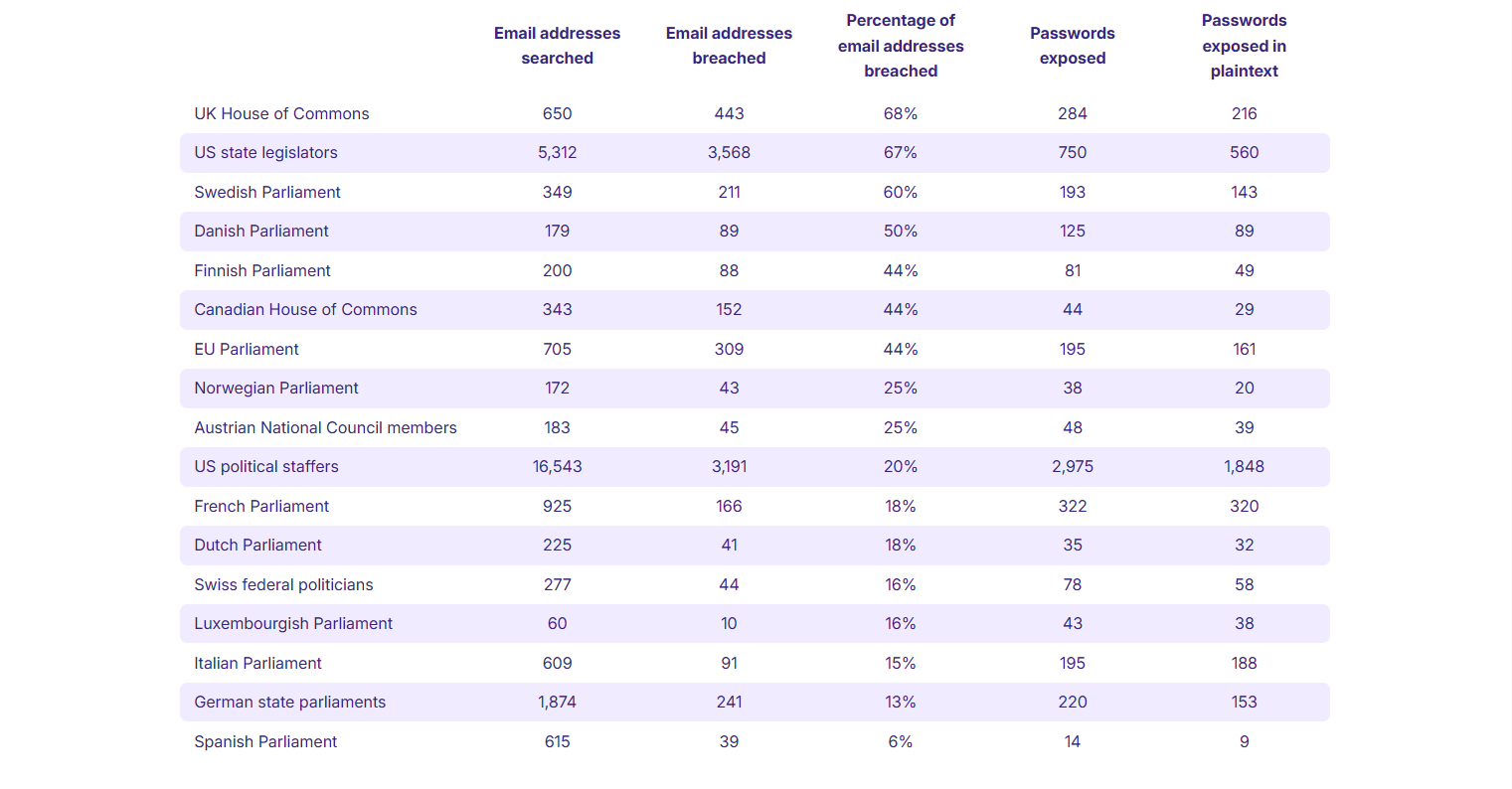
‘It’s a potential national security threat’: Proton study finds over 3,500 US legislators’ official emails leaked and exposed on the dark web

Published

on


  • Thousands of official government email addresses are exposed online
  • Credentials including plaintext passwords are available on the dark web
  • The UK has the highest percentage of exposed credentials

The official email accounts of public officials all over the world have been leaked online, with many exposed alongside their plaintext passwords, making it trivial for an attacker to breach their accounts.

Researchers at Proton scoured the darker side of the internet for the publicly available email addresses of government officials – and discovered thousands of exposed credentials.

Source link

Advertisement
Continue Reading

Tech

This Week In Security: Flatpak Fixes, Android Malware, And SCADA Was IOT Before IOT Was Cool

Published

on

Rowhammer attacks have been around since 2014, and mitigations are in place in most modern systems, but the team at gddr6.fail has found ways to apply the attack to current-generation GPUs.

Rowhammer attacks attach the electrical characteristics of RAM, using manipulation of the contents of RAM to cause changes in the contents of adjacent memory cells. Bit values are just voltage levels, after all, and if a little charge leaks across from one row to the next, you can potentially pull a bit high by writing repeatedly to its physical neighbors.

The attack was used to allow privilege escalation by manipulating the RAM defining the user data, and later, to allow reading and manipulation of any page in ram by modifying the system page table that maps memory and memory permissions. By 2015 researchers refined the attack to run in pure JavaScript against browsers, and in 2016 mobile devices were shown to be vulnerable. Mitigations have been put in place in physical memory design, CPU design, and in software. However, new attack vectors are still discovered regularly, with DDR4 and DDR5 RAM as well as AMD and RISC-V CPUs being vulnerable.

The GDDR6-Fail attack targets the video ram of modern graphics cards, and is able to trigger similar vulnerabilities in the graphics card itself, culminating in accessing and changing the memory of the PC via the PCI bus and bypassing protections.

Advertisement

For users who fear they are at risk — most likely larger AI customers or shared hosting environments where the code running on the GPU may belong to untrusted users — enabling error correcting (ECC) mode in the GPU reduces the amount of available RAM, but adds protection by performing checksums on the memory to detect corruption or bit flipping. For the average home user, your mileage may vary – there’s certainly easier ways to execute arbitrary code on your PC – like whatever application is running graphics in the first place!

NoVoice Android Malware

McAfee identified a malware campaign in the Android Play store targeting older devices – using vulnerabilities publicly disclosed and patched between 2016 and 2021 – that was still found in over 50 apps in the official Google store.

All of the infected apps are built using a modified Facebook SDK to avoid detection, which unpacks the actual malicious payload from inside a PNG polyglot image. By using a common SDK found in millions of apps, the app looks like any other app using common libraries, even when viewing a decompiled list of classes referenced inside the binary.

Polyglot files are files that contain multiple valid file formats simultaneously – for instance a single file for Windows, Linux, or Web Browser or a JPEG containing a ZIP of all the works of Shakespeare. Polyglot files are possible because different formats often look for the start of data at different locations or when one file format denotes the length of valid data and happily ignores extraneous information. For malware, polyglot files are often used to hide malicious content in ways that detection tools or researchers may not spot.

Advertisement

Once the malicious payload is extracted from the PNG image in the app, the malware collects a fingerprint of the device, contacts a control server, and downloads exploits for that specific version. After gaining root, the exploit disables SELinux protections and replaces core system libraries with Trojan copies that impact every app. McAfee reports 22 different exploits in use, including Linux IPv6 kernel and Android GPU driver vulnerabilities, however all of the exploits used were fixed as of the 2021-05-01 Android security patches.

Ultimately, the malware steals authentication tokens and message databases from WhatsApp, reading them out of the local storage of the app, extracting the key from the running WhatsApp instance, and sending the decoded databases to a remote service. The malware also contains mechanisms to survive a factory reset by modifying the system partition of the device, but a full firmware re-install is still enough to get rid of it.

Unfortunately, older Android devices are still prevalent, and devices no longer supported by their manufacturers are still vulnerable to exploits based on publicly known and fixed security issues. There isn’t a good solution for devices abandoned by manufacturers, other than alternative firmware like LineageOS, but users of devices stuck on old firmware may also not be tech savvy enough, interested enough, or in a position to risk the device becoming nonfunctional by installing custom firmware.

Flatpak and XDG Fixes

Flatpak 1.16.4 and xdg-desktop-portal 1.20.4 have been released to address multiple security issues:

Advertisement
  • CVE-2026-34078 in Flatpak allows a complete sandbox escape from the jailed app environment
  • CVE-2026-34079 allows deleting any file on the host environment
  • GHSA-2fxp-43j9-pwvc allows read access to files accessible by the Flatpak system helper, a system service for integrating Flatpak apps with the rest of the system environment
  • GHSA-rqr9-jwwf-wxgj in xdg-desktop-portal which allowed writing to arbitrary system files, independent of the bug in Flatpak itself

Flatpak is a Linux application packaging format that aims to provide installations that work on any Linux distribution. Normal packaging formats like deb and rpm are tightly linked to the specific version of the specific distribution they are built for. Flatpak packages all dependencies for an application, which increases the package size but reduces the load on the developer to provide builds for every possible variation. xdg-desktop-portal is a companion helper to Flatpak to manage access to system resources like screenshots, opening files outside the sandbox, and opening links in the default browser.

Flatpak attempts to introduce a modern sandboxing security model on top of Linux apps, similar to the restricted access model most mobile apps run under on Android or iOS. Traditionally, any code running has the permissions of the user running it; reducing that access can reduce the attack surface. Flaws in the sandboxing code can allow exploits in an app to impact the rest of the system.

Almost all modern Linux distributions include Flatpak support, and it may not even be obvious to users when a package comes from Flatpak versus a traditional package – many commercial Linux applications like Slack and Steam distribute as Flatpak images, and many open source tools also provide images. For all our Linux users – make sure you’ve applied any pending security updates in your distribution!

Minnesota Ransomware

In an example of real-world impacts, Minnesota has requested assistance from the National Guard after a significant ransomware attack against Winona County. The state has asked the National Guard to assist in recovering from an attack impacting unspecified systems, but which apparently was severe enough that local and state resources weren’t enough. The only definitive statements from county officials are that emergency dispatch and 911 services are not disrupted – a frighteningly low bar you hope to not see. This is the second ransomware attack this county has seen this year, reportedly from unrelated attackers.

While high-profile ransomware attacks against governments and major corporations get lots of press, smaller companies are also impacted. Ransomware continues to be a pervasive problem, especially for organizations with a small – or even no – official IT department or security positions. Many security companies offer discounted or sometimes even free support to small companies and non-profits; if this is you, there’s no better time to look into multi-factor authentication, account privilege auditing and limiting, and testing your (offline) backups!

Advertisement

Router Hacks Redirect DNS

Following on with the real world impacts of some of the advisories, Lumen reports a widespread campaign to exploit home routers and install authentication-hijacking malware.

The attack targets TP-Link and MikroTik routers: TP-Link is a common home router brand, while MikroTik is more common in small business and remote office environments. Lumen comments that the attack seems to focus on older models, implying that it is using older, publicly disclosed vulnerabilities in devices which have been designated end-of-life by the manufacturers. Nearly 20,000 unique IPs were seen communicating with the control servers, so there were a lot of unmaintained routers out the Internet.

Once the router was compromised, the attackers used DNS redirection to send users to fake login pages to capture authentication info for Microsoft Office and other corporate resources. By hijacking DNS in the router and passing a custom DNS server over DHCP to local systems on the network, the attackers controlled the login pages. While DNS level attacks can’t defeat protections like SSL, users may not notice that they are being phished with an unencrypted login lookalike site, or they might just ignore the SSL warnings and click through anyhow.

Lumen credits Russian state actors with the attack, with the victims including national and local governments and regulatory agencies.

Advertisement

Malware on 3D Printer Repos

Striking closer to home, this Reddit post points out a malware campaign targeting sites holding models for 3D printers such as Printables, Thingiverse, and Makerworld.

Abusing the ability to upload arbitrary files to the model sites, the goal appears to be to trick the user into downloading a zip file containing Blender assets with instructions on “how to convert them to a STL”. Unfortunately, Blender has an embedded scripting environment (Python) – opening untrusted Blender ‘blend’ files allows direct execution as the user running Blender! The malicious files and instructions then download traditional malware and infect the user. Vendors of 3D assets have experienced this before, but it may be a first for the printing sites to deal with.

The campaign appears to have been stopped a few days later, with the original poster reporting that the flood of fake accounts appears to have stopped a few days later.

Unfortunately this goes to show that constant vigilance is needed – if something that should be a basic 3d model expects you to download additional tools to convert it to the format used everywhere else on the site, it’s probably worth being suspicious. Formats with embedded scripting environments are a new level of unexpected behaviors users have to be aware of – difficult if you’re not already a Blender user familiar with the capabilities and risks!

Advertisement

PLC takeover

Finally, this week’s “you hope it’s not your problem” is an advisory from CISA, the United States cyber security agency. It appears that Iranian state-sponsored agents have been attacking Programmable Logic Controller (PLC) systems. Usually outside the realm of the home hacker, PLC systems like these are used to control factories, power plants, water treatment facilities, and other industrial scale facilities.

Before the Internet of Things took the reins as the joke category for security — “the ‘S’ in IOT stands for security” — one of the strongest contenders was SCADA, or Supervisory Control and Data Acquisition devices. SCADA fills a suspiciously parallel role to IOT in the industrial space, providing network monitoring and control of physical systems, and suffers some of the same fate. A SCADA system may be too difficult to update, too important to risk the downtime of a change gone wrong, or simply too legacy to have support from the manufacturer, and like an IOT device, generally isn’t expected to be exposed to the entire Internet.

Out of the realm of most people – even technically inclined ones – SCADA attacks may still be some of the highest profile attacks someone has heard of. The Stuxnet worm in 2010 targeted SCADA control systems and modified PLC-controlled centrifuges used for uranium refinement. In 2015 and 2016 the Ukrainian power grid suffered two major attacks targeting the SCADA control systems, closing breakers and forcing manual intervention at each substation to restore power to 250,000 people. The attacks evolved into the ‘CRASHOVERRIDE’ malware, which is specifically designed to target power grid SCADA control systems.

The simplest fix is to ensure these systems are never connected to the Internet at large. (If simple can be said to apply to processes controlling multi-million dollar facilities.) But even separated from direct connections, systems that cannot be safely updated to patch security concerns will always be at risk of router and firewall appliance compromises, or compromised PCs or laptops allowed onto the control network.

Advertisement

Source link

Continue Reading

Tech

Suspect Arrested For Allegedly Throwing Molotov Cocktail at Sam Altman’s Home

Published

on

San Francisco police arrested an individual early on Friday morning for allegedly attacking the home of OpenAI CEO Sam Altman and making threats outside of the company’s headquarters, a spokesperson confirmed to WIRED. OpenAI’s corporate security team sent a note to employees about the incident on Friday.

“At approximately 3:45am PT, an unidentified individual approached Sam’s residence and threw an incendiary device toward the property. The device landed nearby and extinguished. There were no injuries and only minimal damage was reported,” the message to staff reads.

“Shortly afterward, an individual matching the suspect’s description was contacted by security outside MB1,” the message continues, referring to OpenAI’s headquarters in San Francisco’s Mission Bay neighborhood. “This person made threatening statements about the building.”

OpenAI’s corporate security team told staff that it is cooperating with law enforcement to assist with an investigation, and that employees may notice an increased police and security presence around the office on Friday. The security team said that the company’s offices remain open, but employees were advised to “not let anyone tailgate into the building.

Advertisement

“Early this morning, someone threw a Molotov cocktail at Sam Altman’s home and also made threats at our San Francisco headquarters. Thankfully, no one was hurt,” said OpenAI spokesperson Kayla Wood in an email to WIRED. “We deeply appreciate how quickly SFPD responded and the support from the city in helping keep our employees safe. The individual is in custody, and we’re assisting law enforcement with their investigation.”

The San Francisco Police Department did not immediately respond to a request for comment.

This is a developing story. Please check back for updates.

Source link

Advertisement
Continue Reading

Tech

LG G6 vs. C6 OLED TVs: What’s actually different, and which one should you buy?

Published

on

LG’s 2026 OLED lineup is headlined by the G6, but the C6 is likely the model most people will end up considering. On paper, both TVs share a lot, including LG’s new Alpha 11 AI processor Gen 3, along with similar gaming features and AI-driven tools.

After seeing both models up close during LG’s recent reviewer workshop at its U.S. headquarters in New Jersey, the overlap becomes even more apparent, but so do the areas where they start to separate.

The differences aren’t always obvious at first glance. If you’ve been trying to figure out what actually separates the G6 from the C6, and which one makes more sense for your setup, here’s what you need to know.

The G6 is where LG is pushing OLED the hardest

The G6 is positioned as LG’s flagship, and the focus this year is clearly on brightness.

It combines a new panel with Hyper Radiant technology and LG’s Brightness Booster Ultra system, with claims of up to 3.9 times the brightness of a standard OLED. In real use, that shows up most clearly in HDR highlights and brighter scenes, where the G6 has more punch and better visibility.

Advertisement

At the same time, LG is maintaining core OLED strengths. The G6 is certified for both “perfect black” and “perfect color,” so contrast and accuracy remain intact alongside the brightness gains.

The C6 carries more of that experience than you’d expect

While the G6 leads on paper, the C6 doesn’t feel like a major step down.

It runs on the same Alpha 11 AI processor Gen 3 and includes many of the same core features, including Dolby Vision, Dolby Atmos, and LG’s updated AI-driven picture and sound tools.

Brightness is improved over previous generations, even if it doesn’t reach the same peak levels as the G6. For most viewing scenarios, the gap is present but not always dramatic unless you are specifically comparing HDR-heavy content side by side.

Gaming performance is essentially identical

This is where the distinction between the two models almost disappears.

Advertisement

Both the G6 and C6 support 4K at 165Hz, along with VRR, Nvidia G-Sync, and AMD FreeSync Premium. That level of support puts them closer to high-end gaming monitors than traditional TVs.

LG is also focusing on low input lag and smoother motion handling, which makes both models equally capable for fast-paced gaming. If gaming is your priority, there’s little reason to choose one over the other.

AI features are shared, not exclusive

Both models use the same processing platform, and that shows in how similar their feature sets are.

AI Picture Pro handles real-time image optimization, while AI Sound Pro can simulate virtual 11.1.2 surround sound. There’s also a personalization layer that adapts picture and audio settings based on your preferences over time.

Advertisement

Filmmaker Mode with ambient light compensation adds another layer by adjusting the image based on room lighting without sacrificing accuracy.

Where the gap really starts to show

The biggest differences come down to performance ceiling and positioning.

The G6 is built to push OLED further, especially in brightness and overall visual impact. It is also the model that scales up to larger, premium sizes, going as high as 97 inches.

The C6 is designed to be more flexible. It starts smaller, at 42 inches, and is priced to fit a wider range of setups, from bedrooms to living rooms.

So which one actually makes more sense?

For most people, the C6 is the more balanced option. It delivers the key improvements LG is focusing on this year, including better brightness, updated processing, and strong gaming performance, without pushing into flagship pricing.

Advertisement

The G6 still has the edge in peak performance, especially if brightness is a priority or you’re building a high-end home theater. But the gap between the two isn’t as wide as you might expect in everyday use.

Source link

Advertisement
Continue Reading

Tech

“Uncanny Valley”: OpenAI and Musk Fight Again; DOJ Mishandles Voter Data; Artemis II Comes Home

Published

on

This week, our hosts discuss why OpenAI and Elon Musk’s legal feud is heating up once again—and happening alongside SpaceX’s IPO filing. They also dive into how a Department of Justice lawyer misled a judge about how they’re handling voter data, and why the Artemis II’s launch captured all of our imaginations.

Articles mentioned in this episode:

You can follow Brian Barrett on Bluesky at @brbarrett and Leah Feiger on Bluesky at @leahfeiger. Write to us at [email protected].

How to Listen

You can always listen to this week’s podcast through the audio player on this page, but if you want to subscribe for free to get every episode, here’s how:

Advertisement

If you’re on an iPhone or iPad, open the app called Podcasts, or just tap this link. You can also download an app like Overcast or Pocket Casts and search for “uncanny valley.” We’re on Spotify too.

Transcript

Note: This is an automated transcript, which may contain errors.

Brian Barrett: Hey, it’s Brian. Zoë, Leah and I have really enjoyed being your new hosts these past few weeks, and we want to hear from you. If you like the show and have a minute, please leave us a review in the podcast or app of your choice. It really helps us reach more people. And for any questions and comments, you can always reach us at [email protected]. Thank you for listening. On to the show. Welcome to WIRED’s Uncanny Valley. I am Brian Barrett, executive editor.

Leah Feiger: And I’m Leah Feiger, senior politics editor.

Advertisement

Brian Barrett: This week, we’re discussing why OpenAI and Elon Musk’s feud in the courts is starting to heat up again. And speaking of Musk, we’re going to go over some key takeaways from SpaceX’s recent confidential IPO filing. Then we’ll dive into the rising concerns around how some agencies in the current administration are handling voter data. And finally, let’s get away from it all and go to outer space and talk about why the Artemis II launch was such a big deal for everyone watching.

Leah Feiger: Before we dig into our lineup this week, we do briefly have to talk about what happened between the U.S. and Iran in recent days.

[Archival audio]: President Trump is threatening Iran again, writing online this morning Trump said, quote, “A whole civilization will die tonight never to be brought back again.”

[Archival audio]: Moments ago, President Trump once again reiterated his threat to devastate Iran if a deal is not reached before the deadline he set of 8:00 PM Eastern time tonight.

Advertisement

[Archival audio]: Breaking news out of the White House, the U.S. President has agreed to a two-week ceasefire.

Leah Feiger: The entire situation was very odd. I guess this is how global politics happens these days. I’m so curious for your thoughts.

Brian Barrett: Well, yeah, talk about what happened or more specifically what didn’t happen this week, which was potential World War III. We were on the brink of it feels like, and I don’t think that’s… It’s interesting, there were good odds that Trump was bluffing, right? Because he has done this time and again, he says, “Here’s this deadline,” and then he pushes it back. But what he’s bluffing about has gotten really alarming and it’s only a bluff until it’s not. You know what I mean? I think threatening to annihilate an entire civilization, terrifying stuff, even if it’s bluster. Terrifying bluster.

Source link

Advertisement
Continue Reading

Trending

Copyright © 2025