












The acquisition is the latest attempt by Nvidia to pull ahead in the global AI race.
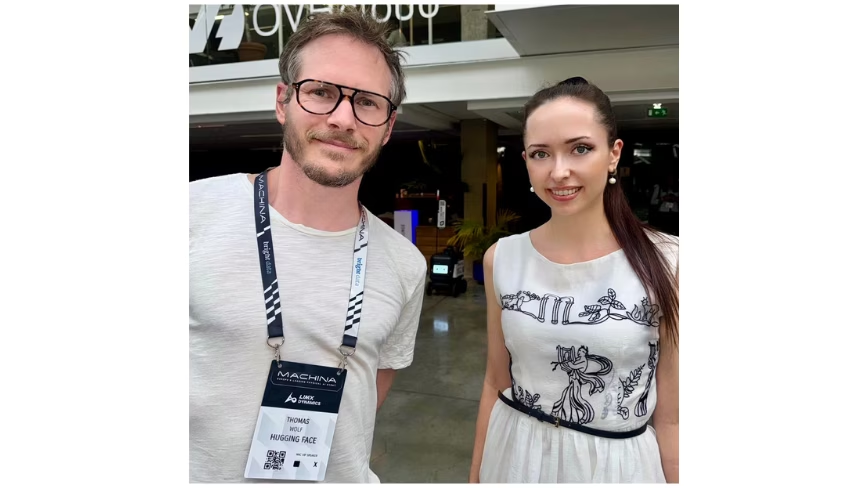
Nvidia has agreed to acquire open-source AI and machine learning platform Hugging Face for $12.9bn, according to announcement released today (3 September).
In a statement, Nvidia said that as part of the acquisition, the organisation will scale Hugging Face’s platform, strengthen its infrastructure and expand AI access for developers and institutions across the world.
The company also explained that Hugging Face will continue to serve as an open platform for the AI ecosystem, where developers can select their models, frameworks, cloud, inference service providers and computing platforms. Additionally, users will still be able to build or deploy via Hugging Face without Nvidia compute.
The deal is expected to close in the first half of 2027, pending regulatory approval, according to a number of outlets.
Rumours of a Hugging Face acquisition first surfaced last week, after Business Insider reported that the platform was exploring a sale.
Commenting on the announcement, Nvidia’s president and CEO Jensen Huang said: “Recently, I co-authored an open letter on the importance of open weights to the AI economy. Joined by leaders from across the industry, we made a simple point: open weights broaden access to AI and help ensure that AI leadership is distributed across companies, institutions and communities.
“Open models let start-ups, businesses, universities and public institutions build on advanced capabilities without training every model from scratch. They enable organisations to match the right model to the right job.
“That is how AI can advance safely, strengthen cybersecurity and sovereignty, accelerate innovation, and reach factories, hospitals, farms, classrooms and main street businesses around the world.”
Hugging Face made headlines in July after AI models developed by OpenAI were able to breach containment during testing and hack into the platform and a connected third-party business.
The incident sparked serious concerns in the tech industry around AI’s rapidly advancing ability to bypass boundaries and, effectively, go ‘rogue’.
Shortly afterwards, Nvidia formed an alliance with other companies in the technology space in the wake of the Hugging Face breach. The alliance was created in order to develop and share tools designed for enhanced AI safety and cybersecurity.
‘Corporate scouting ground’
Commenting on today’s announcement, Forrester principal analyst Naveen Chhabra said Nvidia is “clearly on the path to vertical integration”, which he said is good for Nvidia’s business, “but not necessarily for the market overall”.
“Nvidia gains visibility into customer’s preferences and the AI models they use. They can see which models are trending, what datasets customer are downloading, and the architectures that are gaining traction weeks before they hit mainstream tech news,” said Chhabra. “It turns Hugging Face into a corporate scouting ground and an unparalleled market intelligence machine.
“Nvidia also gets data-driven foresight into what next-generation chip architectures they need to build based on developer habits.
“They are securing the software layer because hardware-only companies get commoditised over time.”
The acquisition is Nvidia’s latest major financial investment in AI.
Earlier in the week, Nvidia announced plans to invest $3.5bn into MediaTek, a Taiwanese semiconductor company. The investment is part of a partnership designed to develop the next generation of AI computing platforms.
In late July, it was reported that Nvidia would be joining forces with Safe Superintelligence in a long-term strategic partnership to help the AI company in its growth plans. It was reported that the collaboration involves the investing of $5bn into the company.
And in August, the Wall Street Journal reported that Nvidia is planning to use its $6bn deal with AI start-up Poolside to build open-weight AI models to rival those made by China’s DeepSeek and Moonshot.
With additional reporting by Colin Ryan
Don’t miss out on the knowledge you need to succeed. Sign up for the Daily Brief, Silicon Republic’s digest of need-to-know sci-tech news.
Updated, 5.13pm, 3 September 2026: This article was amended to include a comment from Forrester principal analyst Naveen Chhabra.












































You must be logged in to post a comment Login