Connect with us
DAPA Banner

Tech

Hegseth’s War On Anthropic Encounters The First Amendment

Published

on

from the yet-another-unanticipated-defense dept

The expression, “to make a federal case out of something” usually describes making a bigger deal out of something than it should be. But in the case of Anthropic and Hegseth, Trump, and the Department of Defense*, this federal case is actually quite simple: what the government defendants did to Anthropic is beyond the bounds of anything the law or Constitution would allow. It didn’t require some complicated analytical parsing to see the problem with the Administration’s behavior, and the remedy is straightfoward: there’s now an injunction depriving that behavior of any effect (albeit stayed for seven days).

But the government is only restrained as to what it did that was actually illegal. Importantly, the injunction clarifies that to the extent that the government could lawfully stop working with Anthropic, it remained fully able to divorce itself. From the full paragraph on the last page of the preliminary injunction order itself articulating what has been restrained:

This Order restores the status quo. It does not bar any Defendant from taking any lawful action that would have been available to it on February 27, 2026, prior to the issuances of the Presidential Directive and the Hegseth Directive and entry of the Supply Chain Designation. For example, this Order does not require the Department of War to use Anthropic’s products or services and does not prevent the Department of War from transitioning to other artificial intelligence providers, so long as those actions are consistent with applicable regulations, statutes, and constitutional provisions.

As the decision justifying the injunction explains, this case wasn’t about whether and how DOD could use Anthropic and whether Anthropic could have a say in how it was used, which was the issue underpinning the contract dispute between the two. Had it been, then the DOD could have simply walked away from the product. The problem is that the government didn’t just stop doing business with Anthropic; it went further, and it is those actions that broke the law.

The question here is whether the government violated the law when it went further. After Anthropic went public with its disagreement with the Department of War, Defendants reacted with three significant measures that are the subject of this lawsuit. First, the President announced that every federal agency (not just the Department of War) would immediately ban Anthropic from ever having another government contract. That would include, for example, the National Endowment for the Arts using Claude to design its website. Second, Secretary Hegseth announced that anyone who wants to do business with the U.S. military must sever any commercial relationship with Anthropic. That would mean a company that used Claude to power its customer service chatbot could not serve as a defense contractor. Third, the Department of War designated Anthropic a “supply chain risk,” a label that applies to adversaries of the U.S. government who may sabotage its technology systems. That designation has never been applied to a domestic company and is directed principally at foreign intelligence agencies, terrorists, and other hostile actors. [p.1-2]

And the court counts several ways that the government’s actions were likely illegal. At minimum, Anthropic suffered a due process violation for not having notice and an opportunity to respond to the government’s sudden supply chain risk designation, which threatened a cognizable liberty interest the Fifth Amendment protects. (“The record shows that the Challenged Actions threaten to cripple Anthropic by not only stripping it of billions of dollars in federal contracts and subcontracts but also by labeling it as an adversary to the United States and ending its ability to have any commercial relationship with any company that might want to do business with DoW.”) [fuller analysis p.24-29]

Advertisement

The “supply chain risk” designation was also likely “both contrary to law and arbitrary and capricious.” On the first point, there are two statutory paths for designating a vendor a supply chain risk, and this case addressed just one of them—the other will be addressed by the DC Circuit. But it found the government’s claim it was using the statutory authority properly to be wanting: First, Anthropic’s conduct did not meet the statutory definition of a supply chain risk.

On the record before the Court, Anthropic’s conduct does not appear to be within the definition of “supply chain risk” in Section 3252. Section 3252 defines a supply chain risk as limited to “the risk that an adversary may sabotage, maliciously introduce unwanted function, or otherwise subvert . . . a covered system.” 10 U.S.C. § 3252(d)(4). Assuming without deciding that a domestic company can be an “adversary,” the plain text of the statute is directed at covert acts or hacks, not overt positions taken during contract negotiations. Indeed, it is difficult to understand how one could sabotage, maliciously introduce an unwanted function, or subvert an information technology system by publicly announcing usage restrictions or insisting on such restrictions in conversations with DoW. Defendants appear to be taking the position that any vendor who “push[es] back” on or “question[s]” DoW becomes its “adversary.” (Dkt. No. 128 at 41.) That position is deeply troubling and inconsistent with the statutory text. [p.30-32]

And second, those procedural rules the government blew off to invoke the statute, such as the need to notify Congress first, actually mattered. Despite what the government argued at oral argument, that the Congressional notification requirements were only for the benefit of Congress, the court found that they were important safeguards Congress had built into the statute to prevent its abuse and therefore non-optional. (“Section 3252 and its enabling regulations create institutional safeguards—which the Secretary must complete before making a designation—to ensure that its designation is applied properly. The Supply Chain Designation failed to comply with these mandated procedural safeguards.”) [see analysis p.32-34].

In addition, the designation itself was likely arbitrary and capricious. As the court noted early in its decision (emphasis added):

The Department of War provides no legitimate basis to infer from Anthropic’s forthright insistence on usage restrictions that it might become a saboteur. At oral argument, government counsel suggested that Anthropic showed its subversive tendencies by “questioning” the use of its technology, “raising concerns” about it, and criticizing the government’s position in the press. Nothing in the governing statute supports the Orwellian notion that an American company may be branded a potential adversary and saboteur of the U.S. for expressing disagreement with the government.[p. 2; further analysis p.35-37 (“In sum, the contradictory positions, the procedural defects, and the rushed process following a public declaration of the foreordained conclusion all indicate that the actions were arbitrary and capricious.”)]

And then there is the problem at the heart of the matter: that it appears the government is trying to punish Anthropic for daring to criticize it, and that sort of retaliation for speech violates the First Amendment.

Advertisement

The record supports an inference that Anthropic is being punished for criticizing the government’s contracting position in the press. In their announcements, the President and Secretary Hegseth called Anthropic “out of control” and “arrogant,” describing its “sanctimonious rhetoric” as an attempt to “strong-arm” the government. The Department of War’s records show that it designated Anthropic as a supply chain risk because of its “hostile manner through the press.” Punishing Anthropic for bringing public scrutiny to the government’s contracting position is classic illegal First Amendment retaliation. [p.2]

And it violates the First Amendment not only by impinging on Anthropic’s right to speak, but everyone else, who is now deterred from speaking out as well, even on matters of public concern like ethical use of AI, given that the government is now inflicting consequences on those who speak in ways it doesn’t like. To the court, the government’s action looks clearly retaliatory. (“The record shows that Defendants’ conduct appears to be driven not by a desire to maintain operational control when using AI in the military but by a desire to make an example of Anthropic for its public stance on the weighty issues at stake in the contracting dispute.”) [p.19]. A retaliation claim can succeed when (1) the plaintiff was engaged in constitutionally protected activity, (2) the defendant’s actions would “chill a person of ordinary firmness” from continuing to engage in the protected activity, and (3) the protected activity was a substantial motivating factor in the defendant’s conduct—in other words, that what the defendant did was intended to chill speech, and here the court found all these prongs met. [p.20].

On the first, Anthropic was publicly staking out a position on what deployments of Claude are currently unsafe and what rights Anthropic has to allow Claude’s use by the government only with certain safety restrictions, which the court found to be a matter of public concern and thus protected by the First Amendment. (“[T]he record shows that Anthropic and its CEO, Dario Amodei, are a loud and influential voice regarding the capabilities, risks, and safe uses of AI technology.”) [p.20]. As to the second, there was plenty of evidence of speech being chilled:

Anthropic has submitted evidence that the Challenged Actions threaten to cripple the company and chill public debate. See supra Section II.G. Several amicus briefs support this conclusion. A group of 37 individuals working on AI technology assert that the Challenged Actions “chill[] professional debate on the benefits and risks of frontier AI systems and various ways that risks can be addressed to optimize the technology’s deployment.” (Dkt. No. 24-1 at 8.) An industry group of “values-led investors” warns that the Challenged Actions chill speech necessary to allow them to direct their investments to support the “principles and values” they care about. (Dkt. No. 77-1 at 12.) In short, the Challenged Actions easily qualify as ones which would chill a person of ordinary firmness from continuing to engage in further protected speech amici in the case showed how everyone’s speech was being chilled by what the government had done.[p.21]

And as for the third, the government’s behavior clearly resulted from displeasure with Anthropic’s views and the desire to relinquish them.

Secretary Hegseth expressly tied Anthropic’s punishment to its attitude and rhetoric in the press. He stated that “Anthropic delivered a master class in arrogance.” (Dkt. No. 6-21 at 2.) Referring to Anthropic and Amodei, he further stated: “Cloaked in the sanctimonious rhetoric of ‘effective altruism,’ they have attempted to strong-arm the United States military” through their “corporate virtue-signaling” and “Silicon Valley ideology.” (Id.) “Anthropic’s stance is fundamentally incompatible with American principles.” (Id.) The President described Anthropic as “radical left, woke company” and its employees as “leftwing nut jobs,” who “made a DISASTROUS MISTAKE trying to STRONG-ARM the Department of War.” (Dkt. No. 6-20 at 2.) Read in context of these repeated references to rhetoric and ideology, the term “strong-arm” in the Presidential Directive and the Hegseth Directive appears to be characterizing Anthropic as applying public pressure. […] These specific references to Anthropic’s viewpoint and public stance are direct evidence of what motivated Defendants’ decision-making.[p.21-22]

And the government’s defense—that Anthropic’s “contracting position” is conduct, not speech entitled to First Amendment protection, and that Anthropic’s refusal to accept DOD’s terms was what prompted the government’s actions—was unavailing.

Advertisement

First, without reaching the question of whether private contract negotiations alone could constitute protected activity under the First Amendment, the record shows that Anthropic engaged in protected speech when it took public the parties’ contracting impasse and the reasons behind its refusal to agree to DoW’s terms. (See, e.g., Dkt. Nos. 6-7, 6-18.) As already explained, Anthropic’s views on this matter fall within the heart of what the First Amendment protects: “subject[s] of general interest and of value and concern to the public” and “of legitimate news interests.” See Snyder, 562 U.S. at 452–53 (citation omitted). Therefore, to the extent Anthropic publicly discussed its “contracting position,” that speech is protected by the First Amendment.

Next, Defendants argue that even if Anthropic’s public statements constitute protected speech, the contract dispute—not Anthropic’s speech—was the motive and “but for” cause of the Challenged Actions. (Dkt. No. 96 at 22–24.) They point out that although Anthropic and Amodei have long advocated for AI safety, Defendants took the Challenged Actions only after Anthropic refused to remove its usage restrictions. But Defendants’ own actions belie the notion that Anthropic’s contracting position is what drove the Challenged Actions. Anthropic had imposed its usage restrictions from the beginning of DoW’s use of Claude Gov, and no one had ever suggested that this indicated that Anthropic was untrustworthy or a potential saboteur. To the contrary, Anthropic passed extensive vetting at that time and was praised by the government, which had made arrangements to expand the company’s role. It was only when Anthropic publicly discussed its dispute with DoW that Defendants criticized its rhetoric and ideology and adopted the punitive measures at issue.[p.22-23]

Throughout the decision the court observes that if the dispute here were just over the contract, then surely the government would have just stopped using Claude. But it didn’t just do that; it did more. And that more is now enjoined. The February 27 Presidential Directive from Trump “ordering all federal agencies to cease use of Anthropic’s technology” is to have no effect, nor is any agency action (by any agency,** not just the DOD), taken in response to it. No one in the Trump Administration (Anthropic had named pretty much every agency as defendants, so that’s basically how it boils down) may “issu[e] or maintain[] any guidance, directive, communication, or instruction to any officer, employee, contractor, or agent, in furtherance of or implementing the Presidential Directive” or “tak[e] any other action to implement, effectuate, or further the purposes of the Presidential Directive.”

Meanwhile, Hegseth and the DOD are also enjoined from “implementing, applying, or enforcing in any manner” what the court referred to as the Hegseth Directive, issued later on February 27, designating Anthropic a “Supply-Chain Risk to National Security” and “directing that no contractor, supplier, or partner doing business with the United States military may conduct commercial activity with Anthropic.” Nor can it implement, apply, or enforce anything in the March 3 letter DOD sent notifying Anthropic of the supply chain designation and the associated determination formalizing that designation under 10 U.S.C. § 3252. Hegseth and the DOD are also enjoined from “[f]rom issuing or maintaining any guidance, directive, communication, or instruction to any officer, employee, contractor, or agent, in furtherance of or implementing the Hegseth Directive or the Supply Chain Designation [and from] taking any other action to implement, effectuate, or further the purposes of the Hegseth Directive or the Supply Chain Designation.”

* No, it’s not the “Department of War” as unfortunately both parties and even the court called it, for reasons that elude. Perhaps Anthropic feared it would pull a Trump-friendly judge and need to speak the Administration’s language in order to be treated fairly, but such was not the case, at least in this piece of the case in the Northern District of California—maybe it will be different in the second piece of the case in the DC Circuit. But it’s not clear why the court had to humor them; it applies law, and the law, as passed by Congress to create, name, and fund the agency, calls it the Department of Defense, with Hegseth having been appointed to a specific job called the “Secretary of Defense.” If Congress wanted it to be called the “Department of War” it could have named it thus, but it found there were tangible policy reasons not to when it in fact changed its name to the DOD instead. It typifies the Trump Administration’s typical indifference to any law that might happen to govern any of its behavior to ignore it and Congress’s authority to pass it by unilaterally trumping Congress’s wishes and rename it, but no one else needs to indulge yet another of their abuses of power by humoring their choice.

** The Executive Office of the President is not bound by the injunction directly, despite being a named defendant. Nevertheless, “[l]ike all other persons, EOP is barred from acting for, with, by, through, or under authority from any enjoined Defendant, or in concert or participation with any enjoined Defendant, in any manner inconsistent with the preliminary injunction order.” [p.42]

Advertisement

Filed Under: 1st amendment, defense department, dod, free speech, pete hegseth, supply chain risk

Companies: anthropic

Source link

Advertisement
Continue Reading
Click to comment

You must be logged in to post a comment Login

Leave a Reply

Tech

Kash Patel’s personal email account was accessed by hackers linked to Iran

Published

on

A hacking group called Handala has gained access to FBI Director Kash Patel’s email account, Reuters reports. The group published content from Patel’s email on their website as proof, including photos of Patel “sniffing and smoking cigars” and “making a face while taking a picture of himself in the mirror with a ​large bottle of rum.”

TechCrunch was able to independently confirm that at least some of the emails Handala stole were from Patel’s account by checking information used by mail delivery systems that’s stored in an email’s header. Several stolen emails included a cryptographic signature that linked them to Patel’s account. The FBI has also separately confirmed that the Director’s account was hacked. “The FBI is aware of malicious actors targeting Director Patel’s personal email information, and we have taken all necessary steps to mitigate potential risks associated with this activity,” the Bureau told TechCrunch. “The information in question is historical in nature and involves no government information.”

The FBI is offering up to $10 million in rewards for more information about the hackers who targeted Patel’s account. Handala presents as a pro-Palestinian hacking group online, but is believed to be one of several aliases used by cyberintelligence units working for the Iranian government, Reuters writes. Groups affiliated with Iran have targeted officials in the US before. In August 2024, the FBI shared that a separate group, APT42, was trying to gain access to both the Trump and Harris campaigns. Three men associated with APT42 were later charged that September.

Handala has appeared to become more active during the current conflict between the US, Israel and Iran. According to Reuters, the group claimed to be behind a cyber attack on Stryker, a medical devices company, earlier in March. Handala also said it accessed and published personal data from Lockheed Martin employees stationed in the Middle East.

Advertisement

Source link

Continue Reading

Tech

New Qumulo European software R&D hub to create 50 jobs in Cork

Published

on

The roles will be available in areas such as engineering, research and development, and customer service.

Data management and cloud data platform provider Qumulo officially launched its new European software R&D hub in Cork today (27 March), amid a plan for expansion that will also create 50 new jobs in the area over the next three years.

The project is supported by IDA Ireland and aims to address challenges for data management at scale and scope.

New roles will include opportunities in engineering, R&D and customer service, and the Cork-based team will be responsible for researching and developing solutions to enable the secure, frictionless and instantaneous transfer of “exabyte-scale” workloads globally, the company said. 

Advertisement

Established in 2012, US company Qumulo is headquartered in Seattle, Washington and has a significant global presence across the US, the Middle East and Europe.

Qumulo’s CTO Kiran Bhageshpur explained Cork was chosen as the location for its second R&D centre in part because of the access to “stellar third-level institutions in the south-west” and a “deep talent pool in Cork”.

He added, “Additionally, the excellent support infrastructure for companies like Qumulo provided by IDA Ireland made Cork the obvious choice for us to build a team focused on leveraging AI to help businesses manage global-scale data infrastructure.”

Minister for Enterprise, Tourism and Employment Peter Burke, TD said, “Qumulo’s decision to establish a new European software R&D hub in Cork is a strong endorsement of Cork as a location where cutting-edge engineering and global ambition meet. 

Advertisement

“It highlights the depth of talent emerging from our universities, the strength of the region’s technology ecosystem and Ireland’s ability to support companies delivering pioneering innovation on a global scale.”

Cork’s R&D ecosystem has experienced a boost as of late, with global semiconductor, power systems and IoT company Infineon Technologies also officially opening a new Cork-based R&D centre earlier this month. The new location focuses on Infineon’s innovations in the automotive and consumer microelectronics space, in areas such as battery management, motor control and touchscreens. 

Don’t miss out on the knowledge you need to succeed. Sign up for the Daily Brief, Silicon Republic’s digest of need-to-know sci-tech news.

Advertisement

Source link

Continue Reading

Tech

Former Google VP to lead Apple's AI product marketing

Published

on

Apple has snatched up Lilian Rincon, a nearly decade-long Google veteran, as it continues to retool its Apple Intelligence team.

Colorful, intertwined ribbon design forms an abstract star shape on a black background, glowing with gradients of orange, red, pink, blue, and purple.
Apple Intelligence continues to undergo changes

Before working at Apple, Rincon served as Vice President of Product Management at Google since 2024. However, before that she held various product management roles in the company since 2017.
According to 9to5Mac, Rincon will lead product marketing and product management for its AI platforms, including Apple Intelligence and Siri. In the role, she’ll report directly to Greg Joswiak, Apple’s senior vice president of worldwide marketing.
Continue Reading on AppleInsider | Discuss on our Forums

Source link

Continue Reading

Tech

Using FireWire On A Raspberry Pi Before Linux Drops Support

Published

on

Once the premium option for data transfers and remote control for high-end audiovisual and other devices, FireWire (IEEE 1394) has been dying a slow death ever since Apple and Sony switched over to USB. Recently Apple correspondingly dropped support for it in MacOS 26, and Linux will follow in 2029. The bright side of this when you’re someone like [Jeff Geerling] is that this means three more years of Linux support for one’s FireWire gear, including on the Raspberry Pi with prosumer gear from 1999.

If you’re not concerned about running the latest and greatest – and supported – software, then using an old or modern Mac or PC is of course an option, but with Linux support still available [Jeff] really wanted to get it working on Linux. Particularly on a Raspberry Pi in order to stay on brand.

Adding a FireWire port to a Raspberry Pi SBC is easy enough with an RPi 5 board as you can put a Mini PCIe HAT on it into which you slot a mini PCIe to Firewire adapter. At this point lspci shows the new device, but to use it you need to recompile the Linux kernel with Firewire support. On the Raspberry Pi you then also need to enable it in the device tree overlay, as shown in the article.

With this you now have FireWire 400 support right off the bat, but to use the FireWire 800 port you need to also connect external power to the adapter, which [Jeff]’s Canon GL1 video camera with its FW400 port does not require, so he didn’t bother with that.

Advertisement

Capturing the video from the GL1 via FW400 was done using the DVgrab utility, with a subsequent capture attempt successful. This means that at least until 2029 [Jeff] will be happily using his GL1 camera this way.

Meanwhile over on the Dark Side, you can still happily install FireWire drivers made for older Windows versions on Windows 10 and 11, which is great news for e.g. people who have expensive DAW gear kicking around. Perhaps the demise of FireWire is still a long while off as long as you’re not too picky about the OS you’re running.

Advertisement

Source link

Continue Reading

Tech

This Premium Sennheiser Soundbar Is $1,000 Off

Published

on

Looking for an all-in-one soundbar that sounds as big as it looks? Sennheiser’s Ambeo Max uses its oversized body to produce beefy, enveloping sound, and right now you can grab it for just $2,000 at Best Buy, a sizable $1,000 markdown from the usual list price. It’s one of our favorite stand-alone premium soundbars, particularly if you don’t want to deal with an exterior subwoofer but still want bigger bass than you’re likely to find on smaller options.

While it might be a bit larger than your average soundbar, Sennheiser uses the space well, packing a ton of functionality and drivers into the less-than-compact body. There are both full-range and 1-inch tweeters combined in every conceivable direction, and the result is an impressive reproduction of true spatial audio, something few other stand-alone bars can claim. As a result, it also has an impressive low-end, with bass that doesn’t rival dedicated subwoofers, but comes really close for how much simpler the setup process will be.

The larger footprint also allows for a huge number of inputs, more than you’re likely to find on those tiny soundbars that slide under your screen. In addition to an HDMI 2.1 output with eARC, you’ll get three HDMI inputs with 4K pass-through at 60Hz, USB, Ethernet, and optical audio. There are even RCA ports in case you want to hook this up to your turntable. There’s also a dedicated subwoofer output, in case you decide you want to add one to your setup down the road, giving you a ton of options should you decide to put the Ambeo Max at the center of your home audio setup.

Ready to make the move to a bigger, better soundbar? Swing on over to Best Buy to grab this hefty discount on the Sennheiser Ambeo Max, or check out our guide to the best premium soundbars for some of our other favorite picks. If you’re just out looking for a great deal in general, the Amazon Big Spring Sale is underway, and we’ve got a dedicated post with all the best discounts on everything from smartwatches to water bottles.

Advertisement

Source link

Continue Reading

Tech

Hey, Game Devs: The ‘Placeholder Assets’ Excuse For Using AI Is Running Really Thin

Published

on

from the be-better dept

We’ve been talking a lot of about the use of artificial intelligence lately, for obvious reasons. Many of those conversations have revolved around the video game industry and I’ve been fairly vocal about pushing back against the “all AI is bad everywhere forever” dogma that I see far too often. There are plenty of folks in our community that don’t agree with me on that, and that’s fine. But if the picture you’re getting is that I’m an AI evangelist, that’s simply not true. There are potentially good uses of AI in my view, as well as a whole lot of potential negative outcomes of its use. I’m not blind to that.

And, in the video game industry specifically, one bit of pushback that seems to be sorely needed is on game developers that use generative AI in their games, fail to say so, and then excuse its use as accidental after the fact. That is becoming as common a refrain from game developers as the laughable excuse in trademark instances that is, “Well, I have to be an aggressive jerk about my trademarks or else I lose them.” Neither is true.

The most recent version of this concerns the recent hit launch of Crimson Desert. In what is becoming something analogous to the antiquated process by which people who watch golf tournaments on TV looking for missed rules violations could then send into the PGA, which I’ve coined as McPromptism, new game releases get put under a microscope by people looking to find AI uses within them. Crimson Desert went through this process and, wouldn’t you know it, people found clear uses of AI-generated assets in the game.

The game’s extremely high fidelity and impressive graphics are a big part of the sales pitch, which made it all the more disappointing when players began to come across what appeared to be AI-generated artwork littered throughout the game. In light of the disappointment, developer Pearl Abyss has apologized for including the slop in their game, promising to remove and replace all of it.

“We also acknowledge that we should have clearly disclosed our use of AI,” the Crimson Desert account posted on X. “We are currently conducting a comprehensive audit of all in-game assets and are taking steps to replace any affected content. Updated assets will be rolled out in upcoming patches. In parallel, we are reviewing and strengthening our internal processes to ensure greater transparency and consistency in how we communicate with players moving forward.”

Advertisement

Like I said above, this excuse is getting old. Very old. Game developers and publishers will be more than aware at this point that a sizable percentage of the gaming public is very allergic to the use of AI in games, particularly when that use is not acknowledged at the forefront. If placeholder assets generated by AI are to be used at all in the development of a game, it is inexcusable for a developer to not have a process to remove them in place of human-created art before the game is published. That’s sloppy at best, and a lie of an excuse at worst.

Especially because it’s not like there aren’t other options that have nothing to do with AI.

The practice is becoming more common in AAA developer spaces, but critics argue that setting aside the use of AI in your game, it’s pretty foolish to use temporary assets that don’t call obvious attention to themselves. In games of such massive scale, BRAT-green blocks that scream “DO NOT USE” are much easier to flag than something approximating the final product.

I’m struggling to come up with a counter-argument to that.

I’m still in a place where I think there are valid uses of AI in gaming development. If a dev or publisher wants to explore those uses and, importantly, is upfront about it, there may be a place for that.

Advertisement

But the excuse of laziness when it comes to stripping AI assets out when their use was not intended is lame and needs to go away.

Filed Under: ai, crimson desert, placeholder, slop, video games

Source link

Advertisement
Continue Reading

Tech

Professional Development Suite Teaches In-Demand Skills

Published

on

In today’s technological landscape, the only constant is the rate of obsolescence. As engineers move deeper into the eras of 6G, ubiquitous artificial intelligence, and hyper-miniaturized electronics, a traditional degree is only a starting point.

To remain competitive in today’s job market, technical specialists must evolve into future-ready professionals by cultivating more than just niche expertise. Success now demands a high degree of adaptive intelligence and strategic communication, allowing specialists to translate complex data into actionable business decisions as industry shifts accelerate.

To bridge the gap between technical proficiency and organizational leadership, the IEEE Professional Development Suite offers training on programs designed to build the strategic competencies required to navigate today’s complex landscape. The suite provides deep technical dives into domains such as telecommunications connectivity and microelectronics reliability. Organizations can stay ahead of the curve through informed decision-making and a future-ready workforce.

Mastery of electrostatic discharge and 5G networks

Within the semiconductor sector, which is projected to become a US $1 billion industry by 2030, electrostatic discharge (ESD) is a major reliability challenge. Because even a microscopic, unnoticed discharge can compromise a semiconductor, ESD issues account for up to one-third of all field failures, according to the EOS/ESD Association.

Advertisement

IEEE’s targeted training—the online Practical ESD Protection Design certificate program—equips teams with technical protocols to mitigate the risks and ensure long-term hardware reliability. Specialized ESD training has become essential for chip designers and manufacturing professionals seeking to improve discharge control.

The interactive modules cover theory, real-world case studies, and practical mitigation techniques. The standards-based instruction is aligned with ANSI/ESD S20.20–21: Protection of Electrical and Electronic Parts and other industry guidelines.

As 5G network capabilities expand globally, so does the demand for engineers who can master the protocols and procedures required to manage complex telecommunications systems. The IEEE 5G/6G Essential Protocols and Procedures Training and Innovation Testbed, in partnership with Wray Castle, takes a deep dive into the 5G network function framework, registration processes, and packet data unit session establishment. The program is designed for system engineers, integrators, and technical professionals responsible for 5G signaling. Stakeholders such as network operators, equipment vendors, regulators, and handset manufacturers could find the program to be beneficial as well.

“The IEEE Professional Development Suite ensures that learners are not just keeping pace with change but helping to drive it.”

Advertisement

To bridge the gap between theory and practice, the course includes three months of free access to the IEEE 5G/6G Innovation Testbed. The secure, cloud-based platform offers a private, end-to-end 5G network environment where individuals and teams can gain hands-on experience with critical system signaling and troubleshooting.

Leadership training programs

Technical knowledge alone is not enough to climb the corporate ladder. To thrive today, engineering leaders must have a strategic vision and people-centric leadership skills.

The IEEE Leading Technical Teams training program focuses on the challenges of managing engineers in R&D environments and fostering creative problem-solving through an immersive learning experience. It’s designed for professionals who have been in a leadership position for at least six months. Participants can gain self-awareness.

The program includes a 360-degree assessment that gathers feedback about the individual from peers and direct reports to build a personalized development plan. The goal is to help technical professionals transition from high-performing individual contributors into leaders who drive innovation by inspiring their teams rather than just managing tasks.

Advertisement

Organizations can enroll groups of 10 or more to learn as a cohort—which can ensure that everyone stays on the same page while setting a training schedule that fits the team’s deadlines.

In collaboration with the Rutgers Business School, IEEE offers two mini MBA programs to bridge the gap between technical expertise and executive leadership. The programs offer flexibility to fit the demanding schedules of senior professionals. The online format lets participants engage with content as their time permits, while live virtual office hours with faculty provide opportunities for real-time interaction.

During the mini MBA for engineers 12-week curriculum, technical professionals master core competencies such as financial analysis, business strategy, and negotiation to effectively transition into management roles.

The mini MBA in artificial intelligence embeds AI literacy directly into business strategy rather than treating the technology as a standalone subject. Participants learn to evaluate AI through financial modeling and governance frameworks, gaining a practical foundation to lead initiatives that incorporate the technology.

Advertisement

The programs are offered to individuals as well as to organizations interested in training groups of 10 employees or more.

Earning credits that count

All the programs within the IEEE Professional Development Suite offer continuing education units and professional development hours.

Earning globally recognized credits provides a professional advantage, signaling a commitment to growth that often serves as a prerequisite for advancing into senior, lead, or principal roles. Additionally, the credits satisfy annual professional engineering license renewal requirements, ensuring practitioners remain compliant while expanding their capabilities.

Why curated content matters

Developed by IEEE Educational Activities, the training programs are peer-reviewed and built to align with industry needs. By focusing on upskilling (improving current skills) and reskilling (learning new ones), the IEEE Professional Development Suite ensures that learners are not just keeping pace with change but helping to drive it.

Advertisement

From Your Site Articles

Related Articles Around the Web

Source link

Advertisement
Continue Reading

Tech

MOM releases list of entry-level vacancies paying up to S$10,000

Published

on

Disclaimer: Unless otherwise stated, any opinions expressed below belong solely to the author.

Since last year, Singapore’s Ministry of Manpower has been trying to help fresh graduates in their job search by periodically publishing a list of entry-level vacancies available in the country, and what the expected pay brackets are for each job.

While this list lags the market by about three months, with Dec figures only published in Mar, it still serves as a good indicator of where the openings appear, what jobs are worth looking at and how much they pay—both at the bottom and top end.

This data is collected from companies employing at least 25 people—so not micro businesses—and the figures are rounded up to the nearest 10.

Advertisement

Here are the latest findings:

List of entry-level PMET job opportunities for fresh graduates (Dec 2025)

Industry Job Title Vacancies Median Min. Salary ($) Median Max Salary ($)
Transportation & Storage Computer engineer 20 S$5,000 S$10,000
Arts, Entertainment & Recreation Sports coach 10 S$4,250 S$8,250
Financial & Insurance Services Financial/Investment adviser 70 S$5,000 S$8,000
Financial & Insurance Services Operations officer 30 S$4,000 S$8,000
Public Admin & Education Research and development manager 190 S$4,500 S$7,000
Public Admin & Education Secondary school teacher 40 S$4,000 S$7,000
Information & Communications Software developer 240 S$4,500 S$6,550
Manufacturing Process engineer 70 S$4,000 S$6,000
Manufacturing Mechanical engineer 60 S$3,800 S$6,000
Wholesale Trade Sales manager 30 S$3,800 S$6,000
Financial & Insurance Services Financial compliance officer/Risk analyst 50 S$4,000 S$6,000
Public Admin & Education Research officer 220 S$4,000 S$6,000
Arts, Entertainment & Recreation Film, stage and related directors and producers 10 S$4,200 S$6,000
Professional Services Resident technical officer 70 S$4,800 S$5,800
Construction Building construction engineer 280 S$3,500 S$5,500
Information & Communications Systems designer/analyst 110 S$4,000 S$5,500
Real Estate Services Premises and facilities maintenance manager 50 S$4,000 S$5,200
Construction Quantity surveyor 340 S$3,500 S$5,000
Construction Civil/Structural engineering draughtsman 140 S$3,500 S$5,000
Professional Services Auditor 80 S$4,000 S$5,000
Health & Social Services Registered nurse and other nursing professionals 200 S$3,000 S$5,000
Manufacturing Quality control/assurance engineer 70 S$3,500 S$4,800
Wholesale Trade Electrical engineer 10 S$3,500 S$4,800
Transportation & Storage Assistant mechanical engineer 10 S$2,400 S$4,800
Accommodation Sales manager 30 S$4,000 S$4,800
Retail Trade Retail manager 30 S$3,500 S$4,550
Transportation & Storage Logistics/production planner 40 S$3,000 S$4,500
Real Estate Services Quantity surveyor 20 S$3,500 S$4,500
Administrative & Support Services Management executive 60 S$2,800 S$4,500
Administrative & Support Services After sales adviser/Client account service executive 40 S$3,500 S$4,500
Health & Social Services Social worker 180 S$3,820 S$4,500
Health & Social Services Pre-primary education teacher 120 S$3,000 S$4,500
Food & Beverage Services Food and beverage operations manager 40 S$3,150 S$4,350
Food & Beverage Services Retail manager 10 S$3,100 S$4,150
Accommodation Hotel operations/Lodging services manager 30 S$3,500 S$4,100
Accommodation Customer service manager 10 S$3,450 S$4,000
Real Estate Services Premises and facilities maintenance officer 90 S$3,100 S$4,000
Information & Communications IT support technician 120 S$2,800 S$3,800
Administrative & Support Services Business development executive 30 S$2,900 S$3,800
Arts, Entertainment & Recreation Exhibition/Conference/Event planner 10 S$3,200 S$3,800
Food & Beverage Services Management executive 60 S$2,800 S$3,700
Wholesale Trade IT support technician 20 S$2,800 S$3,500
Retail Trade Merchandising/Category executive 30 S$2,800 S$3,500
Retail Trade IT support technician 20 S$2,800 S$3,300
Professional Services IT support technician 80 S$2,600 S$3,200

Right off the bat, you can see a surprising entry at the very top of the list—a computer engineer—not in the IT industry but in Transportation & Storage.

This could be a good tip, since most computer science graduates may be looking for a job in tech when there might be a more attractive position available in a different sector.

In second place, we have another unexpected profession: a sports coach. Unfortunately, MOM doesn’t say specifically what kind of “sport” we’re talking about here and what the expectations are, but it is still quite informative that fresh entrants could see offers paying over S$8,000 per month.

Advertisement

Further down the list, we have more predictable vacancies in Finance, but, as it turns out, S$7,000 could be earned in Public Administration jobs under Research & Development and as a Secondary School Teacher.

Then, at the very bottom, we have IT support technicians in non-tech industries and other support roles.

When it comes to the quantity of openings, by far the most are still in construction, with a few hundred Quantity Surveyors and Construction Engineers needed. There are also shortages in Nursing, Teaching, Social Work, and, despite murmurs of a crisis, Software Development.

Youth unemployment in Singapore among the lowest in the world

The vacancy list coincided with the release of a MOM report dedicated to the employment situation of Singapore youths (that is, people aged 15 to 24). While most in this age bracket still pursue education, the ones who have already completed it and joined the labour force have mostly found employment.

Advertisement

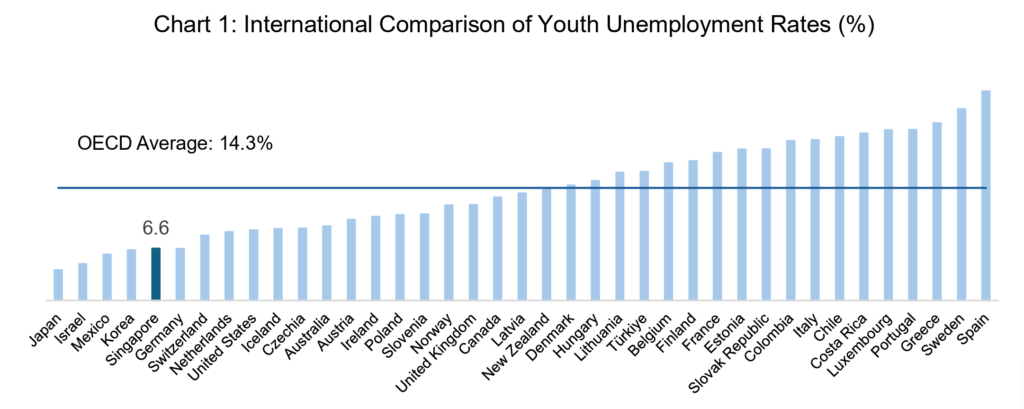
While the unemployment rate among them is 6.6%—so, a bit more than twice the 3.0% for the entire country—it is considerably below the 14.3% average reported by OECD, and would place Singapore among the best performing countries:

Source: Youths in the Labour Market 2025/ Singapore Ministry of Manpower

This figure has largely stayed at the same level over the years, with the exception of the pandemic period:

Source: Youths in the Labour Market 2025 / Singapore Ministry of Manpower

What’s more, Singapore also does very well in long-term unemployment statistics, as only 1.1% of local youths looking for work are out of a job for six months or longer.

Source: Youths in the Labour Market 2025 / Singapore Ministry of Manpower

The labour market may be becoming more competitive as companies invest in AI and offload unnecessary workers, but compared to other developed economies, Singapore still seems to be doing very well.

  • Read other articles we’ve written on Singapore’s current affairs here.

Featured Image Credit: kandal stock/ Shutterstock.com

Source link

Advertisement
Continue Reading

Tech

10 Things You Can Do While Waiting in the TSA Line

Published

on

For more than 40 days and 40 nights, the US Congress failed to come to a deal that would restart paychecks for many Department of Homeland Security employees. The evidence is all over the country’s airports, in the form of hours-long waits to go through security.

Workers with the Transportation Security Administration have been forced to call out as they struggle to pay for gas, rent, childcare, and groceries, according to officials from the American Federation of Government Employees, which represents some 47,000 TSA agents. Nearly 12 percent of agents called out on Thursday, compared to a usual average of 4 percent.

On Friday, President Donald Trump signed an executive order directing DHS to pay TSA workers; the department said employees could see paychecks “as early as Monday,” though union representatives said it could take longer than a week for agents to receive back pay. (Congress still hasn’t voted to fund the department and fully reopen the government.) But it’s unclear whether airports can avert disaster over the upcoming spring holiday weekend. Record-setting long lines still snake around some of the nation’s largest airports.

So if you’re flying, show up early and be prepared to wait. Emphasis on “prepare.” WIRED’s got some especially WIRED-y ideas to pass the time.

Advertisement

Consider TSA PreCheck

Image may contain Airport and Terminal

Photograph: The Washington Post/Getty Images

Think of a line as a sort of ritual liminal space, a threshold specially made for contemplation. Ponder, perhaps, your mistakes. Top of the list: Not signing up for TSA PreCheck. If you’re already in line, it’s too late right now, but it need not always be so. Those who can swing the $80 fee—good for five years—get expedited boarding, and therefore the right to stand in the security lines that seem to be moving the quickest right now. The online sign-up process takes just a few minutes. What a great way to kill some time!

Applicants then have to sign up for (or walk into) 10-minute in-person document check meetings at local Enrollment Centers, which are located everywhere from airports to local Office Depot and Staples locations. After that, actual enrollment can take anywhere from three to 60 days, the TSA says.

Read WIRED

You’re here already! Nose around. Check out our latest magazine package, The War Machine, which examines how technology has changed how the world fights and then tries to recover. Or head to the Gear homepage to read about the latest in gadgets and gadget trends. If you’re feeling more nostalgic, check out this list of some of WIRED’s best stories from the past 30 years.

Breathe Easy

Just because you’re nice and calm right now doesn’t mean that everyone around you is acting the same way. Escape with some deep breathing, your headphones, and, perhaps, a meditation app. Some options are right here.

Advertisement

While You’ve Got Those Headphones Out

Turn on a podcast! WIRED just updated its list of top ones. Best tech- and science-related recommendations include Flesh and Code, about the dark side of AI love; Your Undivided Attention, a pod hosted by tech-industry veterans about the downsides to living online and how we might make it better; and Ologies, which delights in taking listeners down various scientific rabbit holes. Oh, and Uncanny Valley, WIRED’s insider look at the people, power, and influence of Silicon Valley.

Organize Your Photos

Is your photos folder a hellscape? Us, too. What a great time to tackle the task of deleting what no longer serves you. Going through pictures one-by-one is always an option, but WIRED has also tested—and liked!—two apps to help phone users declutter. Rodeo organizes screenshots by location, and helps you organize reminders and lists to share with friends and family. Swipewipe is the Tinder for photos: Just swipe left to remove images from your phone forever ever.

Finally Figure Out How to Solve a Rubik’s Cube

Image may contain Toy and Rubix Cube

Photograph: Getty Images

This one requires some forethought, but a Rubik’s Cube might be the perfect line-waiting companion. No flailing limbs, loud noises, or even screens. It’s just you, your fingers, and sheer geometric logic. Here’s our step-by-step guide.

Belatedly Hear the Gospel of Horizon Worlds (on Mobile!)

Meta’s Horizon Worlds is going through some weirdness, as the tech giant shifts away from its (titular) metaverse and VR bets to focus on AI. After announcing Horizon Worlds would be sunset in virtual reality, Meta reversed course just a day later. Whatever: It’s definitely around on mobile! Visit a comedy club! Make some friends! Avoid the children (unless you yourself are a child)!

Advertisement

Ski (Digitally)

There are plenty of mobile gaming options. WIRED senior writer Jeremy White especially loves Grand Mountain Adventure and Grand Mountain Adventure 2 (Android, iOS), open-world skiing and snowboarding games that take you to the most beautiful mountains and ski resorts to cliff hop, slalom, or even cruise the backcountry. We have more mobile game recs here.

Ponder the Line

Image may contain Airport Terminal Silhouette Adult Person Clothing Footwear Shoe Sitting Pants and Aircraft

Photograph: Vital Pictures/Getty Images

If you’d rather spend your time contemplating the world in front of you, there has perhaps never been a better time to learn about the theory behind perfect queues. There’s a whole cottage industry of crowd-science consultants and scientists working out the math and psychology behind the most efficient way to get a bunch of people from here to there. Learn about them here, then consider how your own airport could be doing this better.

Disavow Airport Theory

Last year, TikTokers fell for “airport theory,” the idea that life could be better (?) and more relaxing (??) if flyers arrived at the airport as late as possible, rolling right through security to the boarding line. This gives us angina, and—look around!—feels like an especially bad idea right now. Here are other airport hacks to consider on your next trip, hopefully after Congress has decided to pay federal employees for their work.

Source link

Advertisement
Continue Reading

Tech

Verizon waives late fees for federal workers affected by partial DHS shutdown

Published

on

Verizon will waive late fees and offer flexible payment arrangements for workers affected by the partial government shutdown. The carrier has made similar offers in the past, like during the COVID-19 pandemic when it gave customers extra mobile data at no additional cost.

The Department of Homeland Security has been hit the hardest by the partial shutdown, but Verizon’s offer covers any federal worker who’s able to offer employment verification. Verizon says employees can call 1-800-Verizon (1-800-922-0204) to get their late fees waived and set up a payment plan.

The partial government shutdown started in February after Congress failed to pass a new DHS funding bill. The lack of funding has not affected all of DHS’ sprawling organizations equally, however. While the Transportation Security Administration is no longer able to pay its employees — leading to significant delays in airport security lines over the last week — both Immigration and Customs Enforcement and Customs and Border Protection have been spared thanks to a separate funding pool established by a previous bill.

Lawmakers continued inability to fund DHS also happens to hinge on both agencies. Democratic senators and congresspeople are demanding ICE agents wear body cams and remove masks before making arrests, among other restrictions, and refusing to fund DHS until those restrictions are worked into the bill. Both Republicans and Democrats have also separately proposed funding the entire department except for ICE and CBP, but while that bill passed in the Senate, it hasn’t been taken up in the House.

Advertisement

Source link

Continue Reading

Trending

Copyright © 2025