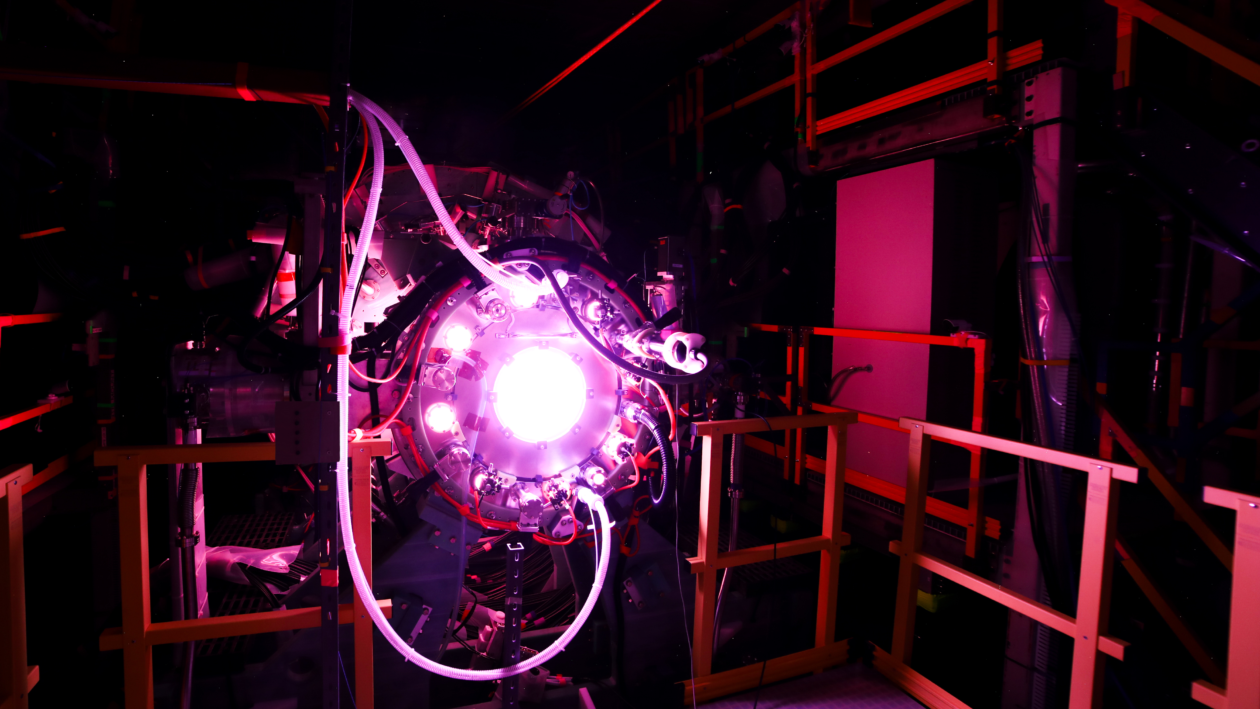
The glow from a super hot plasma generated inside Polaris, Helion Energy’s seventh fusion prototype device. (Helion Photo)
Helion Energy, a startup racing to commercialize fusion power, announced $465 million in new funding Thursday, bringing its total capital raised to more than $1.5 billion. The Everett, Wash.-based company said it is now valued at $15.5 billion.
The company aims to be the first in the world to commercialize fusion, replicating the reactions that power the sun and stars to produce nearly limitless clean energy. In a statement, Helion co-founder and CEO David Kirtley said his company is best positioned to generate electricity from fusion this decade.
Helion is operating under the sector’s most ambitious timeline, signing a deal with Microsoft to supply energy to a Central Washington data center by 2028. The company broke ground on the 50-megawatt plant, dubbed Orion, last July in Malaga, Wash.
Many experts say significant hurdles remain before any company achieves commercial fusion power. Helion’s critics also raise concerns about the startup’s secrecy and limited scientific publications, making it difficult for independent researchers to evaluate its approach.
Helion’s leaders acknowledge that key technical issues still need to be resolved in the final designs for its fusion plant. The company is running tests in Everett on Polaris, its 60-foot-long, seventh-generation fusion device, and recently revealed it is building another machine called Tiny Merge, which is roughly one-eighth the size of Polaris.
Advertisement
“With this agile testbed, we will be able to test new ideas with much less energy and far fewer resource requirements, meaning we can iterate faster than we can on full-scale machines such as Polaris,” Michael Hua, Helion’s senior director of radiation safety and nuclear science, recently told GeekWire.
An aerial view of Orion, Helion’s planned fusion plant being built in Malaga, Wash. (Helion Photo)
Commonwealth Fusion Systems is also vying to be the first to harness fusion, targeting the early 2030s. The Massachusetts-based company has raised close to $3 billion. On Wednesday, the company announced that five peer-reviewed scientific papers have validated the physics for its approach to fusion energy.
Helion’s Series G round was led by Thrive Capital, with participation from additional new investors including Alta Park Capital, Anti Fund, BoxGroup, Lux Capital, Peak XV Partners and Ford Motor Company Executive Chairman Bill Ford.
Existing backers also participated, including Capricorn Technology Impact Funds, Lightspeed Venture Partners, Mithril Capital, Dustin Moskovitz through Good Ventures Foundation, SoftBank Vision Fund 2 and a university endowment fund.
It marks the largest venture capital funding in the Pacific Northwest so far this year, according to GeekWire’s funding list. (Sedron Technologies, a wastewater treatment startup, raised $500 million in private equity buyout in April).
Advertisement
Helion sits in the No. 1 spot on the GeekWire 200, a ranking of Pacific Northwest startups.
OpenAI CEO Sam Altman is a major investor in Helion and disclosed during the recent Musk v. Altman trial that he owns roughly one-third of the company. OpenAI reportedly explored a power purchase deal with Helion, though Altman said he was not part of those conversations. He resigned from Helion’s board in March.
The 2026 Tony Awards will take place at Radio City Music Hall in New York City and will combine a lively ceremony with plenty of awards to give away, and live performances by Queen Latifah, Whitney Leavitt, and Alex Newell, among others. Hosted by Pink, the 79th edition of the ceremony is set to be a glamorous night celebrating the best Broadway shows of the past year.
As for the predictions, Best Musical is likely to go to Schmigadoon!, a meta musical about musicals based on an Apple TV+ series. Without giving away any spoilers, it’s the story of a couple who become trapped in an alternate-universe town, stuck inside a 1940s Golden Age Broadway musical.
Advertisement
Latest Videos From
But the Tony Awards are no strangers to upsets and surprises, so the gong could to The Lost Boys, a pop-rock musical based on the 1980s movie about a family trying to fight vampires. Both Schmigadoon! and The Lost Boys are leading the nominations chart, with 12 each.
Liberation is highly likely to win Best Play. If it does, it would mark the first time since 2009 that a play by a woman has won the award, and the first time since 1989 that an American woman has taken home the prize. Other likely contenders in the category include Giant, The Balusters, and Little Bear Ridge Road.
Daniel Radcliffe is among the leading lights to land the Best Performance by a Leading Actor in a Play award, for his role in Every Brilliant Thing.
Read on to find out how you can watch the 2026 Tony Awards live online from anywhere in the world.
Advertisement
Can I watch Tony Awards 2026 for free?
Tony Awards 2026 isn’t directly available to stream for free, but those in the US can benefit from free trials to catch the action without paying a penny.
In the US, you can benefit from the free trial periods of live TV services such as YouTube TV and Hulu+Live TV, both of which come with CBS so you can watch the ceremony coverage live.
Just note that this Walmart Plus deal includes the Paramount+ Essential package, where the awards ceremony will be available on-demand the following day, i.e., Monday.
Advertisement
Outside your home country at the moment? Use NordVPN to unlock your free stream from anywhere in the world.
How to watch Tony Awards 2026 online from anywhere
If you’re keen to watch Tony Awards 2026 but you’re away from home and access to the event is geo-blocked, then you could always use a VPN to access it (assuming you’re not breaching any broadcaster T&Cs, of course). You may be surprised by how simple it is to do.
Use NordVPN to watch the 2026 Tony Awards onlinefrom anywhere.
Advertisement
How to watch 2026 Tony Awards online in the US
The 2026 Tony Awards is being broadcast live on CBS in the US.
Alternatively, you can stream this year’s Tony Awards on Paramount+. The event is available live via the Premium subscription, which is $13.99 a month.
Advertisement
If you’re subscribed to the Essential plan ($8.99 per month), however, you can watch the ceremony on-demand the following day, i.e., on Monday.
As we’ve mentioned, another option is to get a 30-day Walmart+ trial (for just $1), which provides free access to Paramount+ Essential.
Traveling abroad? If you’re currently traveling outside the US, you can use a VPN to watch the 2026 Tony Awards from anywhere in the world. We recommend NordVPN.
Advertisement
How to watch Tony Awards 2026 online in the UK
(Image credit: Future)
Unfortunately for UK Broadway fans, the 2026 Tony Awards hasn’t been picked up for broadcast in the region.
Traveling to the UK from the US, Canada, or Australia? Use a VPN to watch Tony Awards 2026from abroad. NordVPN is our recommended provider.
How to watch Tony Awards 2026 in Australia
Like in the US and Canada, the 2026 Tony Awards is available to watch on Paramount+ in Australia as well. It will air live on 10am AEST on Monday, June 8.
Advertisement
Outside Oz right now? Use NordVPN to stream your local content library and watch Tony Awards 2026.
Richard O’Brien’s The Rocky Horror Show (9 nominations)
Arthur Miller’s Death of a Salesman (9 nominations)
Two Strangers (Carry a Cake Across New York) (8 nominations)
Oedipus (7 nominations)
Chess (5 nominations)
August Wilson’s Joe Turner’s Come and Gone (5 nominations)
The Balusters (5 nominations)
Fallen Angels (5 nominations)
Liberation (5 nominations)
Titaníque (4 nominations)
Giant (4 nominations)
Bug (4 nominations)
Dog Day Afternoon (3 nominations)
Becky Shaw (2 nominations)
Every Brilliant Thing (2 nominations)
The Fear of 13 – Marjorie Prime (2 nominations)
Little Bear Ridge Road (1 nomination)
Punch (1 nomination)
Waiting for Godot (1 nomination)
Who is performing at the 2026 Tony Awards?
Queen Latifah
Pink
Jesse Tyler Ferguson
Alex Newell
Julianne Hough
Whitney Leavitt
Dylan Mulvaney
Nikki M. James
Josh Gad
Andrew Rannells
Rory O’Malley
We test and review VPN services in the context of legal recreational uses. For example: 1. Accessing a service from another country (subject to the terms and conditions of that service). 2. Protecting your online security and strengthening your online privacy when abroad. We do not support or condone the illegal or malicious use of VPN services. Consuming pirated content that is paid-for is neither endorsed nor approved by Future Publishing.
Then there’s the missing removable storage. Yes, I’d prefer a card; it’s just easier to swap out a card in the field. But the BF does have 256 gigabytes of built-in storage. I can’t think of the last time I shot enough images to fill that much space before getting back to my laptop to download them. Which is to say that 256-gigabytes of storage is plenty for the nonprofessional photographer.
Photograph: Scott Gilbertson
The main deal-breaker for me is the lack of a viewfinder. I still prefer to shoot through a viewfinder. It’s just muscle memory—hand me a camera, and I will bring it to my eye. If you love a viewfinder, too, this is not the camera for you.
Another problem with the lack of a viewfinder is that the rear screen is nearly unusable in bright sunlight. It’s just too dark to compose accurately. The rear screen also doesn’t tilt or move at all, which means if you like to shoot from the hip, you won’t be able to use it at all. If you want to get an unusual angle, say from the ground, be prepared to lie down to frame it.
You can crank up the screen brightness all the way, which helps a little when you’re in the sun, but it’s still difficult to use in bright daylight. Having the screen brightness all the way up also chews through the already paltry battery life. Sigma claims the BF can shoot about 260 images on a single charge, but that drops significantly if you have to crank up the screen in bright daylight. I was finding that in bright sun, I seldom got more than two to three hours of shooting time on a single charge.
Advertisement
Should You Buy It?
It might sound like the Sigma BF has some serious limitations, and it does, especially when you compare the specs to other cameras in the BF’s $2,200 price range. However, limitations can be a good thing. Without limitations, you have nothing to build from. This is not a camera for the “spray and pray” style of shooting. This camera requires some thought to use well. It requires keeping in mind its limitations and working within them. If you do that, the BF is capable of making great images.
While I do not recommend the Sigma BF for most people, there are no doubt photographers out there who will love it not despite quirky design choices, but because of them. I fully expect this to be one of those cameras that develops a cult following in 20 years.
Netflix has every type of entertainment you could ever want, it seems. If you want a solid sci-fi series to dig into, there are so many good ones to choose from. In fact, the biggest issue you’ll probably face here is trying to decide which show to watch first.
I’ve curated a helpful guide to send you on your way to catching some awesome science fiction entertainment. Scroll on for the best Netflix sci-fi TV shows you should be watching. Check back regularly, as I’ll be updating this list monthly.
The Boroughs is executive-produced by The Duffer Brothers, but this isn’t Stranger Things. Well, there are some similarities, but instead of children banding together to fight monsters, this show follows old people who do it. The cast is stacked with genre legends, making clicking play on this a no-brainer. The series leans into that nostalgic Amblin vibe from the ’80s and takes place at a retirement village in the middle of the desert, where strange things are happening.
Advertisement
TNT
Before Noah Wyle returned to the emergency room to lead HBO’s acclaimed drama The Pitt, he was fighting aliens. No, seriously. Falling Skies originally aired on TNT, so consider the source when evaluating the story’s quality throughout the seasons. That said, Falling Skies is a fun ride.
Advertisement
Warner Bros. Television
11.22.63 premiered on Hulu a decade ago and it’s now resurfaced here. The series, based on an epic piece of historical fiction by Stephen King, posits the existence of a doorway that can transport you back in time. What would happen if someone went through it with the goal of saving JFK from being assassinated? That’s the question King tries to answer in the book and this show. Riveting stuff.
AMC Studios
Advertisement
Pantheon premiered on AMC in 2022 and disappeared a year later, which is a shame because the show is solid sci-fi entertainment. The program takes place in a reality where human consciousness can be uploaded to the cloud. Netflix’s comedy Upload, which is also on this list, tackles similar subject matter. Pantheon is a lot darker and explores all sorts of hot-button issues like corporate responsibility, immortality and morality, all against a backdrop of an unraveling tech conspiracy.
BBC America
Discussing what Orphan Black is about would immediately put me in spoiler territory. All you really need to know is this is one of the most thought-provoking, engaging and original sci-fi programs to hit TV in the past decade. Tatiana Maslany is the highlight; she shows off her acting skills in playing a total of 17 clones here — each with their own mannerisms and accents.
Advertisement
Netflix
Time loop stories are nothing new in the sci-fi world but Russian Doll still manages to etch its own unique space in the genre. Natasha Lyonne stars as a woman who gets stuck in said loop on her 36th birthday and every time she dies, she restarts her day. Themes of grief, generational trauma and addiction permeate the show, making this more than a simple run-of-the-mill comedy.
Advertisement
James Dittiger/USA Network
Resident Alien, like Orphan Black, is not a Netflix Original series. However, I believe both shows deserve to be included on this list — not just because they’re currently streaming on Netflix, but because their cult-like status tells me more people need to be introduced to them. Alan Tudyk stars as an alien residing among humans trying to follow through on a world domination mission. The only problem? He sorta likes being human. He’s just not that great at it.
Netflix
Advertisement
It’s one thing to be a teenager and navigate the awkward elements that high school life has to throw at you. But add some newfound superpowers into the mix, and the challenges become even more complicated. This is basically what I Am Not Okay With This is about. The series is based on Charles Forsman’s graphic novel and there is only one season. After being renewed, the show was ultimately canceled because of COVID restrictions and budgetary issues.
Eriek N Juragan/Netflix
Advertisement
Joko Anwar’s Nightmares and Daydreams
It’s sort of expected when a new genre anthology series premieres that someone will eventually compare it to The Twilight Zone. Well, that’s exactly what I’m going to do with Joko Anwar’s Nightmares and Daydreams. The new seven-episode anthology series leans heavily into horror territory and does so through an Indonesian lens.
Advertisement
Netflix
The popular video game series gets the anime treatment in Netflix’s Devil May Cry. The gist in a nutshell: Dante, a charismatic demon hunter, has to, well, hunt demons to save humanity. Power Rangers alum Johnny Yong Bosch supplies the voice for Dante in the action-packed series co-created by Castlevania and Dredd producer Adi Shankar.
Advertisement
Netflix
Stranger Things caught on like wildfire when the genre series quietly premiered its first season on Netflix in 2016. What began as an homage to ’80s cinema, with callouts to E.T., Dungeons & Dragons, Goonies and the works of Stephen King, has blossomed into a layered and sweeping sci-fi adventure. The program follows a group of kids in Hawkins, Indiana, who, after meeting a mysterious girl they name Eleven, discover a sinister dimension hiding right under their feet. Government cover-ups, demonic hell-beasts and a cast full of beloved misfit characters make up this tour-de-force genre series.
Mariano Landet/Netflix
Advertisement
Netflix’s beautifully shot, post-apocalyptic series is the long-awaited adaptation of the beloved Argentine graphic novel, El Eternauta, which was first published in 1957. The story follows Juan Salvo and a group of survivors who make it through a lethal snowstorm (the snowflakes literally kill) only to discover the real threat against humanity isn’t a weather anomaly but an alien invasion.
Netflix
Emma Stone and Jonah Hill star in this mind-bending drama from Cary Joji Fukunaga (True Detective) and Patrick Somerville (The Leftovers). The 10-episode series follows Annie (Stone) and Owen (Hill) as they enter a drug trial for a medication that will allegedly cure all their problems. As you can probably guess, it doesn’t. Stone and Hill look like they’re having crazy fun throughout the program, as they get to try on a variety of different characters. The addition of Sonoya Mizuno, Justin Theroux and Sally Field to the cast make this an underappreciated gem worth your attention.
Advertisement
Netflix
Time travel is the name of the game in this sci-fi series that flew under the radar for many. Led by Will & Grace alum Eric McCormack, the program follows a group of people whose consciousnesses are sent back in time to inhabit other people’s bodies to make humanity better by changing the past. It sounds complicated but I assure you, it isn’t.
Advertisement
Netflix
3 Body Problem was created by Game of Thrones alums David Benioff and D.B. Weiss, along with The Terror showrunner Alexander Woo, and is based on the Hugo Award-winning novel by Liu Cixin. The high-concept sci-fi series connects a watershed moment in 1960s China to the present day, where a group of scientists must face an emerging global threat unlike anything humanity has ever seen.
Quantrell D. Colbert/Netflix
Advertisement
This sci-fi horror series, which was loosely inspired by the found footage podcast of the same name, follows a film archivist who restores documentary footage found on a bunch of videotapes from 1994. Through his work, he’s sucked into a terrifying mystery surrounding the stuff on the tapes. Netflix may have only given this series one season but it’s still a riveting watch.
Netflix
Inspired by the comic book created by Gerard Way and Gabriel Bá, the series follows a group of adopted superhero siblings who have been raised to save the world. From time travel to saving humanity from multiple apocalyptic events, the ongoing adventures of the dysfunctional Hargreeves flips expected genre tropes on their heads. It’s weird, off-beat, hilarious and poignant.
Advertisement
Netflix
Supacell takes the familiar superhero narrative and flips the script. The series follows four Black people living in South London who suddenly develop superpowers. What connects each of them to their newfound abilities are their families’ histories with sickle cell disorder — a common hereditary condition. Using the genre as its narrative foundation, the show delves into the human drama that plays out among these characters while highlighting relevant cultural themes like racism, human trafficking and predatory health-care practices.
Advertisement
Netflix
Charlie Brooker’s Black Mirror set the standard for what a modern-day genre anthology series can do. Each story featured throughout the series, which currently has six seasons and an interactive standalone movie worth visiting, takes place in a near future world where technology has affected humanity in wonderful, strange and terrifying ways. Uplifting to horrific, Black Mirror is a brain bug of a television show that’ll keep you thinking long after the credits roll.
Olivia Bee/Netflix
Advertisement
They broke the mold when they made The OA. The two-season series created by Brit Marling and Zal Batmanglij follows the story of Prairie Johnson (Marling), a young blind woman who, after being missing for seven years, returns to her family with her sight restored. Where was she all these years? How can she see? Parallel existence across multiple dimensions, that’s how. OK, that answer barely scratches the surface of this extremely unique and layered program. Come for the Quantum Physics, stay for the interpretive dance routines.
Netflix
Like Stranger Things, Dark kicks off with the inexplicable disappearance of a child. Instead of another version of the Upside Down plaguing the town, the German series dabbles with time travel to explore how a family and community can be affected by the event of a kid going missing. A noir slow burn that leans heavily on the horrors of generational trauma, Dark lasted three seasons on Netflix. It will definitely get under your skin.
Advertisement
Netflix
1899 was created by Jantje Friese and Baran bo Odar — the same duo who brought Dark to Netflix — and follows a group of passengers on a ship heading to New York during the turn of the century. This is more than a run-of-the-mill period piece. As soon as things kick off, the show throws time travel, multiple dimensions, reality simulations and other bits of sci-fi craziness at the screen. It may not have gotten a season 2 but there’s still a lot of genre goodness to mull over here.
Advertisement
Cho Wonjin/Netflix
In Parasyte: The Grey, alien parasites land on Earth and begin turning people into shape-shifting monsters. To battle this growing Invasion of the Body Snatchers-style threat, survivors — otherwise known as “The Grey” — rise up to save humanity and the planet. Inspired by the manga by Hitoshi Iwaaki, this Korean series should please any horror and sci-fi fan.
Netflix
Advertisement
Matrix creators Lilly and Lana Wachowski teamed up with Babylon 5 creator J. Michael Straczynski to bring Sense8 to Netflix. The supernatural drama follows eight random people from around the world who learn they are emotionally and mentally linked. Labeled “sensates,” the group learns from each other as they literally are forced to walk in each others’ shoes and take on new and exciting skills. Things wouldn’t be complete without the inclusion of a shadowy organization who’s hunting them all down. Over two seasons, the program explored timely issues like gender, sexuality and identity, blending genres like telenovela, K-drama, Bollywood and Euro-noir as it hops around the globe.
Netflix
Based on the book by Richard K. Morgan, Altered Carbon exists in a future world where consciousness can be moved from one body to the other. Joel Kinnaman starred in the first season as ex-soldier Takeshi Kovacs. His mission to solve a murder evolves into a journey of self-discovery as he works to track down his lost love and answers regarding his previous life. Season 2 finds Anthony Mackie stepping into the role to further the cyberpunk noir tale.
Advertisement
Netflix
Mixing different animation styles with live-action, Love, Death + Robots is an anthology unlike many others. The series, which has drawn comparisons to Black Mirror, dips into a multitude of standalone stories that explore a world where sentient robots, creatures and other such beings have more humanity than humanity itself.
Advertisement
Des Willie/Netflix
Using the 1965 series as inspiration, Lost in Space follows the Robinson family on a space mission to colonize a planet as humanity teeters on the brink of collapse. The show is heavy on family drama, which can be off-putting at times. Thanks to the sociopolitical conflict, a cool alien robot friend and Parker Posey’s deliciously villainous Dr. Smith, the show holds up.
Netflix
Advertisement
For its first three seasons, Manifest was an NBC original. After it was canceled by the network, Netflix swooped in to revive the series. The story follows the passengers of Flight 828, who arrive at their destination five years after originally taking off. The survivors begin having premonitions and visions that help them save others from disasters that have yet to happen. It’s sorta like Lost and Final Destination had a baby, kinda.
Netflix
Alice in Borderland is based on the manga by Haro Aso and follows a group of characters in a parallel version of Tokyo forced to compete in a bunch of twisted games to stay alive. This battle royale-style thriller will appeal to fans of life-or-death competition titles like Squid Game, The Hunger Games and Battle Royale.
Microsoft AI CEO Mustafa Suleyman presents seven new in-house MAI models at the company’s Build developer conference. (Via webcast)
Microsoft has based much of its AI business on models from OpenAI, before expanding more recently to Anthropic. On Tuesday, the company showed how it plans to rely less on both.
At the Build developer conference, the Microsoft AI Superintelligence Team unveiled a family of seven models built from scratch. It’s part of an ongoing effort by the company to build credible in-house alternatives to models from partners and rivals with competing allegiances.
“This is all about long term self-sufficiency for Microsoft and our partners. It’s about models you can trust,” wrote Mustafa Suleyman, CEO of Microsoft AI, in a post announcing the models.
Microsoft is OpenAI’s largest backer, having invested a cumulative total of $13 billion in the ChatGPT maker over multiple funding rounds. The company last year announced an investment of up to $5 billion in Anthropic, and later integrated its technology into a Copilot Cowork AI assistant.
However, Anthropic is also backed by Microsoft rivals Google and Amazon, and OpenAI is increasingly cozy with Amazon — showing the need for Microsoft to control its own AI destiny.
The flagship of the seven newly announced MAI models is MAI-Thinking-1, a reasoning model that Microsoft says draws even with Anthropic’s Claude Sonnet 4.6 in blind human testing, and matches the more capable Claude Opus 4.6 on a widely used coding benchmark.
Suleyman stressed that MAI-Thinking-1 was trained from the ground up with no distillation from other companies’ models, looking to appeal to enterprises that care about clean data lineage.
It’s available in private preview on Microsoft Foundry, where the company also hosts the latest models from OpenAI and Anthropic, including the recently released Claude Opus 4.8.
Microsoft AI also released MAI-Code-1-Flash, a 5-billion-parameter coding model now rolling out in Visual Studio Code and GitHub Copilot, and MAI-Image-2.5, which Microsoft says ranks second on a leading image-editing leaderboard, ahead of Google’s Nano Banana Pro.
Advertisement
The full set of models spans image, voice, transcription, coding and reasoning.
Whenever the topic of fusion power comes up, someone will say it’s only 10 years away from commercialization in an excited tone, and someone older or more cynical will point out that it’s been 10 years away since Eisenhower was president. So it’s with a certain-sized crystal of sodium chloride that we share the news here that the US-based Commonwealth Fusion Systems is applying to feed 400MWe into the grid there by the early 2030s.
The early 2030s is, notably, less than ten years from now.
Commonwealth Fusion Systems isn’t a bunch of nobodies out to suck up venture capital; they’re a talented group of researchers from MIT’s well-known plasma laboratory out to suck up lots of venture capital and hopefully build reactors along the way. So far, the second part is going better than the first: they’ve raised a couple billion dollars, which has let them make great strides in building their SPARC reactor– like crafting the big magnet we told you about in 2021. As that article describes, SPARC is the precursor to the later, larger ARC reactor they hope to hook to the grid in slightly under a decade. Alas, SPARC remains under construction as of this writing. ARC is evidently in the final planning stages, with a physical location determined and grid-tie applied for at the “Fall Line Fusion Power Station” in Virginia.
Advertisement
CFS’s reactors are of the Tokamak type that has been favoured at universities since the 1970s. From China to Europe’s ITER who are also planning to produce power before another decade passes— though not, notably, into a power grid. While promising, Tokamaks aren’t the only game in town, either– steampunk startup General Fusion started making plasma last year, though while if it works it has some big advantages, that one is probably the traditional “ten years away” still.
What do you think? Will fusion power be in the grid before humans make it back to the moon? Add the flying-car potential of eVTOL and we might finally get close to the future we were promised.
The subsidy will support participation in 57 microcredential courses offered by IUA universities this year, spanning areas of national importance.
The Irish Universities Association (IUA) has welcomed the announcement made by the Higher Education Authority (HEA) and the Department of Further and Higher Education, Research, Innovation and Science, confirming the 2026 Micro-credential Learner Fee Subsidy.
Designed to support lifelong learning and create opportunities for students, the subsidy will support participation in 57 microcredential courses offered by IUA universities in 2026, spanning areas of national importance such as digital transformation, artificial intelligence, sustainability, leadership, innovation, healthcare, engineering and business development.
Commenting on the announcement, IUA’s director general Paul Johnston said: “The reintroduction of the Micro-credential Learner Fee Subsidy is very welcome. It represents an important investment in lifelong learning, workforce development and Ireland’s future competitiveness.
Advertisement
“By reducing the cost of participation in these courses by workers and their employers, the subsidy makes university learning more accessible to individuals while also helping their companies, particularly SMEs with limited training budgets, to invest in the skills of their workforce.”
According to the group, microcredentials and skill learning supports are critical to the wider educational ecosystem as, in 2025 when the previous subsidy was withdrawn, registrations for microcredential courses fell by almost 40pc across five universities.
Additionally, universities faced growing pressure on course viability, with some programmes in areas of national skills priority unable to proceed due to insufficient enrolments. These courses were primarily in areas such as climate and sustainability, housing and construction, engineering, digital capability, innovation and leadership.
The IUA stated that a consistent, multi-annual subsidy would provide universities with the confidence to plan ahead, repeat successful courses, invest in new provision and respond more effectively to emerging skills needs. It would also support targets set down by the European Union to achieve a 60pc adult participation rate in learning by 2030.
Advertisement
“There is currently no certainty beyond this year,” said Johnston. “We would therefore call on the Department of Further and Higher Education, Research, Innovation and Science and the Higher Education Authority to place the subsidy on a stable, multi-annual footing.
“A longer-term commitment would provide certainty for learners considering an investment in their own development, for employers seeking to build workforce capability and for universities seeking to sustain and grow high-quality flexible learning provision. Most importantly, it would send a clear signal that lifelong learning is becoming a permanent and valued feature of Ireland’s education and skills system.”
Don’t miss out on the knowledge you need to succeed. Sign up for the Daily Brief, Silicon Republic’s digest of need-to-know sci-tech news.
Details for a potential deal haven’t been finalized yet.
Andrew Harnik/Getty Images
OpenAI could be the latest tech company that the US government takes a stake in. As first reported by NOTUS, “senior US officials” have had discussions with AI companies about potentially acquiring stakes in their firms.CNBC confirmed the talks and its source said that the talks between the Trump administration and OpenAI’s Sam Altman dated back to 2025 when the CEO first proposed the idea.
The discussions have led to a potential agreement that could see OpenAI voluntarily offer some equity to the US government, which would help the company achieve something similar to its proposed “Public Wealth Fund.” OpenAI first suggested this fund in an industrial policy outline published in April, which would “provide every citizen with a stake in AI-driven economic growth.” However, no official terms have been settled yet for this potential deal so it’s still unknown how much of an equity stake the Trump administration would take. Previously, the US government secured a 10 percent stake in Intel with a nearly $9 billion investment.
According to CNBC, the talks are still ongoing as Altman recently met with Washington policymakers to talk about AI regulation. Earlier this week, the Trump administration signed an executive order that would provide the US government with oversight on AI models before they’re released to the public. While there may have been some pressure from tech companies, OpenAI responded by saying it would comply with the order and let government regulators review its latest models before the public gets access.
We spend hours testing every product or service we review, so you can be sure you’re buying the best. Find out more about how we test.
Dreame AirStyle Era: two-minute review
The Dreame AirStyle Era is an eight-in-one multi-styler that works as a dryer and creates smooth, curly, bouncy, or straightened styles from a single device.
On paper, it looks like one for TechRadar’s best hair styler roundup, and it’s the follow-up to the seven-in-one AirStyle Pro, addressing some of that model’s most obvious gaps. Namely, adding a diffuser for the first time, and replacing the Pro’s flyaway attachment with a U-shaped straightening nozzle.
Advertisement
The auto-wrap curl barrels remain the headline act. The 360-degree airflow draws hair in automatically and produces bouncy, natural-looking curls without the need to manually wind sections around a barrel.
Latest Videos From
For fine to medium hair, the results are impressive, and at $349.99 / £349 / AU$699 the Era undercuts the Dyson Airwrap by $250 / £130 / AU$150 while producing comparable curl results as an Airwrap alternative. The smoothing brushes perform well too, and the diffuser is a welcome addition for anyone with naturally curly or wavy hair.
The Dreame AirStyle Era styling system includes interchangeable attachments for drying, smoothing, curling and volumizing (Image credit: Future)
The issues are harder to ignore, though. The maximum temperature of 176F / 80C — unchanged from the AirStyle Pro — will be a limiting factor for anyone with thicker or longer hair. You could rope in one of the best hair dryers for that first stage, but that rather defeats the point of an all-in-one tool. The straightening nozzle is also more fiddly than expected, not to mention time consuming.
None of these are dealbreakers on their own, but together they add up to a tool that falls slightly short of its potential. The Era is still the most complete multi-styler Dreame has produced, and the most attractive multi-styler I’ve tested, and at this price it’s a worthy Airwrap dupe, but it needs to be better than it is in a few key areas to make a truly compelling case.
Advertisement
That’s the two-minute version; read on for my full Dreame AirStyle Era review.
Sign up for breaking news, reviews, opinion, top tech deals, and more.
Dreame AirStyle Era review: price & availability
List price: $349.99 / £349 / AU$699
Available: US, Australia and UK
Launched: May 2026
The Dreame AirStyle Era costs $349.99 / £349 / AU$699 and is available directly from Dreame and Amazon in the US, Dreame in the UK, and from Dreame Australia as well as from several third-party retailers.
It sits closer in price to the $279.99 Shark FlexStyle in the US (which costs AU$499 in Australia), but is more akin in terms of features and attachments to the $599.99 / AU$849 Dyson Airwrap. It’s the follow-up to Dreame’s seven-in-one AirStyle Pro, which had a higher list price of $399.99 in the US but was rarely sold at that, while the latter’s list price is lower in Australia at AU$599.
Advertisement
(There are also other, cheaper Dyson Airwrap dupes, but few come with the auto-wrap curl barrels of these four stylers.)
In comparison to its predecessor, the AirStyle Era swaps the Flyaway Attachment of the Pro for a U-shaped straightening nozzle and adds a diffuser for the first time, addressing one of the glaring gaps in the original’s feature set.
It’s also had a meaningful upgrade under the hood — the NTC temperature sensor now checks 1,000 times per second compared to 300 on the AirStyle Pro, which in practice means more consistent heat distribution and less risk of spikes that could cause damage.
Fast dryer, straightening nozzle, diffuser nozzle, 32mm auto-wrap barrels (L+R), hard smoothing brush, soft smoothing brush, round volumizing brush
The UK listing features different specifications than the US page – 28°C/55°C/80°C for temperatures and 50m/s, 57m/s, 65m/s for wind speeds. We tested the US model so use the US figures throughout.
Dreame AirStyle Era review: design
Pink and bronze colorway with pebbled leather-texture grip
Eight attachments covering drying, curling, straightening, smoothing and diffusing
Twist-on mechanism same as the AirStyle Pro but more secure
Comes with a storage box and bag
The Dreame AirStyle Era follows the same basic design as its predecessor (and all other multi-stylers for that matter) – a tube-shaped dryer onto which you twist different styling heads.
It comes in a single pink colorway, not too dissimilar to the pink Dyson Airwrap i.d, with bronze accents at either end, and a soft pebbled leather-texture grip running the length of the handle.
Advertisement
It feels and looks solid and luxurious, and at 0.64lbs without the cord, it’s light enough that your arm doesn’t start aching even when working through a full set of curls.
The controls consist of two buttons with LEDs that let you cycle through the two heat settings. and three wind speeds. The cool shot is built into the top of the on/off slider rather than given its own dedicated button, and you enable and disable it by sliding up once for on, and sliding up again for off.
The AirStyle Era’s textured handle feels solid and luxurious and features dedicated controls for airflow, temperature and power settings (Image credit: Future)
These controls sit at a natural thumb position on the handle and toe a delicate line between being easy to control mid-style and difficult to press accidentally. This is much rarer on stylers than it should be.
At the base of the handle is a removable dual intake filter— an inner stainless steel mesh that keeps fine hair and particles out of the motor, and an outer mesh that prevents tangling.
Advertisement
A small cleaning brush is included for maintenance, and the filter is straightforward to remove and reattach. Attached to this filter is the cord that runs to 9.2ft / 2.8m with a 360-degree anti-tangle swivel at the handle end.
Each of the eight attachments twist on using the same mechanism as the AirStyle Pro, but unlike the heads on the older model, the Era’s attachments securely lock into place because they’re also magnetic. This was a major complaint in our AirStyle Pro review and I’m glad it’s been resolved.
In terms of the attachments, the line-up is as follows:
Fast dryer: A concentrated nozzle for quick drying
Straightening nozzle: U-shaped head with dual airflow channels that direct air downward to smooth and straighten without heating plates
Diffuser: Bowl diffuser with prongs for dry curls without disrupting them
32mm auto-wrap barrels (x2): One for left curls, one for right; 360-degree airflow draws hair in to create curls without manually winding sections
Soft smoothing brush: Spherical teeth designed for fine, fragile, or chemically treated hair
Hard smoothing brush: Conical teeth for coarser, thicker, or heavily product-styled hair
Round volumizing brush: Wider tooth spacing to reduce tangling, with perforations to diffuse airflow and create lift at the roots
A close-up look at the AirStyle Era’s branding, filter and styling tools (Image credit: Future)
The two additions — the straightening nozzle and diffuser — address the most obvious gaps in the original AirStyle Pro’s feature set.
Advertisement
If you wanted smooth, straight hair or defined natural curls from the Pro, you needed separate tools entirely. The Era fixes that, and the result is a kit that not only covers the full range of everyday styling needs, but it makes it the only styler that can truly rival the Dyson Airwrap in terms of scope and scale.
Elsewhere, everything ships in a leather-textured storage box that keeps the attachments organized and easy to find, plus you get a travel bag if you need something more portable.
Design score: 4.5 out of 5
Dreame AirStyle Era review: performance
Fast dryer attachment works well on fine to medium hair; may struggle with thicker, longer hair
Auto-wrap curling barrels produce good results but swapping between directions is fiddly
Straightening nozzle is less effective than the flyaway attachment it replaces
I started, as Dreame recommends, by removing most of the water in my hair with the fast dryer attachment. Like all multi-stylers of this type, you need to get hair to around 80% dry before switching to any of the styling attachments for best results, and the fast dryer handled that first stage well enough on my fine, shoulder-length hair.
It’s not the hottest of stylers though, and anyone with thicker or longer hair may find themselves reaching for a standalone dryer to get there faster. This was a complaint with the original Pro and hasn’t been fixed, it seems.
Dreame AirStyle Era soft smoothing brush (left), hard smoothing brush (center) and round volumizing brush (right) attachments (Image credit: Future)
The auto-wrap curling barrels are where the Era earns its keep. The 360-degree airflow draws hair in and wraps it around the barrel automatically, producing bouncy, defined curls without the need to manually wind sections. The results hold well, and the curls have a natural quality that can be hard to achieve with traditional tongs. The catch is that if you want the curls to go in different directions, you need to physically swap between the left and right attachment. This isn’t just tricky, because the attached barrel is hot, but it interrupts your rhythm. The Dyson Airwrap handles this on a single, multi-directional barrel, and once you’ve used that system it’s hard not to notice the difference here.
Advertisement
The straightening nozzle is the most interesting new addition on paper — a U-shaped head that uses dual airflow channels to smooth and straighten without heating plates. It’s more intuitive than the flyaway attachment it replaced, while producing a very similar finish, but I found it more fiddly than I’d hoped. You can only smooth small sections at a time and this takes a while, which feels like a step backwards for anyone who relied on the flyaway attachment for quick touch-ups and frizz control.
The diffuser attachment is a new addition to the AirStyle Era compared to the previous AirStyle Pro and it’s great at enhancing natural curls and waves while reducing frizz (Image credit: Future)
The diffuser does what it should. For naturally curly or wavy hair, it distributes airflow evenly without disturbing the curl pattern, and the results are noticeably better than using the fast dryer attachment on the same hair type. It’s not doing anything the category hasn’t seen before, but its absence from the AirStyle Pro was a gap, and it’s good to have it here.
The fast dryer attachment quickly removes moisture before styling; it’s great for fine-to-medium hair but people with thicker and/or longer hair might get frustrated with the device’s temperatures (Image credit: Future)
Finally, the brushes. The soft and hard smoothing brushes both perform well. The soft brush is gentle on fine or fragile hair, with the airflow automatically redirecting downward when attached to leave your hair feeling smooth. The hard brush handles coarser or more tangled hair well, and separates knots without pulling.
In testing, my favorite brush is the round volumizing brush. It’s great for lifting roots and adding shape at the ends and it can even create loose curls.
Advertisement
In terms of noise levels, Dreame claims it produces 76dB, and in testing I recorded 79dB on the highest speed setting. That’s slightly louder than the spec sheet suggests although not unreasonable for a tool of this type and it’s quiet enough to hear music or have a conversation.
The straightening nozzle (pictured) has replaced the flyaway attachment from the previous Pro model and helps smooth hair (Image credit: Future)
Performance score: 4 out of 5
Should you buy the Dreame AirStyle Era?
Swipe to scroll horizontally
Attribute
Notes
Rating
Advertisement
Value
Competitively priced against the Dyson Airwrap and broader than the Shark FlexStyle in terms of attachments, though the performance doesn’t always match the promise.
3.5 / 5
Design
Advertisement
Comfortable, well-balanced, and good-looking with an improved twist-on attachment mechanism.
4.5 / 5
Performance
Strong curling and volumizing results, but the straightening nozzle disappoints and temperature limits will be a factor for thicker hair types.
Advertisement
4 / 5
Buy it if…
Don’t buy it if…
Advertisement
Dreame AirStyle Era: also consider
Swipe to scroll horizontally
Header Cell – Column 0
Dreame AirStyle Era (reviewed)
Dreame Airstyle Pro
Dyson Airwrap i.d.
Shark FlexStyle
Advertisement
Weight (styler only, no cord):
0.64lbs / 0.29kg
0.6lbs / 0.3kg
1.4lbs / 0.6kg XXCHECK
Advertisement
1.5 lbs / 0.7kg
Styler dimensions (L x W):
10.2 x 1.8in / 26 x 4.5cm
Advertisement
10.7 x 1.9in / 27.2 x 4.8cm
11.3 x 1.7in / 28.7 x 4.4cm
Cord:
9.2ft / 2.8m
Advertisement
9.2ft / 2.8m
8.5 ft / 2.7m
8ft / 2.4m
Temperatures:
Advertisement
2 + cool shot
2 + cool shot
2 + cool shot
3 + cool shot
Advertisement
Speeds:
3
3
3
Advertisement
3
Wattage:
1,300W
1,300W
Advertisement
1,300W
1,400W (US), 1,600W (UK)
List price:
$349.99 / £349
Advertisement
$399.99 / £299 / AU$599
$599.99 / £479.99 / AU$849
$279.99 / £269.99 / AU$499.99
Advertisement
How I tested the Dreame Airstyle Era
I used the AirStyle Era as my main styling tool for a week. During this time I used it to dry my hair, and tested all the different attachments, paying particular attention to the auto-wrap curlers.
I compared the styling results to what I managed to achieve with other similar stylers I’ve tested – including the Dyson Airwrap i.d. and Shark FlexStyle. I also assessed how easy the styler was to use and the effectiveness of its design and features.
Cloudflare said agentic traffic has surpassed human traffic for the first time in internet history.
Cloudflare has acquired Voidzero, the company behind the open source JavaScript tooling ecosystem Vite, for an undisclosed amount, at a time when working with AI coding agents is becoming the new norm.
Acquiring Voidzero will help Cloudflare expand AI-generated code analysis, it said, by unifying the Vite build tool, Vitest test runner, Rust-based Rolldown bundler and Oxc toolchain, natively, into its ecosystem.
“The best engineers I know are shipping more code than ever and writing less of it by hand. AI is doing more of the typing, so everything around it has to keep up,” said Matthew Prince, the co-founder and CEO of Cloudflare.
Advertisement
The company said that merging Cloudflare’s global edge network and developer platform with the “modern web’s industry-standard toolchain” will allow the company to create a “frictionless” deployment stack from local code to the global network.
“Our mission at Voidzero has always been to eliminate the fragmentation and performance bottlenecks of the modern web stack,” said Evan You, the founder and CEO of Voidzero.
“Joining forces allows us to keep the Vite ecosystem neutral, open and vendor-agnostic, while giving us the resources and global infrastructure to supercharge the developer experience for millions of engineers worldwide.” The two companies have been collaborating since 2024.
The Voidzero team, including You, will join Cloudflare following the acquisition, but will continue to lead Vite and its other tools.
Advertisement
Alongside the acquisition, Cloudflare is also committing $1m to a Vite ecosystem fund to support independent maintainers and contributors, administered by Vite’s core team.
The Cloudflare Vite plugin alone has reached nearly 14m weekly downloads – or more than 10pc of Vite’s entire weekly volume – while AI usage at the company has grown by 600pc in a matter of months, according to Cloudflare.
The acquisition comes just a month after Cloudflare laid off 20pc of its workers, amounting to more than 1,100 employees, in preference for a slimmer, more AI-powered workforce.
The IT service provider, which claims to interface with around 20pc of the web, recently reported that agentic bots make up more than 57pc of internet traffic, with humans now only accounting less than 43pc.
Advertisement
“That happened faster than I predicted”, said Prince in a post on X. “Thought it would be end of 2027, then early 2027, but agentic traffic [is] growing so fast that bots have now passed human traffic online for the first time in the internet’s history.”
Don’t miss out on the knowledge you need to succeed. Sign up for the Daily Brief, Silicon Republic’s digest of need-to-know sci-tech news.
Taiwanese PC hardware and peripherals manufacturer Thermaltake showcased its Dockpower PSUs at Computex 2026 in Taiwan this week, describing them as the “next generation of PSU architecture.” Read Entire Article Source link
You must be logged in to post a comment Login