Tech
HiFiMAN Svanar Wireless 2 Brings R-2R DAC Architecture to $299 TWS Earbuds

Most true wireless earbuds are fighting the same war: better ANC, clearer calls, longer battery life, smaller cases, and increasingly elaborate software designed to convince us that Bluetooth earbuds require an engineering degree to operate.
HiFiMAN has apparently decided the category needs more resistors.
The new $299 Svanar Wireless 2 takes a less conventional approach by retaining the discrete R-2R digital conversion architecture that distinguished the original $499 Svanar Wireless, while shrinking the circuitry and earbuds themselves. Bluetooth moves from version 5.2 to 6.0, the internal DAC has been redesigned, each earbud drops from 8 grams to 7.4 grams, and HiFiMAN is finally developing a dedicated mobile app.
That last one deserves some emphasis. Our review of the original Svanar Wireless praised its sound quality but found its lack of an app, middling ANC performance, limited battery life, bulky charging case and occasional wireless instability difficult to overlook at $499. HiFiMAN clearly had some homework to do.


Svanar Wireless 2 does not abandon the company’s sound-first approach. Instead, HiFiMAN appears to be trying to make that architecture more practical and $200 less expensive.
Related Reviews:
What Makes Svanar Wireless 2 Different?
Most TWS earbuds rely heavily on highly integrated Bluetooth system-on-chip architectures that handle multiple stages of the signal path inside a compact package.
HiFiMAN does things differently.
The Svanar Wireless 2 uses the company’s new HYMALAYA Mini DAC, a dedicated R-2R digital-to-analog converter that keeps conversion separate from amplification. The signal then passes through an independent Class AB balanced amplifier, rather than combining DAC and amplifier functions into one integrated stage.
An R-2R DAC uses a precision resistor ladder to convert digital information into an analog signal. Implementing that approach inside a battery-powered earbud presents an obvious challenge: space.
The original Svanar Wireless required a stacked two-PCB architecture to accommodate its DAC and amplification circuitry. According to HiFiMAN, the new HYMALAYA Mini uses twice as many resistors while occupying one-fifth the space of the previous implementation.
That smaller footprint is what allowed HiFiMAN to reduce the size and weight of the earbuds without removing the architecture that made the original Svanar Wireless unusual.

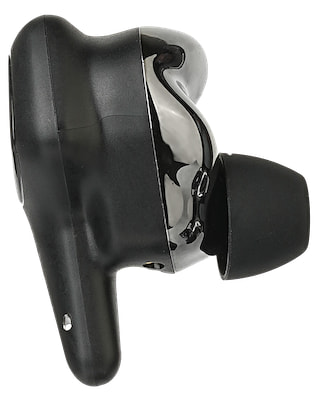
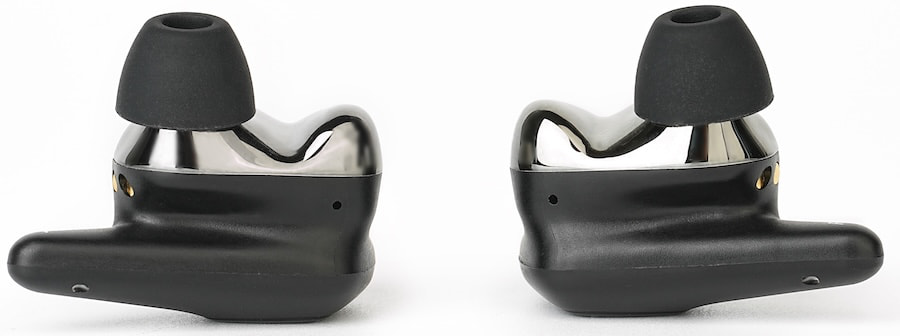
Each earbud now weighs 7.4 grams, down from 8 grams on the original. That may not sound like a dramatic diet plan, but shaving weight and internal volume matters when the entire DAC, amplifier, Bluetooth receiver, battery, microphones and driver have to live inside something jammed into your ear canal.
Topology Diaphragm Returns
The DAC architecture might attract most of the attention, but it still needs something to turn the electrical signal into sound.
Svanar Wireless 2 uses a 10mm dynamic driver featuring HiFiMAN’s Topology Diaphragm technology.
The company’s approach applies a nanoparticle coating to selected areas of the diaphragm in specific geometric patterns. HiFiMAN says varying those patterns, materials and thicknesses allows its engineers to alter the diaphragm’s behavior and better control how it produces sound.
This technology is not new to Svanar Wireless 2. HiFiMAN has been using variations of its Topology Diaphragm in wired IEMs and previous wireless models for years. The important point here is that the company has retained the combination of its proprietary dynamic-driver technology, R-2R conversion and dedicated amplification rather than simplifying the audio path to reach the lower price.
HiFiMAN rates the frequency response at 10Hz to 35kHz, with onboard amplifier output specified at 45mW.

Bluetooth 6.0, LDAC and L2HC
Wireless connectivity has also received a meaningful update.
The original Svanar Wireless used Bluetooth 5.2. Svanar Wireless 2 moves to Bluetooth 6.0 and supports LDAC and L2HC for higher-resolution wireless transmission from compatible devices.
LDAC remains the more broadly relevant codec for Android users, although actual codec support always depends on the source device.
HiFiMAN also specifies up to 35dB of active noise cancellation, along with an IPX5 rating for resistance to water and sweat.
That still leaves an important question.
HiFiMAN’s strength with the original Svanar Wireless was sound quality, not class-leading ANC. Bose, Sony, Technics and others have spent years refining adaptive noise cancellation, microphone arrays and environmental processing. A specification saying “35dB” does not tell us whether Svanar Wireless 2 has closed that experiential gap.
We will need to hear it.
There’s Finally an App
The original Svanar Wireless launched without a dedicated control app, which was difficult to excuse on a $499 flagship wireless product.
HiFiMAN says that will change with the new HIFIMAN Mobile App, which is being developed to provide firmware updates, touch-control customization, EQ adjustment and other settings.
There is one caveat: HiFiMAN says the app will debut soon, so we would not describe it as an available feature until the company actually releases it.
Still, adding proper software support is overdue. Firmware updates should not feel like an optional luxury on premium wireless earbuds in 2026.


Battery Life
This is one area where HiFiMAN still does not appear determined to win the numbers war.
Battery life is rated between four and eight hours per charge, depending on operating mode and usage. The charging case can fully recharge the earbuds three additional times before the case itself needs charging.
That represents some improvement at the upper end compared with the original model, which HiFiMAN rated for up to four hours in HiFi mode, six hours with ANC and seven hours in Transparency mode.
Those figures remain modest compared with some current $300 competitors, however. Sennheiser rates its MOMENTUM True Wireless 5 for up to 12 hours without ANC and 6 hours with ANC, while Technics rates the EAH-AZ100 for 10 hours with ANC when using AAC.
Apparently even an R-2R DAC cannot repeal the laws of battery chemistry.
How Does It Compare?
The $299 price places the Svanar Wireless 2 directly in one of the most competitive parts of the TWS market.
Technics EAH-AZ100 — $299.99
The Technics EAH-AZ100 has been one of our favorites at the same price point. Its 10mm Magnetic Fluid Driver was derived from technology used in Technics’ EAH-TZ700 wired IEM and is designed to reduce driver distortion while delivering strong bass response and high-frequency detail. The AZ100 also offers adaptive ANC, LDAC, LC3, Dolby Atmos with head tracking, three-device multipoint connectivity and substantially longer battery life.
Although, Technics offers more features, HiFiMAN is betting its less conventional R-2R DAC and separate Class AB amplification architecture will give a sonic edge.
Sennheiser MOMENTUM True Wireless 5 — $299.95
Sennheiser’s new MOMENTUM True Wireless 5 uses a 7mm TrueResponse dynamic driver and supports aptX Lossless, aptX Adaptive, Bluetooth 6.0, hybrid adaptive ANC and Dolby Atmos spatial audio. Sennheiser also offers four microphones per earbud, including a bone-conduction microphone, and rates total battery life at up to 40 hours with the charging case.
Sennheiser is leaning heavily into acoustic tuning, codecs, ANC, call quality and software integration. HiFiMAN is putting more emphasis on what happens inside the actual digital-to-analog signal path.
Noble Audio FoKus Rex5 — $449
The Noble Audio FoKus Rex5 costs considerably more at $449 but may be the strongest competitor for listeners whose first priority is sound quality rather than maximum noise cancellation.
Noble packs five drivers into each earbud: one 10mm dynamic driver, three balanced-armature drivers and one planar magnetic driver. It also offers Bluetooth 5.4, multipoint connectivity and onboard storage for personalized EQ profiles.
Where HiFiMAN is using one sophisticated dynamic driver supported by unusual DAC and amplifier architecture, Noble attacks the problem with an elaborate multi-driver acoustic system.
Neither approach is remotely normal for mainstream TWS. That is precisely why both are interesting.
Svanar Wireless 2 Specifications:
- Type: True wireless earbuds
- Driver: 10mm dynamic driver with Topology Diaphragm
- DAC: HYMALAYA Mini R-2R
- Amplifier: Independent balanced Class AB
- Amplifier Output: 45mW
- Frequency Response: 10Hz to 35kHz
- Bluetooth: Bluetooth 6.0
- High-Resolution Codecs: LDAC, L2HC
- ANC: Up to 35dB
- Water Resistance: IPX5
- Battery Life: Approximately 4 to 8 hours, depending on usage
- Case Capacity: Three additional full earbud charges
- Weight: 7.4 grams per earbud
- App: HIFIMAN Mobile App announced; availability forthcoming
- Price: $299
- Availability: September 2026 through Amazon and the HiFiMAN online store

The Bottom Line
The original Svanar Wireless proved that HiFiMAN could make an unusually good-sounding TWS earbud. It also proved that great sound alone does not excuse every usability compromise when the asking price is $499.
Svanar Wireless 2 is interesting because HiFiMAN did not respond by turning it into another conventional Bluetooth earbud.
Instead, the company shrank its R-2R DAC architecture, retained separate Class A/B amplification and its Topology Diaphragm driver, reduced the weight, upgraded connectivity to Bluetooth 6.0 and dropped the launch price to $299.
That price is especially aggressive considering the original Svanar Wireless launched for $499 and the previous Svanar Wireless LE already occupied the $299 slot. HiFiMAN is effectively asking the new flagship to compete where its reduced-cost model used to live.
There are still questions. Battery life is not class-leading, the new mobile app has yet to arrive, and a 35dB ANC specification does not tell us whether HiFiMAN has caught Technics, Sony or Bose in real-world noise cancellation.
But $299 for a TWS design with a dedicated R-2R DAC, separate amplification and a 10mm Topology Diaphragm driver?
The wireless earbud category certainly did not need another anonymous pair of plastic blobs.
This isn’t that.
Where to buy: $299 at HiFiMAN’s Store
You must be logged in to post a comment Login