Tech
Hisense UR9 RGB MiniLED TV Review: Cutting-Edge Tech Minus the Inflated Price

Mini-LED TVs that use RGB backlighting are very much a new thing for most TV makers in 2026, but Hisense got an early jump on the tech, shipping a gargantuan 116-inch RGB Mini-LED model back in 2025. The Hisense UR9 is the company’s flagship RGB MiniLED TV series for 2026, and it brings the benefits of RGB backlighting to real-world screen sizes.
The key difference between RGB and regular mini-LED TVs is that the former uses micro-sized red, green and blue LEDs, while the latter employs white or blue mini-LED modules to illuminate the set’s LCD display. Both approaches can yield images with exceptional brightness, but RGB backlighting brings the added benefits of expanded BT.2020 and DCI-P3 color space coverage, both of which are important factors to consider for viewing 4K/high dynamic range sources.

Related Reviews:
What is it?
The UR9 is one of two new Hisense RGB MiniLED TV series for 2026, with the other being the mid-range UR8 series. UR9 TVs are available in 65-, 75-, 85-, and 100-inch screen sizes. Launch prices for the series range from $2,199.99 to $9,999.99, but the 65-inch model I received for testing was selling for $1,699.99 during my review.
TV makers like to give fancy names to the processors used in their sets, and in the UR9’s case it’s the Hi-View AI Engine RGB processor. Along with carrying out basic picture performance chores such as upscaling and noise reduction, this also makes possible a range of AI enhancements like an Intelligent Scene mode that adapts picture settings based on the content being viewed and Personalized Customization, which generates a custom picture mode based on your viewing preferences.
The UR9’s other picture quality-related features include an Obsidian Panel advanced low-reflection surface to reduce screen glare and Dolby Vision IQ, HDR10+ Adaptive and Filmmaker Mode picture presets.
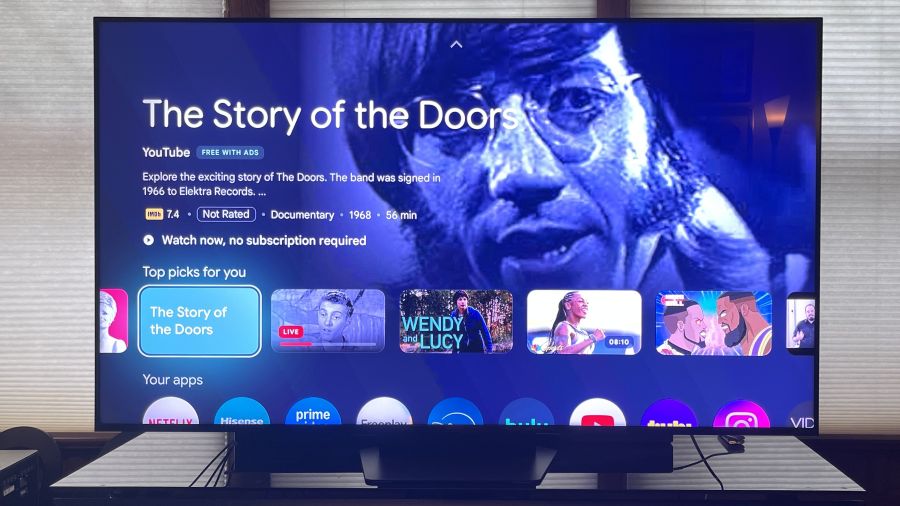
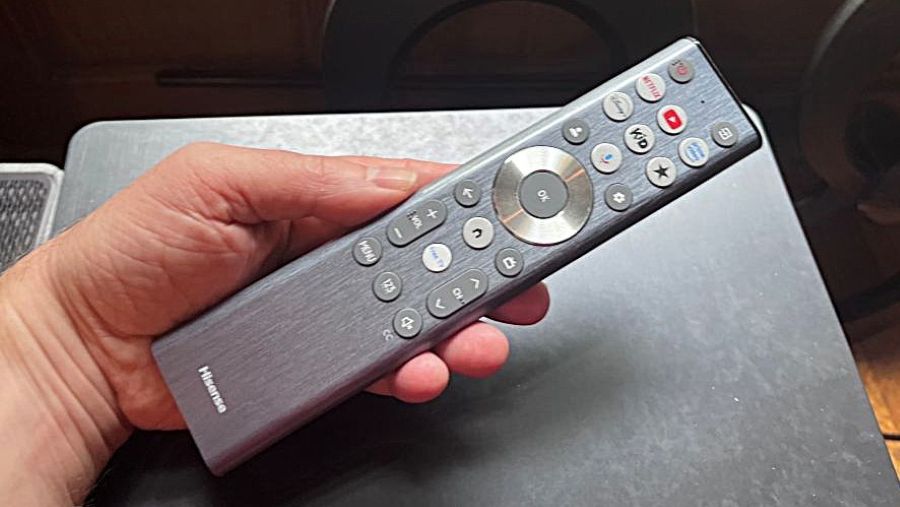
New Hisense TVs for 2026 feature the Google TV smart platform enhanced with the Gemini AI assistant. Google TV has an easy to navigate interface, and it can provide program suggestions based on your Google search history. Some of these can be spot-on, while others strangely miss by a mile (Leave it to Beaver – are you serious, Google?). Gemini AI gets its own separate tab in Google TV, and it allows you to ask questions in a conversational context using the TV’s built-in far-field mic, or, if you don’t want your TV listening in on you full-time, on-demand using the one built into the remote control. For one example of what you can do with Gemini on Google TV, I asked it to create a list of Christopher Nolan films ranked by critical reception (unsurprisingly, The Odyssey and Oppenheimer were at the top of the list) and then after asked for the list to be filtered to sci-fi titles only. Gemini can also be used to generate screensavers via suggested prompts or ones that you come up with on your own.
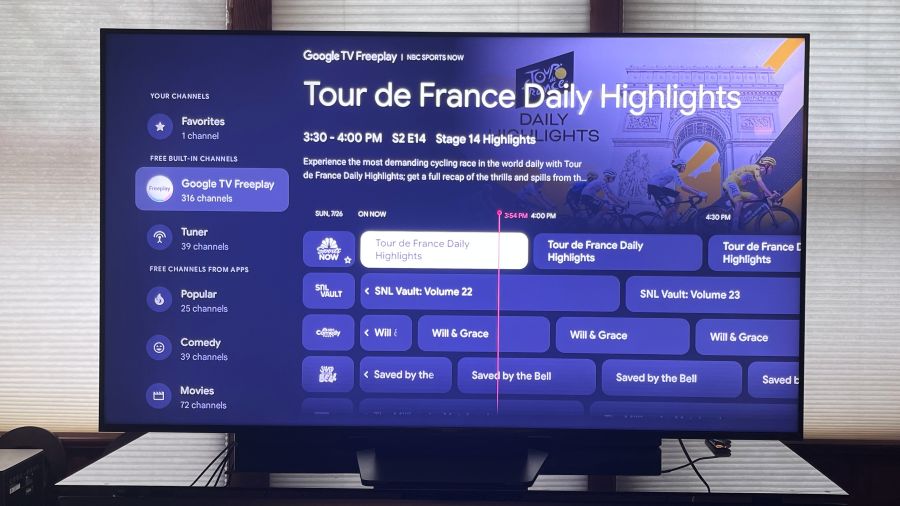
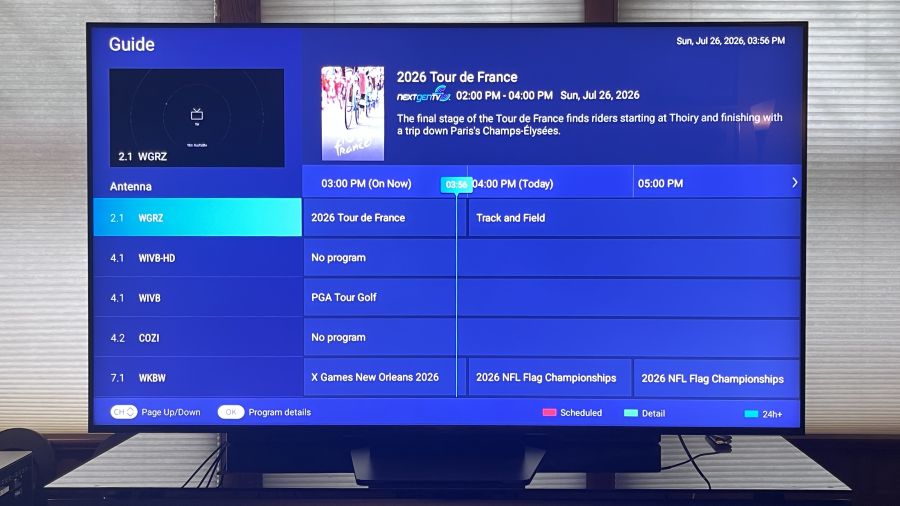
Hisense UR9 series TVs feature a built-in ATSC 3.0 tuner to receive local NextgenTV broadcasts. These can be accessed by pressing the Live tab in the TV’s main interface, where they will show up grouped in the Tuner section of the Google TV Freeplay grid guide. For a more streamlined experience minus Freeplay free streaming channels, you can also access a broadcast channel-only grid guide by pressing a button with a TV icon on the remote control with the tuner input active.
The UR9’s gaming features include a native 180Hz refresh rate supported over three HDMI 2.1 ports. It also supports FreeSync Premium Pro VRR, ALLM (Auto Low Latency Mode), Dolby Vision Gaming and it provides a Game Menu screen overlay that lets you quickly access gaming-related picture adjustments. With the UR9 in its Game picture preset, I measured input lag using a Bodnar 4K meter at 12ms.
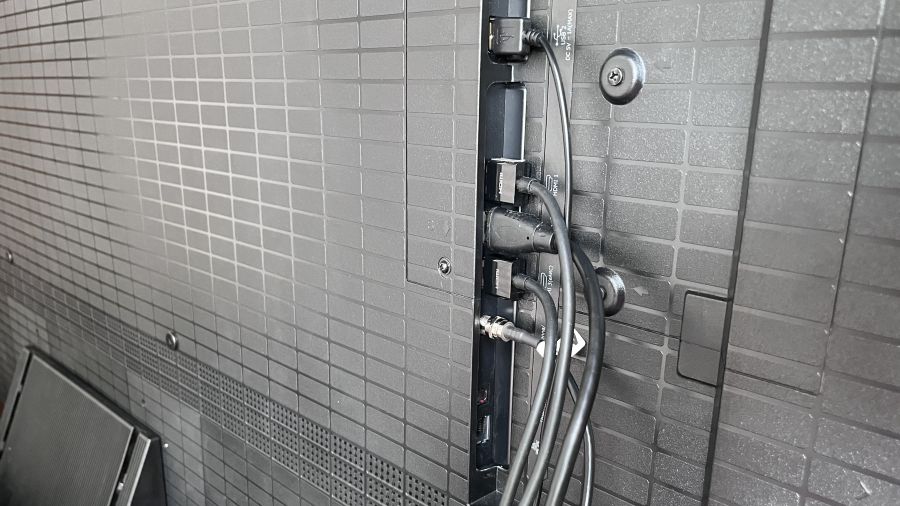
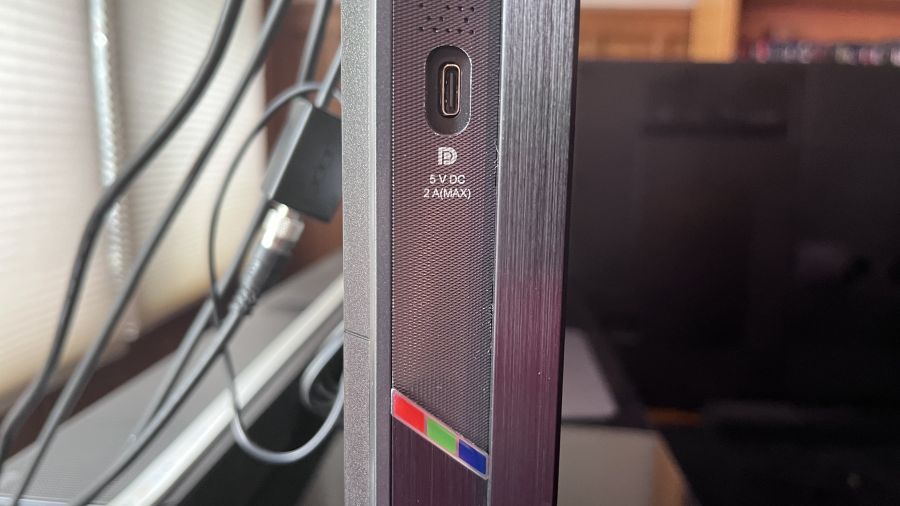
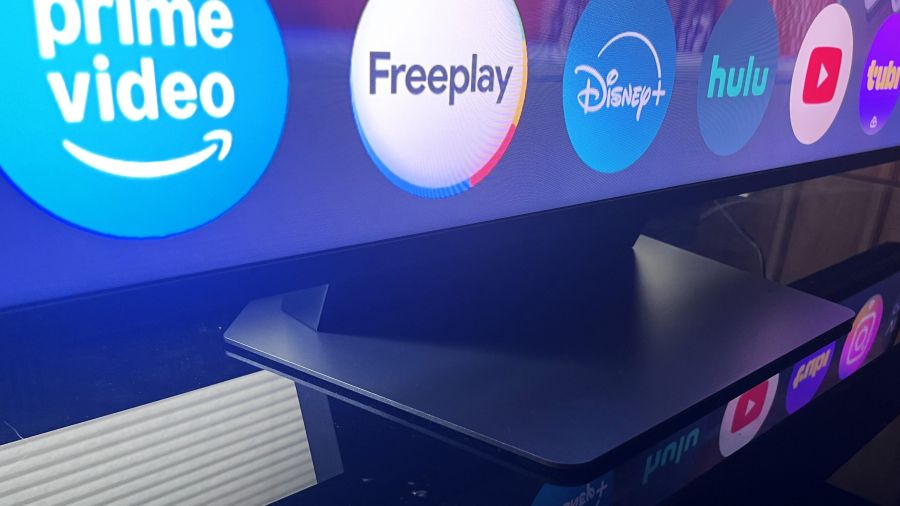
While the UR9 has a relatively slim ⅜-inch bezel, the TV’s panel is thicker than average at 1.75 inches deep. That may have to do with the set’s RGB backlight, but it also has an 80W, 4.1.2-channel speaker system tuned by French audio manufacturer Devialet that provides powerful and relatively immersive sound for a TV and supports both Dolby Atmos and DTS:X. An aluminum pedestal stand provides sturdy support for the TV and has an adjustable height option that elevates the display to a 1.3-inch height – enough to clear space for a typical soundbar.
Along with its trio of HDMI 2.1 ports and ATSC 3.0 tuner input, the UR9 features an optical digital audio output, two USB inputs and an Ethernet port. There’s also a DisplayPort-over-USB-C input located at the bottom left on the TV’s side, and this can be used to connect a computer, tablet or phone.
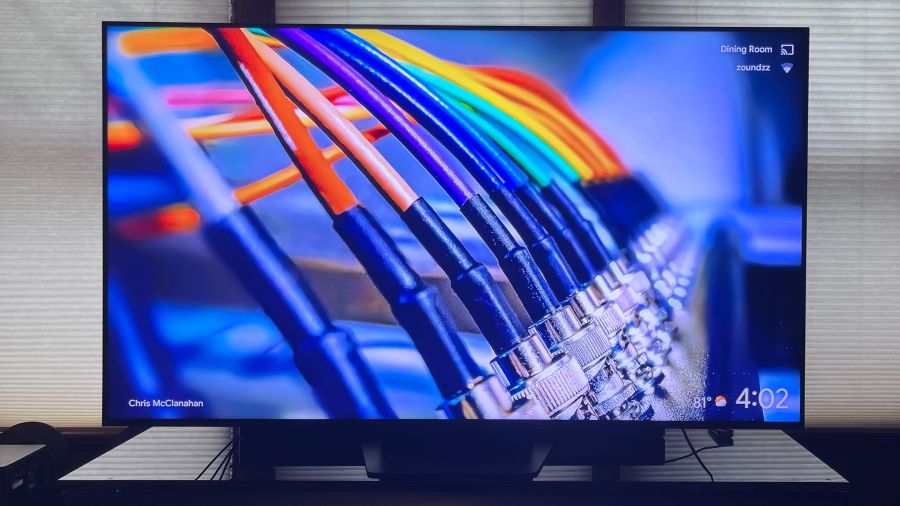
Setup & Viewing Impressions
I ran a basic set of measurements on the Hisense UR9 using Portrait Display’s Calman Color Calibration software. Prior to that, I disabled the TV’s Automatic Light Sensor, a setting located in the Intelligent Settings section of the Display & Sound menu that adapts picture brightness based on ambient lighting conditions. All measurements were otherwise made using the default settings in the UR9’s Filmmaker Mode and Standard picture presets.
Peak HDR brightness measured on a white 10% window pattern in Filmmaker Mode was 3,345 nits and 1,137 nits on a 100% (fullscreen) white pattern. In Standard mode, the results on the same tests were 3,206 nits and 1,136 nits, respectively.
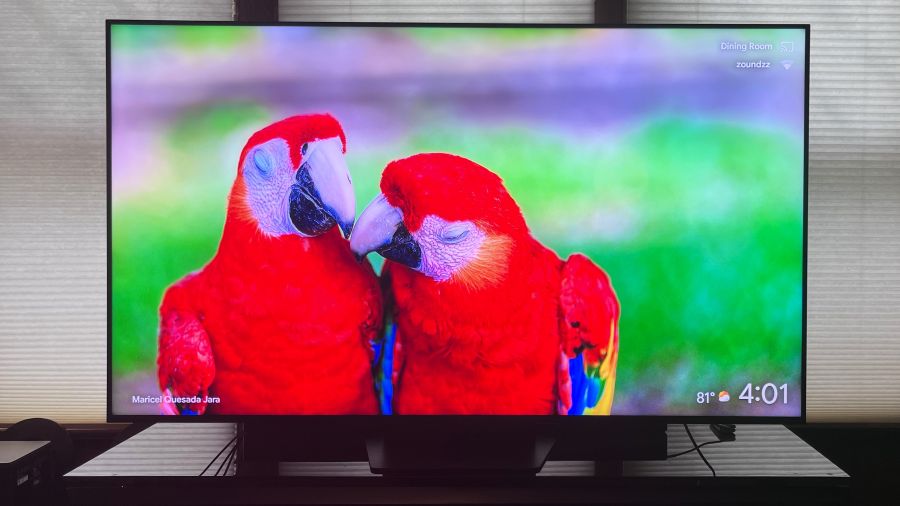
Those are impressive brightness numbers, particularly for fullscreen, and the UR9’s standard dynamic range (SDR) peak brightness results were equally good, measuring 1,698 nits on a 10% pattern and 948 nits on a fullscreen pattern in Standard Mode. For the sake of comparison, when I tested the more expensive Samsung R95H Micro RGB TV, peak HDR brightness topped out at 2,039 nits on a 10% window and 642 nits fullscreen (in Filmmaker mode), and peak SDR brightness was 726 and 583 nits, respectively, on the same tests with the TV in Standard mode.
The Hisense UR9’s color gamut coverage in Filmmaker Mode measured 91.5% for BT.2020 and 99.4% for DCI-P3 – both impressive results. Sticking with the Samsung R95H for a comparison, that model topped the Hisense when it came to BT.2020 color gamut coverage, measuring 93.3%, and its P3 coverage clocked in at 147.9%.
In other measurements, the UR9’s Delta-E (the margin of error between the test pattern source and what’s displayed on-screen) in Filmmaker Mode averaged 2.7 for grayscale and 1.5 for color. Both those results are lower than the 3.0 Delta-E considered to be the threshold for what’s indistinguishable from perfect to the human eye, and they represent a big improvement on earlier generations of Hisense mini-LED TVs, which tended to have higher Delta-E results out of the box.
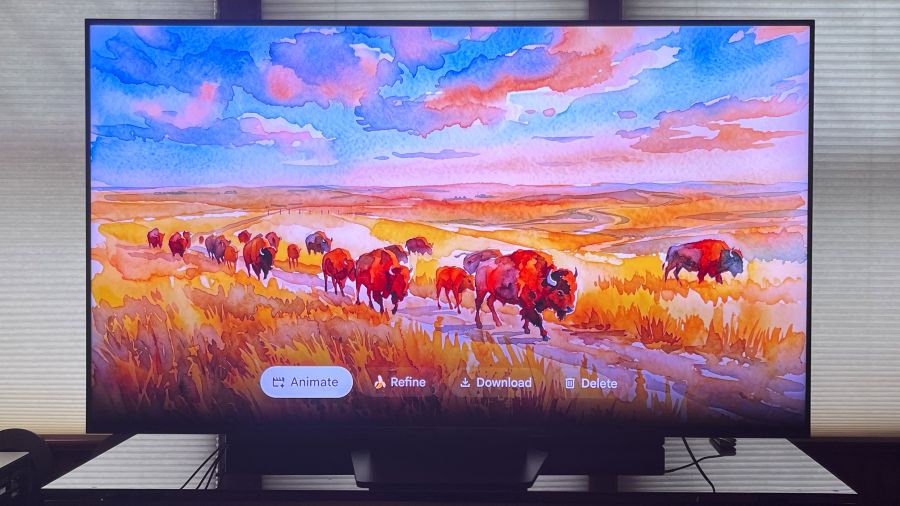
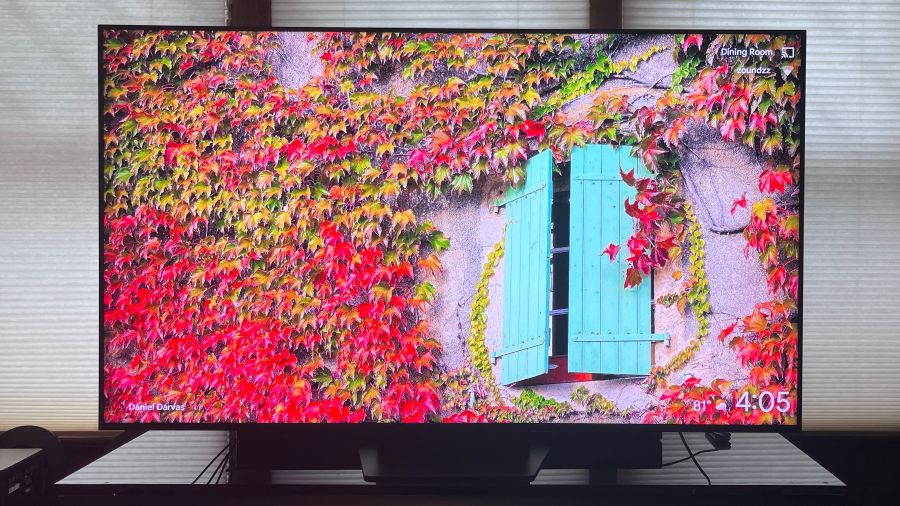
Just because a TV with an RGB backlight measures well doesn’t necessarily mean it’s going to excel with content outside of test patterns. Some models are definitely better than others at using processing to retain color richness and avoid color crosstalk when displaying complex images – something Sony went to great lengths to demonstrate in its Sony Bravia 9 II True RGB TV launch. Even so, I was impressed at how punchy and clean colors looked when watching a 4K Blu-ray of Spider-Man: Into the Spider-Verse (2018). This animated film has a particularly trippy color palette, and the Hisense rendered it every bit as well as the other RGB-backlit TVs I’ve tested in 2026.
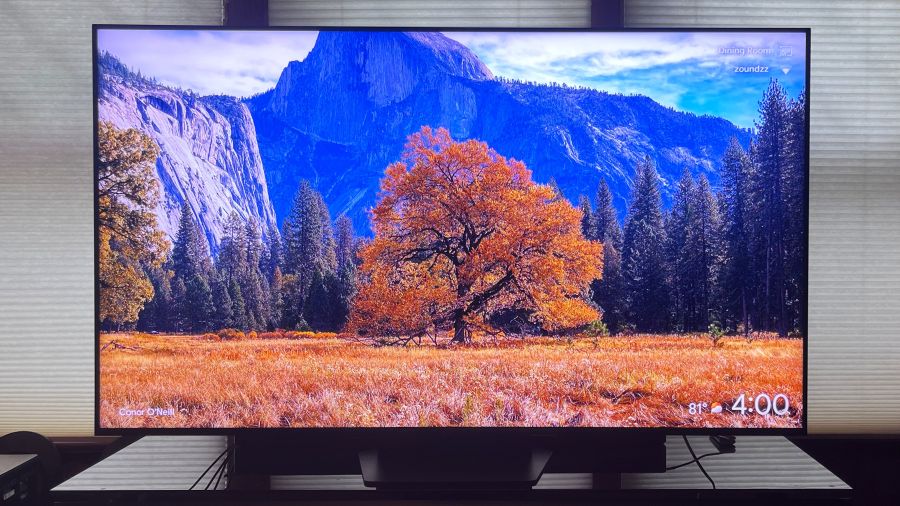
Checking out test patterns and demonstration clips from the Spears & Munsil Ultra HD Benchmark disc, the Hisense UR9 continued to display strong color saturation and very limited blooming on test images with animals and objects against solid black backgrounds. HDR tone mapping was also very good, with the UR9 showing only a limited degree of highlight detail loss when displaying content mastered at 10,000 nits brightness. I did note a level of black crush in aerial nighttime shots of urban buildings that I hadn’t noticed on the Samsung R95H Micro RGB and Sony Bravia 7 II True RGB TVs when I tested them. Also, the UR9’s color saturation and contrast faded when viewing at off-center seats – a limitation the Samsung R95H didn’t suffer from. Otherwise, the Hisense sailed through most of the TV torture tests contained on the Spears & Munsil disc.
Watching a scene from the James Bond movie No Time to Die on 4K Blu-ray where Bond walks across a hillside cemetery revealed a degree of judder and motion blur, but I was able to reduce both by setting the judder and blur sliders to the +2 setting in the TV’s Custom motion menu. I typically use this disc to also test a TV’s built-in speakers, and the Hisense’s Devialet-tuned audio system delivered good dialogue clarity and decent bass, along with a fair degree of Atmos immersion in the movie’s motorcycle and car chase scenes.
House of the Dragon on HBO Max has finally found its footing in season 3, and I’ve regularly tuned in to watch every episode as it’s been released. Episode 5, Unbowed and Unbent, is more low-key and expositional than some of the earlier episodes, with plenty of conversations held in the gloomy chambers of dark castles. Given the UR9’s performance on the aerial nighttime shots from the Spears & Munsil demonstration reel, I wasn’t sure how well it would hold up here, but it ended up doing a good job of fleshing out shadow detail in these scenes, and it also performed nicely with reference “dark” movies I watched such as Alien: Romulus.
The Bottom Line
At its discounted price of $1,699 for the 65-inch model, the Hisense UR9 is a solid RGB MiniLED TV value. However, it’s currently selling for $2,199. Its feature set and overall performance lags behind RGB TV competitors such as the Samsung R95H, but when you consider it costs substantially less than Samsung, it becomes a lot easier to overlook any shortcomings.
The UR9 might be a high-value TV, but it still faces strong competition in the form of the TCL QM8L, an SQD (Super Quantum Dot) mini-LED TV that matches the Hisense’s feature set, Gemini AI included, and offers great performance for the money. The 65-inch QM8L is currently selling for $1,499, and is an astonishing value at that price.

There’s also the complication of the Hisense U8QG, a top 2025 mini-LED TV from the company that’s still available, with the 65-inch model priced in the $1,000 range. I found the U8QG to be excellent when I tested it, and outside of its BT.2020 color gamut coverage, it doesn’t trail the new UR9 by that much.
The bottom line: The Hisense UR9 is a strong value, but even high-value TVs face serious competition in 2026.
Pros:
- High brightness
- Vibrant, accurate color
- Great value for an RGB mini-LED TV
- Native 180Hz Refresh Rate
- ATSC 3.0 tuner
- Devialet-tuned built-in audio with Dolby Atmos and DTS:X support
- Adjustable height stand
- Google TV with Gemini AI assistant
- Low-reflection screen
Cons:
- Poor off-axis picture uniformity
- Just average motion handling
- Comparatively thick panel design
- Only three HDMI 2.1 inputs when competition typically provides four
Our Ratings:
★★★★★★★★★★ Picture Quality
★★★★★★★★★★ Design
★★★★★★★★★★ Usability
★★★★★★★★★★ Sound Quality
★★★★★★★★★★ Features
★★★★★★★★★★ Value
You must be logged in to post a comment Login