Tech
How Many Lumens Do You Need For An Outdoor Projector?


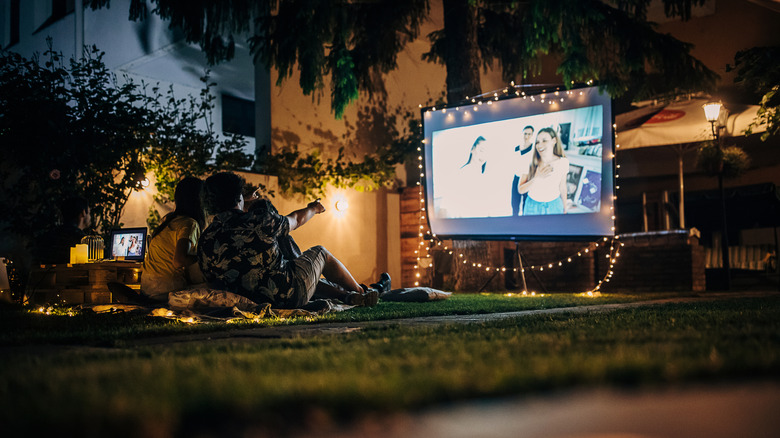
A backyard movie night can be a great way to get family and friends together over the weekend. However, the experience can also be an exercise in frustration if the picture is difficult to make out due to ambient light pollution. When picking out the best possible portable projector for your needs, factors like resolution, smart features, and audio quality may top your list. But you shouldn’t neglect brightness, which is measured in lumens.
In terms of projectors specifically, ANSI lumens are used, as they provide a more precise evaluation of brightness. One ANSI lumen is around the strength of 2.4 lumens and measures brightness from nine separate points in order to arrive at an overall figure. Conversely, lumens are measured from a single point, the source of the light.
So, how bright does your projector need to be for a well-defined picture that isn’t washed out? Typically, a unit rated above 2,000 ANSI lumens should be sufficient in all but the most challenging of scenarios. The brighter the projector, the better the experience can be across a wide range of conditions. But unfortunately, more ANSI lumens can mean higher costs as well, so you’ll need to consider the best options within your budget.
Can outdoor projectors work in daylight?
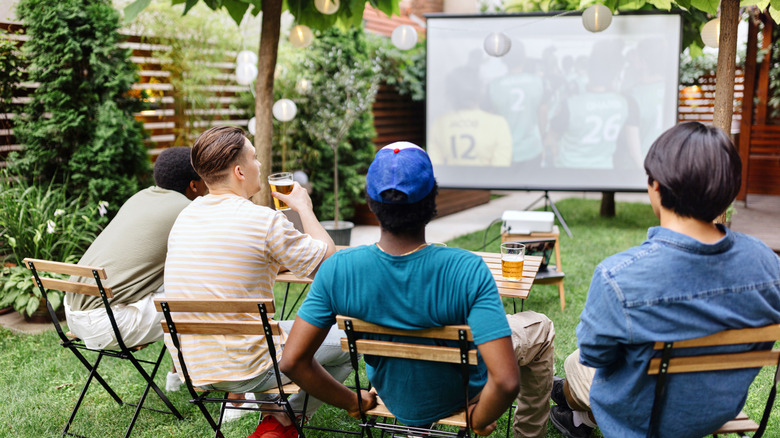
Unfortunately, forcing a projector to compete with the Sun isn’t a recipe for success. According to LBC, the Sun puts out an estimated 6,840,000,000,000,000,000,000,000,000 or 6.84 octillion lumens. For context, the number of lumens you should look for in a camping flashlight is between 300 and 1,000. So, as you may imagine, there isn’t a projector on Earth that can overpower the brightness of the Sun, meaning that watching movies outdoors during the day will be difficult or even unfeasible in some situations.
However, if you are determined to set up a projector during the day, there are ways to help improve your chances of achieving a watchable picture. Of course, a projector with a rating north of 3,500 ANSI lumens can help, but contrast is also a vital component. How intensely a projector can produce bright white colors versus dark blacks is measured using contrast ratio. The higher the number on the left, the better, especially in daylight, making a projector with something above a 6,000:1 contrast ratio desirable.
While the projector itself is a factor in terms of improving daylight viewing, it can’t do all the work. Investing in a quality reflective screen can also help keep your projector’s image looking bright and sharp. Other considerations include things like the time of day, as viewing experiences are often better around sunset. Strategically using your yard’s available shade can help, too. Weather, is another variable, with a cloudy day providing a clearer viewing experience than a sunny one.
You must be logged in to post a comment Login