Tech
How Many Wind Turbines Would It Take To Replace A Micro Nuclear Reactor?



As we slowly drop our reliance on fossil fuels, there is still discussion about how to plug the gaps in our energy needs. Of course, renewable sources like wind power are helping take the strain, and modern turbines are far more capable than early designs were. However, renewable schemes like this are not yet ready to take up all of the energy shortfall, especially in places where the wind doesn’t blow consistently or where large-scale installations simply aren’t practical.
This is why nuclear power is still regularly touted as the energy source the planet needs to help make the transition away from fossil fuels. While there is always controversy and debate surrounding nuclear power, it does pack a “power punch.” It would take around 800 wind turbines to replace a typical nuclear reactor. All these turbines would have a footprint of about 1,000 times that of a nuclear reactor — it just isn’t a practical option. However, there is a comparison where the playing field might be slightly fairer: nuclear microreactors.
Microreactors, as the name suggests, are small reactors useful for supplying power to isolated communities, military installations, research stations, and anywhere else where there is limited or no grid access. In many of these situations, and assuming the right conditions, wind turbines can also be used as a power source.
However, to really understand how wind turbines stack up against microreactors, we first need to understand a few things.
What are microreactors?
There is nothing new about the relationship between nuclear power and portability. U.S. Navy submarines, for instance, have used portable nuclear reactors since the USS Nautilus was commissioned as the first nuclear-powered submarine in 1954. The latest generation of naval reactors powers ships like the USS Gerald R. Ford, one of the largest aircraft carriers in the world.
However, regardless of size, all nuclear reactors unlock the energy contained within matter by splitting uranium or plutonium atoms and use the heat energy released to power turbines that generate electricity. The vast majority of nuclear reactors are a type known as pressurized water reactors (PWRs), and a typical commercial one produces around 1 gigawatt of power.
When it comes to nuclear microreactors, the underlying physics are identical, but there are some fundamental differences. These include how the reactors are cooled, with various reactor types under development. However, for the purposes of this article, the most obvious difference is size. While there is no clear definition that classifies microreactors, the U.S. Energy Information Administration (EIA) classifies microreactors as producing between 1 and 20 megawatts of power. While there are arguments stating that 50-megawatt reactors also fall into this category, let’s give the wind turbines a fair crack at the whip and base our comparison figure on the EIA definition. To be completely fair, we’ll set the bar about midway and run our comparison against a 10-megawatt microreactor.
Wind turbines vs. nuclear microreactors
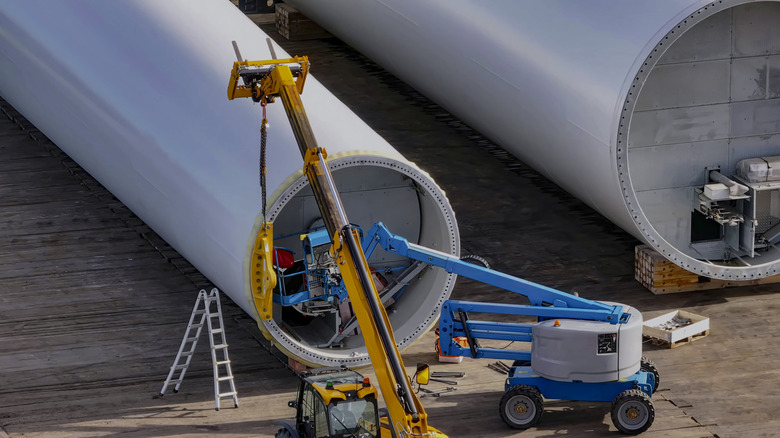
Now that we’ve set the baseline for a microreactor, we need to do the same for a wind turbine. However, this is where we also need to look at one of the biggest drawbacks of wind turbines — they need wind to work, and the weather doesn’t always play ball. The measured output of a wind turbine is its maximum possible output in ideal situations. Our comparison will need to account for this. So, let’s split the difference again and assume that the wind turbines are situated somewhere there is enough wind that they consistently hit half their maximum output.
Which leads us to the next point. Just how much power can a wind turbine generate? Size matters here too — the larger the turbine, the more power it produces. To give wind turbines the best chance, let’s assume that we’re going big with this. A large onshore wind turbine can have a rotor diameter of about 438 feet and can produce up to 3.5 megawatts of power, optimally. Or, about 1.75 megawatts for our wind-adjusted comparison. In this scenario, and when compared to a 10-megawatt microreactor, we’d need about six wind turbines to replace it.
On the face of it, this seems like a realistic option. Certainly when compared to replacing a commercial reactor with wind turbines, the numbers are certainly kinder. However, we need to temper this slightly — a microreactor will provide consistent power regardless of weather conditions and can do so for years at a time without refueling.
You must be logged in to post a comment Login