
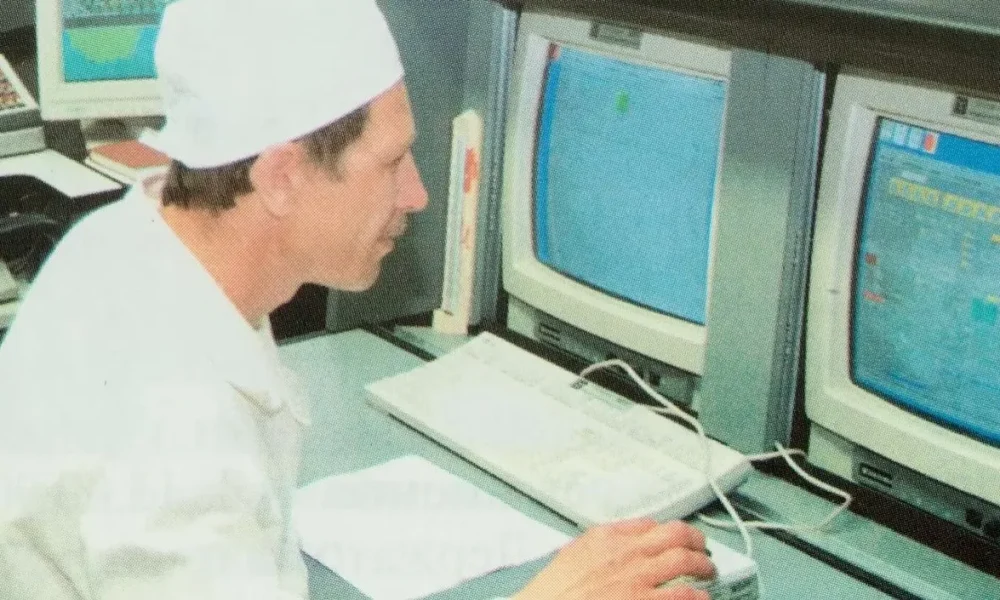
During the 1990s the Chornobyl Nuclear Power Plant – formerly the Chernobyl NPP – continued operating with its remaining three RBMK reactors, but of course the 1970s-era automation with its very limited SKALA computer required some serious modernization. What was interesting here is that instead of just replacing this entire Soviet-era mainframe with a brand-new 1990s one, the engineers responsible opted to build a new system – called DIIS – around it. This is detailed in a recent video by the [Chornobyl Family] on YouTube.
This SKALA industrial control system was previously detailed in a video, covering this 24-bit mainframe computer and its many limitations. It wasn’t quite a real-time control system, but it basically did what it was designed to do. Since at the time it was not clear for how long these three RBMKs would be kept running, they didn’t want to go overboard with investments either.
Ultimately Unit 2 only was active until 1991 due to a turbine fire, Unit 1 until 1996 and Unit 3 was shutdown for the last time in 2000, so this a sensible decision. During those years, an auxiliary information-measurement system (DIIS) was the big upgrade, which got bridged into SKALA via a Ukrainian-made SM-1210 minicomputer, with the latter connected to an 80386 PC which itself was connected to an ARCnet hub.
Best part of this DIIS upgrade was that it made it possible to run modeling algorithms for the reactor core based on measurements, without having to send data all the way over to the central control office in Moscow. Now reactor parameters could be visualized in real-time, and adjustments made via the same PRIZMA program’s magnetic tapes of the SKALA system as before.
Although the result was a bit of an odd mixture of 1970s Soviet mainframe design, 1980s-derived Ukrainian mainframe design and 1990s Intel computing power, it worked well enough to bring the ChNPP to the very doorstep of the 21st century with no issues worthy of note. Definitely a testament to the engineers who hacked this upgrade together and made it work so smoothly.
