Connect with us

Tech

How To Clean Your Dishwasher With Baking Soda

Published

on


A dishwasher’s purpose is to clean your dishes. As such, it’s understandable if you might assume there’s no need to clean the dishwasher itself. However, there are actually several good reasons to add this task to your regular to-do list. For example, although a dishwasher typically shouldn’t smell badly if you’ve been using it properly, a thorough cleaning can fix the problem if a dishwasher does develop odors. On top of that, cleaning your dishwasher can remove mineral buildup and generally promote more reliable overall performance. You also don’t need any special equipment or materials for the job. Although you should always check the owner’s manual of your dishwasher to confirm the manufacturer doesn’t warn against certain cleaning methods, it’s generally possible to clean a dishwasher with some distilled white vinegar and baking soda.

Your first step is to clean out your dishwasher’s filter. Check the manufacturer’s instructions to determine how to do this, as it’s not always possible to remove a dishwasher’s filter, depending on the model you have.

Next, place one to two cups of distilled white vinegar in an upright, dishwasher-safe container in your dishwasher’s lower rack. Run a regular wash cycle without detergent, and turn off the drying cycle. This step helps to clear away grease.

Advertisement

After you’ve done that, sprinkle a cup of baking soda on the inside floor of the dishwasher and run a hot water rinse cycle. Again, you can skip the drying cycle. Open the door and let the interior air dry when the cycle is complete. The baking soda should remove odors.

Advertisement

Important information about cleaning your dishwasher with baking soda

It’s worth noting that you can buy cleaning tablets designed specifically to clean a dishwasher. The baking soda method might simply be more appealing because it involves using items you likely already have on hand.

Along with making your dishwasher smell more pleasant and potentially improving its performance, regular dishwasher cleaning could also save you money in the long run by guarding against the need for costly dishwasher repairs. Regular cleaning might even extend your dishwasher’s lifespan.

You also don’t necessarily need to clean your dishwasher that often. Cleaning it with vinegar and baking soda once a month should be sufficient to get the job done. In fact, overexposing your dishwasher to vinegar can cause damage due to vinegar’s acidity.

In the meantime, you might also wonder whether using a dishwasher is necessary when hand washing is always an option. If so, be aware that using a dishwasher is more sanitary than hand washing. A dishwasher can clean even more thoroughly when the unit itself is clean inside.

Advertisement


Source link

Advertisement
Continue Reading
Click to comment

You must be logged in to post a comment Login

Leave a Reply

Tech

Coffee Maker Steam Wand Gets A Safe Outlet

Published

on

Sometimes a hacker has a specific sort of problem, and uses the tools they have to solve it in a way that just might be helpful to someone else. That’s the case with [Matvey Kukuy]’s Coffee Steam Dryer (V2), which performs the very specific job of safely swallowing up expelled steam and water from an espresso machine’s steam wand.

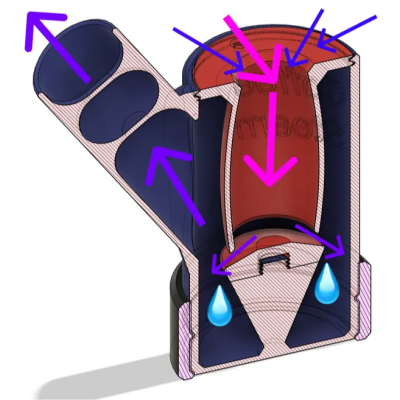
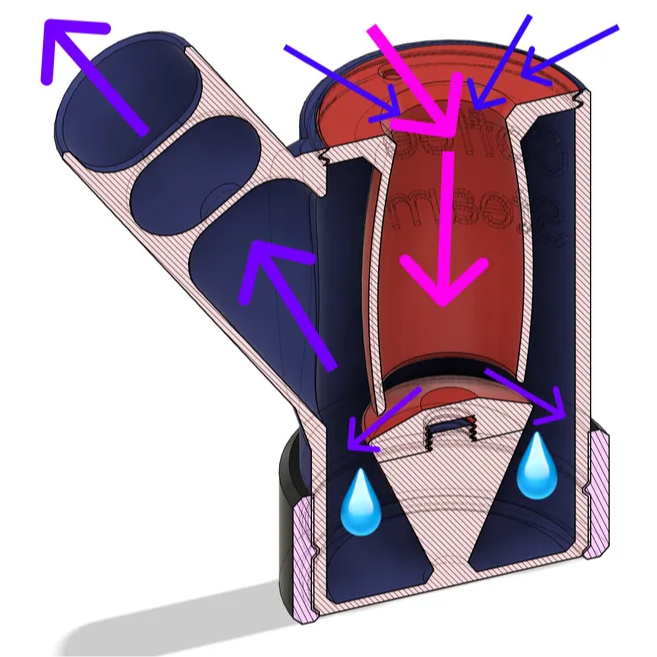
Steam purges into the top inlet and passes through expansion chambers, dragging cool air along with it, until it exits safely.

Steam wands are used to froth milk into a velvety texture, and some machines require purging the wand before using it for best results. Where does the resulting jet of steam and spatter of superhot water droplets go? Not the machine’s problem. That’s for the user to deal with, and [Matvey] decided to address it by designing and 3D printing a tool.

The pipe-like object works by having steam jet into the open top (printed in ABS or ASA for heat resistance) where the device redirects the hot gas and captures any expelled water in the process. The steam flows through expansion chambers, dragging cool air along with it in the process, until it ultimately gets redirected away from the user.

By the time steam exits the outlet, some has condensed and the remainder has cooled and slowed down enough to not be a worry.

Advertisement

It’s the second version of the device, and we like how it has no moving parts and can be disassembled for cleaning and drying.

Coffee is an area that is rich with hacker activity, from 3D-printed micro-brew machines to completely DIY roasters but tools like this show how improving the coffee workflow can also be beneficial.

Advertisement

Source link

Continue Reading

Tech

I love Garmin’s new Forerunner 170 Music smartwatch, but this deal for the superior Forerunner 265 makes it the better buy

Published

on

Garmin’s Forerunner 170 is a solid running watch that brings great performance and smart features, all in a light and small package, and I particularly loved the Music version for phoneless short runs and activities. The watch was even found to be very accurate, according to my colleague Matt Evans’ testing.

At AU$479 (or AU$549 for the Music version), however, it isn’t the most affordable as far as fitness smartwatches go — so when I found the older (but higher-tier) Forerunner 265 discounted by 38% on Amazon, I knew this was a deal too tempting to pass up.

Featuring a more accurate dual-band GPS technology, 13 days of battery life, more size options and on-watch music storage, the Forerunner 265 is hard to beat for just AU$498.

Advertisement

The Garmin Forerunner 265 was the first small Forerunner model with a touchscreen AMOLED display, replacing its predecessor’s monochrome memory-in-pixel display, to make it look and feel similar to something like an Apple Watch or a Samsung Galaxy Watch.

It also features dual-band or multi-frequency GPS for high-precision tracking in dense cities or heavy tree cover, which is technically superior to the Forerunner 170’s single-frequency multi-GNSS tracking.

The 170 is only available in the single 43mm size, while the 265 comes in 46mm and the smaller 265S is 42mm, providing more options for different wrist sizes.

The biggest criticism from our reviewer is the Forerunner 265’s price hike over its predecessor, and slightly worse battery life, which can be credited to the switch to an AMOLED display, but this discount takes care of the former in spades.

Advertisement

Interested in other Garmin products? Check out the latest Garmin Australia coupons here.

Source link

Advertisement
Continue Reading

Tech

2019 21.5-inch iMac now on Apple’s ‘vintage products’ list

Published

on

The age of the Intel Mac is coming to an end in every sense, as Apple now classifies the last 21.5-inch Intel-based iMac as a “vintage product.”

In 2019, Apple updated the aging Intel iMac with eighth-generation Intel processors and new AMD Radeon graphics cards. It shipped in the same slim chassis Apple introduced back in 2012, and Apple still offered then-outdated options like the 1TB Fusion Drive.

It was already a mediocre upgrade in its own right, but the arrival of Apple Silicon the following year made it even less desirable. Now, macOS Golden Gate has ended software support for Intel Macs, and the 2019 21.5-inch iMac has made its way to Apple’s “vintage products” list.

Apple considers a product “vintage” when it stopped distributing it for sale more than five years ago but less than seven years ago. The company provides service and parts for vintage products for up to seven years, assuming the necessary parts are available.

Advertisement

Once a product hasn’t been sold new for more than seven years, it’s then classified as “obsolete.” In short, the 2019 21.5-inch iMac is still eligible for repairs from Apple and its authorized service providers, assuming the required parts are available.

While the 2019 21.5-inch iMac will officially be obsolete in 2028, meaning repairs will no longer be offered, that doesn’t mean the computer won’t be serviceable at all. Apple’s older Intel iMacs feature upgradeable storage, RAM, and a socketed CPU, assuming you’re willing to remove the display with the proper tools.

Software-wise, the last 21.5-inch Intel iMac will likely forever be stuck on macOS Sequoia, though Apple is still expected to release security updates through 2027.

Advertisement

Source link

Continue Reading

Tech

Mythos has made 2026 patching hell. It might make 2027 a breeze

Published

on

Security

Gartner sees huge amounts of technical debt paid down, and better scanning that could make software safer sooner

When Microsoft delivered over 970 patches last week, many saw a nightmare for beleaguered security staff. Gartner research vice president Craig Lawson thinks infosec workers might soon see sunlit uplands as their workloads ease.

Advertisement

Lawson outlined that scenario at Gartner’s IT Symposium in Australia today and explained it by theorising that the increased volume of vulnerability discoveries made possible by Anthropic’s Mythos and other bug-hunting AI might be getting close to finding most of the flaws in established codebases.

“We’ve never had a situation where massive codebases have been audited to that level before,” he told The Register, and offered the recent series of CVEs found in OpenBSD – which has historically been an unusually secure and stable OS – as evidence that AI bug-hunters are cleaning up.

“Think about how much technical debt has been retired in products just in the last six months,” he said. Lawson pointed to the fact security vendors, who in theory know what it takes to create secure products, are also using AI to find flaws in their wares. Those discoveries, he suggested, again indicate AI is taking out potential avenues for zero-day attacks.

The high number of CVEs reported in 2026 is a positive signal. Lawson thinks Mythos and its ilk may also create an invisible signal as vendors use the AI to detect more bugs in their future releases.

Advertisement

He therefore thinks that 2027 might see CVE numbers fall as vendors finish cleaning up old codebases, and because they use AI to more thoroughly test their next releases.

“2027 could be the first year we see a net drop, maybe not in aggregate vulnerabilities, but definitely in severity of flaws,” he told The Register.

He thinks AI will also make defenders happy by giving them better tools. Today, he said, a red-teaming exercise is an infrequent and costly event that usually involves hiring an external provider. AI bug-hunters could mean organizations can effectively run a red team every day.

And if a red team exercise produces tickets that need solving, he thinks AI will help analysts to identify fixes more quickly.

Advertisement

“What if I could spend three minutes going to Gemini and saying ‘Write syntax for an F5 IRule’ that becomes a virtual patch? Everyone can do threat intelligence, enrichment, some of those harder tasks.”

When infosec staff make those fixes, Lawson wants organizations to celebrate the impact of their work.

Today, Lawson said, security operations centers measure staff by the number of tickets they process and close. He thinks a better approach is to celebrate the fact that cyber-defenders kept a hospital open or stopped a ransomware raid. ®

Source link

Advertisement
Continue Reading

Tech

A Super-Accurate Clock Using A Tiny Microcontroller

Published

on

DCF77 is a German VLF transmitting station that broadcasts a time signal across Europe on 77.5 kHz. Thus a common sight in a European home is a clock emblazoned with the words “Radio controlled”. With the timing broadcast in a simple and low speed digital format it doesn’t require the greatest of hardware to decode, and a small microcontroller can handle the task with ease. And there are few smaller than an ATtiny as used in [kwolf1909]’s decoder. It takes a DCF77 bitstream from a receiver, and shows the time on an I2C display.

The receiver isn’t part of this project, however a single-frequency longwave receiver is not a difficult thing to build. The interface is a push-button, for which a short press cycles between display modes and a long press triggers a DCF77 reset. It also supports an external temperature sensor and real time clock module, if you’re using an ATtiny with enough pins.

We like this project; it’s simple and does one thing well, and it’s a welcome reminder that not every device needs a powerhouse of a processor. If you’re interested enough to build your own, we’ve featured someone doing a deep dive into the signal before.

Advertisement

Source link

Advertisement
Continue Reading

Tech

Trump’s DOJ Says ‘Become Ungovernable’ Is Antifa Evidence. Trump’s Convention Put It On The Wall.

Published

on

“Become ungovernable” is a phrase that has traveled around the world and morphed in meaning over time, but in the last few years has basically become an internet culture joke meme, with vaguely anarchist seasoning.

A Hershey's chocolate bar with horizontal pieces that can be broken off, but missing in the middle is a vertical piece-sized hole that was cut out. Across the top is the text "BECOME UNGOVERNABLE".

But, now, in the Trump administration, it has apparently taken on a Schrodinger-esque meaning as either… a slogan for libertarian-leaning MAGA folks… or proof that someone is antifa. Or we just live in a dumb stupid world where nothing matters anymore.

As you may have heard, last week Donald Trump hosted the first-ever GOP “midterms” convention, a desperate ploy to get people excited about the midterm elections as Trump’s approval ratings hit such horrifying lows that even some Republicans are trying to distance themselves. Trump doesn’t have anything productive or helpful he can do to stop the slide caused almost entirely by his own terrible decision-making, and thus he falls back on the only thing he knows how to do: hold rallies to pretend that everyone loves him.

It was apparently difficult to find willing speakers (many top Republican officials came up with excuses to skip the shindig), but he did get Ross Ulbricht to speak. As someone who covered much of the Ross Ulbricht saga — from his arrest for operating the Silk Road Tor marketplace, to the stories of him attempting to hire hitmen to kill off various people, to his “maybe someone else did it!” legal arguments, to his eventual pardon from Trump — I’d say the pardon was a near-perfect encapsulation of Trump 2.0’s transactional corruption.

There were some parts of the Ulbricht prosecution that seemed problematic, and the lifetime sentence was arguably excessive given the evidence, but the attempted murder claims were a pretty big deal. And while some of Ulbricht’s defenders argued he was just a platform operator who shouldn’t be liable for what users did — an argument we’re usually quite sympathetic to — Section 230 never applied to federal criminal charges anyway. And remember: Trump has regularly campaigned on throwing drug dealers in jail, if not executing them outright.

Advertisement

But, freeing Ulbricht became a kind of Libertarian Party cause célèbre, and Trump was desperate for votes in 2024, so to try to bring over some of the increasingly authoritarian wing of the Libertarian Party (as oxymoronic as that may sound) he promised to pardon Ulbricht. Free the guy who set up a giant illegal drugs and weaponry marketplace, in exchange for some votes. Trumpism in a nutshell.

Notably, when Trump spoke in front of the Libertarian Party convention to make this promise, he did so in front of a “Become Ungovernable” banner.

Donald Trump stands behind a podium labeled "LIBERTARIAN National Convention 2024" against a blue background featuring the text "BECOME UNGOVERNABLE".

Last week, when Ulbricht spoke at Trump’s midterms rally, he spoke in front of the same banner:

Ross Ulbricht in a suit stands at a podium in front of a blue brick wall featuring a large yellow splash with the words "BECOME UNGOVERNABLE" written in black.

Ulbricht didn’t have anything interesting to say, just misleadingly claiming that he and Trump were both the “target of a weaponized government,” which only makes sense if you haven’t actually looked at the evidence against Ulbricht. It’s not a “weaponized” government when you actually engaged in criminal activity, dude.

But that banner background really caught my eye, because just a few months ago, with Trump’s DOJ trying to cook up charges against the mythical “antifa” cells that MAGA keeps insisting exist, the DOJ claimed that it had found and indicted an antifa cell in Minnesota. And a key part of the evidence? One of the people had posted to Facebook “become ungovernable.”

With these new charges, Rosen said, “the evidence will prove it all out”.

Rosen showed social media posts and videos of a couple of the people indicted to underscore the allegations that they intended to impede law enforcement. In one video, a man declares he is antifa and discusses bringing guns to a demonstration. He showed another post of a defendant saying people needed to “become ungovernable”.

Advertisement

Literally, the US Attorney highlighted the “become ungovernable” Facebook post in his press conference explaining why those charged were “antifa.”

Oh, so they have NOTHING nothing

Aaron Rupar (@atrupar.com) 2026-06-16T16:10:00.812Z

You could argue that the 2024 Trump appearance in front of the banner doesn’t count. It wasn’t Trump’s convention, he had no say in the backdrop, and it happened two years before his DOJ decided that the phrase was crucial evidence of antifa conspiracy membership. Sure. Fine.

But here we are now, just a few months after one of Trump’s own handpicked prosecutors stood at a press conference and declared that “become ungovernable” was evidence of antifa membership, Trump’s own MAGA convention has plastered that same phrase across the main stage — behind the guy who ran an illegal drugs market and tried to hire assassins to take out his enemies.

Advertisement

It’s almost like nothing actually matters any more, other than whether you’re loyal to Trump or not. And thus, I guess, the only thing one can possible do is… ahem… become ungovernable.

A penguin stands on snow holding a large knife, with the text "BECOME" above it and "UNGOVERNABLE" below it.

Source link

Continue Reading

Tech

The High Crime Of “LMAO”: How Cops Are Treating Flock Mass Surveillance As A Joke

Published

on

Here’s a riddle: Why did a Goshen Police Department officer search 6,474 automated license plate reader (ALPR) networks, representing data from 82,413 cameras, on May 7, 2025? 

If your answer is “I don’t know,” it turns out you’re 100% correct. The officer left the letters “idk” in the search field where cops are supposed to document the reason for the search.

When law enforcement and tech salespeople pitch ALPRs to city councils, they stick to a familiar script. They trumpet the technology, which is often provided by private companies like Flock Safety, Motorola Solutions, or Axon, as an essential tool for solving high-stakes crimes, such as car jacking, kidnapping, or murder.

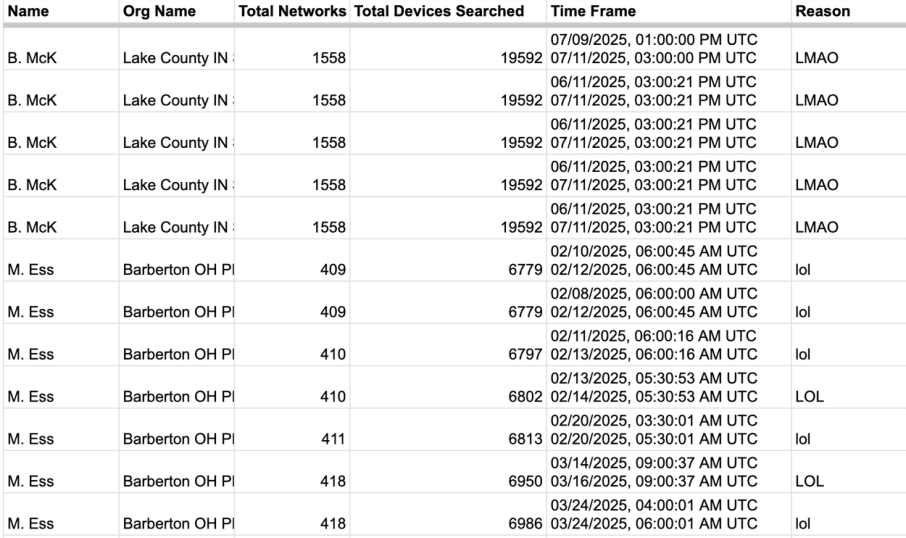
But when you strip away the carefully curated talking points, the data continues to reveal a different (and frankly, ridiculous) story. An EFF analysis of ALPR search logs from Flock Safety systems shows that officers across the country are spying on drivers for completely nonsensical “reasons.” Police are routinely searching the Flock database without providing any legitimate justification, making a mockery of our civil liberties by logging reasons like “LOL” (short for “laugh out loud”), “LMAO” (short for “laughing my ass off”), “sexy,” and “idk” (short for “I don’t know”) to access sensitive ALPR location data.

Advertisement

And in some cases, officers are just mashing keyboard buttons rather than articulating the nature of their searches.

Flock Safety claims it has improved its system by requiring officers to select from a dropdown list of crimes before running a search–but that only makes it easier for officers to hide improper searches behind the veneer of uniformity. The system does not require proof that the dropdown reason actually matches the true purpose of the search. 

With no warrant requirements, limited guardrails, and deficient audit processes, ALPR databases have fostered a culture of unrestricted access to everyone’s location information. This culture of abuse has allowed police to treat a mass surveillance network like their own personal search engine, permitting the tracking of the movements of everyday citizens for low-level complaintspersonal whims, and sometimes, seemingly, for the lols.

A Documented Culture of Abuse

ALPR misuse isn’t a new phenomenon; it has dominated headlines for more than a year. We already know that officers regularly abuse these systems to stalk past and potential romantic partners. We’ve seen ALPRs used to surveil protests, which can chill First Amendment-protected dissent, and seen officers try to use an ALPR system to track down a woman seeking an abortion.

Advertisement

Typically, we learn about these uses from documents called “network audits,” which are long spreadsheets that document all the searches that run through an agency’s system. It is not unusual for even a small agency to have a record of millions of searches from thousands of external agencies across the United States.

We’ve also uncovered horrific systemic profiling, with more than 80 law enforcement agencies using terms like “roma” and “g*psy” to target ethnic Romani people—often without any mention of a suspected crime. And when police aren’t using ALPRs for stalking or profiling, they routinely use them for extreme low-level investigations: verifying whether a student lives in a specific school zonerunning employment background checks, following up on loud music complaints, or targeting a motorcyclist simply for holding a cell phone.

But somehow, it gets worse.

The Absurdity of Documented Search Reasons

EFF’s analysis of Flock Safety’s ALPR search data obtained through public records requests has uncovered a disturbing trend. In the absence of judicial oversight, officers are inputting ridiculously unserious terms to justify their searches. Here is just a snapshot of what police consider a “reason” to track someone’s vehicle:

Advertisement

Surveillance as a Joke

Audit logs sample

  • Barberton Police Department (Ohio) employees ran numerous searches between March 2024 and May 2026, listing “LOL” or “lol” as the reason.
  • Harris County Sheriff’s Office (Texas) employees ran several searches between April and May 2026 listing “LOL” or “lol” as the case number.
  • Lake County Sheriff’s Department (Ind.) employees ran searches in July 2025 for “LMAO.”
  • Richmond Police Department (Calif.) employees ran over multiple searches in November 2024 for “Hehe.”
  • Riverside County Sheriff’s Department (Calif.) employees ran searches in 2024 for “Haha.”

“Don’t Know, Don’t Care” Approach

  • Kankakee County, Sheriff’s Office (Ill.) employees ran searches (2023–2025) for “idk” or “idk lol.”
  • Goshen Police Department (Ind.) ran searches (May–June 2025) for “idk.”
  • Fishers Police Department (Ind.) ran searches in May 2025 for “blah.”
  • A Pasco Police Department (Wash.) employee searched for at least four different license plates, leaving “robbery i don’t remember the case number leave me alone” in the reason field.
  • The San Diego Sheriff’s Department (Calif.) ran searches in May 2025 with “idk” in the reason field. 
  • More than 30 agencies ran more than 6,300 searches with “TBD” (short for “To Be Determined”) as the “reason.” These included the Arizona Department of Public Safety, the Manteca Police Department (Calif.), and the Baton Rouge Police Department (La.). The Priceville Police Department (Ala.) alone ran 1,954 searches with reasons “TBD.” 

Insults and Inappropriate Searches

  • Belton Police Department (Mo.) ran searches (Aug–Sept 2024) for “d*ckhead.”  (asterisk/redaction our own)
  • A Manteca Police Department (Ill.) employee ran searches in June 2024 for “sh*thead”  (asterisk/redaction our own)
  • A Norton Police Department (Mass.) employee ran searches in December 2024 for “Sexy.”
  • Corona Police Department (Calif.) employees ran searches (2023–2025) for “weird” or “WEIRD KID.”
  • Thornton Police Department (Colo.) employees ran several searches in October 2025 for “driving around being weird.”
  • A Columbus Police Department (Ohio) officer ran searches in 2023 for “idiot.”
  • A Michigan City Police Department Officer (Ind.) ran searches in June 2025 listing “f*ck this new search engine.” (asterisk/redaction our own)

Button Mashing 

Button mashing audit logs sample

One of the more alarming discoveries we found in the network audit data is a large number of “reasons” that appear to be nothing more than an officer mashing buttons. These typically involve a nonsensical long string of characters from the same line or area of the keyboard.

For example: 

Advertisement
  • An Eatonton Police Department (Ga.) employee ran searches with reasons such as HJKNUILHuiokjk.kujGJLHBNMNhjhbnmg, and iuohjk.
  • An Atlanta Police Department (Ga.) employee ran searches with asdfga as the reason. 
  • Bay County Sheriff’s Office (Fla.) employees ran searches with reasons such as  ;’lkjh/lkjh and lkjhg.
  • A Brown County Sheriff’s Office (Wis.) employee ran searches with reasons such as gyghkkghghjkghjkggyjgyujdsrdghdfhjkghjghkHJHJKLHLKHJKhjjkjkhjkljk and JHLJKHHJKL.
  • A Lake County Sheriff’s Office (Ohio) employee ran searches with reasons such as asdfg and ghjkl, and a second officer ran a series of searches that started off with “investigation” but then devolved into button mashing, including:
    • InvestigatafyInvestigatafydInvestigatafydlInvestigatafydlhinvestigatafydlhjinvestigatafydlhjiinvestigatafyfdlhjiinvestigatafyfdlhjigkfgtyinvestigatafyfdlhjigkfgtyyinvestigatafyfdlhjijinvestigatafyfdlhjikinvestigatafyfdlhjikfinvestigatafyfdlhjikfginvestigatafyfdlhjikfgtyinvestigatafyfdlhjikfgy and investigatafyfdlhjiy.
  • A Moore Police Department (Okla.) ran searches with reasons such as jhjhjkhjjhjkhjhjhjkhjkhjkhhkjhjkJkhjkhjJkhjkhjkJkhjkhjkhjkhjkhkjhjkjkhjkhkjjkhjkloiuiouukjhjkh and ulkuiou.
  • A Westlake Police Department (Ohio) employee ran searches with reasons such as fghjklghjkl, and lkjhg.
  • A Kentucky State Police employee ran searches with reasons such as mhghjkmhgnhjkjnbvcxcvbnnmbvcbnm, and sdfghj

It’s hard to imagine a situation where these characters add up to a legitimate police code. However, it’s easy to imagine an officer cutting corners with a text field they know no one is checking, especially if they are accessing the Flock Safety app from their phones while driving. 

How Police Departments Are Responding

When confronted with these flagrantly unserious searches, police departments offered a mix of bureaucratic deflections and excuses. 

In response to EFF’s request for comment, Thornton Police Department (Colo.) claimed the system didn’t require officers to select from a defined list at the time, but it does today. They also audited the “driving around being weird” searches, claiming they were all actually for “legitimate public safety purposes.” 

Other police departments we reached out to for comment shared the following: 

  • Richmond Police Department (Calif.) stated that the officers involved with the “Hehe” and “idk” searches were “counseled.”
  • Corona Police Department (Calif.) noted that the employees searching for “WEIRD KID” are no longer employed by the city for unrelated reasons.
  • Columbus Police Department (Ohio) pointed to their union contract, stating their Inspector General only has jurisdiction to investigate incidents within the last 90 days, giving the officer who searched for “idiot” in 2023 a free pass.
  • Belton Police Department (Mo.) promised a “thorough investigation” of the “d*ckhead” searches through existing union and personnel policies.
  • Manteno Police Department (Ill.) said it will “review the searches and the circumstances surrounding them thoroughly” and “take whatever action is determined to be appropriate based on the facts and circumstances.”
  • Manteca Police Department (Calif.) said: “Since the beginning of 2026, our personnel have been directed that the reason field for ALPR searches must identify the law enforcement purpose for the search and that ‘TBD’ is not an acceptable entry.” The spokesperson added: “The presence of ‘TBD’ in the reason field in prior searches should not, by itself, be interpreted to mean that the associated search was conducted without a legitimate law enforcement purpose or that reasonable suspicion was required.” EFF has asked the agency to clarify whether it verified the hundreds of “TBD” searches were legitimate, and we will update this post with a response if we receive one. 
  • Fishers Police Department (Ind.) said that the detective that searched for “blah” has done so “when he has issues with the technology” and that the term “is used when he is actively using the technology to solve a criminal case, and the technology is not moving fast enough for him.” The department shared that “he has been told to use “test” in the future.”
  • The Cobb County Police Department (Ga.) acknowledged that “TBD” stood for “To Be Determined” and is no longer an acceptable search reason: “We have instituted a new policy that took place after the dates listed in your audit that now require, in addition to a criminal offense and a reason, a case number for any search conducted on FLOCK.” 
  • The San Diego County Sheriff’s Department says that it checked the cases where “idk” was used and determined “there was an active investigation associated with the searches.” The department said that this was due to the reason field being optional at the time (which was true on a software level) but California law has required officers to document a purpose for accessing ALPR data since 2015. The sheriff’s spokesperson says the reason field is now mandatory, and involves a dropdown menu. 

Other agencies did not respond to EFF’s requests for comment. We will update with responses as they are received.

The Cop Out of the Drop-Down Menu “Feature Update”

Under the guise of streamlining audit logs, in late 2025, Flock safety announced that they will be replacing the required, free-text search “reasons” with a pre-populated dropdown menu of generic offense categories. Since this update, officers are no longer required to type out why they are digging through a driver’s movement history, and instead can select a pre-packaged option like “Traffic infraction” or “Other” in half a second. 

Advertisement

Replacing the requirement to articulate the reason for the search with one-click searches is a loss for transparency, but also may explain why audit logs including the searches we highlight in this piece significantly decreased since early 2026. 

The Punchline is Our Privacy

Entries like these defeat transparency, undermine accountability, and entirely fail to satisfy what many jurisdictions require by law or policy: an actual reason for the search. And this keeps happening because police use ALPRs as a convenient shortcut around constitutional privacy safeguards. 

In other contexts, such as searches of cell phone location information, police have to go to a judge, demonstrate probable cause, and get a search warrant. But because laws and courts have not caught up with the pace of ALPR technology, police do not do the same before searching ALPR databases. Instead, they are given free rein to track a person’s movements without a sliver of judicial oversight.

As we mention in our piece about the use of ALPR surveillance for low-level investigations, if a police chief stood in front of a city council and asked for permission to install hundreds of cameras just so his officers could investigate the high crime of “haha,” they would be laughed out of the room. The same could be said if an officer asked a judge to sign a warrant to track someone down for “LOL.”

Advertisement

The fact that these searches were not only missed by the agency supervising the officer, but by the often thousands of other agencies whose systems were searched, demonstrates how agencies cannot be trusted to oversee themselves. 

Mass surveillance is incompatible with a free society, and especially so when the people with access to this data are treating it like a joke. This ALPR mass surveillance—the indiscriminate, continuous collection and retention of location data on every driver, regardless of suspicion—should not exist. But because it does, EFF continues to urge courts and state legislatures to immediately step in and impose strict, enforceable restrictions to rein in this abuse. At an absolute minimum, this means mandating rigid data deletion deadlines and an ironclad warrant requirement. 

If police want the power to track a person’s movements, they must be required to convince a judge with evidence and probable cause. They should not be able to bypass the Constitution with a search for “haha.”

Republished from the EFF’s Deeplinks blog.

Advertisement

Source link

Continue Reading

Tech

Tips To Model Your Next CNC Cabinet In CAD Before Buying Anything

Published

on

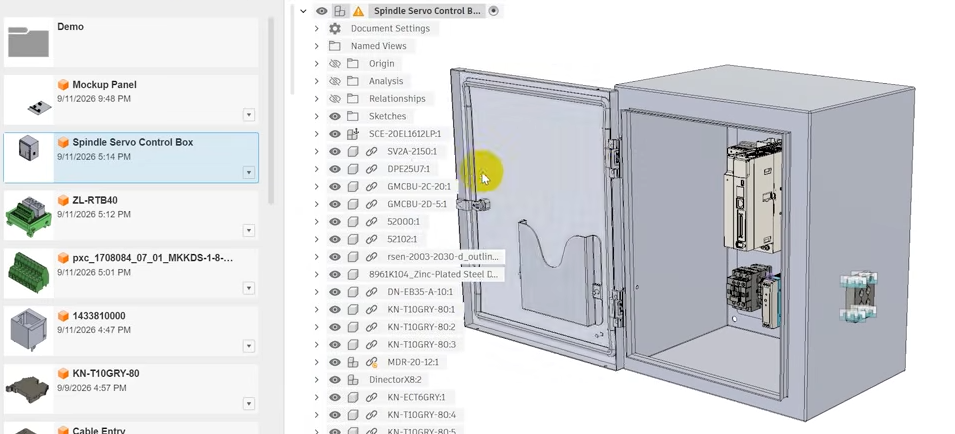
[Clough42] has started a new CNC control cabinet build, and uses it as an opportunity to demonstrate why he models the whole thing out in CAD before ordering parts or physically building anything. One may wonder why to bother, and the simple answer is to ensure there are no surprises or waste. [Clough42] has built plenty of these cabinets and there’s always something that isn’t as expected.

Modeling out an entire cabinet sounds like it should be easy, because today one can obtain 3D models for components from industrial suppliers with ease. In practice, it’s a process fraught with little gotchas.

For example, a STEP file of a component can lack convenient geometric snap points. An enclosure will be a single entity, without a separate door (and certainly not articulated at the hinge). [Clough42] shows ways to deal with all of these, and more, in Fusion 360. With a few simple techniques laying out an entire cabinet in CAD can be easy.

Planning before buying or building is a form of prototyping, and prototyping helps surface problems so they can be avoided before they become costly. This concept extents to design work as well; model everything out to avoid simple goofs like a screwdriver handle trapped by its surrounding bits.

Advertisement

Source link

Advertisement
Continue Reading

Tech

These Simple Tools Make Cleaning Behind Large Appliances A Breeze

Published

on


We may receive a commission on purchases made from links.

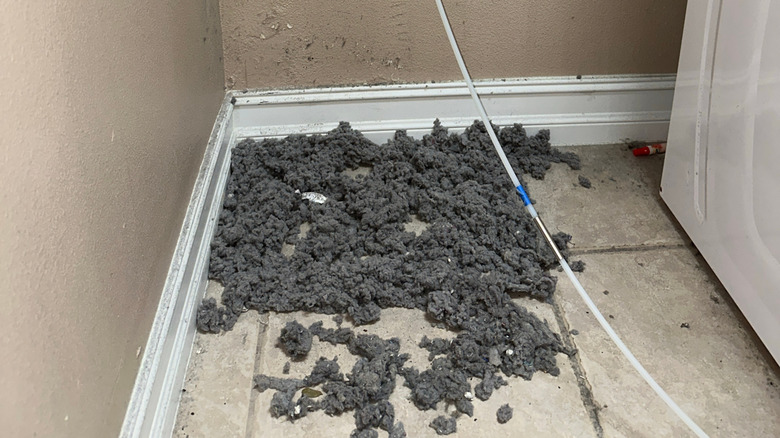
Though it’s easy to overlook, you should clean behind your large appliances on a regular basis. It’s common for lint to fall behind dryers and crumbs and other debris to end up behind stoves, so a good cleaning is more than necessary. If you find this task difficult due to the struggle of having to move such heavy and unwieldy appliances, you’re in luck. There are some handy and pretty simple tools that will help you gain access into these hard-to-reach areas, giving them a good cleaning without straining yourself.

You have a few viable options to get behind and clean your large appliances. One is a basic attachment for your vacuum cleaner’s hose, a vacuum cleaner crevice nozzle like this one on Amazon. These long, slender hose heads are excellent for slipping behind fridges, stoves, and more to suck out all kinds of long-sitting debris. Alternatively, there’s the easy cloth-on-a-stick method. Take a broom handle or similar long, slim object, put a rag on the end, and pull the debris out from behind the appliance. Once it’s out, sweep or vacuum it up and you’re good to go. Speaking of sweeping, sticking a flat broom back there to pull out debris works as well if you’re in a pinch.

Advertisement

Once you get the back of your appliance cleaned up, your work in tight spaces isn’t quite done. Don’t forget to get underneath, which is also easily accomplished without moving anything.

Advertisement

There are tools for underneath too!

While you’re clearing out behind your fridge, washer, dryer, and other similarly large appliances, it’s worth getting underneath them as well. This is another hotbed for dust and debris build-up, so it’s worth cleaning it out on a regular basis. If you’re interested in a tool for this specific job, there are options like the Shark under-appliance wand attachment. Much like the aforementioned crevice nozzle, this is a thin vacuum hose attachment meant to reach in the tight space between your appliance and the floor. It should suck out everything you can’t see.

If you’re looking for something a little simpler that doesn’t demand a vacuum to attach it to, there are manual under-appliance cleaning tools out there. There’s the retractable gap dust cleaner – one of many great gadgets on Amazon for spring cleaning – and other similarly designed tools. This is essentially a long, flat cleaning cloth on an extendable handle that makes it possible to sweep out debris from underneath your immobile appliances. Once you use it to bring everything out, you can sweep it all up with a regular broom.

No one likes adding to their chore list, but all of these tools make it a bit easier and quicker to clean beneath and behind your largest appliances. After all, these aren’t jobs to overlook given the consequences of allowing build-up around them.

Advertisement

Why you need to clean around large appliances

Out of sight, out of mind can become the motto when it comes to things being kicked under and left behind appliances. In reality, the last thing you want to do is forget to clean these areas with regularity. For one, it’s just sanitary. Around stoves and refrigerators, foodstuffs can build up and start to smell, worse yet attracting bugs if left alone for too long. There are also possible safety concerns, like in the case of dryers. Lint and hair build-up can present a fire hazard, as the heat the machine gives off can set these flammable materials ablaze.

Equally seriously, there’s a real risk of harming how your appliances function. For instance, many fridge models have their condenser coils situated in the back toward the ground. These are responsible for taking heat pulled from the fridge and sending it out and away from the unit. You don’t want these to fill with dust and debris or else the fridge will have to work harder to remove that heat thanks to the restricted air flow. This leads to higher energy consumption, a larger energy bill, and possibly damage to the unit if the coils are left clogged for too long. You should do your best to prevent clogging in the first place with regular behind-fridge cleaning.

Even products from the most reliable home appliance brands need to be taken care of and cleaned properly. Thankfully, getting areas like the floor beneath and the space behind them cleaned up is indeed possible, even if you can’t move them by yourself.

Advertisement


Source link

Advertisement
Continue Reading

Tech

Uncommon Thinkers 2026: Last call for nominations for Seattle’s boldest innovators

Published

on

The 2025 “Uncommon Thinkers” award winners, from left: Anindya Roy, co-founder of Lila Biologics; Kiana Ehsani, co-founder of Vercept; Max Blumen of Tin Can representing winner Chet Kittleson, co-founder of Tin Can; Jeff Thornburg, co-founder of Portal Space Systems; Jay Graber of Bluesky; and Brian Pinkard, co-founder of Aquagga. (GeekWire Photo / Kevin Lisota)

It’s the final call to recognize the Seattle area’s boldest innovators — nominations for GeekWire’s 2026 Uncommon Thinkers Awards close this Friday. Help us select individuals who challenge conventional thinking, push boundaries and make an impact across the region.

Now in its fourth year, and in partnership with Greater Seattle Partners, the program aims to honor inventors, scientists, technologists and entrepreneurs who are transforming industries and driving positive change throughout the world.

Community nominations will be accepted through Friday, Sept. 18 at 11 a.m. PT, after which a panel of judges will select honorees. They’ll be celebrated on stage during a VIP reception at the annual GeekWire Gala on Dec. 10. Early-bird tickets available here.

Honorees are selected based on innovation, creativity and leadership and should have a track record of introducing novel ideas, technologies, or solutions that challenge the status quo. Nominees should also demonstrate a measurable and meaningful impact on their respective fields or industries, contributing to the betterment of society.

Do you know an Uncommon Thinker deserving of recognition? Fill out the nomination form today.

Read the GeekWire profiles of last year’s Uncommon Thinkers honorees:

Advertisement

Thanks to First Tech Federal Credit Union, the title sponsor of this year’s GeekWire Gala. For a recap of last year’s event, head here.

Source link

Continue Reading

Trending

Copyright © 2025