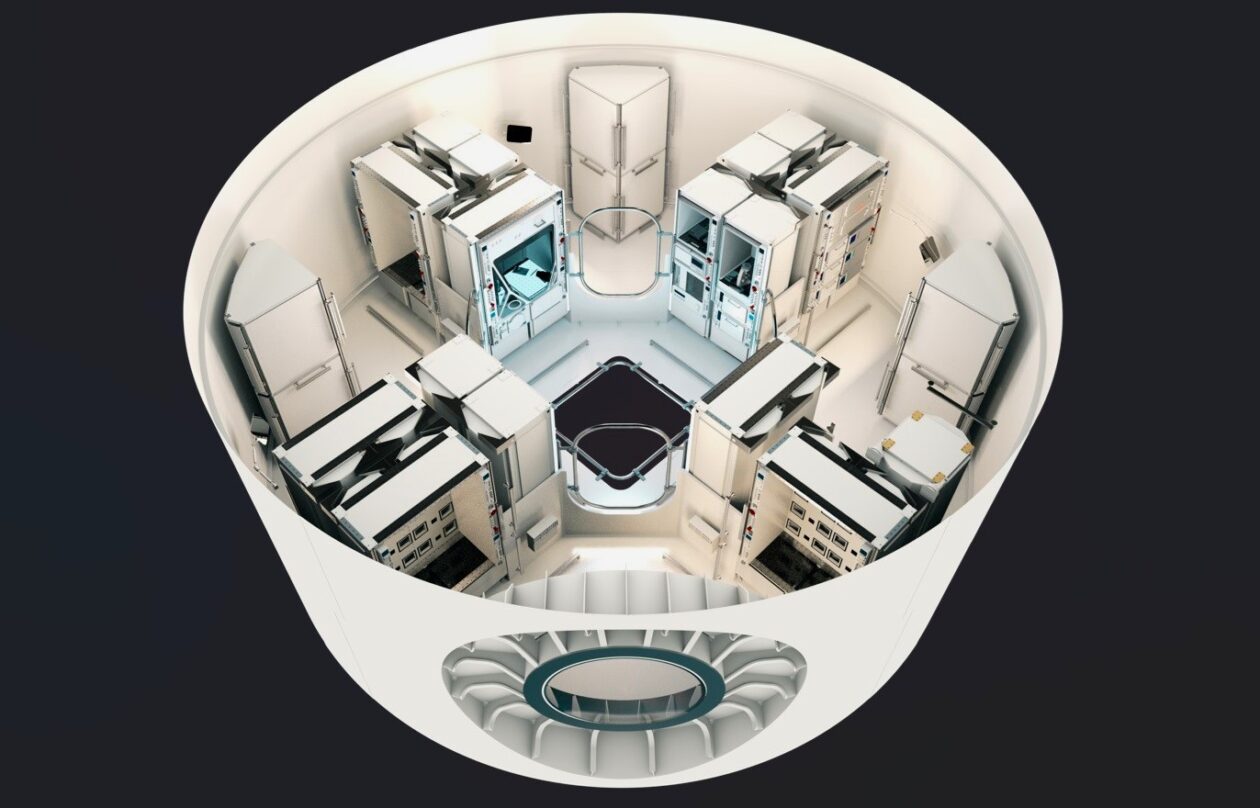











This cutaway view shows the interior of the Starlab space station’s laboratory. (Starlab Illustration)
How do you design a living space where there’s no up or down? That’s one of the challenges facing Teague, a Seattle-based design and innovation firm that advises space companies such as Blue Origin, Axiom Space and Voyager Technologies on how to lay out their orbital outposts.
Mike Mahoney, Teague’s senior director of space and defense programs, says the zero-gravity environment is the most interesting element to consider in space station design.
“You can’t put things on surfaces, right? You’re not going to have tables, necessarily, unless you can attach things to them, and they could be on any surface,” he told GeekWire. “So, directionality is a big factor. And knowing that opens up new opportunities. … You could have, let’s say, two scientists working in different orientations in the same area.”
Mike Mahoney is senior director of space and defense programs at Teague. (Photo via LinkedIn)
Over the next few years, NASA and its partners are expected to make the transition from the aging International Space Station to an array of commercial space stations — and Teague is helping space station builders get ready for the shift.
In the 1980s, Teague helped Boeing and NASA with their plans for Space Station Freedom, an orbital project that never got off the ground but eventually evolved into the International Space Station. Teague also partnered with NASA on a 3D-printed mockup for a Mars habitat, known as the Crew Health and Performance Exploration Analog.
Advertisement
Nowadays, Teague is focusing on interior designs for commercial spacecraft, a business opportunity that capitalizes on the company’s traditional expertise in airplane design.
Mahoney said Teague has been working with Jeff Bezos’ Blue Origin space venture on a variety of projects for more than a decade. The first project was the New Shepard suborbital rocket ship, which made its debut in 2015.
“We partnered with their engineering team to design for the astronaut experience within the New Shepard space capsule,” Mahoney said. “It’s all the interior components that you see that come together, from the linings to the lighting. We created a user experience vision for the displays as well.”
GeekWire’s Alan Boyle sits in one of the padded seats inside a mockup of the crew capsule for Blue Origin’s suborbital spaceship, on display at a space conference in 2017. The door of the capsule’s hatch is just to the right of Boyle’s head. (GeekWire File Photo / Kevin Lisota)
Teague also worked with Blue Origin on design elements for the Orbital Reef space station and the Blue Moon lunar lander. “We were involved in initial concepting for the look and feel of the vehicles,” Mahoney said. “In other cases, we designed and built mockups that were used for astronaut operations and testing. How do we navigate around the lunar lander legs? How do we optimize toolboxes on the surface of the moon?”
Other space station ventures that have benefited from Teague’s input include Axiom Space (which also brought in Philippe Starck as a big-name designer) and Starlab Space, a joint venture founded by Voyager Technologies and Airbus.
Advertisement
Starlab recently unveiled a three-story mockup of its space station at NASA’s Johnson Space Center in Texas. The mockup is built so that it can be reconfigured to reflect tweaks that designers want to make in the space station’s layout, before launch or even years after launch.
“One of the things that’s been very helpful along this development path has been working with Teague, because you have to have a really good idea on how you lay out this very large volume so that you can optimize the efficiency of the crew,” said Tim Kopra, a former NASA astronaut who now serves as chief human exploration officer at Voyager Technologies.
Kopra compared the Starlab station to a three-story condo. “The first floor is essentially like the basement of a large building that has the infrastructure,” he said, “It has our life support systems, avionics and software, the toilets, the hygiene station — which encompasses both the toilet and a cleaning station — and the workout equipment.”
The second floor serves as a laboratory and workspace, with a glovebox, freezer, centrifuge, microscope and plenty of racks and lockers for storage. “We are very focused on four different industries: semiconductors, life sciences, pharmaceuticals and materials science,” Kopra said.
Advertisement
He said the third floor will be a “place that people will enjoy … because Deck 3 has our crew quarters, our galley table, our windows and a little bit more experiment capacity.”
First ever look inside Voyager Space's Starlab Space Station mockup. The space station is 17m tall & 7.7m wide, essentially a 3-story tall building, and can host 4 astronauts continuously & 8 astronauts briefly. The company hopes to launch Starlab by 2029, to replace the ISS. pic.twitter.com/BzwfjUwkmZ
The galley table is a prime example of how zero-gravity interior design differs from the earthly variety. “No chairs,” Kopra said. “Just like on the ISS, all you need is a place to hook your feet. There are little design features, like where do you put a handrail, and how tall is the table?” (He said the designers haven’t yet decided whether the table should be round or square.)
Kopra said one of his top design priorities is to use the station’s volume, and the astronauts’ time, as efficiently as possible. “Time is extremely valuable on the ISS. They calculate that crew time is worth about $135,000 per hour,” he said. “Ours will be a fraction of that, but it really illustrates how important it is to be efficient with the time on board.”
Advertisement
Starlab is laid out to maximize efficiency. “We have a really cool design where the middle has a hatchway that goes all the way through the three stories,” he said. “So, imagine if it were a fire station, you’d have a pole that went from floor to floor. We don’t need a fire pole. We can just translate through that area.”
Mahoney said human-centered design will be more important for commercial space stations than it was for the ISS.
“In the past, space stations have been primarily designed for professionally trained, military background astronauts,” he said. “Now we’ll have different folks in there. … How do we think about how researchers and scientists will be using these spaces? How do we think about non-professional private astronauts? As the International Space Station gets retired, how do these companies step in to fill the void, serving NASA but also a lot of these new customers?”
A three-story mockup of the Starlab space station has been installed inside a building at NASA’s Johnson Space Center in Texas. (Starlab Photo)
An interior view of the Starlab mockup highlights the large observation windows and emergency equipment. (Starlab Photo)
The Internal Payload Laboratory inside the Starlab mockup features a glovebox, cold stowage, an optical bench and a workbench. (Starlab Photo)
Level 3 of the Starlab mockup includes the crew quarters, galley and Earth viewing areas. Starlab Space’s partners include Hilton and Journey, the team behind the Sphere in Las Vegas. (Starlab Photo)
When will commercial space stations step in? The answer to that question is up in the air.
But NASA has been slow to follow through on the revised plan, sparking concern in Congress. Late last month, the space agency said it was still working to “align acquisition timelines with national space policy and broader operational objectives.” Now some lawmakers are calling on NASA to reconsider its plan to deorbit the ISS in the 2030-2031 time frame.
The timetable for the space station transition may be in flux, but Mahoney and other space station designers are staying the course — and taking the long view.
“We may not know right now how the space station is going to be used 20 years from now,” Mahoney said. “How do we start to future-proof and create a system within that’s modular and flexible, so that we can add technologies and add systems, or we can configure in different ways? … Those are the kinds of things that we’re thinking about designing for.”
The funding will be used to expand Evervault’s encryption infrastructure, invest in product development, and grow its engineering and product teams.
Evervault, a data encryption start-up founded by Irishman Shane Curran, has raised $25m in Series B funding.
The round was led by Ribbit Capital, with participation from Sequoia Capital, Index Ventures, Kleiner Perkins, Next Play Ventures and new investors including Operator Partners. The new round brings the start-up’s total funding to date to $46m.
Evervault builds developer infrastructure to collect, process and share sensitive data.
Advertisement
The New York and Dublin-based company helps businesses to encrypt and orchestrate sensitive data without ever handling it in plaintext.
“Most compliance frameworks assume sensitive data will exist in plaintext somewhere, but with automated, high-velocity data exchange, that’s a liability,” said Curran, who is also CEO of the company.
“At Evervault, we believe sensitive data should be treated like hazardous material. Systems must be designed so it isn’t touched in the first place.”
Evervault has initially focused on card payments security with a solution that combines encryption with 3D-Secure authentication, network tokens and card data enrichment in a single integration, along with streamlining payment card industry (PCI) compliance.
Advertisement
The company claimed that on average, its solution helps customers cut PCI data security standard compliance costs by $100,000, achieve compliance 95pc faster and ship secure payment systems “in days rather than weeks”.
The start-up said that since its establishment, it has processed more than $5bn in transaction volume and secured more than four times year-over-year revenue growth.
“Our mission isn’t just about payments,” said Curran in a blogpost announcing the raise yesterday (5 March). “We’re building the trust layer for the internet: a global clearinghouse for sensitive data. A place where companies can share, enrich and route information without taking custody of it. We’re replacing contractual trust with cryptographic guarantees.”
The new funding will be used to expand Evervault’s encryption infrastructure, invest in product development, and grow its engineering and product teams, according to the start-up.
Advertisement
Founded in Dublin in 2019, Evervault’s roots can be traced back to the 2017 BT Young Scientist & Technology Exhibition where Curran took home the top prize for his project qCrypt, which was a quantum-secure, encrypted data storage solution with multi-jurisdictional quorum sharing.
Curran previously spoke to SiliconRepublic.com’s Ann O’Dea at a Future Human pop-up event in 2020, where he discussed his experience as a young entrepreneur and the Irish business contingent in Silicon Valley.
Don’t miss out on the knowledge you need to succeed. Sign up for the Daily Brief, Silicon Republic’s digest of need-to-know sci-tech news.

Netflix’s library of streamable party games is expanding today with a custom version of Overcooked! All You Can Eat. Netflix launched its cloud gaming program with games like Lego Party and Tetris Time Warp, but Overcooked feels a bit unique because it features a roster of Netflix-affiliated characters from KPop Demon Hunters and Stranger Things.
For the uninitiated, Overcooked plays like a more manic version of Diner Dash, where teams attempt to prepare food together in increasingly elaborate kitchens filled with obstacles. The original version of Overcooked! All You Can Eat was released in 2020, and includes DLC and stages from previous versions of the game. Netflix’s version bundles in the same content, and “10 Netflix celebrity chefs” including “Dustin, Eleven, Lucas, and the Demogorgon from Stranger Things,” and “half-dozen faces from KPop Demon Hunters,” like “Mira, Rumi, Zoey, Jinu, Derpy and Sussie.” Like Netflix’s other streaming games, playing Overcooked also requires you to use a connected smartphone as a controller.
As part of a Year in Review blog detailing changes Valve made to Steam in 2025, the company shared a minor update on its hardware plans that doesn’t sound good for anyone hoping to buy a Steam Machine, Steam Controller or Steam Frame in 2026. Specifically, the company is now opening up the possibility its new hardware won’t ship this year at all.
In February, when Valve acknowledged the ongoing memory and storage shortage had delayed the launch of its hardware and could lead to higher prices, the company was still committing to a (fairly wide) window of when its hardware would ship:
“Our goal of shipping all three products in the first half of the year has not changed. But we have work to do to land on concrete pricing and launch dates that we can confidently announce, being mindful of how quickly the circumstances around both of those things can change.”
As of the company’s latest post, however, things somehow sound even less certain. “We hope to ship in 2026, but as we shared recently, memory and storage shortages have created challenges for us,” Valve wrote in its Year in Review post. “We’ll share updates publicly when we finalize our plans!”
While Valve’s air of secrecy can make it easy to read too much into the limited information the company does share, moving from “the first half of the year” to “[hoping] to ship in 2026” certainly gives it wiggle room to not release new hardware this year. And considering the difficulties other companies are facing sourcing memory and storage, it wouldn’t be all that surprising.
Advertisement
HP said in February that RAM accounts for a third of its PC costs, and industry analysts expect the RAM shortage could radically alter the PC landscape as companies are forced to raise prices. Valve’s already struggling to keep the Steam Deck in stock due to its issues securing RAM, it stands to reason sourcing components for even more devices wouldn’t make that process any easier. Then again, the company hasn’t updated its launch timing FAQ, so there’s still reason to hope the Steam Machine ships in 2026.
When thinking of humanity’s ability to harness wind energy, many people will conjure images of windmills from places like The Netherlands or Persia. But people have been using wind energy for far longer than that in the form of sailing ships. Using the wind for transportation goes back another four thousand years or so, but despite our vast experience navigating the seas with wind alone there is still some room for improvement. Many modern sailboats use a number of different pulleys to manage all of the rigging, but this new, open-source pulley can replace many of them.
The pulley, or “block” as they are sometimes called, is built with a polymer roller made out of a type of nylon, which has the benefit of being extremely durable and self-lubricating but is a bit expensive. Durability and lack of squeakiness is important in sailing applications, though. The body is made from CNC-machined aluminum and is composed of two parts, which pivot around the pulley’s axis to allow various ropes (or “lines”) to be inserted without freeing one end of the rope. In testing, this design outperformed some proprietary stainless steel pulleys of similar size.
Another perk of this design is that it can be set up to work in many different applications on a sailboat, whether that’s for hoisting a mainsail or pulling in a jib or any other task a pulley could be used for. It can also be stacked with others in many different configurations to build custom pulleys of almost any type, and can support up to 14 mm lines. For a sailor this could be extremely valuable, because as it stands each pulley on a ship tends to be used in only certain applications, and might also be proprietary from a specific company. This pulley is being released into the open-source world, allowing anyone to create them who wants one.
Seagate introduced the Mozaic 3+ platform in 2024, turning the heat-assisted magnetic recording (HAMR) dream into a real product for customers in need of massive storage capacities. The HDD maker is now introducing the next-generation Mozaic 4+ drives, which offer capacities up to 44TB. Read Entire Article Source link
Apple has made it pretty clear that it wants to siphon off Android and Windows users, and it’s doing it by adopting an aggressive, “budget-friendlier” model across nearly its entire ecosystem.
Apple is using $599 devices to grow its ecosystem
When I first entered the Apple ecosystem, it was when I bought an iPhone 4 in 2011 — I got it right after the 4s made its debut. I don’t remember exactly what I paid, but I know it was less than the initial $199 price tag. And back then, I thought that was a completely asinine amount of money to pay for a phone. Fortunately, or maybe unfortunately, I had more money in my pocket than brains in my head, so I bought it just the same. Continue Reading on AppleInsider | Discuss on our Forums
Anthropic confirmed it has been designated a ‘supply chain risk’ by the US administration, and said it has no choice but to challenge in the courts.
Despite ongoing talks between Anthropic and the US Department of Defense, Anthropic confirmed last night it had received a letter from defense secretary Pete Hegseth confirming the ‘supply chain risk’ designation that had been threatened.
“Yesterday (March 4) Anthropic received a letter from the Department of [Defense] confirming that we have been designated as a supply chain risk to America’s national security,” wrote co-founder and CEO Dario Amodei last night in an official statement. “We do not believe this action is legally sound, and we see no choice but to challenge it in court.”
Amodei was quick to point out that “even supposing it was legally sound”, the limited application of the designation means the “vast majority” of its customers will be unaffected by the move. He said the restriction clearly only applied to the use of Claude by customers as a direct part of contracts with the US defense department, “not all use of Claude by customers who have such contracts”.
Advertisement
“The Department’s letter has a narrow scope, and this is because the relevant statute is narrow, too,” wrote Amodei. “It exists to protect the government rather than to punish a supplier.”
As with previous statements, Amodei strikes a conciliatory tone, saying Anthropic is committed to US national security and will offer continuing support from its engineers to ensure a smooth transition from Claude “for as long as we are permitted to do so”.
Anthropic drew the ire of the US administration after a standoff with the Pentagon, where Anthropic refused to change its safeguards related to using its AI for fully autonomous weapons, or for mass surveillance of US citizens.
With many in Silicon Valley supporting its relatively principled stand, and general users sending it to the top of the US Apple charts in recent days for free downloads – beating OpenAI’s ChatGPT for the first time – its flagship Claude.ai and Claude Code apps went down for around three hours on 2 March due to “unprecedented demand”.
Advertisement
Claude Cowork in particular was already becoming the darling of AI enthusiasts in the professional world, and Bloomberg reported on Tuesday that Anthropic was on track to generate annual revenue of almost $20bn, more than double its run rate from late 2025, signalling the rapid growth at the AI company which is today valued at around $380bn.
Don’t miss out on the knowledge you need to succeed. Sign up for the Daily Brief, Silicon Republic’s digest of need-to-know sci-tech news.
According to the plaintiff, Tinder charged users aged 29 and older more for premium subscriptions such as Tinder Plus and Tinder Gold, while offering cheaper rates for the same services to users in their teens and 20s. The lawsuit claimed the tiered pricing model violated multiple California laws, including the… Read Entire Article Source link
TriZetto Provider Solutions, a healthcare IT company that develops software and services used by health insurers and healthcare providers, has suffered a data breach that exposed the sensitive information of over 3.4 million people.

The firm, which has been operating under the Cognizant umbrella since 2014, disclosed that it detected suspicious activity on a web portal on October 2, 2025, and launched an investigation with the help of external cybersecurity experts.
The investigation revealed that unauthorized access began nearly a year before, on November 19, 2024.
During the exposure period, the threat actors accessed records relating to insurance eligibility verification transactions, which are part of the process providers use to confirm a patient’s insurance coverage before treatment.
Advertisement
The types of data that have been exposed vary per individual, and may include one or more of the following:
Full names
Physical address
Date of birth
Social Security number
Health insurance member number
Medicare beneficiary identifier
Provider name
Health insurer name
Demographic, health, and insurance information
Affected providers were alerted on December 9, 2025, but customer notification started in early February 2026. According to a filing Maine’s Attorney General submitted today, the number of exposed individuals is 3,433,965.
TriZetto says that payment card, bank account, or other financial information was not exposed in this incident.
Also, the company is not aware of any cases where cybercriminals have attempted to misuse this information.
TriZetto says it has taken steps to strengthen cybersecurity on its systems and informed law enforcement authorities of the incident.
Advertisement
Notification recipients are offered free 12-month coverage of credit monitoring and identity protection services from Kroll to help mitigate risks arising from compromised data.
BleepingComputer has contacted TriZetto to learn more about the nature of the security breach and why the firm delayed notifications to consumers for several months, but we have not received a response by publication time.
No ransomware groups have taken responsibility for the attack yet, and no data leaks linked to TriZetto have appeared on underground forums.
Cognizant itself was rumored to have suffered a Maze ransomware breach in 2020. In June 2025, Clorox sued the IT firm for gross negligence after it allegedly let Scattered Spider operatives into its network following a social engineering attack in September 2023.
Advertisement
Malware is getting smarter. The Red Report 2026 reveals how new threats use math to detect sandboxes and hide in plain sight.
Download our analysis of 1.1 million malicious samples to uncover the top 10 techniques and see if your security stack is blinded.
Ubisoft has finally confirmed what Assassin’s Creed fans have suspected for years: a remake of Assassin’s Creed IV: Black Flag is officially in the works.
The company revealed the project, titled Assassin’s Creed: Black Flag Resynced, in a new blog post outlining the future of the long-running series.
We don’t know much about the game yet, but initial reports suggest that Resynced will be a full remake rather than a simple remaster, with upgraded visuals and gameplay improvements, bringing one of the best AC games into the modern age.
It’s also suggested that new story content will be added to flesh out the world around Edward Kenway’s life – at the expense of the modern day gameplay, which has apparently been removed from the remake altogether. It’ll be interesting to see how this all works, given how the original game weaved parts of both storylines into the ending.
Advertisement
We’ve known for quite some time that Ubisoft has been thinking about breathing life into the 2013 game, but this was more or less confirmed when the name surfaced on a European ratings board listing late last year.
Advertisement
We don’t yet have a release date for the game, but we know that an unannounced game was due to arrive before the end of the current financial year. Of course, Ubisoft delayed seven games earlier this year – and Black Flag is expected to be one of them.
Whether or not we see the game before the end of 2026 remains to be seen, but for now we’ll keep our “spyglass on the horizon”.